Recyclers digitise the chain today. Producers and Carriers join free from June 2026.
Every consignment is created, signed and tracked digitally across your network — one record, one audit trail, no paper changing hands.
Running your own chain? Direct subscriptions for Carriers and Producers below.
Speak to us directly +44 203 855 2018A waste movement involves three parties. AnyWaste connects all three in a single digital chain — so the consignment doesn't lose evidence as it changes hands. Recyclers digitise the chain — their supply chain joins free.
Initiates at source.
Creates the consignment when the waste is ready to leave — pre-populated, ready to sign.
Signs on collection.
Signs digitally on collection and again on delivery. No paper ticket. No driver as filing system.
Closes on arrival.
Accepts the load, closes the digital consignment and holds the full chain-of-custody record.
AnyWaste is not a software vendor in front of someone else's process. It is built by an operator with 28 years in waste, recycling, compliance and brokerage — and is backed by an active brokerage moving real material every week.
We build to Defra's published guidance, not to a marketing schedule. DWTS Phase 1 modules are live now; Phase 2 modules (carriers and producers, mandatory October 2027) are being released through 2026–2027 alongside the regulator's guidance.
AnyWaste replaces disconnected paperwork and manual workflows with one connected operating system for producers, carriers, recyclers and global material movements.
One operating system for Waste Transfer Notes, hazardous records, Duty of Care evidence, dashboards and reporting — built for live waste operations.
Waste producers, registered carriers, brokers, recyclers and local authorities — connected to the people who classify, move, receive and refine the material.
Live consignment records, real-time dashboards, defensible duty-of-care evidence and Defra-aligned workflows — without changing your existing process.
AnyWaste links every party in the waste chain. Each step generates the records, evidence and visibility that the next step depends on — without rekeying.
Operational software for the live waste industry — from regulatory reporting to driver workflow, weighbridge capture to marketplace trading. Everything ties back to one consignment record.
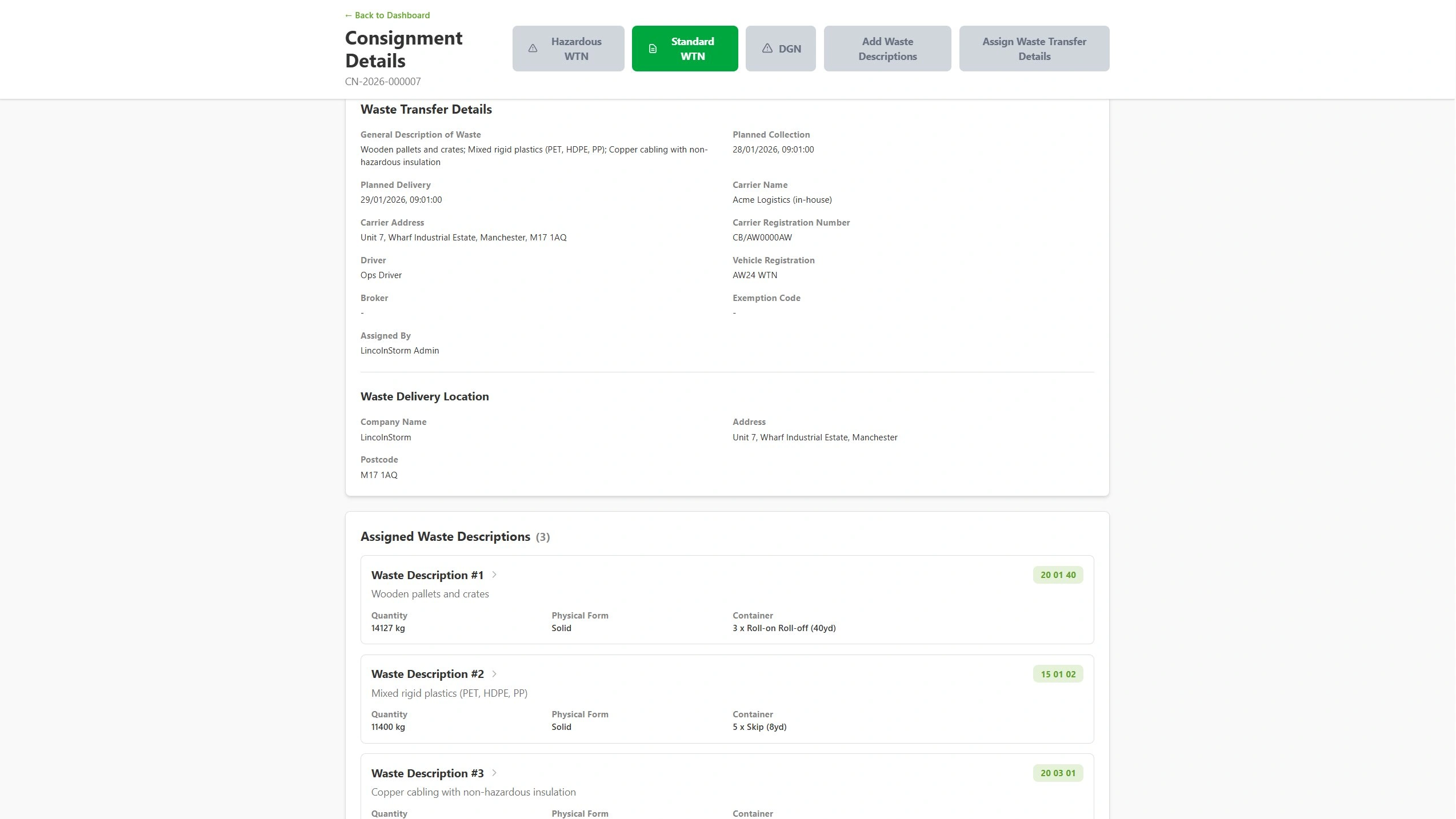
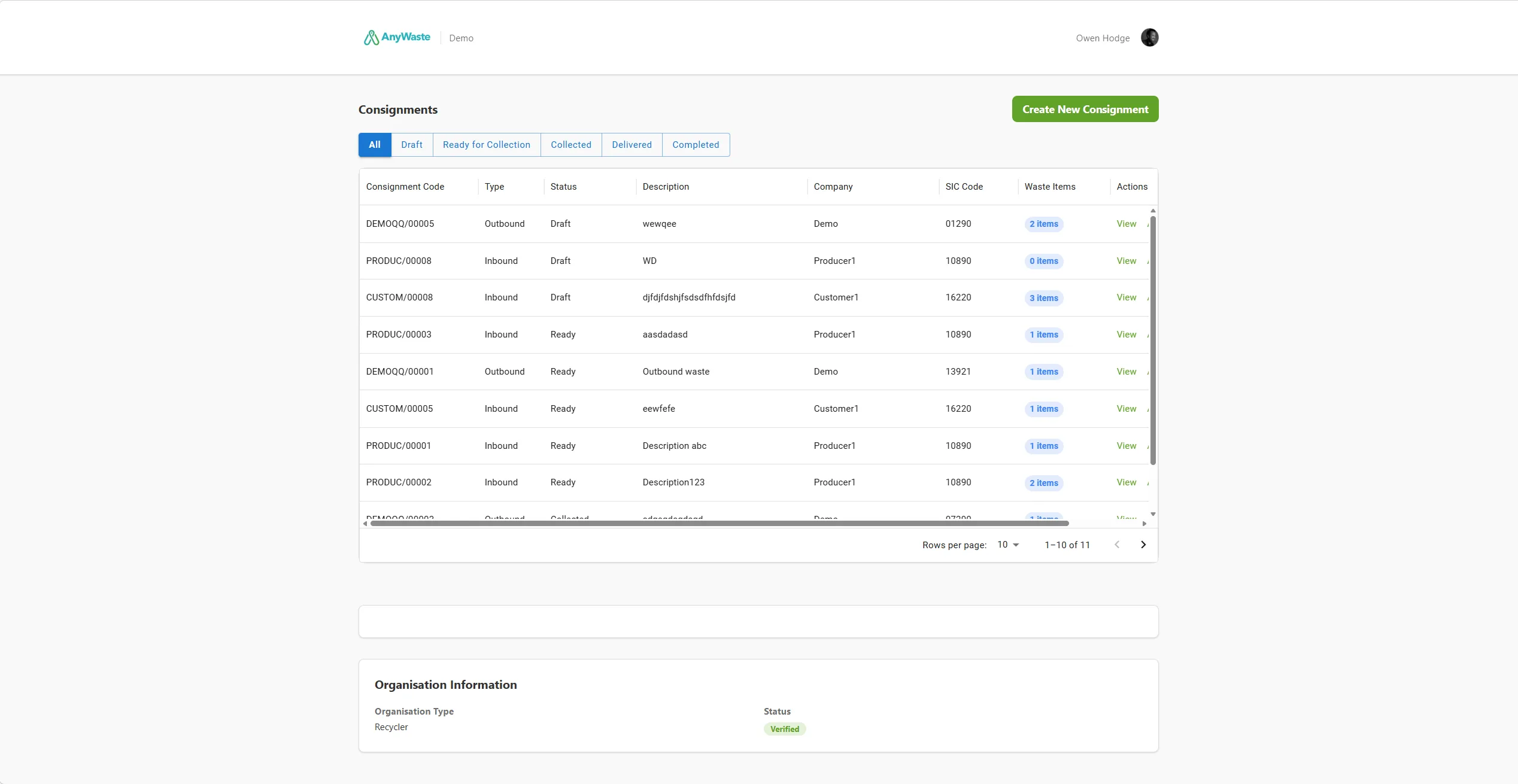
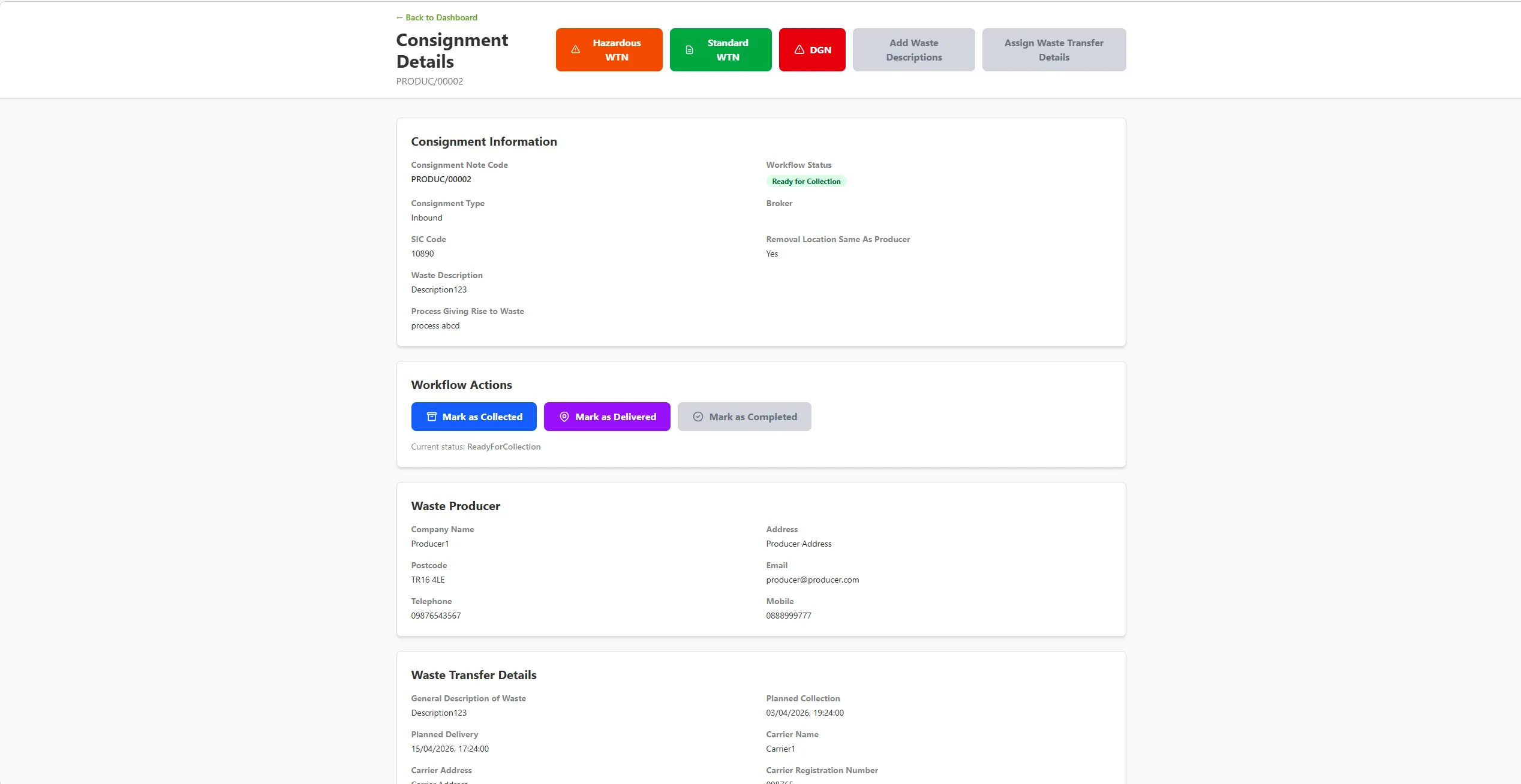
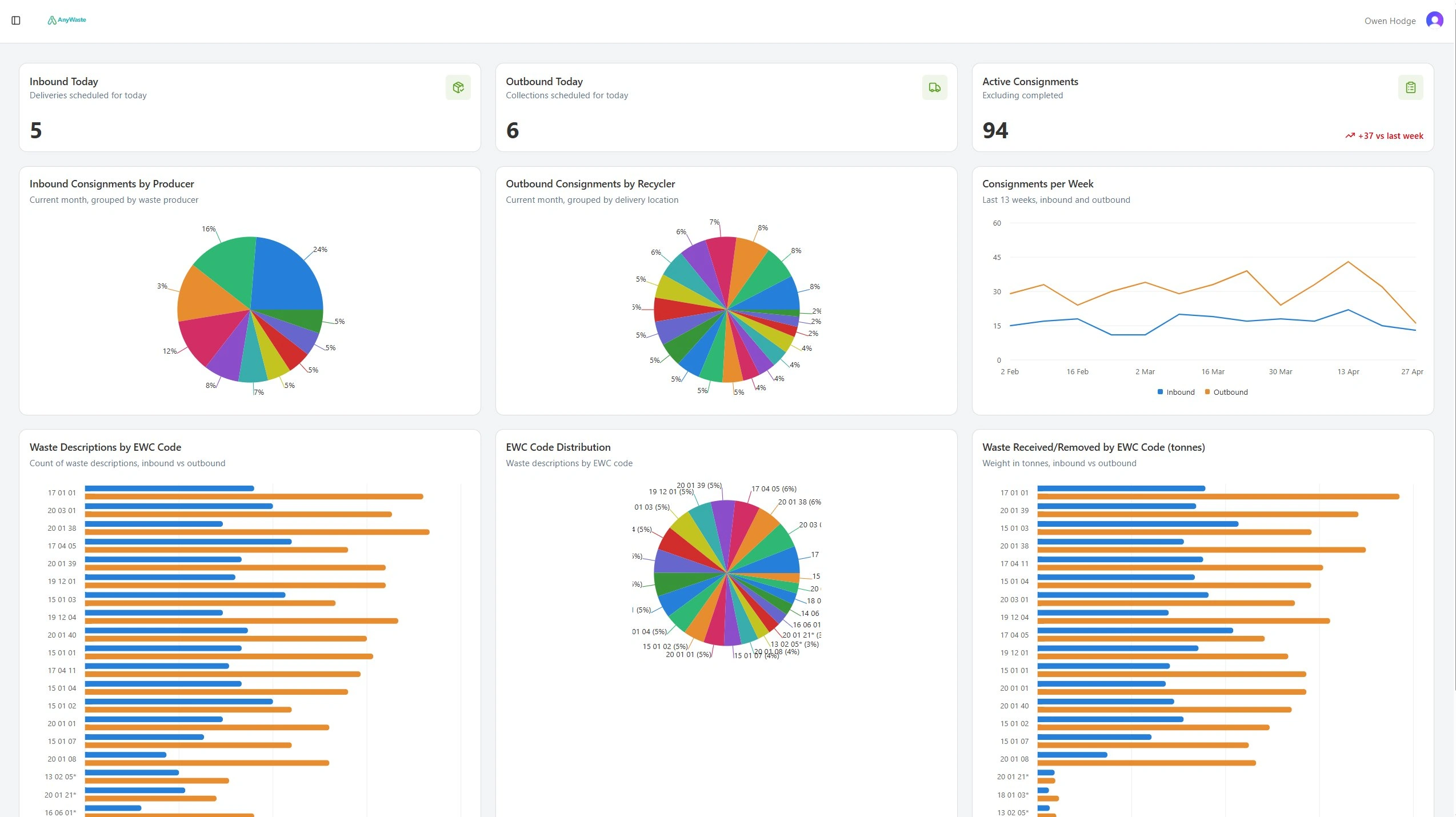
Real screenshots from the AnyWaste application — the same screens the team uses to create, track and evidence waste movements every day. · Captures arriving shortly — slots will fill in as files are uploaded.
See every feature in action — consignment creation, WTN and HWCN workflows, live dashboards, EWC code management, and waste returns. Everything you see is live and operational.
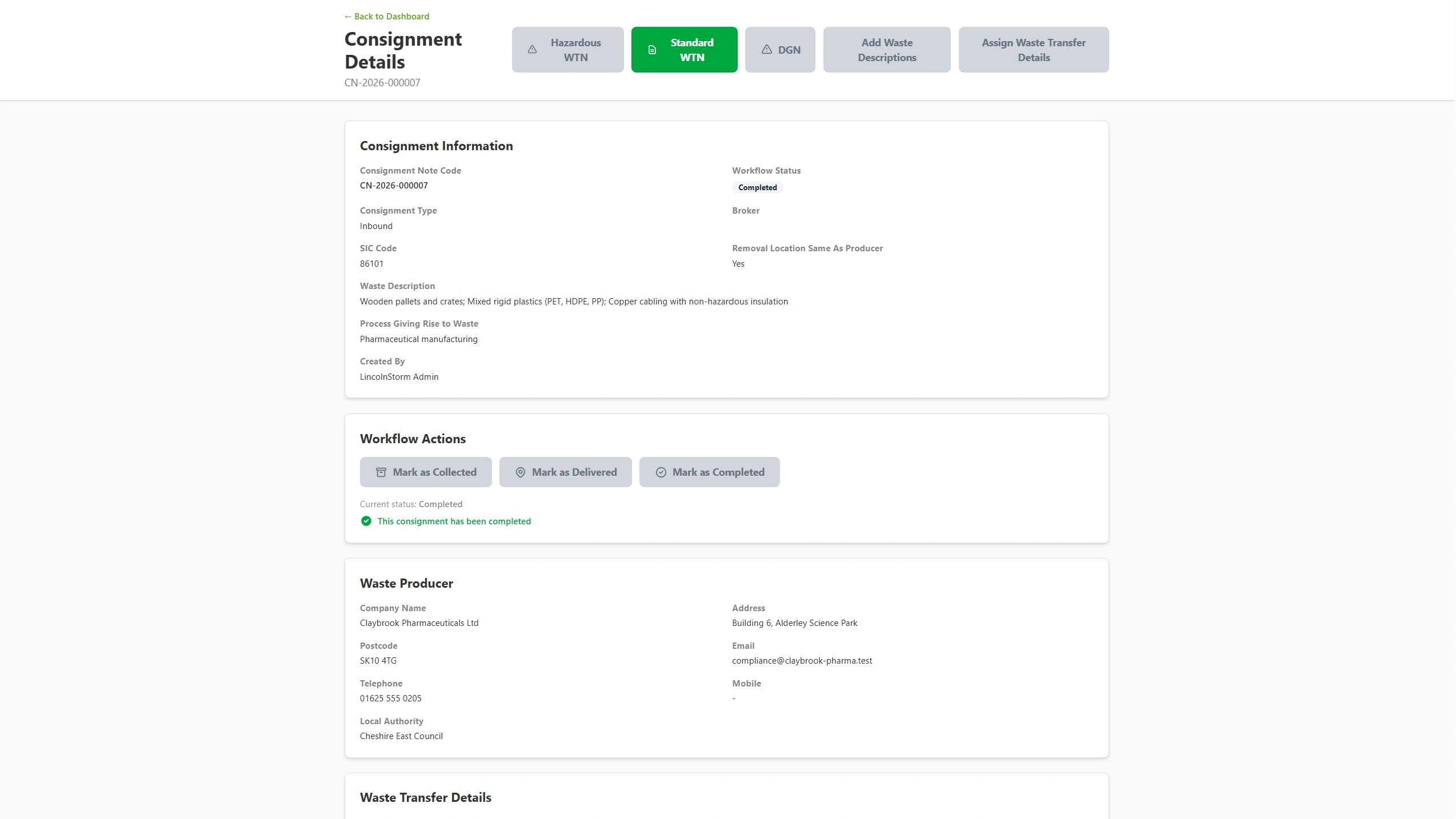
Add the waste movement, customer, carrier, site, material and document details. Most consignments take under two minutes to create.
AnyWaste generates your consignment documents, duty of care records and supporting evidence automatically — keeping everything joined up to each movement in one place.
Use dashboards and reports to see what has moved, what is complete and what still needs attention — without chasing your team for updates.
AnyWaste gives your team a simple way to create, manage, evidence and review waste movements. Start with one load, one customer, one vehicle or one site — then expand when it makes sense. No implementation project. No big migration.
Instead of searching through emails and folders, your team can see what moved, when it moved, who handled it, and what evidence sits behind it.
Start with one waste movementWTN, HWCN and DGN records created in under two minutes for most movements.
Documents, signatures, notes and photos stay connected to the movement record.
Live dashboards show what has moved, what is still open and what needs attention.
Waste Received Reports with date filters and CSV export — ready for submissions.
Build a clearer audit trail to support your Duty of Care obligations when asked.
DWTS-aligned from day one. Arrive at the mandatory date with clean records already in place.
See the AnyWaste platform in action — digital consignment creation, live dashboards, waste returns, and the full duty of care workflow. Live consignment notes being issued by real recyclers across the UK right now.
Create WTNs, HWCNs, DGNs, digital signatures and Duty of Care records from a mobile, tablet or desktop. Site teams can issue records in the field while the office sees updates in real time. Fewer manual errors. Less duplicated admin.

Your full operation at a glance. Inbound today, outbound today, active consignments, consignments per week, waste by EWC code, waste received and removed by tonnage — all live, all in one screen.
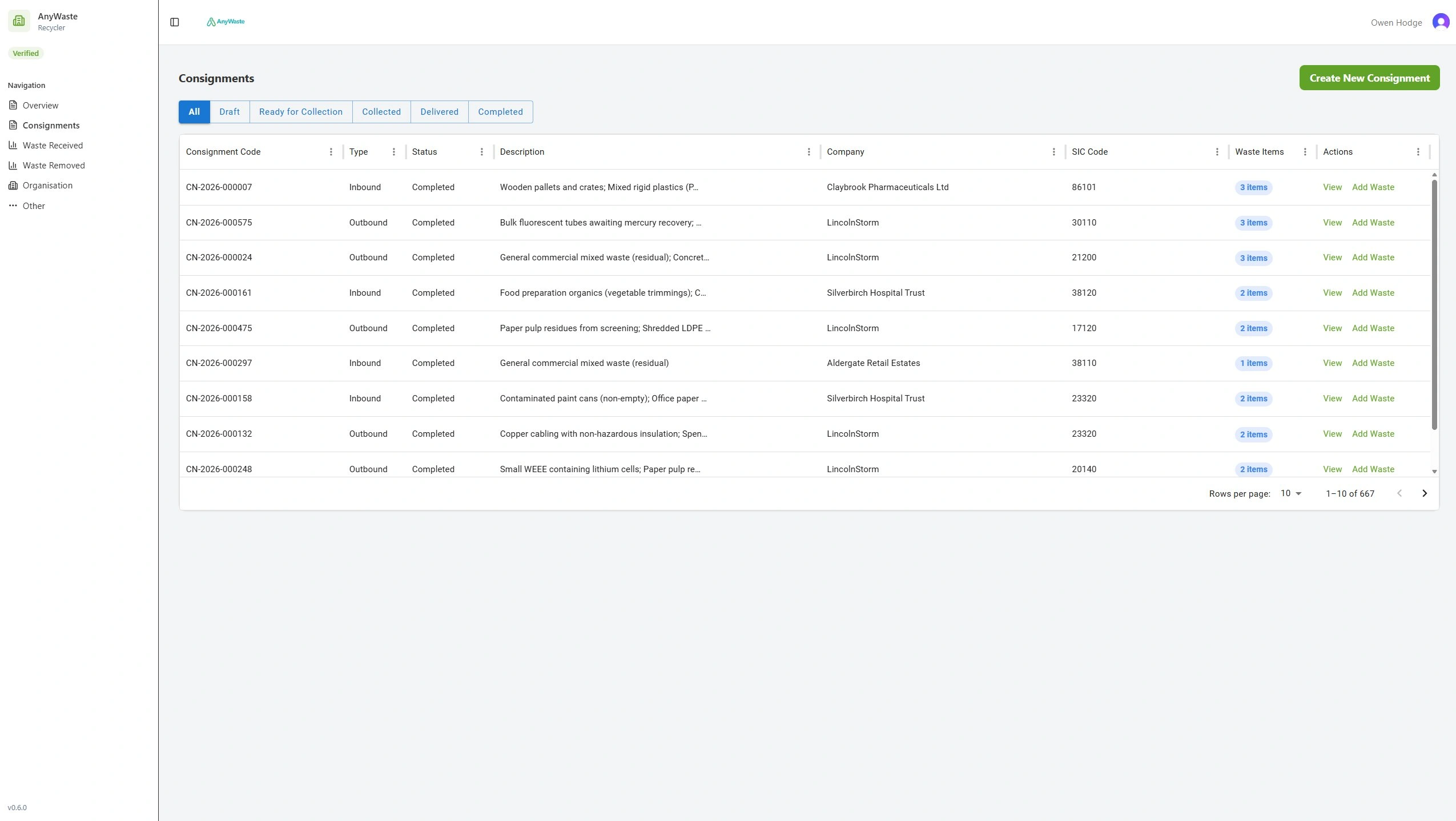
Create, manage, and complete consignments digitally. Every movement carries a consignment code, type, status, waste description, EWC codes, carrier details, collection and delivery dates, and waste quantities. Standard WTN, Hazardous WTN, and Dangerous Goods Note — all in one workflow.


The full list of consignments — inbound and outbound — across every status. Filter by stage (Draft, Ready for Collection, Collected, Delivered, Completed), drill into any record, or create a new consignment in one click. The same record drives the WTN, HWCN and DGN downstream.
The driver-facing module is in final development and will be live in Q3 2026. Drivers will be able to access their assigned collections, confirm pickups, capture waste details on mobile, and generate digital documentation in the field — eliminating paper notes from the collection process entirely.
DIWASS integration is scheduled for July 2026. This will extend AnyWaste's digital waste tracking capability to cross-border waste movements — connecting with the emerging Digital International Waste Shipment System to deliver end-to-end traceability for transfrontier shipments.
Your drivers view their assigned collections, issue digital Waste Transfer Notes on their phone, and submit signed compliance records in the field. Every movement tracked in real time — no paper, no delays.
Producer to regulator, with carriers, recyclers and export movements connected in between — working from the same digital evidence trail in real time.
Books a movement with accurate description, EWC code and pre-acceptance data.
Driver workflow — collection capture, signatures, photos, live status from the cab.
Pre-advice, weighbridge, inspection and acceptance — all linked to the same record.
Annex VII workflows for green-list movements, with DIWASS integration this summer.
Audit-ready evidence, regulator submissions and customer assurance — ready on demand.
From the moment waste is booked to the moment recovery is confirmed — every step captured, connected and audit-ready in the live AnyWaste platform.
Live dashboards, digital movement records and driver workflows — operators are creating WTNs, HWCNs and DGNs, tracking active consignments and pulling audit-ready evidence on AnyWaste right now.
Most waste businesses are already doing the right things. The problem is that the evidence is often spread across emails, spreadsheets, PDFs, vehicle notes and shared folders. When a client, auditor or regulator asks for proof, finding it can take longer than it should.
Paperwork that is handwritten, photocopied or filed in folders is difficult to retrieve, easy to lose, and hard to share quickly when asked.
When a client or regulator asks for evidence of a specific movement, pulling it together from different systems and inboxes takes time your team does not have.
Quarterly returns and regulatory submissions built on spreadsheets carry real error risk and cost significant staff time that could be better spent elsewhere.
Recyclers, carriers, producers, and local authorities operate in silos. A waste movement passes through four parties with four separate paper records — none connected.
Transfrontier Shipment of Waste regulations — Annex VII, Article 18, Green and Amber List requirements — are increasingly difficult to manage without dedicated digital tools.
The first mandatory phase of the UK Digital Waste Tracking System begins October 2026 for permitted waste receiving sites. Businesses that delay are already behind.
Answer 8 short questions and we'll tell you which phase of DWTS applies to your operation, when it's expected to land, and the practical actions to start today — built around the latest GOV.UK guidance.
This checker provides general guidance only and does not replace legal, regulatory or professional advice. Operators should verify their obligations using official GOV.UK guidance and seek professional advice where appropriate.
Watch our DWTS explainer to understand exactly how the Digital Waste Tracking System affects your operation, what the mandatory dates mean, and how AnyWaste makes compliance straightforward.
The Defra guidance on DWTS has been complex and the rollout phased, which has led many operators to conclude they can wait or that it does not apply to them. The legislation tells a different story.
"I'm a recycler. I don't need to register yet — DWTS isn't mandatory until later."
If you operate a permitted waste receiving site — a recycling centre, MRF, treatment facility, transfer station, or landfill — DWTS is mandatory from October 2026 in England, Wales and Northern Ireland. That is five months away. The public DWTS beta is due July 2026. Registering on AnyWaste now means your records, workflows and team are ready before the beta opens.
"I'm a carrier or producer. It's not my problem yet."
Phase 1 starts with receivers. Waste collectors become mandatory from October 2027. But the recyclers and facilities you work with will require DWTS-compatible documentation from October 2026. If you are not connected digitally, you will start losing contracts before your own mandatory date arrives. Get ahead now.
"I'll just use the government's own system when it goes mandatory."
The government's Defra system handles the mandatory data reporting requirement. It does not replace your operational system — consignment management, WTNs, HWCNs, DGNs, reporting, CRM, and logistics. AnyWaste integrates with the Defra service while running your entire operation. You need both.
These are direct statements from official UK Government and Environment Agency publications. The links are provided so you can read the source yourself.
"Those required to hold a permit or licence to receive waste will be mandated to record details of waste received on the digital waste tracking service from October 2026."
Gov.uk — Digital Waste Tracking Service ↗"All affected organisations will be legally required to use the service from October 2026 in England, Wales, and Northern Ireland and from January 2027 in Scotland. Operators should treat preparation as essential rather than optional."
Environment Agency Blog, 30 April 2026 ↗"Phase 1 will apply to around 12,000 permitted waste receiving sites. As the service expands, over 100,000 operators are set to be in scope."
Gov.uk — Waste Crime Action Plan ↗"The move to mandatory digital reporting has been laid in legislation. The public DWTS beta is scheduled for July 2026, ahead of the October 2026 mandatory date for permitted receiving sites."
Environment Agency Blog ↗The mandatory move to digital waste tracking is backed by the Environment Act 2021 and the Environmental Protection Act 1990. Non-compliance carries enforcement risk. This is not a technology choice — it is a legal obligation.
The rollout is phased. Here is a clear breakdown by operator type so you know exactly where you stand.
| Operator Type | Mandatory From | Scope | Status |
|---|---|---|---|
| Permitted waste receiving sites (recyclers, MRFs, treatment facilities, HWRCs) | October 2026 (Scotland: January 2027) |
~12,000 sites in England, Wales and Northern Ireland | Act Now |
| Waste collectors and carriers | October 2027 | Private beta from autumn 2026, public beta spring 2027, mandatory October 2027 | Prepare Now |
| Waste producers (commercial and industrial) | Phase to follow | Over 100,000 operators expected to be in scope as the service expands | Get Connected |
| All operators — voluntary beta | July 2026 | Public beta arriving July 2026. Start your AnyWaste records now and be ready when it opens. | July 2026 |
Roadmap dates are indicative and subject to development, regulatory and integration requirements.
Public DWTS beta arriving July 2026. Get your records and workflows in place now so you are ready from day one.
DWTS public beta opens. Producers and brokers connect to recyclers. Driver signing from mobile goes live.
All permitted waste receiving sites in England, Wales and NI must be on DWTS. Scotland from January 2027.
Waste collectors and carriers must also be on DWTS. Over 100,000 operators in scope across all phases.
Creating a digital WTN on AnyWaste takes under two minutes. Finding, completing, copying, and filing a paper note takes ten minutes or more — per movement. At 20 movements a day, that is over 60 hours a month recovered.
Manual AATF returns, quarterly EA reporting, and paper-based duty of care reviews absorb staff time that costs money. AnyWaste automates the reporting and generates returns from live data — reducing the cost of compliance significantly.
Every movement is timestamped, documented, and searchable in seconds. When the EA comes calling — or a client asks for a duty of care audit — you produce the records immediately. No scrambling through filing cabinets.
From October 2026, waste producers using DWTS-compliant systems will expect their recyclers to be connected. If you are still on paper while your competitors are digital, you risk losing contracts before your own mandatory date arrives.
Live dashboards showing inbound and outbound tonnage, EWC code distribution, and weekly consignment trends give operations managers the data they need to make better decisions — not guesses based on last month's spreadsheet.
AnyWaste is live and operational. Onboarding takes less than 30 minutes. You can be creating digital consignments today.
Book a demoNo more paper WTNs, manual HWCNs, or lost forms. Everything issued, signed, and archived digitally on a mobile or tablet. Every document EA-ready in seconds, not days.
AnyWaste was built around digital waste tracking from the start. The system is live today, managing real consignments for real operators — with digital WTNs, HWCNs and DGNs already in active use. When the mandatory date arrives, operators on AnyWaste will already be working the right way.
Talk through your setupDigital WTN and HWCN — created quickly, stored automatically, no paper copies needed.
Dangerous Goods Note — generated in the same workflow as the WTN and HWCN.
Complete audit trail — every movement timestamped, archived and searchable when you need it.
EWC code management — support classification across all waste streams, built into the consignment workflow.
Waste returns and reporting — Waste Received Report with date filter and CSV export for regulatory returns aligned to EA reporting requirements.
Phase 1 is mandatory from October 2026 for permitted waste receiving sites in England, Wales and Northern Ireland. Scotland follows in January 2027. If you hold an environmental permit or a waste management licence that authorises receipt of waste, you are in scope. The first wave covers permitted recyclers, transfer stations, MRFs and licensed treatment sites taking commercial loads. Exempt-only operations sit outside Phase 1. What is required is the move from paper WTNs and HWCNs to digital records, captured in a system Defra recognises. The deadline is fixed; the transition you control.
Phase 1 (October 2026) catches receiving sites — the people accepting the waste. Phase 2 (October 2027) extends the same obligation to waste carriers, brokers and dealers — the people moving and arranging the waste. The data points Defra wants are largely the same: who, what, when, where, what classification, what evidence. The difference is which party in the chain is responsible for capturing each step. Phase 2 is more complex because carriers move between dozens of producer and recipient sites a week, so the record has to follow the load through the chain rather than sitting in one facility's database.
The full Duty of Care record, digitised. That means producer details, the producer's EWC code claim, waste description, hazard classification, weight or estimate, container or load type, carrier identity, vehicle and driver, route, destination receiving site, recipient's acceptance and weight on arrival, and any onward processing or rejection. Where the waste is hazardous, the HWCN sits on top with chemistry and component breakdown. Where it is a dangerous good, the DGN sits on top with UN classification and packing group. The point of the digital format is the evidence is captured once at point of creation, not reconstructed from paper after the fact.
Every workflow has been built against the published Defra technical guidance for DWTS Phase 1. WTN, HWCN, DGN and waste-return record formats match the regulator's expected data model. EWC code structure follows the UK List of Wastes. Hazardous-waste rules apply automatically when chapter 16 or 20 codes are used. The platform is structured so that when Defra opens the digital reporting interface, AnyWaste records can be submitted in the required format without remapping. The same audit trail satisfies Environment Agency, Natural Resources Wales, SEPA and NIEA inspection requirements without separate reporting.
Three things, in priority order. First, move WTN and HWCN creation off paper into a digital system this quarter, not next. Operators that wait until the deadline land in chaos as data-quality issues surface under time pressure. Second, audit EWC code usage and waste descriptions. Codes that have drifted over years of paper records will be the source of most rejections under Phase 1. Third, train operations and admin staff on the new workflow before October 2026 traffic hits. The platform is the easy part. Operational habit takes time to bed in — start the habit now.
Most business software is built for generic office workflows. Waste operations have different documentation requirements, different compliance obligations and different day-to-day pressures. AnyWaste is built around how waste businesses actually work.
A busy recycling site processes hundreds of movements every week. Paper-based records are slow to create, easy to lose and impossible to query quickly when a client or regulator asks for evidence.
Regulatory returns require pulling data from multiple sources, checking against paper records and manually formatting submissions. This costs real staff time and carries real error risk.
When a client, the EA or an internal team asks for evidence of a specific movement, finding it quickly should not require searching through folders, filing cabinets and email threads.
Significant reductions in compliance admin time, near-elimination of documentation errors, and an EA-ready audit trail at all times.
Drivers carrying paper WTNs face constant risk of loss, damage, and incomplete information. A missing document can hold up an entire collection schedule.
Operations managers have no live view of what has been collected, what documentation is in place, or what is outstanding across a fleet.
Each driver carries individual duty of care responsibilities. Without a digital system, enforcing consistent documentation standards across a fleet is extremely difficult.
Eliminate paper-based documentation risk, give operations managers live visibility, and demonstrate professional compliance to clients and regulators.
Waste producers bear legal responsibility for the correct handling of their waste, even after it leaves their premises. Without digital records, demonstrating duty of care is difficult and stressful.
Managing paper WTNs from multiple contractors across multiple sites is an administrative burden that creates compliance risk — particularly in multi-site organisations.
Many producers are aware of DWTS but haven't yet taken steps to prepare. The closer enforcement gets, the more disruptive a last-minute transition becomes.
Eliminate duty of care documentation risk and enter the DWTS era already prepared — while competitors are still scrambling.
Local authorities managing multiple HWRCs have compliance records spread across paper systems and separate contractor documentation — with no unified view.
Statutory reporting to Defra, EA returns, and internal performance reporting each require data aggregation from fragmented operational records — a major administrative overhead.
Ensuring all contractors maintain correct documentation, valid permits, and full duty of care compliance is extremely difficult without a shared digital platform.
AnyWaste is live with a local authority operator, demonstrating multi-site digital waste tracking and automated reporting in a real operational environment.
The Transfrontier Shipment of Waste regulations govern the movement of waste across international borders — designed to prevent illegal dumping, ensure appropriate treatment, and create a verifiable chain of custody from origin to destination.
Non-hazardous waste streams moving across borders with Annex VII documentation. Carriers must be able to produce it on demand.
Formal pre-notification to competent authorities of dispatch and destination required. Approvals must be obtained before any movement.
Brokers, dealers, and consignees carry specific legal obligations under TFS regulations. Complete, accurate records of every notified shipment are mandatory.
DIWASS is the emerging framework for digitising cross-border waste movement documentation across the UK and Europe. AnyWaste is building its international module with DIWASS integration as a core design requirement — scheduled for July 2026.
Let us know you are interestedDomestic digital waste tracking operational. WTN, HWCN, DGN all live.
Mobile-first driver interface for field operations and collection confirmation.
Cross-border digital shipment tracking integrated with DIWASS framework and EU regulatory systems.
Verified international materials trading with full traceability and cross-border audit trail.
They are two regimes for cross-border waste shipment under the Waste Shipment Regulation. Annex VII is the simpler regime — it accompanies green-list (non-hazardous) waste destined for recovery and gets signed and held by the parties involved. No prior consent from competent authorities is required. Article 18 is the prior-notification regime — used for amber-list or hazardous waste destined for recovery or disposal. The notifier submits a notification document, financial guarantee and shipment plan to the dispatching, transit and destination competent authorities, and shipment cannot start until consent has been given by all of them.
Annex VII applies to green-list waste under Annex III of the Waste Shipment Regulation destined for recovery. Common examples are mixed-paper grades, sorted plastic fractions, scrap metals and certain WEEE fractions. Article 18 prior-notification applies to all amber-list waste under Annex IV, all hazardous waste, all waste destined for disposal regardless of hazard, and to waste being mixed during shipment. Some destinations also require notification regardless of waste classification — non-OECD destinations and certain third countries. Misclassifying green-list waste that should have been notified is one of the most common compliance failures the Environment Agency cites in enforcement.
Plan for at least 30 working days from notification to first shipment. The notifier submits the notification document to the dispatching competent authority. They acknowledge within three working days, then forward to transit and destination authorities. Each has 30 working days to consent, object or request more information. In practice, allow extra time for queries — a fortnight is normal, a month is not unusual. Consents are valid for one year. The financial guarantee covers shipment, recovery and possible take-back if anything goes wrong. Always build contingency into commercial timelines for the regulator's response window.
DIWASS is the Digital Waste Shipment System the EU is rolling out to digitise the notification process. From May 2026 EU member states must accept Article 18 notifications digitally. The UK is not part of DIWASS directly post-Brexit, but UK exporters shipping into EU member states will be filing into a digital interface on the destination side. Defra has signalled UK intent to provide an aligned digital framework for UK-side TFS records. For exporters the message is straightforward: paper-based notification workflows have a limited shelf life. The same digital evidence that satisfies the Environment Agency will work into DIWASS once it is live.
Both, where the customer wants it. The platform captures the Annex VII paperwork digitally at point of dispatch for green-list movements — the most common case. For Article 18 amber-list and hazardous notifications, AnyWaste's brokerage team manages the notification process directly: drafting the notification document, agreeing the financial guarantee, submitting to dispatching, transit and destination competent authorities, tracking consents, and handling the shipment plan. The platform captures the record of every step so the audit trail is complete from collection through to recovery certificate. Operators handling their own notifications use the platform for record-keeping; those who do not, contract us for the full service.
Three roles. One chain. One party pays — and brings everyone else on for free.
The party that buys AnyWaste — usually the Recycler. Pays a monthly tier based on volume. Invites their Producers and Carriers into the Connected Supply Chain.
Producers and Carriers invited into a Recycler's Connected Supply Chain. Sign digital consignments. See your movements across every connected Recycler. No payment required.
A Linked Account converts to a paid tier when they want to own their records, manage a fleet, add Driver Tracking, or invite their own supply chain.
Choose the tier that fits your monthly digital duty of care (DoC) volume. Every Carrier and Producer you invite joins free.
| Feature | Recycler Starter | Recycler Growth | Recycler Scale | Multi-Site Recycler | Enterprise Recycler |
|---|---|---|---|---|---|
| Monthly price | £50 | £150 | £350 | From £499 | By quotation |
| Best for | Digital duty of care for small recyclers | Small operational recyclers | Growing operational recyclers | Regional / multi-depot recyclers | National / bespoke operations |
| Sites included | 1 | 1 | 1 | Up to 3 | Custom |
| Admin users | 1 | 2 | 3 | 4 | Custom |
| Driver seats | 0 | 2 | 5 | 10 | Custom |
| DoC allowance / month | Up to 25 | 25–100 | High volume (fair use) | Multiple sites | High-volume / complex |
| Digital WTN / HWCN / DGN | ✓ | ✓ | ✓ | ✓ | ✓ |
| EWC code assistance | ✓ | ✓ | ✓ | ✓ | ✓ |
| Basic reporting | ✓ | ✓ | ✓ | ✓ | ✓ |
| Driver app & digital signatures | — | Coming Q3 2026 | Coming Q3 2026 | Coming Q3 2026 | Coming Q3 2026 |
| Operational dashboard | — | ✓ | ✓ | ✓ | ✓ |
| Advanced reporting & analytics | — | — | ✓ | ✓ | ✓ |
| Customer records | — | — | ✓ | ✓ | ✓ |
| Recurring jobs | — | — | ✓ | ✓ | ✓ |
| Cross-site reporting | — | — | — | ✓ | ✓ |
| Compliance export packs | — | — | — | ✓ | ✓ |
| Integrations | — | — | — | ✓ | ✓ (full) |
| White-label option | — | — | — | — | ✓ |
| API integrations | — | — | — | — | ✓ |
| DWTS / DIWASS integrations | Standard | Standard | Standard | Standard | Bespoke |
| Support | Email + scheduled callback | Priority support | Dedicated onboarding | Dedicated account manager | |
| Choose Starter ↓ | Choose Growth ↓ | Choose Scale ↓ | Choose Multi-Site ↓ | Talk to sales |
Most Carriers begin as a free Linked Account via a Recycler invite. Move to a paid tier when you want your own records, Driver Tracking, or your own supply chain.
Join via Recycler invite. Sign digitally. See consignments across connected Recyclers.
No commitment.Owned records. Your own dashboard.
2 vehicles or users included.Adds capacity above your tier.
On top of base tier.Multiple depots, group reporting.
For carrier groups.Large fleets, integrations, bespoke workflows. Tailored to fleet.
Most Producers begin free, invited by their Recycler. Upgrade when you want to own your records and invite your own supply chain.
Via Recycler invite. Initiate consignments. Duty of care on every movement.
No payment required.Owned account. Basic duty of care. Smaller producers.
Owned records.Larger producers needing more functionality.
Single site, deeper features.Multiple UK sites with group reporting.
Group oversight.Complex, multi-country or group-level. Tailored rollout.
For operators with specialist requirements — international movements, advanced reporting, integrations and marketplace.
All add-ons available on any anchor account. Talk to us if you're unsure which apply.
1 site · 1 admin · up to 25 DoC/mo
1 site · 2 admins · 25–100 DoC/mo
1 site · 3 admins · high volume (fair use)
Multiple sites · 4 admins · 10 drivers
High-volume and complex requirements
Worked example: Multi-Site Recycler base £499 + additional sites, admin users and driver seats as required, plus DoC volume scaling. National operators with high-volume or complex requirements typically take the Enterprise Recycler plan on a bespoke quotation.
Choose your plan below — live pricing direct from the AnyWaste platform.
Pick a plan, then continue to secure checkout in app.anywaste.com. Plans, billing and account management live on the same account that operates your consignments — no separate sign-up to maintain.
1 site · 1 admin · up to 25 DoC/mo
1 site · 2 admins · 25–100 DoC/mo
1 site · 3 admins · high volume (fair use)
Multiple sites · 4 admins · 10 drivers
National operators, high-volume sites or complex multi-site requirements. We’ll scope sites, admin users, driver seats and DoC volume against your operation.
Uses your included driver seats within your subscription. No additional setup required — drivers log into the AnyWaste app under your account.
Recyclers can allocate unused driver seats to external haulage companies. Your subcontractor drivers operate inside your AnyWaste workflow with their own logins.
Once a haulage company exceeds 5 drivers or services multiple clients, we recommend a dedicated AnyWaste carrier account. Talk to us about partner pricing.
Yes. When a Recycler invites a Producer or Carrier into their Connected Supply Chain, that party gets a free Linked Account. They can sign consignments digitally and see their movements across every connected Recycler. They only pay if they choose to upgrade for ownership of records, Driver Tracking, fleet management, or to invite their own supply chain.
Your records become yours. Linked Accounts operate within the anchor account's data scope. When you convert to paid, your records sit in your own owned account — and you can invite your own Carriers and Producers from that point.
Each Recycler tier includes a monthly allowance of digital duty of care documents. If you consistently exceed your allowance, we'll suggest the next tier up. We don't cut anyone off mid-month — we'll have a conversation.
Yes. Sign up free, set up your Recycler account, and invite a small part of your supply chain to test the workflow. Move to a paid tier when you're ready to take it across the operation.
No. AnyWaste is independent software designed to support digital duty of care and operate to digital waste tracking standards. We are not the regulator's system. We help you be ready for it.
Standard hazardous waste documentation is included in the Recycler tiers. TFS and DIWASS are separately priced modules — talk to us if international movements or specialist documentation apply.
Pricing is published and consistent. For complex multi-site or enterprise rollouts we provide tailored quotations rather than discounts.
Yes — upgrade or downgrade at any time. Changes apply from the next billing cycle.
Full CSV / JSON export is available at any time. On cancellation we provide a 30-day data export window per the DPA.
AnyWaste is designed to support digital duty of care record-keeping and operates to digital waste tracking standards. Customers remain responsible for ensuring their waste classifications, carriers, destinations and regulatory obligations are correct. AnyWaste is not a substitute for legal or regulatory advice.
AnyWaste digitises the whole chain, not just your operation. Invite your Producers and Carriers — they join free. Every consignment is created, signed and tracked digitally across your network, from collection to delivery.
Built by UK waste operators · Used across Producers, Carriers and Recyclers
A waste movement involves three parties. AnyWaste connects all three in a single digital chain — so the consignment doesn't lose evidence as it changes hands.
The Producer creates the consignment when the waste is ready to leave — pre-populated, ready to sign.
The Carrier signs digitally on collection and again on delivery. No paper ticket. No driver as filing system.
The Recycler accepts the load on arrival, closes the digital consignment, and holds the full chain-of-custody record.
Connected Supply Chain is the operating layer for waste movements — designed so the parties who already work together can finally work from the same record.
When your entire supply chain is on AnyWaste, documents never need to leave the platform. No printing, no manual signatures, no lost tickets.
Producers and Carriers join at no cost via a simple invite. No procurement decision, no onboarding overhead. Just a link.
Producers can initiate consignments at source. They arrive with you ready to review and close — no admin overhead on your end.
See every consignment in your supply chain — where it is, who's signed, what's pending. Across every Producer and Carrier, in one view.
Every movement carries a timestamped, digitally signed record. Inspection-ready isn't a mode you switch on — it's how the platform works.
Whether mandatory digital tracking arrives in 6 months or 2 years, your supply chain is already compliant.¹ You're not waiting on a government deadline.
¹ AnyWaste is designed to support digital duty of care record-keeping. Customers remain responsible for ensuring their waste classifications, carriers, destinations and regulatory obligations are correct.
The same Connected Supply Chain, framed by what each party actually needs — and what it costs them to join.
You're the anchor. Every Carrier and Producer you invite joins your Connected Supply Chain. You get a fully digital, paperless operation from day one.
Join via a Recycler invite at no cost. Sign consignments digitally, track your movements, and build toward a fully owned operational account when you're ready.
Running your own jobs too? A direct Carrier subscription gives you your own customer CRM, multi-client management, branded paperwork, fleet tools and the ability to invite your sub-contractors. Be the principal in your own chain, not just an invited operator.
Accept a Recycler's invite and your duty of care documentation is digital from day one — no cost, no admin overhead, no paperwork.
Multi-site or running your own waste programme? A direct Producer subscription lets you own your records, invite your own carriers, manage multiple sites, and run waste compliance as your own operation rather than your Recycler's.
Carriers and Producers can join two ways. The free Linked Account is for operating on someone else's chain. A direct subscription is for running your own.
Both routes are fully compliant. The difference is whether you're operating on someone else's platform or running your own.
Most compliance tools in the waste sector solve one piece of the puzzle. A digital form here. A spreadsheet replacement there. None of them connect the chain.
AnyWaste does. One platform, one audit trail, three roles working from the same record. Linked accounts for the partners operating on your chain. Direct subscriptions for those running their own.
That's the operating layer the waste sector has been missing.
Book a 15-minute walk-throughDigital waste tracking is the direction of travel in UK waste regulation. The exact timetable continues to move, but the destination is settled: mandatory digital records, signed at the point of movement, retained for the chain of custody.
AnyWaste is designed around that workflow. By bringing your Producers and Carriers onto the platform now, your supply chain is operating to digital standards well before the regulation requires it.
When the rules land, you don't need to retrain your team or migrate from paper. You just keep working.
Read our DWTS briefingAnyWaste is designed to support digital duty of care record-keeping and operates to digital waste tracking standards. Customers remain responsible for ensuring their waste classifications, carriers, destinations and regulatory obligations are correct. AnyWaste is not a substitute for legal or regulatory advice.
Sign up free, set up your account, and start inviting your Producers and Carriers within minutes. No procurement cycle. No paperwork to roll out.
Search by waste type, material, description or keyword to identify likely European Waste Catalogue codes and understand whether the waste may be hazardous.
ⓘ This tool supports classification research. Final classification must be verified by a competent person using official guidance and waste composition.
Loading EWC code library…
Accurate waste classification is a legal requirement. Using the wrong EWC code can affect duty of care compliance, documentation validity, downstream acceptance and regulatory reporting.
AnyWaste helps waste operators create digital records, manage WTNs and HWCNs, track waste movements and generate compliance-ready reports — all in one unified platform.
Official sources used
AnyWaste helps waste operators, recyclers and carriers create digital waste records, manage WTNs and HWCNs, track loads in real time and generate compliance-ready reporting.
Get a summary of this code with compliance notes to review offline.
No spam. We'll send the classification summary and information about AnyWaste.
AnyWaste Global Ltd was founded by Damian Lambkin, an operator with 28 years' direct, hands-on experience across waste management, battery recycling, hazardous waste compliance, transfrontier shipments and environmental regulation. AnyWaste is the digital infrastructure that experience demanded.
AnyWaste Global Ltd was founded in 2021 by Damian Lambkin to consolidate 28 years of operational waste, recycling and compliance experience into a single digital platform. The gap in the market was not about software — it was about building a platform that understood, from the inside, how waste businesses actually operate, what regulators actually require, and how to turn compliance into a business advantage rather than a burden.
Alongside that experience, AnyWaste's operational brokerage has moved over 2,000 tonnes of mixed-chemistry batteries including alkaline, NiCad, NiMH, lithium-ion and lithium primary, with 500 tonnes of lithium-ion recycled in the past 6 months alone. The platform was built around that operating reality. Every workflow on AnyWaste reflects a real one we have run ourselves.
Our development team is based in the South West UK and we operate globally. AnyWaste Global Ltd is headquartered at the 2 Victoria Hall, Coombe Lane, Axminster, Devon, EX13 5AX.
A connected digital ecosystem for the waste and recycling industry — combining compliance, logistics, brokerage and material trading into one operating layer.
28 years in waste management, battery recycling, compliance, transfrontier shipments and environmental regulation. Former Coastguard Search and Rescue Officer.
Leads product strategy and development roadmap. Translates compliance requirements into platform architecture and user experience.
Leads the AnyWaste engineering team. Responsible for platform architecture, DWTS digital integration, and multi-tenant system build.
Leads buyer qualification, market intelligence, and commercial partnership development across the UK waste and recycling sector.
Former UK Secretary of State for Environment, Food and Rural Affairs (Defra). Extensive experience in environmental regulation, waste policy, and sustainability at the highest level of UK government.
One of the UK's leading waste and environmental lawyers. Specialist expertise in waste regulation, Environment Agency enforcement, transfrontier shipment law, and environmental permitting.
Operational, practical and compliance-aware. Real waste-industry experience underpins every part of the platform.
Whether you need a live demonstration, a pricing conversation, or just want to see what the platform does for operations like yours — our team is ready.
Or call us directly +44 203 855 2018Our demos are live platform walkthroughs tailored to your operation and waste streams. Allow 30 minutes. We will show you exactly what AnyWaste does for businesses like yours — including the live consignment management, digital WTN workflow, and reporting.
Fill in the form and we will be in touch within one working day.
This Data Processing Agreement governs the processing of personal data by AnyWaste Global Ltd as a Processor on behalf of Customers using the AnyWaste platform. It forms part of the AnyWaste Terms of Service.
IMPORTANT --- HOW THIS AGREEMENT IS ACCEPTED This Data Processing Agreement ("DPA") forms part of the contract between AnyWaste Global Ltd and the Customer. It is incorporated by reference into the AnyWaste Terms of Service. By completing registration for an AnyWaste account, ticking the acceptance checkbox on the registration form, or by continuing to use the Platform after this DPA has been published or updated, the Customer is deemed to have read, understood, and agreed to be bound by the terms of this Agreement on behalf of the business entity they represent. No handwritten or electronic signature is required. If the Customer does not agree to these terms, they must not register for or use the Platform.
| Document | Data Processing Agreement |
| Version | 1.0 |
| Last updated | 6 May 2026 |
| Applies to | All customers of AnyWaste Global Ltd using the AnyWaste platform |
| Governing law | England and Wales |
| Data regulator | Information Commissioner's Office (ICO), United Kingdom |
| Contact | privacy@anywaste.com |
1.1 In this DPA, the following terms shall have the meanings set out below:
| "Agreement" | This Data Processing Agreement together with all Schedules and the AnyWaste Terms of Service. |
| "Controller" | The Customer: the natural or legal person, public authority, agency, or other body which, alone or jointly with others, determines the purposes and means of the processing of Personal Data. |
| "Processor" | AnyWaste Global Ltd, a company incorporated in England and Wales, which processes Personal Data on behalf of the Controller in connection with the provision of the Services. |
| "Personal Data" | Any information relating to an identified or identifiable natural person (as defined in Article 4(1) UK GDPR) which is processed by the Processor on behalf of the Controller under this Agreement. |
| "Processing" | Any operation or set of operations performed on Personal Data, whether or not by automated means, including collection, recording, organisation, structuring, storage, adaptation, retrieval, consultation, use, disclosure, dissemination, restriction, erasure, or destruction. |
| "Data Subject" | An identified or identifiable natural person to whom Personal Data relates. |
| "Sub-processor" | Any third party engaged by the Processor to carry out Processing activities on Personal Data on behalf of the Controller. |
| "Personal Data Breach" | A breach of security leading to the accidental or unlawful destruction, loss, alteration, unauthorised disclosure of, or access to, Personal Data transmitted, stored, or otherwise processed. |
| "Applicable Data Protection Law" | The UK GDPR, the Data Protection Act 2018, the Privacy and Electronic Communications Regulations 2003 (PECR), and any successor or amending legislation in force in the United Kingdom. |
| "Services" | The digital waste tracking, compliance, reporting, and software-as-a-service platform provided by the Processor via anywaste.com and app.anywaste.com. |
| "Technical and Organisational Measures" | The security measures implemented by the Processor as set out in Schedule 2 of this Agreement. |
1.2 Terms not defined in this DPA have the same meaning as in Applicable Data Protection Law or the Terms of Service.
1.3 References to "Article" are references to articles of the UK GDPR. References to legislation include all subordinate legislation and any amendments or re-enactments.
2.1 This DPA is accepted without the need for a handwritten or electronic signature. The Customer is deemed to have accepted this Agreement by one or more of the following acts:
2.2 The person completing the registration process represents and warrants that they have the authority to bind the Customer (the business entity) to the terms of this Agreement. Where a business entity uses the Platform through multiple Authorised Users, each such user's access and use of the Platform constitutes the business entity's continued acceptance of this Agreement.
2.3 AnyWaste may update this DPA from time to time. Where material changes are made, AnyWaste will provide not less than 30 days' notice by email to the registered account holder and/or by a prominent notice on the Platform. The Customer's continued use of the Platform following the effective date of any updated DPA constitutes acceptance of the revised terms. Where a Customer does not accept the updated terms, they may terminate their subscription in accordance with the Terms of Service.
2.4 A copy of this DPA is available at all times on the AnyWaste website. Customers may download or print this DPA for their own records. AnyWaste will provide a copy by email on request to privacy@anywaste.com.
3.1 The Processor shall process Personal Data only to the extent necessary to provide the Services and strictly in accordance with the documented instructions of the Controller as set out in this DPA and the Terms of Service.
3.2 The subject matter, duration, nature, purpose, types of Personal Data, and categories of Data Subjects are set out in Schedule 1 (Processing Activities) to this Agreement.
3.3 The Controller is responsible for determining the lawful basis for processing under Article 6 UK GDPR (and Article 9 where special category data is involved) and for ensuring that its instructions to the Processor are lawful.
3.4 If the Processor considers that any instruction from the Controller infringes Applicable Data Protection Law, the Processor shall notify the Controller immediately and shall not be required to follow that instruction.
4.1 The Controller shall:
5.1 The Processor shall:
6.1 The Processor shall, to the extent reasonably practicable, assist the Controller in responding to requests from Data Subjects exercising their rights under Chapter III UK GDPR, including:
6.2 The Processor shall promptly forward to the Controller any request received directly from a Data Subject that relates to the Controller's processing activities, and shall take no action on such a request without the Controller's written instruction.
6.3 The Controller is solely responsible for responding to Data Subject requests. The Processor shall provide the necessary technical assistance to facilitate such responses within a reasonable timeframe agreed between the parties.
7.1 Taking into account the state of the art, the costs of implementation, and the nature, scope, context, and purposes of processing, the Processor shall implement and maintain appropriate Technical and Organisational Measures to ensure a level of security appropriate to the risk, including as appropriate:
7.2 The Technical and Organisational Measures in place as at the date of this Agreement are set out in Schedule 2. The Processor may update such measures from time to time, provided that updates shall not materially reduce the level of protection afforded.
8.1 By accepting this DPA, the Customer provides general written authorisation for the Processor to engage Sub-processors. The current list of authorised Sub-processors is set out in Schedule 3 and will be updated as Sub-processors change.
8.2 Prior to engaging any new Sub-processor, the Processor shall notify the Controller by updating Schedule 3 on the AnyWaste website and providing not less than 30 days' prior written notice to the registered account holder by email ("Sub-processor Change Notice").
8.3 The Controller may object to any new Sub-processor on reasonable grounds relating to data protection by notifying the Processor in writing within 14 days of the Sub-processor Change Notice. If the parties cannot resolve the objection within 30 days, either party may terminate the Services on written notice without liability for such termination.
8.4 Where the Processor engages a Sub-processor, it shall impose data protection obligations on that Sub-processor by way of a written agreement that provides at minimum the same level of protection as this DPA. The Processor shall remain fully liable to the Controller for the Sub-processor's performance of those obligations.
9.1 The Processor shall not transfer Personal Data outside the United Kingdom or the European Economic Area without the prior written consent of the Controller, save where such transfer is permitted under Applicable Data Protection Law.
9.2 Where transfers to third countries are agreed, the Processor shall ensure that an appropriate safeguard is in place in accordance with Chapter V UK GDPR, including:
9.3 The Processor shall promptly notify the Controller if any safeguard in place for an international transfer is no longer valid.
10.1 The Processor shall notify the Controller without undue delay and, where feasible, within 48 hours of becoming aware of a Personal Data Breach affecting Personal Data processed under this Agreement.
10.2 Such notification shall include, to the extent available at the time:
10.3 The Processor shall cooperate fully with the Controller to enable the Controller to comply with its obligations under Articles 33 and 34 UK GDPR in respect of notifying the ICO and, where required, Data Subjects.
10.4 The Processor shall not make any public announcement or notification to Data Subjects regarding a Personal Data Breach without the Controller's prior written consent, except as required by applicable law.
11.1 The Processor shall provide reasonable assistance to the Controller in carrying out Data Protection Impact Assessments (DPIAs) required under Article 35 UK GDPR, where such assessments concern processing activities carried out by the Processor.
11.2 The Processor shall provide reasonable assistance to the Controller in consulting the ICO where required under Article 36 UK GDPR.
12.1 The Processor shall maintain accurate and up-to-date records of all categories of processing activities carried out on behalf of the Controller in accordance with Article 30(2) UK GDPR. Such records shall be made available to the ICO on request.
13.1 The Processor shall make available all information necessary to demonstrate compliance with this DPA and Article 28 UK GDPR.
13.2 The Processor shall allow for audits, including inspections, conducted by the Controller or a mandated auditor, subject to the following conditions:
13.3 Where the Processor provides a relevant third-party audit certification (including ISO 27001 or SOC 2) or a completed information security questionnaire, this shall satisfy the Controller's audit rights in respect of the matters covered by that certification or questionnaire.
14.1 On termination or expiry of the Services, or earlier on the Controller's written request, the Processor shall, at the Controller's election:
14.2 The Processor shall provide written confirmation of deletion or destruction within 30 days of the termination date.
14.3 The Processor may retain Personal Data to the extent required by applicable law, provided that the Processor notifies the Controller of such requirement and processes the retained data only as required by law.
14.4 The Processor's back-up systems shall remove Personal Data within a maximum of 90 days of any deletion request.
15.1 Each party's liability under this DPA is subject to the limitations and exclusions set out in the Terms of Service.
15.2 The Processor shall indemnify the Controller against all claims, losses, damages, and costs arising from the Processor's breach of this DPA or of Applicable Data Protection Law, to the extent attributable to the Processor.
15.3 The Controller shall indemnify the Processor against all claims, losses, damages, and costs arising from the Controller's breach of this DPA or of Applicable Data Protection Law, to the extent attributable to the Controller.
16.1 This DPA commences on the date of the Customer's acceptance and continues for the duration of the Services.
16.2 Either party may terminate this DPA on written notice if the other party materially breaches any provision and fails to remedy the breach (if capable of remedy) within 30 days of written notice.
16.3 Clauses 7, 10, 14, and 15 shall survive termination of this Agreement.
17.1 Governing Law. This DPA is governed by the laws of England and Wales. The parties submit to the exclusive jurisdiction of the courts of England and Wales.
17.2 Entire Agreement. This DPA, together with the Terms of Service and all Schedules, constitutes the entire agreement between the parties with respect to the processing of Personal Data, and supersedes all prior agreements, representations, and understandings.
17.3 Amendments. AnyWaste may update this DPA from time to time. The current version shall always be published on the AnyWaste website. The Customer's continued use of the Platform after any update constitutes acceptance of the revised DPA, subject to the notice provisions in clause 2.3.
17.4 Severability. If any provision is found to be invalid, illegal, or unenforceable, the remaining provisions shall continue in full force.
17.5 Priority. In the event of any conflict between this DPA and the Terms of Service, this DPA shall take precedence in respect of data protection matters.
| Subject matter | Processing of personal data of waste operators, company representatives, drivers, and authorised users in connection with the provision of digital waste tracking, consignment note management, duty of care documentation, hazardous waste records, and regulatory reporting services via the AnyWaste platform. |
| Duration | For the duration of the Services and for such further period as required by applicable law. |
| Nature of processing | Collection, recording, storage, retrieval, organisation, structuring, use, disclosure by transmission, and deletion of personal data via the AnyWaste digital platform, including automated processing for the generation of waste transfer documents, dashboards, and regulatory returns. |
| Purpose | To enable the Controller to create, manage, and retain digital waste transfer notes (WTNs), hazardous waste consignment notes (HWCNs), dangerous goods notes (DGNs), duty of care records, and regulatory compliance data in accordance with the Waste (England and Wales) Regulations 2011, the Hazardous Waste (England and Wales) Regulations 2005, the Waste Regulations 2011, and associated Environment Agency frameworks. |
| Types of personal data | Full name; email address; telephone number; job title and employer details; vehicle registration numbers; carrier licence reference numbers; digital signature data; login credentials (stored in hashed form only); IP address and device identifiers; audit log data; any personal data contained within waste movement documentation entered or uploaded by the Controller. |
| Categories of data subjects | Employees, contractors, and representatives of waste producer organisations; employees, contractors, and representatives of waste carrier and logistics organisations; employees of waste recycling and treatment facility operators; drivers and logistics personnel; waste brokers and waste managers; local authority personnel; any other natural persons whose data is included in waste documentation processed via the Platform. |
| Special categories | None ordinarily expected. The Controller is solely responsible for ensuring that no special category personal data (as defined in Article 9 UK GDPR) is submitted to the Platform unless expressly agreed in writing with the Processor. |
---------------------------------------------------------------------------------------------------------------------------------------------------------------------------------------------------------------- The following measures are in place as at the date of this Agreement. AnyWaste may update these measures over time; any updates shall not materially reduce the level of protection afforded to Personal Data. ----------------------------------------------------------------------------------------------------------------------------------------------------------------------------------------------------------------
------------------------------------------------------------------------------------------------------------------------------------------------------------------------------------------------------------------------------------------------------------------------------------ The following Sub-processors are authorised as at the last-updated date of this Agreement. AnyWaste will provide 30 days' advance notice of changes to this list in accordance with clause 8.2. The current version of this Schedule is always published on the AnyWaste website. ------------------------------------------------------------------------------------------------------------------------------------------------------------------------------------------------------------------------------------------------------------------------------------
| Sub-processor | Country | Processing Activity | Safeguard |
| \<span class="legal-tbc">[cloud infrastruct | ure provider — | to be confirmed]</span> UK / EEA Cloud hosting, data storage, and automated backup | services UK Adequacy / IDTA as applicable |
| \<span class="legal-tbc">[email delivery pr | ovider — to be | confirmed]</span> \<span class="legal-tbc">[detail to be confirmed before publica | tion]</span> Transactional email delivery --- platform notifications and account communications UK Adequacy / SCCs as applicable |
| \<span class="legal-tbc">[analytics provide | r — to be conf | irmed]</span> \<span class="legal-tbc">[detail to be confirmed before publica | tion]</span> Anonymised platform usage analytics (no Personal Data transferred in identifiable form) UK Adequacy / SCCs as applicable |
The current and complete Sub-processor list is maintained on the AnyWaste website. Customers may request a copy at any time by contacting privacy@anywaste.com.
| Processor (AnyWaste Global Ltd) | |
| Registered address | 2 Victoria Hall, Coombe Lane, Axminster, Devon, EX13 5AX, United Kingdom |
| Company number | 13460286 |
| ICO Registration | Application in progress — ICO registration to be confirmed |
| Privacy contact | privacy@anywaste.com |
| Data Protection contact | \Privacy Lead, privacy@anywaste.com |
LEGAL REVIEW REQUIRED BEFORE PUBLICATION All \<span class="legal-tbc">[detail to be confirmed before publication]</span> placeholders must be completed before this document is published. This document should be reviewed by a qualified UK solicitor prior to publication. Items requiring completion: registered address, company number, ICO registration number, and all Sub-processor details in Schedule 3.
AnyWaste Global Ltd | Registered in England & Wales | anywaste.com | privacy@anywaste.com
This document is published on the AnyWaste website and is updated from time to time. The version displayed on the website is always the current operative version.
How AnyWaste Global Ltd collects, uses, stores, and shares personal data when you visit anywaste.com or use the AnyWaste platform.
HOW THIS POLICY APPLIES TO YOU This Privacy Policy explains how AnyWaste Global Ltd collects, uses, stores, and shares personal data when you visit anywaste.com, use the AnyWaste platform, or otherwise interact with us. By using our website or platform, you acknowledge that you have read and understood this policy. You do not need to sign this document. If you do not agree with how we process personal data, please do not use our services.
AnyWaste Global Ltd ("AnyWaste", "we", "our", "us") is the data controller responsible for the personal data processed in connection with anywaste.com and the AnyWaste digital waste tracking platform ("Platform"). We are registered with the Information Commissioner's Office ("ICO") and comply with the UK General Data Protection Regulation ("UK GDPR") and the Data Protection Act 2018 ("DPA 2018").
| Data Controller | AnyWaste Global Ltd |
| Registered address | 2 Victoria Hall, Coombe Lane, Axminster, Devon, EX13 5AX, United Kingdom |
| Company number | 13460286 |
| ICO Registration | Application in progress — ICO registration to be confirmed |
| Privacy contact | privacy@anywaste.com |
For any questions about this Privacy Policy or about how we handle your personal data, please contact us at privacy@anywaste.com.
When you register for an AnyWaste account we collect:
When you use the Platform to create and manage waste documentation we may process:
When you access the Platform we automatically collect certain technical data:
When you contact us, we collect:
We process personal data only where we have a valid lawful basis under Article 6 of the UK GDPR. The table below sets out the purposes for which we use personal data and the lawful basis for each:
| Purpose | Lawful Basis (UK GDPR) | Further Information |
| Providing and operating the Platform and delivering the Services | Performance of a contract (Art. 6(1)(b)) | Necessary to provide the services you have subscribed to. |
| Processing account registration and managing your subscription | Performance of a contract (Art. 6(1)(b)) | Necessary to set up and administer your account. |
| Generating and retaining waste transfer documentation (WTNs, HWCNs, DGNs) | Performance of a contract (Art. 6(1)(b)) and Legal obligation (Art. 6(1)(c)) | Some records are required by law under waste management regulations. |
| Sending transactional and service-related communications | Performance of a contract (Art. 6(1)(b)) | Necessary to deliver important account and service information. |
| Sending marketing and promotional communications | Consent (Art. 6(1)(a)) or Legitimate interests (Art. 6(1)(f)) | For existing customers we may rely on soft opt-in under PECR. You may opt out at any time. |
| Complying with legal and regulatory obligations | Legal obligation (Art. 6(1)(c)) | Includes Environment Agency requirements, HMRC obligations, and ICO requirements. |
| Improving the Platform and developing new features | Legitimate interests (Art. 6(1)(f)) | We use aggregated and, where possible, anonymised data. You may object at any time. |
| Preventing fraud, misuse, and security threats | Legitimate interests (Art. 6(1)(f)) | We have a legitimate interest in maintaining the integrity and security of the Platform. |
| Responding to enquiries, complaints, and support requests | Legitimate interests (Art. 6(1)(f)) or Performance of a contract (Art. 6(1)(b)) | Necessary to manage customer relationships and resolve issues. |
We do not sell, rent, or trade personal data. We may share personal data only as set out below.
We engage trusted third-party service providers ("Sub-processors") to assist in delivering the Platform, including cloud infrastructure, email delivery, and analytics services. All Sub-processors are bound by data processing agreements providing at minimum equivalent data protection safeguards. Where AnyWaste acts as a data processor on behalf of its business customers, the Sub-processors engaged are listed in Schedule 3 of our Data Processing Agreement, which is published on this website.
We may disclose personal data where required to do so by applicable law, court order, or regulatory authority, including the Environment Agency, the Information Commissioner's Office, and HMRC. We will notify you of any such disclosure where we are legally permitted to do so.
In the event of a merger, acquisition, or sale of all or part of our business, personal data may be transferred to a successor entity. We will notify you in advance by publishing an updated Privacy Policy and, where appropriate, by direct communication.
We will share personal data with third parties where you have given your prior explicit consent.
We process personal data principally within the United Kingdom. Where we transfer personal data outside the UK, we ensure that an appropriate safeguard is in place under Chapter V of the UK GDPR. Appropriate safeguards include:
You may request details of the safeguards applicable to any international transfer by contacting privacy@anywaste.com.
We retain personal data only for as long as necessary for the purposes for which it was collected, or as required by applicable law. Our principal retention periods are:
| Category | Retention Period | Legal Basis for Retention |
| Waste transfer and consignment note records | Minimum 3 years from date of waste transfer (standard); minimum 3 years from date of submission to the Environment Agency (hazardous) | Waste (England and Wales) Regulations 2011; Hazardous Waste (England and Wales) Regulations 2005 |
| Account and registration data | Duration of subscription plus 6 years from termination | Contractual obligations; Limitation Act 1980 |
| Financial and billing records | 6 years from the end of the relevant financial year | Companies Act 2006; HMRC requirements |
| Support and communications records | 3 years from last communication | Legitimate interests |
| Marketing consent records | Until consent is withdrawn, plus 2 years for audit | UK GDPR Art. 6(1)(a); PECR |
| Technical and audit log data | 12 months from creation | Legitimate interests (security) |
You have the following rights under the UK GDPR. To exercise any of these rights, contact us at privacy@anywaste.com. We will respond within one calendar month.
| Right of Access | You may request a copy of the personal data we hold about you and information on how it is used (Article 15 UK GDPR). |
| Right to Rectification | You may request correction of inaccurate or incomplete personal data (Article 16 UK GDPR). |
| Right to Erasure | You may request deletion of your personal data where it is no longer necessary for its original purpose or where you have withdrawn consent, subject to our legal retention obligations (Article 17 UK GDPR). |
| Right to Restriction | You may request that we restrict processing of your personal data in certain circumstances (Article 18 UK GDPR). |
| Right to Data Portability | Where processing is based on consent or contract and is automated, you may receive your data in a structured, commonly used, machine-readable format (Article 20 UK GDPR). |
| Right to Object | You may object to processing based on legitimate interests or for direct marketing at any time. We will cease such processing unless we can demonstrate compelling legitimate grounds (Article 21 UK GDPR). |
| Automated Decisions | You have the right not to be subject to solely automated decisions producing legal or similarly significant effects (Article 22 UK GDPR). We do not currently use such automated decision-making. |
| Right to Withdraw Consent | Where processing is based on consent, you may withdraw it at any time, without affecting the lawfulness of processing carried out before withdrawal. |
| Right to Complain | You have the right to lodge a complaint with the Information Commissioner's Office (ICO) at ico.org.uk or by calling 0303 123 1113. |
We take the security of personal data seriously. We implement appropriate technical and organisational measures to protect personal data against accidental or unlawful destruction, loss, alteration, unauthorised disclosure, or access, including:
Please note that no method of transmission over the internet is entirely secure. You are responsible for keeping your account credentials confidential and should notify us immediately at privacy@anywaste.com if you believe your account has been compromised.
The Platform is intended solely for business users and is not directed at or intended for use by children under 18 years of age. We do not knowingly collect personal data from children. If we become aware that personal data from a child has been submitted to the Platform, we will delete it promptly. Please notify us at privacy@anywaste.com if you believe this has occurred.
We may update this Privacy Policy from time to time to reflect changes in our practices, the Platform, or applicable law. Where we make material changes, we will notify registered users by email and by a prominent notice on the Platform before the change takes effect. The "last updated" date at the top of this page indicates when the policy was most recently revised. Your continued use of the Platform after a change is published constitutes your acceptance of the updated policy.
| Privacy enquiries | privacy@anywaste.com |
| Postal address | AnyWaste Global Ltd, \2 Victoria Hall, Coombe Lane, Axminster, Devon, EX13 5AX, United Kingdom |
| ICO (complaints) | ico.org.uk | 0303 123 1113 |
The terms on which AnyWaste Global Ltd makes the AnyWaste digital waste tracking platform available to its customers.
PLEASE READ THESE TERMS CAREFULLY These Terms of Service ("Terms") govern your access to and use of the AnyWaste platform and all associated services. They form a legally binding agreement between AnyWaste Global Ltd and the Customer. By registering for an AnyWaste account --- including by ticking the acceptance checkbox on the registration form --- or by accessing or using the Platform in any way, the Customer agrees to be bound by these Terms on behalf of the business entity they represent. No handwritten or electronic signature is required. If you do not agree to these Terms, you must not register for or use the Platform. If you are accepting on behalf of a business, you represent that you have the authority to bind that business to these Terms.
| "Agreement" | These Terms of Service, together with the Privacy Policy, Data Processing Agreement, Cookie Policy, and any Order Form, all of which are incorporated by reference. |
| "AnyWaste" / "we" | AnyWaste Global Ltd, a company incorporated in England and Wales. |
| "Platform" | The digital waste tracking and compliance software-as-a-service platform operated by AnyWaste Global Ltd, accessible at anywaste.com and app.anywaste.com. |
| "Services" | All features and functions made available through the Platform, including waste transfer note creation, hazardous waste consignment management, dangerous goods note creation, duty of care records, reporting, and analytics. |
| "Customer" / "you" | The business entity (sole trader, partnership, LLP, or limited company) that registers for and uses the Platform. |
| "Authorised User" | Any individual employed by or contracted to the Customer and authorised by the Customer to access and use the Platform. |
| "Content" | All data, documents, text, and information uploaded, created, or transmitted through the Platform by the Customer or its Authorised Users. |
| "Fees" | The subscription and usage charges payable by the Customer for access to the Services. |
| "Intellectual Property Rights" | All patents, copyrights, trademarks, database rights, design rights, trade secrets, know-how, and other intellectual property rights, whether registered or unregistered. |
| "Order Form" | A written or electronic order for Services agreed between the Customer and AnyWaste, specifying the subscription tier, Fees, and any specific terms. |
2.1 These Terms are accepted without the need for a handwritten or electronic signature. The Customer is deemed to have accepted these Terms by:
2.2 The person completing registration represents and warrants that they have authority to bind the Customer to these Terms. All Authorised Users' use of the Platform is subject to and governed by these Terms.
2.3 AnyWaste may update these Terms from time to time. Where material changes are made, AnyWaste will provide not less than 30 days' notice by email to the registered account holder and/or by a prominent notice on the Platform. The Customer's continued use of the Platform after the effective date of any update constitutes acceptance. If the Customer does not accept the updated Terms, they may terminate their subscription in accordance with clause 11.
2.4 The current version of these Terms is always available at anywaste.com/terms. AnyWaste will retain a record of the version of these Terms that was in force at the time of each Customer's registration.
3.1 The Platform is for use by business customers only. By registering, you represent and warrant that:
3.2 You are responsible for maintaining the confidentiality of your account credentials and for all activities that occur under your account. Notify us immediately at support@anywaste.com if you suspect any unauthorised access to your account.
3.3 We reserve the right to refuse registration or to suspend or terminate accounts where we have reasonable grounds to do so, including where information provided is inaccurate or where there is suspected misuse.
4.1 Subject to payment of the Fees and compliance with this Agreement, AnyWaste grants the Customer a limited, non-exclusive, non-transferable, revocable licence to access and use the Platform during the subscription term, solely for the Customer's internal business purposes.
4.2 The Customer may permit its Authorised Users to access the Platform. The Customer remains responsible for all use by its Authorised Users and for ensuring they comply with these Terms.
4.3 The Customer must not:
5.1 Access to the Platform is subject to payment of the applicable Fees. Subscription plans and Fees are published on the AnyWaste website and may be updated from time to time.
5.2 Fees are payable in advance by the payment method selected at registration. All Fees are quoted exclusive of VAT unless stated otherwise. VAT will be charged at the applicable rate.
5.3 Subscriptions automatically renew at the end of each subscription period unless the Customer cancels in accordance with clause 11.
5.4 AnyWaste may vary the Fees applicable to subscription renewals by providing not less than 30 days' written notice before the renewal date. The Customer may cancel in accordance with clause 11 if it does not wish to accept the revised Fees.
5.5 If the Customer fails to pay any amount when due, AnyWaste may:
5.6 All Fees paid are non-refundable except as provided in clause 5.7 or as required by applicable law.
5.7 Where AnyWaste cancels or materially reduces the Services other than as a result of the Customer's breach, AnyWaste shall provide a pro-rata refund of prepaid Fees for the unused portion of the subscription term.
6.1 The Customer shall:
6.2 The Platform is a digital record-keeping and compliance tool. AnyWaste does not provide legal advice, and nothing on the Platform constitutes legal or regulatory advice. The Customer is solely responsible for ensuring that its use of the Platform satisfies its legal and regulatory obligations. AnyWaste strongly recommends that the Customer seeks independent legal advice on its regulatory obligations.
7.1 The Customer must not, and must ensure that its Authorised Users do not, use the Platform to:
7.2 AnyWaste reserves the right to investigate any suspected breach of this clause and to suspend or terminate the Customer's access pending investigation.
8.1 All Intellectual Property Rights in the Platform --- including its software, design, databases, and all associated documentation --- are owned by or licensed to AnyWaste Global Ltd. Nothing in this Agreement transfers any Intellectual Property Rights to the Customer.
8.2 The Customer retains all Intellectual Property Rights in its Content. By uploading Content to the Platform, the Customer grants AnyWaste a limited, non-exclusive licence to use, store, and process that Content solely to the extent necessary to provide the Services.
8.3 AnyWaste may use aggregated, anonymised data derived from Platform usage (which does not identify any individual or Customer) to improve the Platform, conduct research, and produce statistical reports. This does not constitute a breach of the Customer's rights.
9.1 Each party agrees to treat as confidential all non-public information of the other party disclosed in connection with this Agreement and not to disclose it to any third party without prior written consent.
9.2 This obligation does not apply to information that: (a) is or becomes publicly available through no breach of this Agreement; (b) was already known to the receiving party; (c) is independently developed without use of the Confidential Information; or (d) is required to be disclosed by law or regulatory authority.
9.3 This clause shall survive termination for a period of five years.
10.1 AnyWaste warrants that:
10.2 AnyWaste does not warrant that:
10.3 The Customer warrants that:
10.4 All other warranties, conditions, and terms implied by statute, common law, or otherwise are excluded to the fullest extent permitted by applicable law.
11.1 Nothing in this Agreement limits or excludes liability for: death or personal injury caused by negligence; fraud or fraudulent misrepresentation; or any liability that cannot be excluded under applicable law.
11.2 Subject to clause 11.1, AnyWaste's total aggregate liability to the Customer under or in connection with this Agreement shall not exceed the total Fees paid by the Customer in the 12-month period immediately preceding the event giving rise to the claim.
11.3 Subject to clause 11.1, AnyWaste shall not be liable for any: loss of profits, revenue, or business; loss of anticipated savings; loss or corruption of data; indirect, consequential, or special loss or damage; or loss arising from the Customer's failure to comply with its legal or regulatory obligations.
11.4 AnyWaste shall not be liable for any failure or delay resulting from circumstances beyond its reasonable control, including acts of God, pandemic, civil unrest, government action, or third-party infrastructure failures. AnyWaste will notify the Customer promptly of any such event.
12.1 The Customer may cancel its subscription at any time via the account settings or by contacting support@anywaste.com. Cancellation takes effect at the end of the then-current subscription period. No refund is due for any unused portion of a pre-paid period, save as provided in clause 5.7.
12.2 AnyWaste may terminate this Agreement immediately on written notice if the Customer:
12.3 On termination for any reason:
12.4 Clauses 8, 9, 11, 14, and 15 shall survive termination.
13.1 AnyWaste will use commercially reasonable endeavours to make the Platform available 99.5% of the time in any calendar month, excluding scheduled maintenance and circumstances beyond our reasonable control.
13.2 We will provide not less than 24 hours' advance notice of scheduled maintenance where practicable, and will endeavour to schedule it outside normal UK business hours.
13.3 We reserve the right to modify, update, or discontinue Platform features with reasonable notice. Where a material feature is discontinued, we will provide not less than 30 days' notice.
14.1 Each party shall comply with its obligations under the UK GDPR, the DPA 2018, and any other applicable data protection legislation.
14.2 Where AnyWaste processes personal data on behalf of the Customer in connection with the Services, the parties' obligations as data processor and data controller are governed by the Data Processing Agreement, which is incorporated into and forms part of this Agreement.
14.3 AnyWaste's collection and use of personal data as a data controller in its own right is governed by the Privacy Policy.
15.1 Governing Law. This Agreement is governed by the laws of England and Wales. The parties submit to the exclusive jurisdiction of the courts of England and Wales.
15.2 Entire Agreement. This Agreement constitutes the entire agreement between the parties and supersedes all prior representations and understandings. No terms proposed by the Customer (including any purchase order terms) shall be incorporated.
15.3 Updates. We may update these Terms as described in clause 2.3. The current version is always published at anywaste.com/terms.
15.4 Assignment. AnyWaste may assign its rights and obligations to a successor entity without consent. The Customer may not assign its rights or obligations without AnyWaste's prior written consent.
15.5 Severability. If any provision is found invalid or unenforceable, the remaining provisions continue in full force.
15.6 Waiver. No failure to exercise any right under this Agreement constitutes a waiver of that right.
15.7 No Partnership. Nothing in this Agreement creates a partnership, agency, joint venture, or employment relationship between the parties.
15.8 Notices. Written notices under this Agreement shall be sent to legal@anywaste.com (for AnyWaste) or to the email address registered on the Customer's account.
| General enquiries | hello@anywaste.com |
| Technical support | support@anywaste.com |
| Legal / compliance | legal@anywaste.com |
| Data protection | privacy@anywaste.com |
| Postal address | AnyWaste Global Ltd, \2 Victoria Hall, Coombe Lane, Axminster, Devon, EX13 5AX, United Kingdom |
Guidance, updates and practical insight on digital waste tracking, waste compliance, EWC codes, TFS exports, recycling markets and the future of sustainable resource movement.
Practical updates on the UK Digital Waste Tracking Service — phase 1 timelines, scope, evidence requirements and what waste operators should be doing now.
View updatesWorking guidance on Duty of Care, Waste Transfer Notes, Hazardous Waste Consignment Notes, reporting and digital evidence — written for real operations.
View guidanceHow EWC codes work, where mistakes happen, and why accurate waste descriptions matter as much as the code itself.
Explore EWC guidanceCross-border waste movements, Annex VII, green list shipments and what stronger digital records should look like.
Read TFS insightsCompliance and traceability for lithium-ion and portable batteries, plus the commercial picture for black mass and critical minerals.
Read battery insightsWhere compliance-led brokerage adds value — moving the right material to the right route, with the right paperwork.
View market updatesPlatform releases, partnerships, milestones and news from the AnyWaste team.
View company newsChecklists, one-pagers and reference guides for DWTS readiness, Duty of Care, EWC classification and waste documentation.
Browse resourcesA plain-English guide to DWTS — what it covers, who it applies to, and how the service is intended to replace paper-based waste records.
The legal duty, the people it covers, and the records every business that produces or handles waste should be keeping.
The European Waste Catalogue explained — structure, purpose and how it underpins UK waste classification today.
How Annex VII works for green list shipments — what each field means and where mistakes typically occur.
Where the operational risks sit and where the value chain is moving as the UK builds battery recovery capacity.
The AnyWaste platform is live for operators preparing for DWTS — with WTNs, HWCNs and DGNs available now.
Practical updates and guidance on the UK Digital Waste Tracking Service. Phase 1 is mandatory from October 2026 for permitted waste receiving sites in England, Wales and Northern Ireland — this is where we publish what changes, what to do about it, and what AnyWaste is preparing.
The Digital Waste Tracking Service (DWTS) is the largest single change to UK waste regulation in a generation. When it goes live, the paper waste transfer note and the paper hazardous waste consignment note will be replaced by a mandatory digital record covering every waste movement, every producer, every carrier, every receiving site. The data will sit with the Environment Agency, Natural Resources Wales, SEPA and DAERA, and will feed enforcement, statistical reporting and producer responsibility schemes for years to come.
This category tracks where DWTS actually is — not where it was last announced — and what UK operators should be doing now to be ready. We publish updates from Defra and the four UK regulators, technical analysis of the consultation outcomes, and practical preparation guidance. We do not speculate beyond what the government has put in writing.
The DWTS has had a long policy gestation. The original Defra and devolved administration-led consultation on digital waste tracking ran in 2022, with the government response published in 2023. A delivery roadmap has been published more than once and has been revised more than once. The clearest current position is that the service is being built incrementally rather than launched in a single switch-over, and that the timeline has moved later than the original 2024–25 ambition. We track each official announcement and link to the source. We do not publish speculative timelines.
What is settled is the policy direction. The four UK regulators — the Environment Agency in England, Natural Resources Wales, SEPA in Scotland and DAERA in Northern Ireland — have a coordinated commitment to a mandatory digital service replacing the paper-based Section 34 regime for waste transfer notes and the separate regime for hazardous waste consignment notes. The service will cover every waste movement in the UK, including movements internal to a single operator and movements that cross UK borders. The data collected will be used for enforcement, statistics and producer responsibility scheme reporting.
What is less settled is the technical detail: the API specification, the data schema, the precise role of accredited third-party software, the transition period for paper notes, and the enforcement model for the period between go-live and full mandatory use. These are the points where operators most often ask us for clarity and where the answer is most often "we are waiting for the regulator to publish." We do not fill that gap with guesses.
DWTS scope is broad by design. The service will apply to waste producers, carriers, brokers, dealers, transfer stations, treatment facilities, recovery operations and disposal operations. Every party in the chain of custody for a waste movement will have a defined role in the digital record. For most UK operators, the practical effect is that a movement that today involves a paper note signed at handover will instead involve a digital record created, signed and committed to the central service in real time or near-real time.
Producers will need to confirm waste classification, the receiving facility and the carrier, and sign the movement record digitally. Carriers will need to accept the movement, record the journey and confirm delivery. Receiving facilities will need to accept the consignment, confirm weights and close the record. Each of these actions today happens on paper, often imperfectly, and often reconstructed after the fact when an inspection or a customer asks. Under DWTS, each will be a real-time data submission.
What this means in 2026, well ahead of mandatory use, is that operators with sloppy practices on paper will have sloppy practices on digital — only this time the data quality will be visible to the regulator from the inside. Operators preparing now are doing two things: cleaning their reference data (customer, carrier, site, EWC code, treatment route) and getting their teams used to the discipline of completing the record at the point of movement rather than after it. Both are sensible regardless of when DWTS goes live, because both are what good duty of care looks like under the current paper regime as well.
The most common question we are asked is whether to wait for DWTS or to digitise duty of care now under the existing paper regime. Our view is straightforward. The cost of digitising now is not wasted when DWTS arrives, because the discipline transfers. The cost of waiting is paid in two places: continued reliance on paper records that the regulator already considers inadequate, and a compressed implementation timeline when the mandatory date is finally announced.
Practical preparation falls into four areas. First, reference data: a single, current, deduplicated list of customers, sites, carriers, EWC codes and treatment routes. Most operators have this data scattered across spreadsheets, drivers' notebooks and customer-relationship systems that do not talk to each other. Second, capture at point of movement: a process and a tool that creates a digital record at the moment the waste changes hands, not when the paperwork lands on someone's desk three days later. Third, classification discipline: the EWC code on the record is the producer's responsibility and the regulator's first test of whether the producer understands their waste — see our EWC code guidance. Fourth, retention and retrieval: digital records that can be searched, exported and produced for an inspection within minutes, not days.
AnyWaste was built around these four points before DWTS was announced, and the platform continues to evolve in parallel with the government's published roadmap. We publish updates here when there is something material from a UK regulator to publish. We do not publish marketing-led DWTS commentary, because the audience for this category is operators who need the actual position, not the optimistic one.
Below this pillar are our latest articles on DWTS. We update them as the four UK regulators publish new material, and we link to the primary sources in every piece. If you operate in UK waste — as a producer, carrier, broker, dealer, transfer station or treatment facility — this category is the one to follow most closely through 2026 and 2027. The regulation that will most change how you operate is the one that is still being built. Be ahead of it, not behind it.
A plain-English guide to DWTS — what it covers, who it applies to, and how the service is intended to replace paper-based waste records.
A practical readiness checklist for permitted sites, carriers and brokers ahead of Phase 1 mandatory use.
Why hand-written records are increasingly difficult to defend during inspections, audits and dispute investigations.
A plain-English guide to DWTS — what it covers, who it applies to, and how the service is intended to replace paper-based waste records.
For decades, the paper Waste Transfer Note has been the workhorse of the UK waste industry. A two-part form, a signature, a copy filed in a drawer somewhere — this has been the reality of duty of care documentation for most businesses producing or handling waste. Functional, familiar, and deeply imperfect.
Paper records get lost. They are difficult to check, easy to falsify, and nearly impossible to analyse at scale. They create gaps in the audit trail between waste leaving a producer and arriving at a facility. And they give regulators very little real-time visibility into how waste is moving through the supply chain.
The Digital Waste Tracking Service — DWTS — is the UK government’s answer to these problems. Introduced under the Environment Act 2021, it represents the most significant change to waste record-keeping in England, Wales, Scotland and Northern Ireland in a generation. This guide explains what DWTS is, why it exists, who it applies to, how it works in practice, and what businesses need to do to be ready for it.
Before diving in, the table below sets out the key terms used throughout this guide in plain English.
| Term | Plain-English Explanation |
| Controlled waste | Household, industrial, and commercial waste as defined under the Environmental Protection Act 1990. DWTS applies to controlled waste movements. |
| Waste Transfer Note (WTN) | The document that must accompany the transfer of non-hazardous waste between parties. Under DWTS, this becomes a digital record. |
| Consignment Note | The document required for hazardous waste movements. More detailed than a WTN, requiring EWC codes, hazard details, and carrier information. Replaced by a digital record under DWTS. |
| EWC Code | European Waste Catalogue code: the six-digit number that classifies the type of waste. Central to every DWTS record. |
| Duty of Care | The legal obligation under the Environmental Protection Act 1990, Section 34, on every party in the waste chain to ensure waste is managed properly. DWTS provides the digital infrastructure through which duty of care is evidenced. |
| Environment Agency (EA) | The environmental regulator for England. Responsible for enforcing waste regulation and overseeing DWTS implementation. |
| Digital Waste Tracking Service (DWTS) | The mandatory digital platform introduced under the Environment Act 2021 for recording all controlled waste movements in England, Wales, Scotland and Northern Ireland. |
| Transfrontier Shipment (TFS) | The movement of waste across international borders. Subject to additional controls; DWTS interfaces with TFS documentation requirements. |
| Mirror entry | Where the EWC catalogue contains both a hazardous (*) and non-hazardous code for the same waste type, requiring an assessment to determine which applies. |
| HP criteria (HP1–HP15) | The fifteen hazardous properties used to assess whether a waste should be classified as hazardous. Retained in UK law from EU legislation. |
The Digital Waste Tracking Service is a mandatory digital platform on which businesses must record all movements of controlled waste. Rather than producing a paper Waste Transfer Note or Consignment Note, parties in the waste chain — producer, carrier, broker, and receiving facility — each record their part of the transaction digitally, creating a connected, end-to-end audit trail accessible to the regulator.
The service is being delivered by the Environment Agency for England, Natural Resources Wales (NRW) for Wales, the Scottish Environment Protection Agency (SEPA) for Scotland, and the Northern Ireland Environment Agency (NIEA). While implementation timelines and detailed requirements have been developed with some variation between the four nations, the core system is a single shared platform — meaning a waste movement that crosses the border between, say, England and Wales is tracked consistently throughout.
The case for replacing paper waste documentation was made in the waste policy environment long before it was enacted in legislation. The specific problems it is designed to address include:
Illegal waste activity. The Environment Agency estimates that the cost of illegal waste activity in England alone runs to hundreds of millions of pounds annually. Fly-tipping, illegal dumping, and unlicensed operations are all enabled by the ease with which paper documentation can be falsified, lost, or simply not produced. A mandatory digital trail makes this significantly harder.
Evidential gaps in the legitimate chain. Even within the legitimate waste industry, paper documentation routinely leaves evidential gaps. A carrier may hold a copy of a transfer note that does not match the facility’s records. A producer may be unable to demonstrate the destination of a particular waste stream. These gaps expose businesses to regulatory risk even where no wrongdoing has occurred.
Regulatory intelligence limitations. Paper-based reporting — annual returns, periodic submissions, inspection records — gives regulators a retrospective and incomplete picture of waste flows. DWTS creates a near real-time dataset of waste movements that the Environment Agency can analyse to identify patterns, target enforcement resources, and assess compliance across the sector.
Environmental and resource data quality. Accurate data on what types of waste are moving where, in what quantities, and to what end destinations underpins environmental policy, circular economy planning, and the UK’s ability to report accurately on waste statistics. The current system relies heavily on self-reported data of variable quality. DWTS creates a far richer and more reliable dataset.
DWTS applies to controlled waste as defined under the Environmental Protection Act 1990. This covers household, industrial, and commercial waste — in practice, the vast majority of waste produced or handled by businesses in the UK.
The service covers both hazardous and non-hazardous waste. For non-hazardous waste, it replaces the paper Waste Transfer Note. For hazardous waste, it replaces the paper Consignment Note process currently governed by the Hazardous Waste (England and Wales) Regulations 2005.
Certain categories of waste and activities are subject to separate or modified rules. The current position — which may be refined as secondary legislation and regulatory guidance is finalised — is broadly as follows:
Agricultural waste: subject to its own regulatory framework; DWTS applicability is subject to ongoing clarification
Mining and quarrying waste: separately regulated; interface with DWTS to be confirmed in sector-specific guidance
Radioactive waste: subject to the Radioactive Substances Act regime; not in scope for DWTS
Exempt waste operations: the extent to which exemptions under the Environmental Permitting Regulations interact with DWTS obligations is subject to ongoing regulatory guidance; businesses relying on exemptions should monitor EA updates
Household waste collected by local authorities: phased obligations; direct household producers are not within scope in the same way as commercial and industrial producers
The most tangible change DWTS introduces is the replacement of physical paper documentation with digital records created, transmitted, and stored within the DWTS platform. To understand what this means in practice, it helps to compare what the paper system required with what the digital system requires in its place.
| Document / Action | Current Paper-Based Requirement | Under DWTS |
| Waste Transfer Note | Paper or electronic copy, retained for 2 years by both parties | Digital record created in DWTS at point of transfer; automatically retained and accessible to regulator |
| Hazardous Waste Consignment Note | Multi-part paper consignment note; pre-notification in some cases | Digital consignment record with real-time tracking; pre-notification integrated into system |
| EWC code assignment | Producer assigns manually; no automatic validation | Code entered digitally; platform can flag inconsistencies with receiving facility permit |
| Carrier registration check | Producer/consignor responsible for verifying carrier registration status | Digital system can cross-reference registered carrier database at point of recording |
| Regulatory returns | Annual/periodic returns submitted separately by facility operators | Data aggregated automatically from movement records; reduces separate reporting burden |
| Duty of care documentation | Chain of paper documents; gaps possible across supply chain | End-to-end digital trail from point of production to final disposal or recovery |
| Evidence for enforcement | Paper records requested by EA inspector; can be incomplete, lost, or altered | Digital records accessible to regulator in near real-time; tamper-evident audit trail |
The central principle is one of progressive digital completion. Each party in the waste chain — producer, carrier, broker, receiving facility — has a defined role in creating and updating the digital record. No single party completes the entire record; instead, the record grows as the waste moves through the chain, with each party confirming their element. This mirrors the existing duty of care framework but makes compliance visible and verifiable in real time.
Under DWTS, the waste producer — the business or individual whose activities generated the waste — initiates the digital record. This involves:
Creating a movement record in the DWTS platform (or via an integrated third-party system) at or before the point of transfer, specifying the waste description, EWC code, quantity, and the intended carrier and receiving facility.
Confirming the carrier’s registration status. The system cross-references the carrier’s registration with the Environment Agency’s register of licensed carriers, brokers, and dealers.
Retaining the digital record as evidence of duty of care compliance. The Environment Agency can access this record directly; there is no separate submission or filing required.
For producers of hazardous waste, the process is more detailed and mirrors the existing Consignment Note requirements but in digital form: the waste’s hazardous properties, EWC code, UN number where applicable, and emergency contact information must all be recorded. Pre-notification obligations — where they apply to specific waste types — are integrated into the digital workflow.
The waste carrier — the registered business transporting the waste — must:
Access the movement record created by the producer and confirm acceptance of the waste
Update the record during transport to reflect current status (this may be done via mobile device for drivers)
Confirm delivery to the receiving facility upon arrival
Carry digital evidence of the movement record during the journey, accessible to inspection by EA officers
One of the practical implications for carriers is the need to ensure drivers have access to the DWTS platform — through a company-issued device, a mobile application, or a web browser — during collections and deliveries. Carriers operating paper-based internal systems will need to review their operational workflows.
Waste brokers and dealers — those who arrange the collection or disposal of waste on behalf of others without themselves handling the waste — have specific responsibilities under the duty of care framework. Under DWTS, these responsibilities are reflected in the digital record:
Brokers must record the waste movements they arrange, referencing both the producer’s original record and the carrier and facility involved
The broker’s registration and authorisation details are captured digitally, removing the current gap where broker involvement may not be adequately evidenced in paper documentation
The receiving facility — a transfer station, recycling facility, treatment plant, or final disposal site — closes the movement record by:
Confirming receipt of the waste and the quantity received
Recording any discrepancy between the waste as described and the waste as received — including any unexpected hazardous content or incorrect EWC code
Updating the record with the waste’s intended or actual fate: recovery, treatment, or disposal
This last element is significant. A receiving facility that records a discrepancy — for example, a load arriving with an incorrect EWC code, or waste that appears to be hazardous arriving under a non-hazardous classification — creates a visible flag in the DWTS system. This flag is accessible to the Environment Agency and can trigger follow-up action. Under the paper system, such discrepancies were routinely unresolved and undocumented.
DWTS applies across the controlled waste chain. The table below sets out the principal business categories within scope and the likely nature of their obligations. Specific requirements are subject to the final regulatory text and any sector-specific guidance published by the EA and devolved regulators.
| Business Type | Likely DWTS Obligation |
| Waste producers (industrial, commercial, and institutional) | Must record waste movements digitally from point of transfer; duty of care obligations apply digitally |
| Registered waste carriers | Must record each movement on DWTS; carry digital evidence of registration and movement records |
| Waste brokers and dealers | Must record brokered movements; digital record of arranged transfers required |
| Permitted waste management facilities (MRFs, transfer stations, treatment plants) | Must record waste in and waste out; permit conditions will reference DWTS compliance |
| Hazardous waste producers and consignors | Full consignment note process moves to digital platform; pre-notification requirements integrated |
| Exempt waste operations | Position under DWTS still subject to final regulatory clarification; watch EA guidance |
| Household waste: local authority collections | Likely phased or modified obligations; DWTS primarily targets controlled waste in the commercial and industrial chain |
In practice, virtually every business that produces more than trivial quantities of waste will have some obligation under DWTS. The question is not whether DWTS applies but to what extent and from what date. The Environment Agency’s phased rollout approach means that larger and higher-risk operators are subject to mandatory requirements first, with smaller producers and lower-volume operators coming into scope progressively.
DWTS is not simply a digital filing system. It is a data-driven compliance infrastructure. The quality of that infrastructure depends entirely on the quality of the data entered into it — and the most important single data field in every DWTS record is the EWC code.
Every movement record in DWTS must include:
The EWC code identifying the type of waste being moved
A waste description consistent with the EWC entry
The quantity in appropriate units (tonnes, litres, items as relevant)
Hazardous or non-hazardous classification, consistent with the EWC code and any required assessment
The significance of this is that EWC classification errors — which are extremely common under the current paper system — will propagate through DWTS records, creating compliance risk for every party in the chain. A producer who assigns the wrong EWC code creates a record that may not match the receiving facility’s permit conditions, triggering a discrepancy flag. A carrier who amends the description between collection and delivery creates a visible inconsistency. A facility that records a different code from the one on the movement record is flagged for investigation.
This creates a direct and commercially important incentive for all parties in the waste chain to invest in accurate EWC classification — not as an abstract compliance exercise, but as the foundation of smooth, non-flagged waste movements through the DWTS system.
DWTS is being introduced on a phased basis. This reflects the scale of the change being asked of the waste industry, the need for software providers and operators to develop DWTS-compatible systems, and the practical reality that mandatory compliance for hundreds of thousands of businesses cannot be switched on overnight.
| Date / Period | Milestone | Significance |
| November 2021 | Environment Act 2021 receives Royal Assent | Primary legislation enabling mandatory digital waste tracking enacted. Section 57 and Schedule 7 provide the legal basis for DWTS. |
| 2022–2023 | DWTS policy development and consultation | Defra and devolved administrations consult industry on DWTS design, scope, and implementation approach. |
| 2023–2024 | Waste Tracking (England) Regulations and devolved equivalents progressed | Secondary legislation developed to operationalise the DWTS framework under the Environment Act powers. |
| 2024 | Pilot and beta testing phases | EA and Defra conduct beta testing with selected businesses and software providers; API documentation published for third-party integrations. |
| April 2025 | Phased DWTS go-live (England) | Mandatory digital waste tracking begins for larger waste producers, carriers, and facilities. Phased rollout approach to allow industry adjustment. |
| 2025–2026 | Full rollout across all business categories | Obligations extend progressively across the full scope of controlled waste producers, carriers, brokers, and facilities. |
| Ongoing | Devolved rollout: Wales, Scotland, Northern Ireland | Each devolved administration implementing DWTS under respective environmental legislation and at their own pace, broadly aligned with England. |
The phased approach means that the specific date by which your business must be using DWTS depends on your sector, size, and the waste streams you handle. The Environment Agency has published guidance on phasing and will update this as rollout progresses. The most current information is available at: https://www.gov.uk/government/collections/digital-waste-tracking.
DWTS is a UK-wide programme, but each devolved administration is responsible for its own implementation within its jurisdiction:
Wales: Natural Resources Wales is the responsible regulator. Welsh implementation guidance is published at: https://naturalresources.wales/guidance-and-advice/environmental-topics/waste/digital-waste-tracking/
Scotland: SEPA is leading Scottish implementation. Scottish guidance is available at: https://www.sepa.org.uk/regulations/waste/
Northern Ireland: The Northern Ireland Environment Agency (NIEA) is implementing DWTS under devolved authority. Guidance is available at: https://www.daera-ni.gov.uk/topics/waste
For businesses operating across multiple UK nations, the single shared DWTS platform means that cross-border movements can be tracked seamlessly. However, businesses should check whether any specific obligations or timelines differ between nations for their particular operations.
DWTS preparation is not a single action — it is a programme of activity that spans classification, documentation, systems, staffing, and supply chain engagement. The following framework sets out the key preparation steps for businesses across the waste chain.
Before DWTS makes every EWC code you assign visible to the regulator, confirm that your classifications are accurate, documented, and defensible. Key actions:
Audit your current waste streams against the EWC catalogue using the EA’s WM3 technical guidance
Confirm that any mirror entries have been assessed, not assumed
Check that non-hazardous codes are supported by a documented rationale, not merely defaulted to
Ensure your EWC codes match the waste types accepted under the permits of your receiving facilities
DWTS does not abolish the duty of care — it digitises the evidence through which you demonstrate compliance with it. Review your existing duty of care documentation procedures:
Who is currently responsible for completing waste transfer documentation?
How is that documentation checked for accuracy before the waste leaves site?
How are carrier registrations currently verified?
How are records currently retained and retrieved if requested by the regulator?
Map each of these steps onto the DWTS workflow and identify the gaps. Where paper processes currently exist, identify their digital replacements. Where responsibilities are unclear, clarify them before the system goes live.
Businesses can access DWTS through the government’s own portal or through an API-connected third-party platform. The right choice depends on your volume of movements, existing systems, and operational complexity. The table below summarises the main options.
| Platform / Approach | Suitable For | Integration Level | Key Consideration |
| EA DWTS portal (direct) | Any business; lower-volume operators | Standalone government portal; manual data entry | No cost but time-intensive; limited workflow integration; no automation |
| Third-party DWTS-integrated software | Medium to high-volume operators; businesses with existing waste management systems | API-connected to DWTS; automates record creation | Review vendor DWTS API certification; check alignment with your existing processes |
| AnyWaste.com | Waste producers, carriers, brokers, and facilities of all sizes | Full DWTS integration with wider compliance, classification, and reporting tools | Purpose-built for waste compliance; EWC code validation, duty of care records, and DWTS submission in one platform |
| Spreadsheet or manual system with DWTS upload | Very small operators during transition | Manual preparation with periodic upload | Highest error risk; not suitable as a long-term approach; no real-time tracking |
DWTS is a chain-wide system. It only works if every party in your waste supply chain is also operating on it. Engagement actions include:
Confirming that your waste carriers are aware of DWTS and are either registered to use the platform directly or using a DWTS-integrated system
Confirming that your receiving facilities are registered and that their permit conditions cover the EWC codes you will be recording
Discussing with brokers and intermediaries how they are managing their DWTS obligations
Including DWTS compliance as a criterion in waste contractor procurement and contract renewals
DWTS changes the day-to-day workflow of everyone involved in waste management at your organisation — from the person who arranges collections to the manager responsible for compliance records. Training should cover:
How to create and update a movement record in DWTS
How to verify carrier registrations within the system
How to handle discrepancies when waste arrives at a facility that does not match the movement record
What records the DWTS system automatically retains and what, if anything, requires separate documentation
DWTS is a mandatory system backed by legal enforcement powers. Failure to use it — or using it inaccurately — constitutes a breach of waste regulation. The consequences range from formal warnings and fixed monetary penalties to permit review and, in serious cases, prosecution.
The forms of non-compliance most likely to attract enforcement attention include:
Failing to create a movement record before or at the point of transfer
Creating a movement record with an incorrect EWC code or inaccurate waste description
Failing to close a movement record at the receiving facility
Discrepancies between the movement record and the facility’s permit — accepting waste not covered by the permit conditions
Operating without registration as a carrier, broker, or dealer while creating movement records on behalf of others
Using the system to obscure or misrepresent waste movements — which constitutes a more serious offence under the Environmental Protection Act 1990
The Environment Agency has a range of enforcement tools available under the Environmental Civil Sanctions (England) Order 2010 and the Environmental Protection Act 1990:
Compliance notices requiring specific actions to be taken within a defined timeframe
Fixed monetary penalties (FMPs) for defined breaches
Variable monetary penalties (VMPs) of up to £300,000 for more serious non-compliance, calculated to remove financial benefit and provide proportionate deterrence
Stop notices preventing specified activities pending compliance
Criminal prosecution for knowingly or recklessly misrepresenting waste movements; unlimited fines on conviction on indictment
DWTS significantly enhances the evidential quality available to the Environment Agency in enforcement proceedings. The digital audit trail — time-stamped, multi-party, and tamper-evident — provides far stronger evidence of both compliance and non-compliance than the current paper system.
AnyWaste was built for exactly this moment. As the waste industry transitions to mandatory digital waste tracking, the gap between businesses with robust, digitally integrated compliance processes and those relying on paper, spreadsheets, or disconnected systems will become acute.
The AnyWaste.com platform is designed to make DWTS compliance straightforward for waste producers, carriers, brokers, and facilities of all sizes. Key capabilities include:
DWTS-integrated movement record creation. Create and submit movement records directly from within the AnyWaste platform, without logging separately into the government portal.
EWC code validation. The platform flags common classification errors, prompts hazardous assessments where mirror entries apply, and ensures consistency between the EWC code assigned and the receiving facility’s permit.
Carrier registration checks. AnyWaste cross-references carrier registration status at the point of movement record creation, reducing the risk of inadvertently using an unregistered carrier.
Duty of care audit trail. Every movement is logged with full timestamps, party identifications, and documentation, meeting and exceeding the DWTS digital record requirements.
Reporting and analytics. Aggregate your waste movement data into management reports, compliance returns, and environmental performance dashboards — turning DWTS data into business intelligence.
Scalability. Whether you manage tens or thousands of waste movements per month, the platform scales to your operational volume without requiring proportional increases in administrative resource.
To find out more about how AnyWaste can support your DWTS transition, visit anywaste.com or contact the team directly.
The following official sources provide authoritative guidance on DWTS, waste tracking obligations, and the wider regulatory framework.
The Digital Waste Tracking Service is the most significant change to waste documentation in a generation. It replaces paper Waste Transfer Notes and Consignment Notes with a mandatory, real-time, multi-party digital record that creates an end-to-end audit trail from the point a waste is produced to its final disposal or recovery destination.
DWTS applies to virtually all controlled waste movements across the UK — non-hazardous and hazardous, commercial and industrial. It applies to producers, carriers, brokers, dealers, and receiving facilities. Its introduction is phased, but the direction of travel is clear: paper-based waste documentation is being retired, and digital compliance is the expectation for every business in the waste chain.
The practical implications run deeper than switching from paper to screen. Accurate EWC classification becomes essential infrastructure. Duty of care procedures must be redesigned around digital workflows. Supply chains must be engaged. Staff must be trained. And systems must be in place before the obligation arrives, not after.
Businesses that approach DWTS as a compliance burden will find it difficult and costly. Businesses that approach it as the foundation of better waste data, stronger compliance evidence, and a more transparent supply chain will find that the investment pays dividends well beyond regulatory conformance.
The time to prepare is now.
AnyWaste Global Ltd | anywaste.com | Waste compliance, simplified.
This article is provided for informational purposes only and does not constitute legal or regulatory advice. DWTS requirements are subject to ongoing regulatory development. Always verify obligations against current official guidance from the Environment Agency, NRW, SEPA, or NIEA as appropriate.
A practical readiness checklist for permitted sites, carriers and brokers ahead of Phase 1 mandatory use.
DWTS Readiness Checklist
A practical, printable checklist and website click-through framework for waste operators preparing for the UK Digital Waste Tracking Service.
The UK Digital Waste Tracking Service (DWTS) is moving from policy and consultation into operational reality. The public beta opened on 28 April 2026 for licensed or permitted waste receiving sites, with receivers encouraged to sign up and begin uploading data ahead of mandatory reporting.
The first mandatory phase applies to permitted waste receiving sites in England, Wales and Northern Ireland from October 2026, and in Scotland from January 2027. Government has stated that this first phase will apply to around 12,000 permitted receiving sites, with later expansion expected to bring more than 100,000 waste operators into scope.
This checklist is designed for waste producers, carriers, brokers, dealers, transfer stations, recyclers, treatment sites and permitted receiving facilities. It can be used as a printable readiness audit, or converted into a website click-through tool that gives operators a simple readiness score and action plan.
Current Official Position
| Area | Current position | Readiness implication |
|---|---|---|
| Public beta | Available from 28 April 2026 for licensed or permitted waste receiving sites. | Receivers should sign up, test uploads and confirm whether they will use API integration or spreadsheet upload. |
| Mandatory receiver phase | Mandatory for waste receivers from October 2026 in England, Wales and Northern Ireland; January 2027 in Scotland. | Permitted receiving sites should treat DWTS readiness as an immediate operational project. |
| Future expansion | The service will expand to other operators under a phased approach. | Producers, carriers, brokers and dealers should prepare now because receiver-side data will expose upstream data quality. |
| Existing documents | Government response states DWTS requirements will replace existing WTN and hazardous waste consignment note requirements where a UK waste movement record is required. | Operators should map existing WTN, HWTN, weighbridge, permit and waste return data into future digital record fields. |
| Exports/imports | For Green List Waste movements, Annex VII documentation will still need to travel with the waste, and relevant information will also need to be entered into DWTS. | Exporters and brokers should retain Annex VII workflows but prepare to digitally mirror relevant data into the UK service. |
For a printable audit: work through each section, tick Yes, Partial or No, and assign an owner and target date for every gap.
For a website click-through: present each item as a yes/no/partial question, capture the operator type, generate a readiness score, then provide a personalised action list.
Suggested scoring: Yes = 2 points, Partial = 1 point, No = 0 points, Not applicable = excluded from the score. A score below 60% should be treated as high risk, 60-79% as action required, and 80%+ as broadly ready subject to testing.
| ✓ | Check | What to confirm | Why it matters | Status | Owner / date |
|---|---|---|---|---|---|
| ☐ | Identify your role in the waste chain | Producer / carrier / broker / dealer / transfer station / permitted receiver / recycler / exporter / local authority site. | Each role will have different obligations as DWTS expands. | Yes / Partial / No | |
| ☐ | Confirm whether you operate a licensed or permitted waste receiving site | List each permit, licence or registered exemption and site address. | Receiver-side obligations start first. | Yes / Partial / No | |
| ☐ | List all sites and depots involved in waste movements | Include consolidation sites, storage yards, transfer stations, treatment lines, export loading points and offices. | DWTS records will expose gaps between operational sites and paperwork sites. | Yes / Partial / No | |
| ☐ | Map all core waste streams | Include EWC/LoW codes, hazardous/non-hazardous status, typical volumes, packaging types and destinations. | Digital reporting will depend on consistent waste classification and descriptions. | Yes / Partial / No | |
| ☐ | Identify high-risk or complex waste streams | Examples: hazardous waste, batteries, WEEE, POPs-contaminated plastics, fines, mixed loads, export material, end-of-waste products. | Complex streams should be prioritised for data quality testing. | Yes / Partial / No |
| ✓ | Check | What to confirm | Why it matters | Status | Owner / date |
|---|---|---|---|---|---|
| ☐ | Nominate a DWTS responsible person | Name a board-level sponsor and an operational owner. | DWTS readiness needs operational authority, not only admin support. | Yes / Partial / No | |
| ☐ | Register for the public beta if eligible | Permitted receiving sites should access the official report receipt of waste service. | Early testing reduces the risk of deadline pressure. | Yes / Partial / No | |
| ☐ | Create a DWTS readiness file | Keep beta sign-up details, regulator correspondence, software decisions, data maps and training records. | This gives evidence of reasonable preparation. | Yes / Partial / No | |
| ☐ | Agree who can create, edit, approve and submit records | Define permissions for site staff, transport planners, weighbridge operators, compliance staff and finance/admin. | Weak user access controls create inaccurate or duplicated records. | Yes / Partial / No | |
| ☐ | Document internal escalation rules | Decide who deals with rejected loads, incorrect EWC codes, destination changes, missing weights and transport discrepancies. | Digital records will make exceptions visible; operators need a controlled process. | Yes / Partial / No |
| ✓ | Check | What to confirm | Why it matters | Status | Owner / date |
|---|---|---|---|---|---|
| ☐ | Audit your current waste descriptions | Compare descriptions on WTNs, HWTNs, invoices, weighbridge tickets and permits. | Descriptions must be specific enough for the receiving business to handle the waste safely. | Yes / Partial / No | |
| ☐ | Confirm EWC/LoW code accuracy | Check recurring waste streams against classification guidance and site permit conditions. | Incorrect EWC codes can affect permit compliance, hazardous waste rules, export legality and downstream acceptance. | Yes / Partial / No | |
| ☐ | Check hazardous waste processes | Ensure hazardous waste movements currently use correctly completed consignment notes where required. | Hazardous waste data is likely to be scrutinised more closely. | Yes / Partial / No | |
| ☐ | Check quantity and weight capture | Confirm whether records use estimated weights, gross/tare/net weighbridge data, container counts or volume conversions. | DWTS readiness depends on reliable, repeatable weight data. | Yes / Partial / No | |
| ☐ | Standardise customer, carrier and destination naming | Create clean master records for company names, addresses, registration numbers and permits. | Duplicate or inconsistent names make digital reporting and auditing harder. | Yes / Partial / No | |
| ☐ | Record rejected, quarantined or adjusted loads | Document the reason, corrected classification, final route and who authorised the change. | Disputes often arise where the load received does not match the load described. | Yes / Partial / No |
| ✓ | Check | What to confirm | Why it matters | Status | Owner / date |
|---|---|---|---|---|---|
| ☐ | List all systems currently used to manage waste movements | Include CRM, booking tools, spreadsheets, weighbridge software, finance systems and customer portals. | Many operators will discover that essential data is split across several systems. | Yes / Partial / No | |
| ☐ | Decide your DWTS submission route | Choose API integration, third-party software, internal system development or spreadsheet upload. | The public beta supports API and spreadsheet upload routes for receivers. | Yes / Partial / No | |
| ☐ | Contact your software provider or internal developer | Ask whether they are building to Defra’s receipt of waste API and what data fields are required. | Late software decisions are a major readiness risk. | Yes / Partial / No | |
| ☐ | Run test uploads using real operational examples | Use representative loads, not artificially simple test data. | Testing should include mixed waste, hazardous waste, rejections, amended weights and multi-site movements. | Yes / Partial / No | |
| ☐ | Check data ownership and audit trail | Confirm who can change a submitted record and how amendments are logged. | The value of DWTS is reduced if records can be changed without accountability. | Yes / Partial / No | |
| ☐ | Build an exportable audit report | Ensure you can pull movement records by date, customer, carrier, EWC code, permit, destination and vehicle. | This supports regulator requests, customer audits and dispute resolution. | Yes / Partial / No |
| ✓ | Check | What to confirm | Why it matters | Status | Owner / date |
|---|---|---|---|---|---|
| ☐ | Review non-hazardous waste transfer note compliance | Every non-hazardous load moved off business premises currently needs a WTN or document with the same information, kept for two years. | Poor current paperwork is a warning sign for DWTS readiness. | Yes / Partial / No | |
| ☐ | Review hazardous waste consignment note compliance | Hazardous waste movements must be accompanied by a correctly completed consignment note prepared before movement. | The receiving site must check the waste and note before accepting the waste. | Yes / Partial / No | |
| ☐ | Check season ticket arrangements | Ensure annual/season tickets only cover consistent holder, carrier and waste type, with schedules retained. | Season tickets are often misused when waste stream or carrier details change. | Yes / Partial / No | |
| ☐ | Retain historic records properly | Keep current statutory records and make sure they can be found quickly. | Digital transition does not remove the need to evidence historic compliance. | Yes / Partial / No | |
| ☐ | Align documents with invoices and weighbridge tickets | Check that commercial and operational records say the same thing. | Mismatches can create disputes and compliance concerns. | Yes / Partial / No |
| ✓ | Check | What to confirm | Why it matters | Status | Owner / date |
|---|---|---|---|---|---|
| ☐ | Verify carrier/broker/dealer registrations | Check public register details, expiry dates, company names and registration numbers. | Duty of care requires reasonable steps to prevent waste being unlawfully managed. | Yes / Partial / No | |
| ☐ | Confirm each downstream site is authorised | Check permits/licences/exemptions and waste acceptance criteria. | A digital record is only useful if the route itself is legitimate. | Yes / Partial / No | |
| ☐ | Review broker role clarity | Confirm whether the broker is arranging, dealing, buying/selling or taking control of the waste. | Role clarity prevents gaps in responsibility. | Yes / Partial / No | |
| ☐ | Prepare for carrier, broker and dealer reform | Government consulted on moving from a registration model towards a more robust system with stronger accountability and possible technical competence requirements. | Operators should expect higher due diligence expectations even before formal reform is fully implemented. | Yes / Partial / No | |
| ☐ | Create a route approval register | Include producer, carrier, broker, receiving site, permit scope, waste codes, prices, evidence requirements and review date. | This converts due diligence from an informal check into a controlled process. | Yes / Partial / No |
| ✓ | Check | What to confirm | Why it matters | Status | Owner / date |
|---|---|---|---|---|---|
| ☐ | Map the receiving process from gate to acceptance | Record booking, vehicle arrival, weigh-in, load inspection, classification check, acceptance/rejection, weigh-out and storage location. | DWTS receiver data must reflect real site operations. | Yes / Partial / No | |
| ☐ | Check weighbridge integration or manual upload process | Confirm how gross, tare and net weights will be captured and linked to each movement. | Manual re-keying increases error risk. | Yes / Partial / No | |
| ☐ | Train operators to spot description mismatches | Examples: wrong EWC code, undisclosed hazardous waste, wet/dry mismatch, contamination, wrong packaging, wrong destination. | Receiving sites will be the first mandatory users and must protect themselves. | Yes / Partial / No | |
| ☐ | Define rejected-load procedure | Record rejection reason, photographs, quarantine location, customer notification, carrier instruction and final route. | A rejected load needs a defensible digital trail. | Yes / Partial / No | |
| ☐ | Connect storage and treatment records | Link receipt records to processing, transfer, recycling, recovery, disposal or export outputs. | DWTS is likely to strengthen the connection between input and output data. | Yes / Partial / No |
| ✓ | Check | What to confirm | Why it matters | Status | Owner / date |
|---|---|---|---|---|---|
| ☐ | Identify all export and import waste routes | List green list waste, notified waste, Annex VII movements and TFS approvals. | Cross-border routes carry higher enforcement and documentary risk. | Yes / Partial / No | |
| ☐ | Retain Annex VII documentation where required | Government response states Annex VII documentation will still need to travel with Green List Waste, with relevant information also entered onto DWTS. | Do not assume digital UK reporting removes international shipment documents. | Yes / Partial / No | |
| ☐ | Check overseas destination legitimacy | Confirm recovery operation, permit status, receiving site details and local acceptance requirements. | Export documentation needs to withstand UK and overseas scrutiny. | Yes / Partial / No | |
| ☐ | Mirror export data into internal records | Capture exporter, consignee, notifier, carrier, shipment dates, waste description, quantities and route. | Digital consistency reduces the risk of mismatch between UK and export documents. | Yes / Partial / No |
| ✓ | Check | What to confirm | Why it matters | Status | Owner / date |
|---|---|---|---|---|---|
| ☐ | Train all staff who touch waste records | Include sales, booking, weighbridge, drivers, site operatives, finance/admin and compliance. | DWTS failure is more likely to be a process issue than a technology issue. | Yes / Partial / No | |
| ☐ | Create simple data-entry rules | Use approved waste descriptions, approved EWC codes, mandatory fields and amendment procedures. | Simple rules reduce inconsistent records. | Yes / Partial / No | |
| ☐ | Train staff on why digital records matter | Explain that DWTS supports compliance, fraud reduction, dispute resolution, customer confidence and regulator visibility. | Staff are more likely to comply when they understand the purpose. | Yes / Partial / No | |
| ☐ | Run a mock regulator audit | Ask staff to find a movement record, supporting documents, permit evidence, carrier details and final destination within 15 minutes. | This tests whether the system works under pressure. | Yes / Partial / No |
| ✓ | Check | What to confirm | Why it matters | Status | Owner / date |
|---|---|---|---|---|---|
| ☐ | Tell customers what data you will need | Provide a data requirement sheet covering waste description, EWC code, site address, contacts, expected quantity and collection details. | Producer-side data quality affects receiver-side compliance. | Yes / Partial / No | |
| ☐ | Update onboarding forms | Capture registration numbers, company numbers, SIC codes where relevant, addresses, permits, waste streams and authorisations. | Good onboarding prevents repeated correction work. | Yes / Partial / No | |
| ☐ | Update contracts and terms | Include obligations to provide accurate waste descriptions, notify changes, use authorised routes and cooperate with digital reporting. | Commercial documents should support compliance duties. | Yes / Partial / No | |
| ☐ | Prepare a customer-facing DWTS explanation | Explain what will change, why data is needed and how digital records protect all parties. | This reduces friction when asking for better information. | Yes / Partial / No | |
| ☐ | Use readiness as a commercial differentiator | Show customers that your routes, records and due diligence are ready for regulator visibility. | Good records help legitimate operators win trust. | Yes / Partial / No |
| ✓ | Check | What to confirm | Why it matters | Status | Owner / date |
|---|---|---|---|---|---|
| ☐ | Start with an operator-type question | Ask: Which best describes your organisation? Producer, carrier, broker/dealer, receiving site, recycler/treatment facility, exporter, local authority, other. | The answer should control which checklist sections appear. | Yes / Partial / No | |
| ☐ | Use a progress score | Each question should allow Yes / Partial / No / Not applicable and create a percentage score. | This gives an immediate, useful result. | Yes / Partial / No | |
| ☐ | Generate an action plan | For each Partial or No answer, show a suggested action, risk level and recommended owner. | The tool should produce practical next steps, not only a score. | Yes / Partial / No | |
| ☐ | Capture lead information ethically | Offer to email the full report after collecting name, organisation, email and consent. | This turns the resource into a useful compliance lead magnet. | Yes / Partial / No | |
| ☐ | Add a disclaimer | State that the tool is guidance only and does not replace legal, regulatory or site-specific professional advice. | This protects AnyWaste and sets realistic expectations. | Yes / Partial / No |
| Score | Readiness level | Meaning | Recommended response |
|---|---|---|---|
| 0-39% | High risk | Core records, systems or responsibilities are not ready. | Treat as urgent compliance project. Assign senior owner and complete data/process mapping immediately. |
| 40-59% | Material gaps | Some controls exist, but the organisation is unlikely to be ready without focused action. | Prioritise receiver obligations, data quality, software route and staff training. |
| 60-79% | Action required | Basic readiness is visible, but gaps remain in testing, evidence or route governance. | Run beta testing or internal mock submissions and close named gaps. |
| 80-100% | Broadly ready | The organisation has mapped roles, data, systems and controls. | Continue testing, monitor official updates and refresh training before mandatory use. |
| Period | Actions |
|---|---|
| Days 1-15 | Confirm scope, appoint owner, list sites, permits, waste streams, customers, carriers and receiving routes. |
| Days 16-30 | Audit current WTNs, HWTNs, weighbridge records, invoices and permit returns. Identify missing or inconsistent data fields. |
| Days 31-45 | Choose software/API/spreadsheet route. Speak to software provider or internal developer. Prepare representative test data. |
| Days 46-60 | Register for public beta if eligible. Run test uploads or mock internal submissions. Document errors and corrections. |
| Days 61-75 | Train staff, update customer onboarding, improve waste descriptions, set rejection/amendment rules and approve route register. |
| Days 76-90 | Run a mock audit from booking to final destination. Produce readiness report, close critical gaps and assign monthly review. |
AnyWaste.com includes an interactive DWTS Readiness Checker that takes the same questions in this checklist and gives you a personalised readiness score against Phase 1 and Phase 2 scope. The check is free to run and takes about five minutes. Subscribers can then act on the score directly inside the platform by configuring digital WTNs, HWCNs and DGNs to match their workflow. Visit AnyWaste.com.
Why hand-written records are increasingly difficult to defend during inspections, audits and dispute investigations.
By: AnyWaste Global Environmental Compliance Team | Published: 2025 | Category: Regulatory Change & Digital Compliance
There is a filing cabinet in a warehouse somewhere in the East Midlands that contains, according to its owner, all the proof she needs. Thousands of Waste Transfer Notes, hand-written by drivers over a decade, recording waste collections from business premises across four counties. The problem, as her solicitor recently pointed out, is that forty per cent of them are illegible, fifteen per cent have incorrect EWC codes, and three are missing entirely for a period now under investigation by the Environment Agency.
She is not a fly-tipper. She is not a rogue operator. She runs a legitimate, registered waste carrier business that has been operating for eleven years without a formal enforcement notice. But she is staring at the prospect of a regulatory investigation she may struggle to defend, not because she did anything wrong, but because the paper records she relied on to prove she did everything right are turning out to be insufficient.
Her situation is not unusual. Across the UK waste sector, paper-based Waste Transfer Notes and Consignment Notes that were never seriously questioned during routine operations are being exposed as inadequate when they are put under real scrutiny — during Environment Agency inspections, insurance disputes, client audits, permit reviews, and criminal prosecutions. And with the mandatory Digital Waste Tracking Service now arriving under the Environment Act 2021, the gap between what paper records can prove and what regulators expect to see is about to become considerably harder to ignore.
Before examining why paper records fail, it is worth being precise about what they are legally required to achieve.
The duty of care on waste is established by Section 34 of the Environmental Protection Act 1990. It imposes an obligation on everyone who produces, carries, keeps, treats, or disposes of controlled waste to take all reasonable measures to ensure the waste is managed properly. The Environmental Protection (Duty of Care) Regulations 1991 give effect to this duty by requiring that a written description of the waste accompanies every transfer, and that both the transferor and transferee retain a copy for at least two years.
For hazardous waste, the requirements are more stringent. The Hazardous Waste (England and Wales) Regulations 2005 require a formal multi-part Consignment Note to accompany every hazardous waste movement, with specific data fields including EWC code, quantity, hazard classification, and emergency contact information. These notes must be retained for three years.
On paper — and this is the central irony — these requirements sound robust. A written description. A signature. A retained copy. A two-year chain of evidence. What could go wrong?
Quite a lot, as it turns out.
| £1bn+ | The estimated annual cost of illegal waste activity in England, according to the Environment Agency — a figure the agency attributes in significant part to the ease with which paper waste documentation can be falsified or simply absent. |
A paper Waste Transfer Note, even a perfectly completed one, has a fundamental limitation: it records what the parties agreed to write down, not necessarily what actually happened. It is a declaration, not evidence. The difference between these two things is rarely important in normal operations. It becomes extremely important under the following conditions.
The Environment Agency’s national enforcement priorities include waste crime, illegal dumping, and permit non-compliance. Under powers granted by the Environmental Permitting (England and Wales) Regulations 2016, EA officers can inspect premises, require the production of records, and take copies of documentation. Where paper records are incomplete, illegible, or inconsistent, the burden falls on the operator to explain the discrepancy.
The EA’s own enforcement and sanctions guidance makes clear that the quality of an operator’s record-keeping is treated as an indicator of management competence and intent. A business that can produce complete, consistent, and accurate records when challenged is treated very differently from one that cannot. The EA’s Enforcement and Sanctions Statement describes record-keeping adequacy as a factor considered in both the decision to take formal action and the severity of any sanction applied.
In practice, what this means is that a paper-based operator who has been doing everything right but has poor records is vulnerable to the same enforcement attention as an operator who has genuinely been cutting corners. The paper record cannot distinguish between the two.
One of the most serious scenarios in which paper Waste Transfer Notes are tested is when waste is found at an illegal dumping site or unlicensed facility. Under the Environmental Protection Act 1990, everyone in the chain of custody for that waste may face investigation. The EA will seek to trace the waste back through its documentation trail.
The challenge for legitimate operators in this situation is that paper records are their only defence. If the carrier they used was legitimate at the time of transfer but subsequently transferred the waste to an unlicensed site, the producer’s paper WTN shows they passed the waste to the carrier — but it cannot show what happened after that. It cannot show the route taken, the time of delivery, the actual destination, or whether the carrier’s registration was genuine.
Digital waste tracking fundamentally changes this. A digital record that shows the waste moving from producer to a registered carrier to a permitted facility, with each stage confirmed and time-stamped, is a document of custody. A paper WTN that shows the producer handed waste to someone who said they were a registered carrier is much weaker evidence of the same thing.
Waste management contracts increasingly include compliance warranties — representations by the waste service provider that it will operate in accordance with all applicable regulatory requirements, maintain accurate records, and ensure waste reaches the contracted destination. When these warranties are alleged to have been breached, the dispute often comes down to documentation.
Paper records are poor evidence in commercial disputes. They are one-sided (each party holds only their copy), they can be altered, and they depend on the completeness of whoever filled them in on a given day. A driver who left a field blank, used the wrong EWC code, or wrote a waste description that does not match what was collected creates an evidentiary problem that neither the client nor the contractor can easily resolve months or years later.
Digital records are multi-party and time-stamped from the moment of creation. In a dispute about whether waste was collected on a particular date, whether the correct quantity was taken, or whether it was described accurately, the digital record provides an objective reference point that neither party can unilaterally alter.
Permitted waste management sites face periodic permit reviews by the Environment Agency. Under the Environmental Permitting (England and Wales) Regulations 2016, the EA can review a permit at any time and must consider the operator’s compliance history as part of any variation or renewal process. A site whose records show a pattern of inconsistency — EWC codes that do not match accepted waste types, quantities that do not add up, missing documentation for certain periods — is a site whose permit may be subject to additional conditions, variation, or in serious cases, revocation.
Paper-based record-keeping makes it easy for these patterns to develop invisibly. A digital system that validates data at entry and flags inconsistencies prevents the same patterns from becoming embedded, because problems are surfaced at the time they occur rather than discovered during a review.
The problems with paper Waste Transfer Notes are not theoretical. They are documented in Environment Agency enforcement records, court judgements, and sector research. The following failure modes appear repeatedly in regulatory proceedings and industry surveys.
Hand-written records depend on the handwriting of whoever completes them. In a sector where documentation is often completed by drivers in a cab, in poor light, in a hurry, illegibility is a routine occurrence. An illegible EWC code, waste description, or carrier name is not a minor inconvenience: it is a gap in the legal record that an inspector or court may treat as absence of evidence.
The EA’s Waste Duty of Care code of practice requires that descriptions be sufficient to allow anyone handling the waste to comply with the duty of care. An illegible description meets neither the letter nor the spirit of this requirement.
A survey of waste transfer documentation conducted by environmental compliance consultancies has consistently found that a significant proportion of paper WTNs in circulation have incomplete data fields. Common omissions include:
EWC code: left blank or filled in with a generic code such as 20 03 01 regardless of the actual waste type
SIC code of the waste producer: routinely omitted, particularly by smaller operators who are unfamiliar with the requirement
Address of the transfer point: sometimes omitted where collections are made from multiple sites on a single round
Signature and name of the transferee: occasionally missing where drivers are in a hurry or where the receiving facility does not have a formal check-in process
Each of these omissions, individually, may seem minor. Cumulatively, they can undermine the validity of the entire document as a legal record.
The Environment Agency’s WM3 waste classification technical guidance makes clear that EWC codes must be assigned based on the nature and origin of the waste, not on a driver’s best guess or a pre-printed pad that a company has been using for five years without review. In practice, incorrect EWC codes on paper WTNs are extremely common.
The consequences range from relatively minor — a mismatch between the code on the WTN and the code on the receiving facility’s acceptance record — to serious, where a waste classified as non-hazardous on the WTN arrives at a facility and is found to contain hazardous substances. In the latter case, the incorrect classification creates liability for the producer, the carrier, and potentially the facility that accepted the waste without querying the description.
The two-year retention requirement for Waste Transfer Notes is a legal minimum. In practice, the physical storage of paper records over long periods is unreliable. Office moves, floods, fires, and basic administrative disorganisation have all resulted in the destruction of records that were subsequently needed for regulatory purposes. Unlike digital records, paper records cannot be recovered once physically lost.
The Environment Agency’s data on waste crime investigations shows that the inability of operators to produce records for specific periods is a recurring feature of investigations — not because the records never existed, but because they cannot be found.
Paper waste documentation is one of the most falsified categories of compliance document in the environmental sector. The National Waste Crime Survey, published by the Chartered Institution of Wastes Management (CIWM) in collaboration with the Environment Agency, consistently identifies document fraud as a key enabler of waste crime. The survey found that operators offering suspiciously low prices for waste collection — a known indicator of illegal activity — routinely provide clients with completed, plausible-looking WTNs for waste that has been illegally disposed of.
The CIWM’s waste crime research, along with the EA’s own Waste Crime: Tackling the serious organised criminal gangs strategy document, makes clear that paper documentation fraud is not a marginal problem. It sits at the heart of an estimated £1 billion annual illegal waste economy in England alone.
| 34% | Proportion of businesses in a CIWM waste crime survey that reported receiving falsified or suspected falsified waste transfer documentation from contractors. The figure rose to over 40% among businesses in construction, demolition, and retail. Source: CIWM National Waste Crime Survey |
The Environment Agency has significantly increased its enforcement activity in the waste sector over the past five years. Total enforcement actions — including fixed monetary penalties, stop notices, permit revocations, and prosecutions — have risen substantially. The EA’s Annual Report and Accounts and its Waste Crime Strategy both reflect a shift towards targeting the full chain of custody for illegally managed waste — not just the site where waste ends up, but every operator in the chain who contributed to it getting there.
One of the most important developments in waste enforcement over the past decade is the increasing willingness of regulators and courts to hold multiple parties in the waste chain accountable for the same incident. The chain of custody doctrine — the principle that liability for waste can extend through every party that handled or documented it — means that a producer, carrier, and broker can all face enforcement action arising from the same illegal disposal event.
This doctrine makes record quality a matter of self-protection, not just regulatory compliance. A producer who can demonstrate, through complete and accurate records, that they verified carrier registration, described the waste correctly, and transferred it to a party who accepted it under the appropriate code is in a fundamentally different position from one who has a drawer full of hand-written notes that raise as many questions as they answer.
Under the Environmental Civil Sanctions (England) Order 2010, the Environment Agency can issue fixed monetary penalties of £300 for prescribed lower-tier offences and variable monetary penalties of up to £300,000 for more serious breaches. The assessment of penalty level explicitly takes into account the quality and completeness of the operator’s records.
Operators with complete, accurate, and consistent documentation who can demonstrate good faith compliance are treated more favourably in penalty assessment than those with inadequate records. The EA’s civil sanctions guidance specifically references record quality as a mitigating or aggravating factor. In other words, the quality of your documentation is not just a technical compliance matter — it has a direct and quantifiable effect on the financial consequences if something goes wrong.
For criminal waste offences, the Sentencing Council’s Environmental Offences Guideline requires courts to assess the culpability of the offender and the harm caused. Record quality feeds directly into culpability assessment. An operator who can demonstrate documented systems, accurate records, and staff training is assessed very differently from one whose operations were conducted without a coherent compliance framework.
Court judgements in waste cases regularly reference the absence or inadequacy of records as evidence of a disorganised, negligent, or deliberately opaque operation. The presence of thorough, accurate documentation is treated as evidence of genuine compliance intent, even where something has gone wrong.
The following table compares the performance of paper Waste Transfer Notes and digital DWTS records across nine criteria that matter in inspections, audits, and enforcement proceedings.
| The Test | Paper WTN — How It Performs | DWTS Digital Record — How It Performs |
| Proof of transfer | Paper copy held by producer and carrier. No independent verification. Copy can be lost, altered, or simply not produced. | Digital record created in DWTS by producer. Confirmed by carrier. Closed by facility. Time-stamped and tamper-evident. Regulator can access at any time. |
| EWC code accuracy | No validation at point of entry. Incorrect codes assigned without challenge. | Platform can flag inconsistencies between code, waste description, and receiving facility permit. Errors surfaced before the movement, not after. |
| Carrier registration check | Producer responsible for manually verifying carrier is registered. Commonly skipped in practice. | Registration can be cross-referenced digitally at point of record creation. Non-registered carriers flagged automatically. |
| Chain of custody | Chain relies on each party retaining their copy. Gaps are common. A missing copy at any point creates an evidential break. | Multi-party digital record. Each party’s confirmation is recorded. No single party holds the full record; the platform holds it. |
| Inspection response | EA inspector requests paper records. Operator locates files. Records may be incomplete, illegible, or missing. Time-consuming and stressful. | EA inspector accesses digital records directly. No search, no delays. Records are complete, searchable, and exportable. |
| Regulatory returns | Annual and periodic returns submitted separately, based on aggregated paper records. High scope for error and underreporting. | Movement data aggregated automatically. Returns drawn directly from accurate, real-time movement data. |
| Dispute evidence | In a contractual or regulatory dispute, the paper record is the only evidence. Its credibility depends on its completeness and whether it has been altered. | Digital records are time-stamped, multi-party, and auditable. Disputes can be resolved by examining the exact sequence of events recorded in the system. |
| Storage and retrieval | Physical files. Two-year retention requirement. Files lost to flood, fire, office moves, or disorganisation are a common compliance failure. | Cloud-stored, automatically retained, instantly retrievable. No physical storage burden. |
| Fraud and falsification | Paper WTNs are one of the most commonly falsified compliance documents in the waste sector. Detection is difficult without physical inspection. | Tamper-evident digital records. Alterations are logged. Falsification is significantly harder and leaves a visible trace. |
The picture this table presents is not a close contest. In every dimension that matters under scrutiny — evidential quality, fraud resistance, regulatory accessibility, chain of custody, and discrepancy detection — the digital record performs demonstrably better. The only meaningful advantage of the paper system is familiarity, and familiarity is not a legal defence.
It is tempting to frame the paper record problem as one that only affects bad actors — operators who are deliberately cutting corners or using documentation fraud to mask illegal activity. This framing is comfortable but wrong. The deeper problem is that even legitimate, well-intentioned operators are at risk from paper-based record-keeping, and the risk increases every year as regulatory standards rise and enforcement becomes more data-driven.
Consider a common scenario. A waste producer uses the same carrier for five years. The carrier is registered, professional, and entirely legitimate. Collections happen on time, the waste goes where it is supposed to go, and everyone is satisfied. Then the carrier is involved in an incident — a vehicle accident, a complaint from a receiving facility, a routine EA inspection that raises questions. The EA asks the producer for records of every transfer over the past two years.
The producer goes to the filing cabinet and finds: a set of paper WTNs, some legible and complete, some not. A few collections from a period when their regular admin person was on maternity leave are documented by different drivers in inconsistent handwriting with varying degrees of completeness. Two WTNs from the same week have different EWC codes for the same waste stream. One form is missing entirely.
None of this reflects illegal activity. All of it creates compliance risk. The EA’s investigation becomes harder to resolve and more expensive because the records that should close it quickly are inadequate.
Permitted waste sites face a particular vulnerability. When the EA inspects a site, it cross-references the waste the site has accepted against its permit schedule and its records of accepted EWC codes. If the paper acceptance records contain codes or descriptions that do not correspond to the waste that was actually received — because producers sent incorrect information, because acceptance staff recorded codes inconsistently, because records from a busy bank holiday weekend are less complete than usual — the facility faces questions it may find hard to answer.
Digital records created in DWTS address this directly. The receiving facility closes the movement record at the point of acceptance, recording the actual waste code and quantity. Discrepancies between what was expected and what arrived are flagged immediately. The facility’s acceptance record is linked to the movement record initiated by the producer, creating a consistent chain that neither party can later dispute.
The insurance implications of inadequate waste documentation are increasingly significant. Environmental liability policies — which cover the costs of remediation, regulatory defence, and third-party claims arising from environmental incidents — routinely include conditions requiring the policyholder to maintain adequate records. An operator who cannot produce complete duty of care documentation may find that their insurer disputes liability on the grounds that the operator failed to meet their policy’s record-keeping conditions.
Similarly, in mergers, acquisitions, and due diligence processes, the quality of a waste operator’s documentation is increasingly assessed as a material compliance indicator. The British Standards Institution’s ISO 14001 environmental management standard specifically requires documented evidence of waste management compliance as part of an effective environmental management system. Businesses seeking certification, and those that require it from their contractors, are already holding operators to a higher documentation standard than the minimum legal requirement.
The Environment Act 2021 is explicit: mandatory digital waste tracking is coming for every part of the controlled waste chain. The Digital Waste Tracking Service — DWTS — replaces paper Waste Transfer Notes and Consignment Notes with a real-time digital record that is accessible to regulators, consistent across parties, and auditable in ways that paper never was.
For the waste sector, this is not primarily a technology change. It is an evidential change. The standard of proof that regulators, courts, insurers, and clients will expect is shifting from what can be demonstrated on paper to what can be shown in a tamper-evident, multi-party, time-stamped digital record. Operators who make this transition early, thoughtfully, and with attention to underlying classification and process quality will be in a fundamentally stronger position than those who treat DWTS as an IT upgrade rather than a compliance overhaul.
There is a category of risk specific to the transition period that is worth naming clearly. Operators who continue to rely primarily on paper records during the period leading up to mandatory DWTS use — and who have not begun the underlying work of EWC classification review, duty of care procedure update, and supply chain engagement — face a compressed and disruptive transition when the obligation arrives.
But there is a subtler risk too. The Environment Agency’s enforcement priorities are already shifting towards data-driven intelligence. Even before DWTS is mandatory, the EA’s waste crime units are using digital tools to identify suspicious patterns in movement data. The waste sector’s paper-based practices are already less defensible than they were a decade ago, not because the legal standard has changed, but because the regulatory environment around them has.
Businesses that are ahead of the curve on this issue are not waiting for mandatory DWTS compliance. They are:
Auditing their EWC codes and ensuring classifications are accurate, documented, and defensible before any record — digital or paper — is created
Updating their duty of care procedures so that every transfer is documented consistently and completely, regardless of which member of staff completes the form
Registering on the DWTS platform and beginning to create digital movement records voluntarily, to build operational familiarity before mandatory use begins
Reviewing their supply chain to ensure carriers, brokers, and facilities are DWTS-registered and capable of participating in the digital chain
Using platforms such as AnyWaste.com that integrate classification support, duty of care records, and DWTS compliance in a single workflow
It would be a mistake to read this article purely as a warning about regulatory risk. There is a larger point.
The UK waste sector handles approximately 200 million tonnes of waste annually. According to Defra’s UK Statistics on Waste, England alone generates around 182 million tonnes per year, of which a substantial proportion is commercial and industrial waste moving through the supply chain that the DWTS is designed to track. The quality of documentation for these movements is not an abstract administrative concern — it is the information infrastructure on which the UK’s circular economy ambitions, environmental reporting commitments, and resource recovery targets all depend.
When waste is misclassified on a paper WTN, it does not just create regulatory risk for the operator. It creates a data gap that distorts the national picture of how waste is moving, what is being recovered versus disposed of, and whether the UK is meeting its environmental targets. The Resources and Waste Strategy for England, published by Defra in 2018 and underpinning subsequent policy development, explicitly acknowledges that better data collection is a prerequisite for better waste management outcomes.
The shift from paper to digital waste records is therefore not simply a compliance exercise. It is a precondition for a sector that is fit for purpose — one that can demonstrate where materials are going, how they are being managed, and what contribution the industry is making to a genuinely circular economy.
The woman with the filing cabinet in the East Midlands is not alone. Across the UK, thousands of waste operators — carriers, producers, brokers, and permitted sites — are sitting on paper documentation that seemed perfectly adequate until the moment it was tested.
The legal framework for duty of care has not fundamentally changed. The obligation to document waste transfers accurately and retain those records remains. What has changed is the context in which those records are tested. Regulators are more data-driven, enforcement is better resourced, the chain of custody doctrine extends further down the supply chain, and the mandatory Digital Waste Tracking Service is replacing the paper system entirely.
In this environment, the question for every waste operator is not whether they are legally required to maintain records. They are. The question is whether those records would survive scrutiny — an EA inspection, an insurance dispute, a permit review, or a prosecution. If the honest answer involves a filing cabinet, a set of hand-written notes, and a degree of uncertainty, the time to address that is now, before the obligation to do so becomes unavoidable.
DWTS is not a burden. It is, for the operators who approach it correctly, the most significant improvement in their compliance position in a generation.
All claims in this article are supported by publicly available official guidance, regulatory data, sector research, and legislation. The following sources are cited or referenced throughout.
AnyWaste Global Ltd | anywaste.com | Waste compliance, simplified. | This article is for informational and educational purposes. It does not constitute legal advice.
Working guidance on UK waste compliance — Duty of Care, Waste Transfer Notes, Hazardous Waste Consignment Notes, reporting and digital evidence — written for the people who actually keep the records.
Duty of care under Section 34 of the Environmental Protection Act 1990 is the foundation of every legal waste movement in England and Wales, with parallel regimes in Scotland and Northern Ireland. It has been law since 1991. It is also the most regularly broken legal obligation in UK waste — not because operators are deliberately negligent, but because the day-to-day reality of producing, moving and receiving waste pulls in a different direction from careful documentation.
This category covers what duty of care actually requires, what good evidence looks like, where operators most commonly trip up, and what the regulators are looking for when they inspect. We publish guidance grounded in the regulations and Environment Agency, NRW, SEPA and DAERA practice — not generic compliance advice.
Section 34 of the Environmental Protection Act 1990 places a duty on any person who imports, produces, carries, keeps, treats, disposes of, or as a broker has control of controlled waste. The duty has several limbs, and the limb most often overlooked is the duty to take all reasonable measures to prevent the waste being illegally managed by another person. In practice, that means the producer cannot simply hand the waste over and forget it. The producer has to be satisfied that the next holder is authorised to receive it and will manage it lawfully.
The Waste (England and Wales) Regulations 2011 (as amended) sit underneath Section 34 and set out the detail: the written description requirement, the waste transfer note for non-hazardous waste, the requirement to apply the waste hierarchy and the requirement to use the correct EWC code. The hazardous waste regime sits separately, under the Hazardous Waste (England and Wales) Regulations 2005, with consignment notes rather than transfer notes and stricter record retention.
The Code of Practice on the duty of care, issued under Section 34(7) by Defra and the Welsh Government, is statutory guidance. It is not optional. The Environment Agency and NRW will refer to it in any duty of care investigation. Operators who treat the code as suggestion rather than instruction are the ones who appear in court reports.
The duty of care is not satisfied by completing paperwork. It is satisfied by paperwork that accurately reflects waste that was correctly classified, lawfully transferred and properly received. The paperwork is evidence. The compliance is what happened.
The two regimes are often discussed together but they have meaningfully different requirements and are enforced under different regulations. Waste Transfer Notes apply to non-hazardous waste movements under Section 34 and the 2011 Regulations. Hazardous Waste Consignment Notes apply to hazardous waste movements under the Hazardous Waste Regulations 2005 in England and Wales, with broadly similar regimes in Scotland (Special Waste Regulations) and Northern Ireland.
WTNs must include a description of the waste, the relevant EWC code, the quantity, the SIC code of the producer's business, the carrier's registration details, the transfer station or treatment facility receiving the waste, and signatures from both transferor and transferee. Season tickets (covering multiple transfers of the same waste over up to a year) are permitted and widely used for routine commercial collections. WTNs must be retained for two years.
Hazardous Waste Consignment Notes are stricter. The consignment note number must be unique and traceable. The note must accompany the waste during transport. The receiving site must complete the relevant section on receipt and return a copy to the producer within prescribed timeframes. Annual returns must be made to the regulator summarising hazardous waste movements. Consignment notes must be retained for three years. Producer notification or registration obligations apply in some UK jurisdictions — including premises registration with NRW in Wales — though England removed its general producer notification requirement in April 2016.
The split between the two regimes is determined by waste classification, which is the producer's responsibility. A waste mis-classified as non-hazardous and moved under a Transfer Note when it should have moved under a Consignment Note is a duty of care failure, a Hazardous Waste Regulations failure and an EWC code failure, all at once. The penalties stack.
Anyone who carries, brokers or deals in waste in the course of business must be registered with the relevant UK regulator. The Waste (England and Wales) Regulations 2011 set out the two-tier system: lower-tier registration for organisations carrying their own non-hazardous waste, and upper-tier registration for anyone carrying waste for someone else, anyone brokering or dealing in waste, and anyone carrying hazardous waste regardless of whose it is.
Lower-tier registration is free, lasts indefinitely and requires no renewal. Upper-tier registration costs a few hundred pounds, must be renewed every three years, and requires the applicant to confirm they are a "fit and proper person" — a test that considers technical competence, financial standing and any relevant criminal convictions.
Producers have a corresponding duty of care obligation to check that anyone they hand waste to is properly registered. The check is not optional, and the regulators expect to see evidence that it was done. "I assumed they were registered" is not a defence and has not been one since the regime started. Digital duty of care platforms make the check trivial — the public registers can be queried by registration number in seconds. Operators relying on paper still need to do the check; they just have a more cumbersome way of recording that they did.
Compliance failures cluster in a small number of areas. The first is EWC misclassification — most often a hazardous waste classified as non-hazardous because the producer did not work through the mirror entry test, or a Chapter 19 treatment output classified under the original Chapter 16 input code. The second is missing or incomplete paperwork — transfer notes without weights, consignment notes without return copies, season tickets that were never renewed. The third is unregistered carriers — typically small operators who think the registration requirement does not apply to them. The fourth is unauthorised receiving sites — waste handed to someone who does not hold an environmental permit or registered exemption for that waste type.
These failures are caught in three ways. The first is regulator-led inspection. The second is intelligence-led investigation, where the regulator follows up on tip-offs, customer complaints or anomalies in producer responsibility scheme data. The third is criminal investigation, often triggered by a fire, a fly-tipping incident or an illegal export discovery, which then traces back to producers whose paperwork should have prevented the waste reaching the responsible party.
The pattern in serious cases is consistent. The producer's paper records do not match the carrier's records, the receiving site's records, or the waste's actual destination. Once the records start to diverge, the regulator has the evidence to pursue. Operators who keep clean, contemporaneous, digital records are not immune to inspection. They are immune to the version of inspection that ends in prosecution.
Below this pillar are our latest articles on UK waste compliance and duty of care. We cover Section 34, the Hazardous Waste Regulations, carrier registration, EWC classification within a duty of care context, regulator practice, court decisions, and the practical compliance discipline that makes the difference between a clean inspection and an enforcement notice. See our EWC code guidance and DWTS updates for related categories.
The legal duty, the people it covers, and the records every business that produces or handles waste should be keeping.
The differences in scope, content, validity and storage — without the jargon.
How well-organised digital evidence can shorten audits and reduce risk during regulatory visits.
The legal duty, the people it covers, and the records every business that produces or handles waste should be keeping.
ENVIRONMENTAL COMPLIANCE GUIDE | DUTY OF CARE
Waste Duty of Care Explained for UK Businesses
The legal duty, the people it covers, and the records every business that produces or handles waste should be keeping.
Author: AnyWaste Global Environmental Compliance Team | Published: 2025 | Category: Waste Compliance Fundamentals
Every business in the United Kingdom that produces waste — and almost every business does — is subject to a legal obligation known as the waste duty of care. It does not matter whether you run a city-centre office, a manufacturing plant, a building site, a restaurant, or a logistics depot. If your activities generate controlled waste, the duty applies to you.
The duty of care is not a technicality or a bureaucratic box to be ticked. It is a substantive legal obligation with teeth: financial penalties of up to £300,000, unlimited criminal fines, and in the most serious cases, prosecution under the Environmental Protection Act 1990. It is also the legal framework through which the UK government expects every business in the waste supply chain to account for what happens to its waste — from the moment it is produced to the moment it reaches its final destination.
This guide explains the waste duty of care in plain English. It covers who is subject to it, what it requires, what documents you need to keep, the difference between Waste Transfer Notes and Consignment Notes, and what happens when things go wrong. It also explains how the duty of care is changing as mandatory digital waste tracking under the Environment Act 2021 replaces paper-based documentation.
| Who this guide is for |
|---|
1. The Legal Foundation: What Is the Waste Duty of Care?
| The Waste Duty of Care It shall be the duty of any person who imports, produces, carries, keeps, treats or disposes of controlled waste or, as a dealer or broker, has control of such waste, to take all such measures applicable to him in that capacity as are reasonable in the circumstances to— (a) prevent any other person committing the offences of treating, keeping or disposing of waste in a manner likely to cause pollution or harm to health; (b) prevent the escape of the waste from his control or that of any other person; (c) ensure that, if the waste is transferred, it is transferred only to an authorised person or for authorised transport purposes; and (d) ensure that when the waste is transferred, it is accompanied by such a written description of the waste as will enable other persons to avoid a contravention of section 33 of this Act... Legal source: Environmental Protection Act 1990, Section 34 |
|---|
That is the statutory language. In plain English, what Section 34 of the Environmental Protection Act 1990 requires is this: if you have anything to do with controlled waste, you must make sure it is managed properly, that it does not escape, that it is only passed to people who are authorised to handle it, and that it is accurately described in writing when it moves.
The duty applies not just to the person who originally produces the waste, but to every person who subsequently handles it. A producer, a carrier, a broker, a treatment facility — each is in the chain, and each bears their own version of the duty.
1.1 The Statutory Instruments That Give Effect to the Duty
The duty of care in Section 34 is given practical effect by two key sets of regulations:
For hazardous waste, additional requirements apply under the Hazardous Waste (England and Wales) Regulations 2005, which supplement the duty of care with more detailed documentation, notification, and carrier authorisation requirements.
1.2 What Is Controlled Waste?
The duty of care applies to controlled waste as defined under the Environmental Protection Act 1990, Section 75, and further elaborated in the Controlled Waste (England and Wales) Regulations 2012. Controlled waste means household waste, industrial waste, and commercial waste. In practical terms, it covers the overwhelming majority of waste generated by businesses in the UK.
What is not covered by the duty of care as defined here includes: radioactive waste (regulated separately), certain agricultural waste (though agricultural waste regulations impose equivalent obligations), waste from mines and quarries (separately regulated), and sewage and effluent managed through the water regulatory framework. If you are in any doubt about whether a particular waste stream is controlled waste, the EA’s guidance on waste types is the appropriate starting point.
2. Who Is Subject to the Duty of Care?
The duty of care applies to a wide range of parties in the waste management chain. It is not limited to businesses that specialise in waste management. Any business that generates waste as a by-product of its activities is a waste producer and is therefore subject to the duty. The table below sets out the main categories of person subject to the duty and their specific obligations.
| Category | Who This Includes | Core Duty of Care Obligation |
|---|---|---|
| Waste producer | Any business or individual whose activities generate waste, including businesses that import waste or whose activities change the nature of waste. | Must describe waste accurately, use only authorised persons, and retain documentation. |
| Waste carrier | Any person who transports controlled waste in the course of a business or for profit. Must hold a carrier registration (upper or lower tier) with the EA. | Must carry written waste description during transport. Must not accept waste without adequate documentation. Must take waste only to authorised destinations. |
| Waste broker / dealer | A person who arranges the collection or disposal of waste on behalf of another, without physically handling the waste. | Must be registered as a broker with the EA. Must not arrange transfers to unauthorised parties. Must retain records of arranged movements. |
| Waste manager / operator | Any person who keeps, treats, processes, or disposes of controlled waste — typically the operator of a permitted facility. | Must accept waste only with adequate documentation. Must check waste matches its description. Must hold or be exempt from holding an environmental permit. |
| Importer / exporter | Any person who imports controlled waste into the UK, or exports it to another country. | Additional obligations under the Transfrontier Shipment of Waste Regulations 2007. Must comply with both the duty of care and TFS documentation requirements. |
| Landowner / occupier | A landowner or occupier on whose land waste is deposited, even without their consent (in certain circumstances). | May incur liability for removal costs in some circumstances. Should take steps to prevent unauthorised waste deposits and notify the EA if they occur. |
The critical point to understand is that the duty does not disappear when you hand your waste to someone else. It extends to every person in the chain, and each person is responsible for their own element of it. A producer who transfers waste to a registered carrier has discharged part of their duty — but only part. They remain responsible for having described the waste accurately, verified the carrier’s registration, and retained their copy of the documentation.
| ⚠ The Duty Cannot Be Outsourced Businesses frequently assume that once they have paid a waste contractor to collect their waste, their legal responsibility ends. This is incorrect. The Waste Duty of Care Code of Practice makes clear that the duty of care is a personal legal obligation. It cannot be discharged by paying someone else to manage waste. If your waste ends up illegally disposed of, you may be held accountable regardless of whether you used a contractor — unless you can demonstrate that you took all reasonable steps to prevent it. |
|---|
2.1 The Householder Exception
It is worth noting that the duty of care as set out in Section 34 EPA 1990 does not apply to householders in respect of their own household waste. A private individual putting out their household bins is not subject to the same documentation obligations as a business. However, this exception applies only to domestic household waste from a private residence — it does not apply to waste generated by businesses operating from residential premises, nor to any commercial activity, however small.
3. The Six Core Obligations Under the Duty of Care
The duty of care, as set out in Section 34 and given practical effect by the Code of Practice and the 1991 Regulations, resolves into six core obligations for waste producers and handlers. These are summarised in the table below.
| # | Obligation | What This Means in Practice |
|---|---|---|
| 1 | Describe the waste accurately | Provide a written description sufficient to enable any person handling the waste to comply with their own duty of care. This means identifying the waste type, its EWC code, and any relevant properties — including whether it is hazardous. A description such as 'general waste' or 'skip waste' is not sufficient. |
| 2 | Use only authorised persons | Only transfer waste to a person authorised to receive it: a registered waste carrier, a permitted waste management facility, or a person exempt from the requirement to hold a permit. Verify registration before transfer — do not rely on assurances alone. |
| 3 | Prevent waste from escaping | Take reasonable measures to prevent waste from escaping from your control — whether through inadequate containment, poor storage, open skips, or inadequate supervision of contractors. This includes waste stored on your premises before collection. |
| 4 | Transfer only with a written description | Ensure that a written description of the waste accompanies every transfer. For non-hazardous waste this is the Waste Transfer Note. For hazardous waste this is the Consignment Note. Both must include the EWC code, waste description, producer details, and carrier details. |
| 5 | Retain documentation for the required period | Keep copies of all Waste Transfer Notes and Consignment Notes for at least two years (WTNs) and three years (Consignment Notes). These records must be available for inspection by the Environment Agency on request. |
| 6 | Check the documentation you receive | When receiving waste, check that the documentation is complete and that the waste matches its description. Receiving waste without adequate documentation, or waste that does not match its description, is itself a breach of the duty of care. |
Of these six obligations, the two that most commonly give rise to enforcement action and compliance failures are accurate description of waste (and the correct assignment of EWC codes) and use of authorised persons (verifying carrier registration). Both failures are also the most easily preventable with the right systems in place.
4. Waste Transfer Notes: What They Are and What They Must Contain
The Waste Transfer Note (WTN) is the primary document through which the duty of care is evidenced for non-hazardous waste transfers. There is no single prescribed format for a WTN — you may use a pre-printed form, a typed document, or a digital record — but it must contain a specific set of data fields to be legally compliant.
The requirements are set out in the Environmental Protection (Duty of Care) Regulations 1991 and elaborated in the Waste Duty of Care Code of Practice. The following table sets out the required fields.
| Field | Status | Guidance Note |
|---|---|---|
| Description of the waste | ESSENTIAL | Must be sufficient to enable any person handling the waste to comply with their own duty of care. Generic descriptions ('general rubbish', 'skip waste') are not adequate. Must reference the EWC code. |
| EWC code | ESSENTIAL | The six-digit European Waste Catalogue code identifying the waste type. Must be accurately assigned — see the EA's WM3 guidance. |
| Whether the waste is hazardous | ESSENTIAL | Clearly identify whether the waste is classified as hazardous. Hazardous waste requires a Consignment Note, not a WTN. |
| Quantity of waste (weight or volume) | ESSENTIAL | The quantity being transferred. Use appropriate units (tonnes, litres, or cubic metres). Estimated quantities are acceptable but should be as accurate as practicable. |
| Name and address of the waste producer | ESSENTIAL | The business or individual generating the waste. For non-business producers (e.g. construction homeowners) additional rules may apply — check EA guidance. |
| Address where the waste was produced or held | ESSENTIAL | The site from which the waste is being transferred, if different from the producer's address. |
| Name and address of the transferee (carrier) | ESSENTIAL | The registered carrier or other authorised person receiving the waste. |
| Registration number of the waste carrier | ESSENTIAL | The EA or devolved agency carrier registration number. Verify this is current before completing the WTN. |
| Authorisation held by the transferee (permit, exemption, or registration) | ESSENTIAL | State the type of authorisation held by the carrier or receiving facility — permit number, exemption type, or carrier registration. |
| Date of transfer | ESSENTIAL | The date the waste is transferred. For season-ticket WTNs covering multiple collections, the start and end date of the period must be stated. |
| Signature of both parties | ESSENTIAL | Both the transferor and the transferee must sign. For collections by a driver, the driver may sign on behalf of the carrier. |
| SIC code of the waste producer | REQUIRED | The Standard Industrial Classification code for the producer's business activity. Commonly omitted but legally required. |
4.1 Season Tickets — WTNs for Regular Collections
Where waste is transferred on a regular basis by the same parties (for example, a weekly or fortnightly collection by a regular carrier), it is permissible to use a single WTN as a ‘season ticket’ that covers multiple transfers over a defined period of up to twelve months. The season ticket WTN must:
A season ticket WTN does not remove the obligation to maintain accurate records of each individual transfer. The Code of Practice recommends that an accompanying schedule records each collection date, quantity, and any relevant variation in waste description. This additional record strengthens the audit trail if the season ticket is later scrutinised.
4.2 Who Must Sign — and When
Both the transferor (the person giving the waste) and the transferee (the person receiving it) must sign the WTN. For a standard business collection, this typically means a representative of the producer signs at the point of collection, and the driver signs on behalf of the carrier. Where an electronic or digital signature system is used, this is acceptable provided the signature is attributable to an identified individual and the record is retained in a durable and retrievable form.
Under the forthcoming mandatory Digital Waste Tracking Service, this signing process will be replaced by digital confirmation within the DWTS platform — each party confirms their element of the movement record electronically. This removes the practical difficulties of lost, unsigned, or illegible paper WTNs.
4.3 Retention — Two Years Minimum
Both parties to a waste transfer must retain their copy of the WTN for at least two years from the date of transfer. This applies to both the paper and digital versions of the record. The Environment Agency can request records going back two years as part of any inspection or investigation. Records that cannot be produced when requested are treated as absent, regardless of why they cannot be found.
| Practical Tip — Retention |
|---|
5. Hazardous Waste and Consignment Notes
Where waste is classified as hazardous under the Hazardous Waste (England and Wales) Regulations 2005, the standard Waste Transfer Note is not sufficient. Hazardous waste movements require a formal Consignment Note — a more detailed document that captures additional information required to ensure hazardous waste is managed safely throughout its journey.
The Consignment Note requirement reflects the higher risk associated with hazardous waste and the additional regulatory controls that apply to it. Getting this right is important: describing hazardous waste as non-hazardous on a WTN, or using a WTN in place of a Consignment Note, are both regulatory breaches that can attract enforcement action against the producer, the carrier, and the receiving facility.
5.1 Hazardous Waste Producer Notification
Under the Hazardous Waste Regulations, a business that produces more than 500 kilograms of hazardous waste per year must notify the Environment Agency of its premises as a hazardous waste producer. This notification must be renewed annually. A business that produces hazardous waste without notifying the EA is in breach of the Regulations, and all movement records produced without valid notification may be challenged.
Notification can be completed online. The EA’s guidance on notification is available at: https://www.gov.uk/dispose-hazardous-waste
5.2 WTN vs Consignment Note: Key Differences
The table below sets out the key differences between the two documentation types.
| Requirement | Waste Transfer Note (non-hazardous) | Consignment Note (hazardous) |
|---|---|---|
| Applies to | Non-hazardous controlled waste | Hazardous waste (as defined under the Hazardous Waste Regulations 2005) |
| Legal basis | Environmental Protection (Duty of Care) Regulations 1991 | Hazardous Waste (England and Wales) Regulations 2005 |
| Retention period | Minimum 2 years by both parties | Minimum 3 years by all parties in the chain |
| Format | No prescribed format — must contain required data fields | Prescribed multi-part format; EA-approved format available |
| Pre-notification | Not required | Required for certain waste types and certain destinations — check EA guidance |
| Producer registration | Not required for producers | Producers of more than 500kg of hazardous waste per year must notify the EA |
| Carrier requirement | Registered waste carrier required | Registered waste carrier required; carrier must also be authorised to carry hazardous waste |
| EWC code requirement | Yes — required field | Yes — required field; code must correctly identify hazardous status |
| Emergency contact | Not required | Emergency contact information (24-hour) must be included |
| DWTS transition | Replaced by digital DWTS record from 2025–2026 rollout | Replaced by digital DWTS consignment record from 2025–2026 rollout |
| Regulatory Reference — Hazardous Waste Full guidance on hazardous waste classification, notification, documentation, and consignment procedures is available from the Environment Agency at: https://www.gov.uk/dispose-hazardous-waste | The Hazardous Waste Regulations 2005: https://www.legislation.gov.uk/uksi/2005/894/contents |
|---|
6. Registered Carriers, Brokers and Dealers: Why Checking Matters
One of the most common duty of care breaches, and one of the most easily avoided, is the transfer of waste to an unregistered carrier. The duty of care requires that waste is only transferred to an ‘authorised person’ — a term defined in Section 34(3) of the Environmental Protection Act to include registered waste carriers, holders of environmental permits, and certain exempt operators.
An upper-tier registered carrier is one who carries waste as part of a business or for profit. Virtually all commercial waste collection companies are upper-tier carriers. A lower-tier registered carrier carries only their own waste. The distinction matters because the public EA register lists both categories, and producers must verify that the carrier they use holds the appropriate tier of registration for the waste being collected.
6.1 How to Verify Registration
The Environment Agency maintains a public register of waste carriers, brokers, and dealers. Any business can search this register by company name or registration number to verify that a carrier is currently registered. The register is available at: https://environment.data.gov.uk/public-register/view/search-waste-carriers-brokers
Equivalent registers are maintained by Natural Resources Wales, SEPA, and NIEA for their respective jurisdictions. Carrier registrations are not automatically transferable across UK nations, and a carrier registered in England is not automatically authorised to operate in Scotland.
6.2 What Happens If You Use an Unregistered Carrier
Using an unregistered carrier is a breach of the duty of care regardless of whether you knew the carrier was unregistered. The duty requires you to take reasonable steps to verify registration. Checking the public register before engaging a carrier is a reasonable step. Simply taking a contractor’s word for it, or not checking at all, is not.
Waste transferred to an unregistered carrier that is subsequently found to have been illegally disposed of can result in enforcement action against the producer as well as the carrier. The producer’s defence — that they checked the registration — is only available if they actually checked it.
| ⚠ Check Before Every Contract Renewal |
|---|
7. Records Every Business Should Be Keeping
Compliance with the duty of care depends on documentation. The following records are the minimum that every business producing or handling waste should maintain. These are not merely good practice recommendations — most are legal requirements.
7.1 The Minimum Legal Records
7.2 Records That Go Beyond the Legal Minimum
The following records are not strictly prescribed by legislation in all circumstances, but their absence creates compliance risk and evidential gaps that can prove extremely costly if things go wrong:
| The Classification Register |
|---|
7.3 How the Digital Waste Tracking Service Changes Record-Keeping
Under the Environment Act 2021, mandatory digital waste tracking through the DWTS is replacing paper WTNs and Consignment Notes for businesses within scope of Phase 1 rollout (from October 2026). The digital record created in DWTS satisfies the documentation requirements of the duty of care, with several significant improvements over paper:
Businesses that begin using digital waste tracking before it becomes mandatory for them will be better prepared, better documented, and better protected. The AnyWaste.com platform integrates DWTS compliance with EWC classification support, carrier registration checks, and duty of care record management in a single workflow.
8. What Happens When the Duty Is Breached
The duty of care is a legal obligation backed by criminal and civil sanctions. The Environment Agency has both the powers and the institutional appetite to enforce it. The table below sets out the principal breach types and their potential consequences.
| Breach | Potential Consequence | Legal Authority |
|---|---|---|
| Failure to maintain adequate records | Fixed Monetary Penalty (up to £300) or Variable Monetary Penalty (up to £300,000 for serious breach) | Environmental Civil Sanctions (England) Order 2010 |
| Transferring waste to an unregistered carrier | Prosecution under EPA 1990. Unlimited fine on conviction on indictment. | Environmental Protection Act 1990, Section 34 |
| Knowingly or recklessly providing a false waste description | Prosecution. Unlimited fine. Potential custodial sentence. | Environmental Protection Act 1990 and Hazardous Waste Regulations 2005 |
| Failure to prevent waste escape | Enforcement notice, prosecution, or civil liability for clean-up costs | Environmental Protection Act 1990, Section 34 |
| Permit breach (incorrect EWC codes accepted at facility) | Permit suspension or revocation, prosecution, VMP up to £300,000 | Environmental Permitting (England and Wales) Regulations 2016 |
| Permit breach — repeat or serious non-compliance | Permit revocation, prosecution, director disqualification in serious cases | EPA 1990 and Company Directors Disqualification Act 1986 |
| Failure to notify as a hazardous waste producer | Prosecution, fine. Also exposes all downstream movements to challenge. | Hazardous Waste (England and Wales) Regulations 2005 |
Beyond direct regulatory sanctions, breaches of the duty of care can have broader commercial consequences: loss of contracts with clients who require duty of care compliance as a condition of business, permit suspension affecting the viability of a waste management operation, and reputational damage in a sector where word travels quickly.
The EA’s approach to enforcement is set out in its Enforcement and Sanctions Statement, which describes the factors considered in determining the appropriate enforcement response: the severity and persistence of the breach, the operator’s compliance history, the quality of their records, and whether they have been cooperative with the investigation.
| ⚠ The Personal Liability Risk for Directors Where a breach of the Environmental Protection Act 1990 is committed with the consent or connivance of a company director or officer, that individual can be prosecuted personally alongside the company. This applies to duty of care breaches as well as to waste crime offences. Directors and senior managers who are aware of compliance failures and fail to address them are not insulated from personal liability by the corporate structure. See: EPA 1990, Section 157 |
|---|
9. Sector-Specific Guidance at a Glance
The duty of care applies universally, but its practical implications vary by sector. The table below provides a quick-reference overview of key duty of care considerations for seven common business categories.
| Sector | Typical Waste Streams | Key Duty of Care Considerations |
|---|---|---|
| Office-based business | Paper, packaging, food waste, WEEE from old equipment | WTN required for all collections. Check carrier registration. Do not assume the bin collection company is automatically compliant. |
| Retail and hospitality | Food waste, packaging, mixed commercial, cardboard, glass | Season-ticket WTNs can cover multiple collections. Waste cooking oil is often misclassified — check EWC code carefully. |
| Construction and demolition | Mixed C&D waste, soil, concrete, timber, asbestos-containing materials | Pre-demolition surveys required for ACMs. Soil must be tested before classifying as non-hazardous. Asbestos waste is absolutely hazardous (17 06 05*). |
| Manufacturing and industrial | Process residues, chemicals, solvents, oils, packaging, WEEE | High likelihood of hazardous waste streams. Mirror entry assessment required for solvents, lubricants, and paint waste. Consignment notes required for hazardous. |
| Healthcare and veterinary | Clinical waste, sharps, medicines, offensive waste, domestic-type waste | Clinical waste is strictly regulated. Consignment notes required for infectious and cytotoxic waste. Segregation at source is a legal requirement. |
| Motor trade and garage services | Used engine oil, brake fluid, tyres, ELVs, batteries, contaminated packaging | Used oil is hazardous waste. Batteries (lead-acid, Ni-Cd) are absolutely hazardous. ELV processing requires an Authorised Treatment Facility (ATF). |
| Waste management operators | All waste types accepted under permit, residues from treatment | Must maintain complete acceptance records, close movement records in DWTS, check waste matches description. Permit schedule must cover all accepted EWC codes. |
Whatever sector you operate in, the starting point is always the same: identify every waste stream your business generates, assign the correct EWC code to each, use only registered carriers, document every transfer, retain those records, and review your classifications whenever your activities or materials change.
10. The Devolved Nations: Scotland, Wales and Northern Ireland
The waste duty of care applies across the UK, but the specific regulations and enforcement bodies vary by nation.
Businesses operating across UK nations must comply with the regulations in each jurisdiction they operate in. A carrier registered in England is not automatically registered to carry waste in Scotland. Waste exported across the Irish Sea or the Scottish border is subject to the regulations of both the originating and receiving jurisdiction.
11. The Ten Most Common Duty of Care Mistakes
The following mistakes appear repeatedly in Environment Agency enforcement records, sector surveys, and compliance audits. Each is avoidable with the right processes in place.
Official Guidance and Further Reading
The following official sources provide authoritative guidance on the waste duty of care, EWC classification, carrier registration, hazardous waste, and the Digital Waste Tracking Service.
Summary
The waste duty of care is not a specialist obligation for waste management businesses. It applies to every UK business that produces, carries, treats, or disposes of controlled waste — which means, in practice, almost every business in the country.
Its requirements are straightforward: describe your waste accurately, use registered carriers, prevent waste from escaping your control, document every transfer, retain those records for the required period, and check the documentation you receive. Meeting these requirements is not technically difficult. It requires awareness, a process, and the discipline to follow it consistently.
The consequences of failing to meet these requirements range from financial penalties through permit revocation to criminal prosecution and personal director liability. The risk is greatest not for deliberate wrongdoers — who tend to be aware of what they are doing — but for businesses that have simply never thought carefully about their waste documentation, are relying on outdated practices, or have delegated everything to a contractor without checking what that contractor actually does.
As mandatory digital waste tracking under the Environment Act 2021 rolls out through 2025 and 2026, the standard of evidence required to demonstrate duty of care compliance is rising. Businesses that use this transition as an opportunity to overhaul their classification, documentation, and record-keeping practices will be better placed in every dimension: regulatory compliance, commercial credibility, and protection against the disputes and investigations that no operator anticipates but any can face.
AnyWaste Global Ltd | anywaste.com | Waste compliance, simplified. | This guide does not constitute legal advice. Always verify obligations against current official guidance.
Duty of care is fundamentally about evidence. AnyWaste.com gives every waste movement on the platform a complete digital audit trail — producer, carrier, broker, receiving site, EWC code, description, transfer date, signatures and supporting documents — all retained for the statutory period and retrievable in seconds. Visit AnyWaste.com to subscribe or to book a walkthrough.
The differences in scope, content, validity and storage — without the jargon.
ENVIRONMENTAL COMPLIANCE | WASTE DOCUMENTATION
Waste Transfer Notes vs Hazardous Waste Consignment Notes
The differences in scope, content, validity and storage — without the jargon.
Author: AnyWaste Global Environmental Compliance Team | Published: 2025 | Category: Waste Documentation
If you work in or around the UK waste sector, there are two pieces of paper — or increasingly, two digital records — that underpin almost every legitimate waste movement in the country. The first is the Waste Transfer Note. The second is the Hazardous Waste Consignment Note. Between them, they cover the full spectrum of controlled waste: from the cardboard boxes and food waste in a commercial kitchen to the solvents, used oils, and fluorescent tubes in an industrial facility.
These two documents look similar at first glance. They serve the same broad purpose — documenting the transfer of waste between parties and creating an evidence trail for the duty of care. But they are governed by different legislation, require different data, impose different obligations on carriers and receiving facilities, and carry different consequences when they go wrong.
Understanding the difference between them is not optional. Using the wrong document — or an incomplete version of the right one — is a legal breach that can attract regulatory penalties, compromise permit conditions, and in the case of hazardous waste, create genuine safety risks. This article explains both documents clearly, sets out where they differ, and tells you exactly when to use which one.
| Who this article is for |
|---|
1. The Legal Foundations: Two Documents, Two Sets of Rules
The two documents come from different parts of the waste regulatory framework and were created to deal with fundamentally different levels of risk.
1.1 The Waste Transfer Note
The Waste Transfer Note exists because of Section 34 of the Environmental Protection Act 1990, which imposes the waste duty of care on everyone in the waste chain. Section 34 requires that waste is transferred with "such a written description of the waste as will enable other persons to avoid a contravention" of waste legislation. The Environmental Protection (Duty of Care) Regulations 1991 give practical effect to this requirement by specifying the data fields that a written waste description must contain and how long it must be retained.
The WTN is, at its heart, a document of accountability. It records what was transferred, from whom, to whom, in what quantity, and under what classification. It is not a permit, an authorisation, or a guarantee that the waste was managed correctly. It is evidence that, at the moment of transfer, the parties knew what they were dealing with and who was responsible for it.
1.2 The Hazardous Waste Consignment Note
The Hazardous Waste Consignment Note operates under a separate and more demanding legal framework: the Hazardous Waste (England and Wales) Regulations 2005. These Regulations were introduced to give effect to the requirements of the EU Waste Framework Directive (now retained in UK law) for hazardous waste, and they impose significantly more stringent obligations than the duty of care alone.
Hazardous waste is not simply waste that poses a slightly greater risk than non-hazardous waste. It is waste that has been legally classified as hazardous because it exhibits one or more of fifteen defined hazardous properties (HP1 to HP15) — properties including acute toxicity, carcinogenicity, ecotoxicity, flammability, and corrosivity — at or above defined concentration thresholds. The consequences of mishandling it, for human health and the environment, are qualitatively different from mishandling non-hazardous waste.
The Consignment Note is the documentation mechanism through which the Hazardous Waste Regulations ensure that every movement of hazardous waste is tracked, authorised, and delivered to a facility capable of managing it. Unlike the WTN, its format is prescribed, its data requirements are more detailed, and it involves three parties — the consignor, the carrier, and the consignee — each completing their own section.
2. At a Glance: The Key Differences
Before diving into the detail, the two summary cards below capture the essential differences between the two documents.
| WASTE TRANSFER NOTE Non-hazardous controlled waste Applies to: Non-hazardous controlled waste Legal basis: EPA 1990, s.34 + 1991 Regs Retain for: Minimum 2 years Format: No prescribed form — must include required fields Carrier: Registered waste carrier required Pre-notification: Not required Season ticket: Permitted (up to 12 months) DWTS transition: Replaced by digital record |
|---|
These cards tell you what each document is for and its core requirements. The rest of this article unpacks each of these differences in detail.
3. When to Use Which Document: The Hazardous Waste Test
The single most important question to answer before reaching for either document is: is this waste hazardous? If the answer is yes, you need a Consignment Note. If the answer is no, you need a Waste Transfer Note. If you are not sure, you need to find out before the waste moves.
3.1 How Waste Is Classified as Hazardous
Waste is classified as hazardous under the List of Wastes (England) Regulations 2005, which incorporate the European Waste Catalogue into UK law. The EWC assigns six-digit codes to waste types, and certain codes are marked with an asterisk (*) to denote hazardous classification. There are two types of hazardous entry:
The Environment Agency’s WM3 Waste Classification Technical Guidance is the primary reference for determining whether a waste is hazardous. It sets out the methodology for assessing mirror entries, explains the HP1–HP15 hazardous properties, and provides guidance on when laboratory testing is required.
| ⚠ The Default Non-Hazardous Assumption One of the most common errors in waste documentation is assigning a non-hazardous code — and therefore reaching for a WTN rather than a CN — without conducting the assessment required for a mirror entry. This is not a conservative or cautious approach. It is an incorrect approach. Where a mirror entry exists, the producer must assess the waste. Assuming it is non-hazardous without evidence is a breach of the Hazardous Waste Regulations 2005 and of the duty of care. |
|---|
3.2 The 500kg Notification Threshold for Hazardous Waste Producers
Under Regulation 21 of the Hazardous Waste Regulations 2005, any business that produces more than 500 kilograms of hazardous waste in any twelve-month period must notify the Environment Agency of its premises as a hazardous waste producer. This notification must be renewed annually and the registration number must appear on every Consignment Note issued by that producer.
A business that produces less than 500 kg of hazardous waste per year is still subject to the Hazardous Waste Regulations — it still needs Consignment Notes and must use registered carriers. The only difference below the threshold is that prior notification of premises is not required. Producer notification guidance and the notification process are available at: https://www.gov.uk/dispose-hazardous-waste.
4. A Field-by-Field Comparison
The table below compares the Waste Transfer Note and the Hazardous Waste Consignment Note across nineteen specific requirements. This is the reference you need when you want to know exactly how the two documents differ on any given point.
| Requirement | Waste Transfer Note (WTN) | Hazardous Waste Consignment Note |
|---|---|---|
| What type of waste | Non-hazardous controlled waste — any commercial, industrial, or household waste that does not meet the criteria for hazardous classification. | Hazardous waste only — waste classified as hazardous under the List of Wastes Regulations 2005 and the Hazardous Waste (England and Wales) Regulations 2005. |
| Legal authority | Environmental Protection Act 1990, Section 34, and the Environmental Protection (Duty of Care) Regulations 1991. | Hazardous Waste (England and Wales) Regulations 2005, giving effect to the Waste Framework Directive (retained in UK law). |
| Document format | No legally prescribed format. Must contain the required data fields but may be a printed form, typed document, or digital record. | Multi-part document with a prescribed structure. The EA publishes an approved format. Must accompany the waste throughout its journey. |
| Who completes it | Completed jointly by the waste transferor (producer or holder) and the transferee (carrier or receiving facility). Both must sign. | Completed in parts by the consignor (producer), the carrier, and the consignee (receiving facility). Each party completes their section before the waste arrives or on acceptance. |
| EWC code | Required. Must accurately identify the waste type. Incorrect or generic codes are a breach. | Required. Must correctly identify the waste as hazardous. The specific code determines whether the waste is absolutely hazardous or a mirror entry requiring assessment. |
| Waste description | Must be sufficient to enable any handler to comply with their duty of care. Generic descriptions are not acceptable. | Must include the EWC code, UN number (where applicable), physical form, hazard classification, and HP properties. More detailed than a WTN description. |
| Quantity | Required. Estimated quantities acceptable if actual weight not available at time of transfer. | Required. Weight in tonnes preferred. Must be accurate — significant discrepancies between stated and actual quantities are a compliance risk. |
| Hazard information | Not applicable — the waste is non-hazardous. | Required. Must identify the hazard class and subsidiary hazards, the HP property or properties that make the waste hazardous, and any relevant packaging or labelling requirements. |
| Emergency contact | Not required. | Required. A 24-hour emergency contact name and number must appear on every Consignment Note. |
| Producer details | Name, address, and SIC code of the waste producer. | Full details of the consignor: name, address, SIC code, and hazardous waste producer registration number (where the producer generates more than 500 kg/year of hazardous waste). |
| Carrier details | Name and address of the carrier. Registration number of the waste carrier. | Name, address, and carrier registration number. The carrier must hold an appropriate registration for hazardous waste. Vehicle registration number must be included. |
| Destination | Name and address of the receiving facility. Permit, exemption, or registration number held by the receiving facility. | Name and address of the consignee (receiving facility). Environmental permit number. The facility's permit must authorise acceptance of the specific hazardous waste type. |
| Signature requirements | Signature of both parties (transferor and transferee). Driver may sign on behalf of the carrier. | Signed by consignor, carrier, and consignee each in their respective section. All three signatures required for a complete, legally valid note. |
| Copies retained | One copy each by the transferor and transferee. Both retain for minimum two years. | Multiple copies. The consignor, carrier, and consignee each retain a copy. EA retains a copy in some circumstances. Retained for minimum three years by all parties. |
| Season ticket provision | A single WTN can cover multiple regular transfers of the same waste type by the same carrier to the same destination, for up to twelve months. | No season ticket equivalent. A separate Consignment Note is required for every individual movement of hazardous waste. |
| Pre-notification | Not required. | Required in certain circumstances — including for some waste types and specific facilities. Check the Hazardous Waste Regulations and EA guidance for applicable requirements. |
| Minimum retention period | 2 years from date of transfer. | 3 years from date of transfer. |
| Enforcement for non-compliance | Fixed or variable monetary penalty. Prosecution under EPA 1990. Unlimited fine on conviction on indictment. | Prosecution under Hazardous Waste Regulations 2005 and EPA 1990. Unlimited fine. Custodial sentence possible for serious or repeated offences. |
| DWTS digital replacement | Replaced by a digital movement record in the DWTS platform, created at point of transfer, confirmed by carrier, closed by facility. | Replaced by a digital hazardous consignment record in DWTS, with equivalent data fields and a multi-party confirmation process. |
5. Completing a Waste Transfer Note Correctly
There is no prescribed format for a Waste Transfer Note. You can use a pre-printed pad, a typed form, a spreadsheet, or a digital template. What matters is not the format but the content. A WTN that looks professional but is missing required fields is not legally valid, while a hand-written note that contains all the required information is.
The following fields must appear on every WTN:
5.1 The Season Ticket WTN
Where the same waste is transferred regularly by the same carrier to the same destination, a single WTN can serve as a ‘season ticket’ covering a period of up to twelve months. This avoids the need to complete a new WTN for every individual collection. The season ticket WTN must state the period it covers (start and end date) and must be signed by both parties at the outset.
Season tickets are practical for regular commercial and industrial waste collections. They are not available for hazardous waste — every hazardous waste movement requires its own Consignment Note, regardless of how regularly the same waste type moves between the same parties.
5.2 Retention: Two Years, Both Parties
Both the transferor and the transferee must retain their copy of every WTN for a minimum of two years from the date of transfer. This is a legal requirement under the Environmental Protection (Duty of Care) Regulations 1991. Records must be produced on request by the Environment Agency during that period. Records that cannot be found are treated as absent, regardless of whether they were ever completed.
| Practical Tip: Going Digital on WTNs Now Under the Environment Act 2021 and the DWTS rollout, paper WTNs are being replaced by digital movement records. Businesses that begin creating digital waste records before mandatory DWTS compliance dates will find the transition smoother and their records more easily retrievable and more evidentially robust. The AnyWaste.com platform supports digital WTN creation, EWC code validation, and DWTS-ready documentation from day one. |
|---|
6. Completing a Hazardous Waste Consignment Note Correctly
The Consignment Note is a multi-part document and its format is prescribed. The Environment Agency publishes an approved format for England; equivalent approved formats exist for Wales, Scotland, and Northern Ireland. Using an unapproved or incomplete format does not satisfy the Hazardous Waste Regulations.
The CN is completed in three stages, by three different parties:
6.1 Part A: The Consignor (Waste Producer)
The consignor — the business or individual whose activities generated the waste — completes Part A before the waste is collected. This section must include:
6.2 Part B: The Carrier
The carrier completes their section on collection of the waste. This must include:
The carrier must carry the completed CN throughout the journey and produce it on request to EA officers or police. The carrier cannot begin transporting hazardous waste until Part A has been completed by the consignor and the carrier has completed their own section.
6.3 Part C: The Consignee (Receiving Facility)
The consignee — the licensed facility that receives the hazardous waste — completes their section on acceptance of the waste. This must include:
Where the waste received does not match its description — in type, quantity, or hazardous status — the consignee must not accept it without first consulting with the consignor and, where necessary, notifying the Environment Agency. A consignee who accepts waste that does not match its CN does not simply inherit a paperwork problem; they may be in breach of their own permit conditions.
6.4 Retention: Three Years, All Parties
All three parties — consignor, carrier, and consignee — must retain their copy of the Consignment Note for a minimum of three years from the date of the waste movement. This is longer than the two-year requirement for WTNs and reflects the higher risk associated with hazardous waste. The retention requirement is set out in the Hazardous Waste Regulations 2005.
| ⚠ Do Not Confuse Retention Periods |
|---|
7. Which Document for Which Waste? Real-World Scenarios
The table below works through ten common waste scenarios and tells you which document is required and why. It is not a substitute for a full classification assessment, but it illustrates the decision-making process across a range of typical waste streams.
| Scenario | Which Document and Why | Classification Note |
|---|---|---|
| A office clear-out: paper, cardboard, old furniture, broken electronics | WTN for paper, cardboard and furniture. WEEE regulations apply to the electronics — but the waste itself may be non-hazardous unless it contains batteries or hazardous substances. Check EWC code. | Non-hazardous for most items. WEEE stream may require separate handling. |
| Used engine oil from a vehicle workshop | Consignment Note required. Used mineral oil (EWC 13 02 05* or 13 02 08*) is absolutely hazardous. No assessment needed — it is hazardous regardless. | Absolutely hazardous. CN always required. |
| Mixed construction waste from a renovation site | WTN for clean mixed C&D if no ACMs, contaminated soil, or treated timber. If asbestos-containing materials present: Consignment Note required for ACM fraction (EWC 17 06 05*). | Depends on composition. Pre-demolition survey essential. |
| Waste paint from a decorator | Depends on the paint. Water-based emulsion with no hazardous substances above threshold: WTN (EWC 08 01 12). Solvent-based or containing hazardous substances: Consignment Note (EWC 08 01 11*). | Mirror entry — assess composition before deciding. |
| Food waste from a commercial kitchen | WTN. Food waste is generally non-hazardous (EWC 20 01 08 or 02 02 03). Unless contaminated with cleaning chemicals or pharmaceutical residues. | Non-hazardous in most circumstances. |
| Spent fluorescent tubes / strip lights | Consignment Note. Fluorescent tubes contain mercury (EWC 20 01 21*). Absolutely hazardous. | Absolutely hazardous. CN always required. |
| Old lead-acid car batteries | Consignment Note. Lead batteries (EWC 16 06 01*) are absolutely hazardous. | Absolutely hazardous. CN always required. |
| Contaminated soil from a demolition site | Depends on analysis. Clean soil: WTN (EWC 17 05 04). Soil containing hazardous substances: Consignment Note (EWC 17 05 03*). Laboratory analysis usually required. | Mirror entry — laboratory analysis before classification. |
| Empty drums previously containing chemicals | Depends on what was in them. Drums with residues of hazardous substances: Consignment Note (EWC 15 01 10*). Clean drums from non-hazardous products: WTN. | Assess residues and previous contents before deciding. |
| Clinical waste from a GP surgery | Consignment Note for infectious clinical waste (EWC 18 01 03*). Offensive waste (non-infectious) may use WTN under EWC 18 01 04. | Infectious clinical waste is absolutely hazardous. CN required. |
The purple ‘Mirror Entry’ classification in the table highlights scenarios where the answer genuinely depends on assessment. In every mirror entry case, the right document cannot be determined without knowing the composition of the waste. The EA’s WM3 Technical Guidance is the reference for conducting those assessments.
8. The Most Common Documentation Mistakes — and Their Consequences
Documentation errors are a leading cause of regulatory enforcement action in the waste sector. The table below sets out the nine most common mistakes made with WTNs and Consignment Notes, why they matter, and their risk level.
| The Mistake | Why It Matters and What Goes Wrong | Risk |
|---|---|---|
| Using a WTN for hazardous waste | The WTN has no field for hazard classification, emergency contact, or UN number. Using a WTN for hazardous waste leaves these fields undocumented and constitutes a breach of the Hazardous Waste Regulations 2005. The carrier may also be transporting hazardous waste without the correct authorisation. | MED |
| Completing only parts of the Consignment Note | The CN is a multi-part document. Each section must be completed by the appropriate party. A CN missing the carrier section, the consignee signature, or the hazard classification is incomplete and legally inadequate. | HIGH |
| Using the wrong EWC code on a Consignment Note | If the code used on the CN is a non-hazardous code but the waste is in fact hazardous, the document misrepresents the waste. This can result in the waste being accepted at a facility whose permit does not cover hazardous waste — a breach for both parties. | HIGH |
| Not notifying as a hazardous waste producer | Businesses producing more than 500 kg of hazardous waste per year must notify the EA. Moving hazardous waste without valid notification undermines the entire documentation chain. | MED |
| Accepting waste without a CN at a permitted facility | A receiving facility that accepts hazardous waste without a valid, complete CN is in breach of its permit conditions. The facility cannot assume the producer has correctly classified the waste. | HIGH |
| Issuing a season ticket WTN for hazardous waste | Season tickets are not available for hazardous waste. Every movement requires its own CN. An operator who uses a season ticket WTN for what is actually a hazardous waste stream has used the wrong document entirely. | HIGH |
| Retaining CNs for only two years instead of three | WTNs must be retained for two years; CNs for three. Operators who apply a blanket two-year retention policy to all waste documentation will destroy CNs before they are legally required to. | MED |
| Failure to include emergency contact on the CN | Every Consignment Note must include a 24-hour emergency contact. This is not optional. Its absence is a breach of the Hazardous Waste Regulations and creates a safety gap during transport. | MED |
| Not checking if the carrier is authorised for hazardous waste | Carrier registration alone is not sufficient for hazardous waste. The carrier must hold an appropriate authorisation. Not all registered carriers are authorised for all hazardous waste types. | HIGH |
The common thread running through every mistake in this table is the same: the document was completed quickly, carelessly, or without a clear understanding of which document was needed and what it had to contain. Waste documentation is not difficult to get right. It requires process, discipline, and the right systems — not specialist knowledge beyond what this article provides.
9. Storage, Retrieval and the Inspection Reality
The legal retention requirements for both documents are minimums, not targets. Waste records that cannot be found when needed are effectively non-existent from a regulatory perspective. The Environment Agency does not accept “we had them but we can’t find them” as a satisfactory response to an inspection request for records.
9.1 Physical Storage
Paper WTNs and Consignment Notes should be stored in a single, clearly organised location — typically a dedicated compliance file or binder, organised chronologically by date of transfer. Keep WTNs and Consignment Notes in separate sections; their different retention periods make combined filing a risk for premature destruction.
Physical records should be stored somewhere that protects them from fire, flood, and damage. A filing cabinet in a warehouse that is also used for chemical storage is not an appropriate location for waste documentation. The cost of a fireproof cabinet is trivial compared to the cost of being unable to produce records during an investigation.
9.2 Digital Storage
Scanned copies of paper records, stored in a secure cloud location with automatic backup, provide a practical second layer of protection. Where records are created digitally — through a waste management platform, a DWTS interface, or an electronic transfer note system — ensure they are backed up and that access to historical records is maintained for the full retention period, even if you change software systems.
Under the Digital Waste Tracking Service, digital records created in the DWTS platform are automatically retained and accessible to the Environment Agency without any action on the operator’s part. This is one of the most significant practical improvements DWTS represents over the paper system: the storage and retrieval burden falls on the platform, not the operator.
9.3 What Happens at Inspection
When an EA officer inspects a waste site or investigates a duty of care complaint, one of their first actions is to request documentation for a defined period. The Environmental Permitting (England and Wales) Regulations 2016 give EA officers the power to require the production of records, take copies, and use those records in enforcement proceedings. Under the EA’s Enforcement and Sanctions Statement, the completeness and quality of an operator’s records is explicitly taken into account in penalty assessments.
An operator who can produce complete, accurate, and promptly accessible records is demonstrating the kind of management competence that the EA treats as a mitigating factor. An operator who cannot is demonstrating something else entirely.
| The DWTS Advantage From the Phase 1 mandatory use date (October 2026 for permitted sites, carriers, and brokers), records created in the Digital Waste Tracking Service are accessible to the Environment Agency directly, in real time, without any request to the operator. The inspection dynamic changes: the question becomes not ‘can you produce your records’ but ‘are your records consistent with what the DWTS shows’. Operators whose records are accurate, complete, and consistent with the digital trail have nothing to fear from this change. See: EA DWTS Guidance Collection |
|---|
10. Scotland, Wales and Northern Ireland: What’s Different
The duty of care and the distinction between WTNs and Consignment Notes apply across the whole of the UK, but the specific regulations, enforcement bodies, and in some cases the prescribed document formats vary by nation.
Businesses operating across UK nations, or transporting waste across national borders within the UK, should check the specific requirements of each nation in which they operate. This is particularly important for carriers and brokers, whose operations may span multiple regulatory jurisdictions.
11. The DWTS Transition: What Happens to These Documents
The Environment Act 2021 introduces mandatory digital waste tracking through the Digital Waste Tracking Service (DWTS). Both the paper Waste Transfer Note and the paper Hazardous Waste Consignment Note are being replaced by digital records created and maintained within the DWTS platform.
The legal obligations that underpin both documents do not change. The duty of care under Section 34 EPA 1990 remains. The Hazardous Waste Regulations remain. What changes is the infrastructure through which compliance is demonstrated:
Phase 1 mandatory DWTS use is targeted for October 2026, initially applying to permitted waste management sites, upper-tier registered carriers, and upper-tier waste brokers and dealers. Waste producers come into scope in Phase 2. The full DWTS guidance and rollout timeline is available at: https://www.gov.uk/government/collections/digital-waste-tracking.
| Key Point: The Classification Foundation Remains |
|---|
Official Sources and Further Reading
Every claim in this article is supported by official guidance, legislation, or regulatory documentation. The following sources are cited or referenced throughout.
Summary
The Waste Transfer Note and the Hazardous Waste Consignment Note serve the same fundamental purpose — documenting the movement of waste and demonstrating compliance with the duty of care — but they are different documents, governed by different legislation, with different data requirements, different parties involved, different retention periods, and different consequences when they go wrong.
The WTN is for non-hazardous controlled waste. It is flexible in format, requires two signatures, must be retained for two years, and can be used as a season ticket for regular collections. The Consignment Note is for hazardous waste. It is prescribed in format, requires three signatures from three parties, must be retained for three years, and must be completed individually for every movement without exception.
The decision about which document to use starts with a single question: is this waste hazardous? For absolutely hazardous EWC codes, the answer is always yes. For mirror entries, the answer requires an assessment. For clearly non-hazardous codes, the answer is no. Getting this question right, and documenting the basis for the answer, is the foundation on which every piece of waste documentation depends.
As mandatory digital waste tracking arrives under the Environment Act 2021, both documents are being replaced by digital equivalents in the DWTS platform. The format changes. The obligation does not.
AnyWaste Global Ltd | anywaste.com | Waste compliance, simplified. | This article is for informational and educational purposes. It does not constitute legal advice.
AnyWaste.com creates both digital WTNs and digital HWCNs from the same workflow, applying the correct fields and retention rules automatically based on whether the waste is hazardous. Subscribe today at AnyWaste.com.
How well-organised digital evidence can shorten audits and reduce risk during regulatory visits.
ENVIRONMENTAL COMPLIANCE | REGULATORY INSPECTIONS
Why Digital Compliance Records Matter During Inspections
How well-organised digital evidence can shorten audits and reduce risk during regulatory visits.
Author: AnyWaste Global Environmental Compliance Team | Published: 2025 | Category: Regulatory Compliance & Digital Records
The phone call no waste operator wants to receive on a Tuesday morning is the one from the Environment Agency telling them an inspector will be on site at two o’clock that afternoon. It is not a call that signals crisis — routine site inspections are a normal feature of regulated operations and most are completed without enforcement action. But what happens in the hours between that phone call and the inspector’s arrival, and what the operator can put in front of them when they walk through the door, makes an enormous difference to how the visit goes.
For operators with well-organised digital compliance records, an inspection visit is manageable. Records can be located in seconds. Movement histories can be filtered by carrier, date range, or waste type in moments. Permit condition compliance can be demonstrated with a report generated on the spot. The inspector gets what they need, the visit concludes efficiently, and the operator returns to their day.
For operators relying on paper records, filing cabinets, and the collective memory of staff who may or may not be on site that day, the same visit looks very different. Records have to be physically located. Some are in a different office. The driver who completed a particular WTN left the business eighteen months ago and his handwriting was always difficult to read. Three months of records from a period when the admin person was on leave are held in a different system. By the time the inspector has what they asked for, an hour has passed and the inspector has noted in their visit record that documentation retrieval was slow and some records were incomplete.
This article examines why the quality and accessibility of compliance records matters so much during regulatory inspections, what the Environment Agency actually looks for when it visits, how digital records change the inspection dynamic, and what constitutes genuinely inspection-ready compliance documentation.
| Who this article is for |
|---|
1. What Happens During an Environment Agency Inspection
Understanding why records matter starts with understanding what an EA inspection actually involves. Many operators have a mental picture of an inspection as a dramatic event — hazmat suits, sampled soil, blue flashing lights. In reality, the majority of EA site visits are routine compliance assessments carried out by regulatory officers whose primary tool is not a test kit but a clipboard — or, increasingly, a tablet.
1.1 The Purpose of a Routine Inspection
The Environment Agency conducts site visits for several reasons: routine regulatory oversight of permitted sites, follow-up investigations of complaints or incidents, targeted enforcement activity in response to intelligence, and audits triggered by inconsistencies in submitted regulatory returns. The EA’s Compliance Classification Scheme categorises operators by their compliance history and the environmental risk they present, and uses this to determine inspection frequency and depth. Operators with a good compliance record and well-managed sites receive less frequent and less intensive inspections. Operators with compliance concerns receive more.
A routine inspection of a permitted waste site typically involves:
For carriers and brokers, inspections are typically less frequent and more document-focused: the inspector will request movement records, consignment notes, and carrier registration evidence rather than making a physical site visit.
1.2 The Compliance Classification Scheme
One of the most important things operators often do not know is that every EA inspection results in a compliance classification being recorded against their permit or registration. The EA’s Compliance Classification Scheme uses a scoring system to assess the seriousness of any non-compliance found: C1 (serious), C2 (significant), C3 (minor), and C4 (no non-compliance). This classification is used to determine future inspection frequency, whether enforcement action is taken, and — when a permit renewal or variation is applied for — what the operator’s compliance history looks like.
The quality and accessibility of an operator’s records feeds directly into this assessment. An inspector who finds complete, accurate, and readily accessible records is likely to record a more favourable compliance classification than one who finds fragmentary, illegible, or delayed documentation — even where the underlying activities have been the same.
| 61% | of Environment Agency enforcement actions in the waste sector in recent years have involved record-keeping failures as a contributing factor, according to EA enforcement data. Poor documentation does not just expose operators who have done something wrong — it creates risk for operators who have done everything right. Source: EA Enforcement and Compliance Data — GOV.UK |
|---|
1.3 What the Inspector Has Already Seen Before They Arrive
By the time an inspector arrives on site, they have usually already reviewed the operator’s regulatory history. They know whether the site has received previous compliance classifications, whether there have been complaints, and whether any anomalies have been flagged in regulatory returns. For operators whose movement records will be submitted digitally through the DWTS, the inspector may already have access to the operator’s digital record history before the visit begins.
This pre-visit intelligence shapes the focus of the inspection. An operator whose digital records are consistent, complete, and current presents a very different picture to the inspector before they even arrive compared to one whose records — wherever they exist — show patterns of inconsistency or gaps. The EA’s risk-based approach to regulation means that operators with demonstrably good records attract proportionately less scrutiny. The inverse is also true.
2. Why Paper Records Fail Under Inspection Pressure
The structural weaknesses of paper-based waste records — covered in detail in AnyWaste’s companion article on the compliance risk of paper WTNs — become acutely visible when those records are subjected to the specific demands of a regulatory inspection. The problem is not that paper records are fraudulent or worthless. It is that they are genuinely difficult to use as evidence under the conditions an inspection creates.
2.1 Retrieval Speed and Completeness
An inspector who asks to see all waste movement records for a specific carrier over the previous eighteen months is making a reasonable request. It is a request that, under the duty of care framework, every operator is legally required to be able to fulfil within a reasonable timeframe. For an operator with a digital system, this is a matter of applying a filter and exporting a report. For an operator with a filing cabinet, it is a physical search of potentially hundreds of documents, organised (if they are lucky) by date rather than by carrier.
The time this takes is not a trivial inconvenience. It is itself a compliance indicator. An inspector who observes that an operator cannot retrieve records efficiently will note this in their visit report. More practically, an operator who is still searching for records when the inspector needs to leave for their next visit may find their incomplete response treated as absence of records rather than a retrieval difficulty.
2.2 Legibility and Completeness of Individual Records
Paper WTNs completed by drivers in the field, in a cab, in winter, with a biro that was running out, are frequently illegible in key fields. EWC codes are misread. Carrier registration numbers are transcribed incorrectly. Quantities are estimated rather than weighed and recorded imprecisely. Signatures are illegible. SIC codes are missing.
None of these failures are individually catastrophic. Cumulatively, they create a picture of an organisation whose compliance processes are not well-controlled. An inspector who reviews twenty WTNs and finds that eight have missing or illegible EWC codes, four are missing SIC codes, and two have quantities that appear inconsistent with the waste description will record this pattern. Their compliance classification will reflect it.
2.3 The Backdating Problem
One of the most serious issues that arises with paper records during inspections is the question of when they were actually completed. Paper WTNs can be backdated. They can be completed retrospectively to fill gaps that an approaching inspection has highlighted. They can be amended after the fact to correct errors that should have been caught at the time of transfer.
An experienced inspector knows what backdated or retrospectively amended records look like. Different ink, different handwriting, dates that appear inconsistent with the sequential numbering of forms, descriptions that are suspiciously uniform across a period when variability would be expected. Where an inspector suspects backdating, a compliance concern that might have been minor becomes a serious one involving potential document fraud.
Digital records created in real time through a platform with automatic time-stamping have no backdating problem. The record was created when the platform says it was created, by the user account the platform attributes it to. This is not just an administrative convenience — it is an evidential quality that paper cannot match.
2.4 The Chain-of-Custody Gap
An inspector investigating a specific waste movement — for example, to determine whether a load that ended up at an illegal disposal site was correctly documented by the producer — will want to trace the movement from producer through carrier to facility. With paper records, this means requesting documents from three separate parties, cross-referencing them manually, and identifying discrepancies.
In practice, the producer’s copy, the carrier’s copy, and the facility’s acceptance record rarely tell exactly the same story. Quantities differ. EWC codes are inconsistently applied. Dates do not always line up. Each discrepancy requires explanation. Each explanation takes time. Each unresolved discrepancy is a potential compliance finding.
A digital chain-of-custody record in DWTS is a single record with multiple party confirmations. The producer’s entry, the carrier’s confirmation, and the facility’s acceptance are all part of the same document, time-stamped and linked. Discrepancies that existed are visible. Discrepancies that were resolved are noted. The inspector does not need to request three separate documents from three separate parties and reconcile them by hand.
| “Your records are not just compliance evidence. They are the story your organisation tells about how seriously it takes the law. Make sure it’s a good story, and make sure it’s true.” — AnyWaste Global Compliance Team |
|---|
3. How Digital Records Change the Inspection Dynamic
The difference between a paper-based inspection and a digital-based inspection is not just one of speed and convenience. It is a difference in the quality of evidence, the confidence with which compliance can be demonstrated, and the dynamic between the operator and the inspector.
3.1 The Credibility Advantage
A well-maintained digital compliance record system signals something to an inspector before a single document has been reviewed: this organisation takes compliance seriously. The investment in digital record management, the consistent use of validated EWC codes, the automatic carrier registration checks, the time-stamped audit trail — these are not characteristics of an organisation that is trying to do the minimum necessary to stay out of trouble. They are characteristics of an organisation that has built compliance into its operational DNA.
This credibility advantage has a direct effect on inspection depth and outcome. The EA’s enforcement and sanctions guidance explicitly identifies management systems, record quality, and demonstrated compliance culture as factors considered in both the decision to take enforcement action and the level of any sanction. An operator who can demonstrate systematic digital compliance management is in a materially different position from one who cannot, even where the underlying activities have been equivalent.
3.2 Responding to Requests in Real Time
The table in the next section of this article sets out six common inspector requests and compares the paper-based and digital-based responses. The pattern is consistent: digital records allow operators to respond in real time, with complete and verifiable information. Paper records require search time, cannot always be made complete, and leave residual uncertainty about whether what has been presented is everything that exists.
Real-time responsiveness matters because it changes the character of the inspection. When an operator can answer every request promptly and completely, the inspection moves through its agenda and concludes. When an operator cannot, the inspector’s focus shifts to the gaps: why are these records incomplete? What happened during this period? Is this a systemic problem or an isolated incident? A straightforward compliance visit becomes an investigation.
3.3 Demonstrating Permit Condition Compliance
Permitted waste management sites operate under conditions that specify, among other things, the EWC codes they may accept, the maximum tonnages they may accept in given periods, and the storage and treatment methods they must apply to specific waste types. Demonstrating compliance with these conditions during an inspection requires the site to produce evidence — not assertions — that it has stayed within its permitted parameters.
A paper-based site cannot produce this evidence quickly. Someone has to add up the acceptance records manually, cross-reference the EWC codes, and produce a summary that the inspector can check against the permit. This takes time, is susceptible to arithmetic error, and — critically — cannot be done at all if the records for part of the period are missing.
A digital platform with reporting capability can produce a summary of accepted waste by EWC code by month, compared against permit limits, in real time. The inspector can see at a glance whether permit conditions have been met. Where they have been met comfortably, this closes the point. Where they have been approached or exceeded, the conversation can happen based on verified data rather than approximations.
3.4 The DWTS Effect: Inspector Access Without Request
Under the Environment Act 2021 and the Digital Waste Tracking Service, the inspection dynamic is changing in a more fundamental way. From Phase 1 mandatory use (October 2026 for permitted sites, carriers, and brokers), movement records created in DWTS are accessible to the Environment Agency directly, without any request to the operator. The inspector does not need to ask for records because they already have them.
This changes the inspection conversation from ‘can you show me your records’ to ‘I have your records and I want to discuss these three points’. For operators whose records are accurate and complete, this is fine. For operators whose records contain errors, gaps, or inconsistencies, the inspector arrives already informed of those issues. The opportunity to present a curated selection of the available documentation is gone.
| The DWTS Inspection Reality When DWTS is fully operational, EA inspectors will arrive at waste sites with visibility of that operator’s digital movement records already in front of them. An inspection that currently begins with a documentation request will instead begin with the inspector saying: ‘I’ve been looking at your DWTS records and I have some questions about three movements in September.’ Operators whose records are accurate, consistent, and complete have nothing to fear from this. Operators whose records have been assembled retrospectively, use generic EWC codes, or contain unexplained discrepancies will find that digital transparency is not their friend. See: EA DWTS Guidance |
|---|
4. Six Inspection Scenarios: Paper vs Digital
The table below compares how six common inspector requests are handled under a paper-based system and a well-organised digital system. The contrast is not hypothetical — it reflects the real operational difference between the two approaches during actual regulatory visits.
| Inspector’s Request | ⚠ Paper-Based Response | ✔ Digital-Based Response |
|---|---|---|
| Inspector requests two years of WTNs for a specific carrier | Office staff search through physical files. Some months are in a different folder. One quarter is missing. The carrier name on some forms is abbreviated differently making them hard to identify. Request takes 45 minutes to partially fulfil. | Compliance officer opens the platform, filters by carrier name, selects date range. Complete set of verified digital records exported in under 90 seconds. Every record includes time-stamp and carrier registration confirmation. |
| Inspector asks whether a specific waste load was classified correctly | Producer locates the WTN. The EWC code is present but there is no documented rationale for the classification. Inspector notes the code appears generic and requests further explanation. Written response to follow within 14 days. | Platform shows the movement record, the EWC code assigned, the classification rationale field, the SDS reference, and the mirror entry assessment date. Inspector satisfied on site. No follow-up required. |
| Inspector identifies a discrepancy between WTN quantity and facility acceptance record | Producer has their copy. The facility has their copy. The figures differ by three tonnes. Neither party can explain the discrepancy on the day. Investigation launched. Correspondence continues for six weeks. | Both the movement record (created by the producer) and the facility confirmation record (closed by the facility) are in the same platform, with individual time-stamps. Discrepancy was already flagged at the time of acceptance and a note recorded. Inspector can see the full sequence. |
| Inspector asks to see carrier registration verification for the past twelve months | The producer has no documented verification process. They say they checked registration before signing the contract but have no record of having done so. Inspector notes this as a compliance concern. | Platform logs every movement record creation with a carrier registration cross-reference at that point in time. Operator can demonstrate that registration was valid at the time of every transfer, automatically. |
| Inspector asks about a period during which a specific waste type was produced | Producer pulls records for the period. Three WTNs are written by a driver who left the business. His handwriting is difficult to read. Two EWC codes are unclear. One form appears to have been backdated. | Digital records for the period are time-stamped at creation. No backdating is possible. EWC codes are validated at entry. All records are attributed to a named user account. Inspector has no concerns about the records. |
| Inspector wants to verify that a permit condition limiting a specific waste type to 50 tonnes per month has been observed | Site manager begins manually tallying WTNs. After 20 minutes they have a figure but cannot be certain it is accurate. Request made for time to prepare a full response. | Platform generates a waste type summary report for the specified period in real time, showing tonnage by EWC code by month. Permit condition compliance is demonstrable in under a minute. |
The cumulative effect of being able to respond promptly and completely to every inspector request is significant. A visit that might have raised three or four provisional compliance concerns under a paper-based system concludes cleanly under a digital one, not because the underlying activities are different but because the evidence supporting them is materially better.
5. Record Quality and Enforcement Outcomes
The relationship between record quality and enforcement outcome is not speculative. The Environment Agency’s Enforcement and Sanctions Statement and the Sentencing Council’s Environmental Offences Guideline both make explicit that record quality is a factor in enforcement decisions and penalty calculations. The table below sets out how different records quality factors are treated in enforcement assessments.
| Record Quality Factor | Effect | Practical Consequence |
|---|---|---|
| Complete and accurate records available on request | Mitigating | Demonstrates management competence and good-faith compliance. Reduces probability of formal enforcement action and penalty level. |
| Incomplete or partially missing records | Neutral to aggravating | Creates uncertainty. Inspector cannot confirm compliance. May prompt further investigation to fill the evidential gap. |
| Records that are inconsistent with each other | Aggravating | Inconsistency between, for example, producer WTN codes and facility acceptance codes implies either error or misrepresentation. Likely to escalate investigative attention. |
| Records that appear altered or backdated | Seriously aggravating | Evidence of document manipulation is treated as deliberate non-compliance and may constitute a separate offence under fraud legislation. |
| No records for a defined period | Aggravating | Complete absence of records for a period is treated as evidence that compliance obligations were not met during that period. Reverses the burden of proof in practice. |
| Proactive disclosure of a known issue, with records showing corrective action | Strongly mitigating | An operator who identifies a compliance failure, documents it, and demonstrates remedial steps is treated significantly more favourably than one who conceals or minimises it. |
| Digital records with automated time-stamps and multi-party confirmation | Strongly mitigating | The tamper-evident, automatically retained nature of DWTS records is treated as a positive indicator of systematic compliance management. |
The practical message from this table is that the investment in digital record management pays dividends not just in inspection efficiency but in enforcement exposure. An operator who can demonstrate complete, accurate, and tamper-evident records is in a fundamentally different enforcement position from one who cannot — and the EA’s own guidance says so explicitly.
5.1 Variable Monetary Penalties: How Records Affect the Calculation
Under the Environmental Civil Sanctions (England) Order 2010, the Environment Agency can issue Variable Monetary Penalties (VMPs) of up to £300,000 for significant environmental breaches. The VMP calculation takes into account the operator’s culpability and the steps taken to avoid the breach. Good record-keeping — particularly where it demonstrates proactive compliance management, systematic processes, and early identification of issues — is treated as a factor that reduces culpability.
Conversely, poor record-keeping, even where it does not constitute an offence in its own right, can increase the assessed culpability of an operator who has also committed a substantive breach. The reasoning is straightforward: an operator with good systems who makes an isolated error is assessed differently from an operator whose records suggest that compliance management has been systematically inadequate.
5.2 The Fit and Proper Person Test
Operators of permitted waste sites must demonstrate that they are ‘fit and proper persons’ to hold a permit, as defined by the Environmental Permitting (England and Wales) Regulations 2016. This test considers, among other things, whether the operator has the technical competence and management systems to operate in compliance with their permit. The quality of an operator’s record-keeping is a component of their demonstrated management competence. A pattern of inadequate or missing records can, in serious cases, contribute to a finding that an operator is no longer fit and proper — with permit revocation as the consequence.
6. What Inspection-Ready Digital Compliance Looks Like
Being inspection-ready is not about having perfect records. It is about having complete, consistent, and accessible records that tell an accurate story about how your organisation manages its waste obligations. The following table sets out the ten categories of digital compliance record that form the foundation of inspection-ready documentation.
| Record Category | What It Should Contain |
|---|---|
| Movement records | Every controlled waste movement recorded at point of transfer. EWC code validated. Carrier registration confirmed. Both parties’ confirmation captured. |
| Classification records | For each waste stream, a written classification record: EWC code, basis for the decision, any mirror entry assessment, date last reviewed, and the person responsible. |
| Carrier verification log | A dated record of every carrier registration check, with the result. Retained for the duration of the relationship with that carrier. |
| Hazardous waste notification | Current hazardous waste producer registration number (where applicable), with renewal confirmation on file. |
| Permit compliance records | Records demonstrating compliance with permit conditions — accepted tonnage by EWC code by period, cross-referenced against permit limits. |
| Incident and deviation records | A log of any deviations from normal documentation procedures, including the reason, what was done to correct it, and steps to prevent recurrence. |
| Consignment note archive | Complete archive of Consignment Notes (or digital equivalents) for all hazardous waste movements. Three-year retention applied, separate from WTN archive. |
| Contractor due diligence file | For each waste contractor: registration certificate, permit or exemption number, insurance evidence, and most recent compliance check date. |
| Regulatory correspondence file | All correspondence with the Environment Agency, NRW, SEPA, or NIEA, whether routine or enforcement-related. Date-indexed and complete. |
| Staff training records | Evidence that relevant staff have been trained on waste classification, documentation requirements, and DWTS use. Dated and attributed to named individuals. |
These records collectively provide an inspector with a complete picture of an operator’s compliance activity. Each one individually answers a question the inspector might ask. Together, they constitute the kind of documentary evidence that brings inspections to efficient conclusions.
6.1 Organising Records for Rapid Retrieval
Having records is necessary but not sufficient. Records that exist but cannot be found quickly are only marginally better than records that do not exist. The following practices support rapid retrieval during an inspection:
6.2 The Value of a Pre-Inspection Self-Assessment
Every operator subject to EA oversight should conduct an annual self-assessment of their compliance record quality. This does not require an external consultant or a formal audit. It requires a structured review of:
An operator who can answer yes to all eight questions is in a strong inspection position. An operator who finds gaps through this exercise has the opportunity to address them before an inspector does. That opportunity is valuable and should not be wasted.
| Annual Self-Assessment The Environment Agency’s own guidance encourages operators to self-assess against their permit conditions and the Waste Duty of Care Code of Practice as part of good environmental management. The ISO 14001 environmental management standard builds regular internal audit into its framework. Whether or not you hold ISO 14001 certification, the discipline of self-assessment before the regulator assesses you is consistently the best investment in inspection readiness available. |
|---|
7. The DWTS Transition: Making Digital Records Standard
The Environment Act 2021 introduces mandatory digital waste tracking through the Digital Waste Tracking Service, replacing paper Waste Transfer Notes and Consignment Notes with digital records that are tamper-evident, multi-party, and accessible to the regulator. Phase 1 mandatory use for permitted sites, upper-tier carriers, and brokers is targeted for October 2026.
For operators who begin using DWTS early — either through the government’s own portal or through a DWTS-integrated platform such as AnyWaste — the transition to digital records is an opportunity to clean up classification errors, establish good documentation habits, and arrive at mandatory compliance with a digital record history already in place rather than starting from zero.
The inspection implications are direct. An operator who has been creating DWTS records for eighteen months before mandatory use begins arrives at their first post-DWTS inspection with eighteen months of clean, complete, time-stamped, multi-party digital records. An operator who begins on the mandatory date arrives with nothing.
7.1 What DWTS Changes About Inspections
DWTS does not reduce the number of EA inspections or change the legal obligations that inspections test. What it changes is the quality of evidence available when those inspections occur. Specifically:
7.2 Choosing a DWTS-Compatible Platform
Operators can access DWTS through the government’s own web portal or through third-party software that connects to DWTS via its published API. For operators with high movement volumes, a DWTS-integrated platform that also supports EWC code validation, classification record management, and reporting provides significantly more value than the portal alone.
The AnyWaste.com platform integrates DWTS compliance with the full compliance record management functionality described in Section 6 of this article. Movement records, classification records, carrier verification logs, consignment note archives, and permit condition reporting are all maintained in a single system, with DWTS submission built in. For operators who want to arrive at every future inspection in the position described throughout this article — records complete, accessible, verifiable, and consistent — this is the infrastructure that makes that possible.
8. The Inspection Readiness Checklist
Use the following checklist to assess your current inspection readiness. It can be used as a standalone self-assessment or as the agenda for a compliance team review.
Records completeness
Classification accuracy
Carrier and contractor verification
Hazardous waste compliance
Permit compliance (for permitted sites)
DWTS readiness
Organisation and retrieval
Official Sources and Further Reading
All claims and references in this article are supported by official guidance, legislation, and regulatory documentation.
Summary
The Environment Agency does not arrive on site looking for things to prosecute. It arrives looking to assess whether an operator is managing their regulated activities in accordance with their legal obligations. The most efficient and reliable way to demonstrate this is with complete, accurate, and readily accessible compliance records.
Paper-based records fail this test under inspection conditions not because they are inherently dishonest, but because they are genuinely difficult to use as evidence. They are slow to retrieve, inconsistent in quality, vulnerable to physical loss, impossible to validate automatically, and open to questions about when and by whom they were completed.
Digital records, maintained through a well-designed compliance platform and — from October 2026 — linked to the mandatory Digital Waste Tracking Service, address every one of these failures. They are retrieved in seconds. Their quality is validated at entry. They are backed up automatically. Their time-stamps are tamper-evident. They form a multi-party, verifiable chain of custody from producer to final destination.
The inspection that goes well is rarely the one where an operator had nothing to hide. It is the one where an operator had something to show. Digital compliance records are what that something looks like.
AnyWaste Global Ltd | anywaste.com | Waste compliance, simplified. | This article is for informational and educational purposes. It does not constitute legal advice.
Operators on AnyWaste.com can produce an inspection-ready evidence pack for any waste movement in under a minute — including the WTN or HWCN, the carrier and broker checks, the EWC code rationale, the weighbridge record, and any supporting photographs. If your current compliance pack lives across email folders, paper files and three different spreadsheets, talk to us about migrating. Email hello@anywaste.com.
How EWC codes work, where mistakes happen, and why accurate waste descriptions matter as much as the code itself. Designed for waste producers, carriers and recyclers who need defensible classifications, not just plausible ones.
The European Waste Catalogue (EWC), retained in UK law as the List of Wastes (England) Regulations 2005 and equivalents in the devolved administrations, is the classification system that sits underneath every legal waste movement in the UK. Every Waste Transfer Note carries an EWC code. Every Hazardous Waste Consignment Note carries an EWC code. Every regulatory return, producer responsibility filing and waste shipment notification carries an EWC code. The code is the producer's first declaration about what the waste actually is, and it is the first thing a regulator tests when they inspect.
This category covers how the EWC list is structured, how to determine the correct code, where producers most commonly get it wrong and the consequences when they do. We publish technical guidance grounded in the regulations and in UK regulator practice. We do not publish generic classification advice. For an interactive lookup, use the EWC Code Finder.
The List of Wastes is organised into twenty chapters, each covering a category of waste source. Chapter 01 covers wastes from exploration and mining; Chapter 20 covers municipal wastes including separately collected fractions. Most commercial and industrial waste fits into chapters 02 through 19, with some of the most common codes appearing in chapters 15 (packaging), 16 (wastes not otherwise specified, including end-of-life vehicles, batteries and equipment), 17 (construction and demolition) and 19 (wastes from waste management facilities).
Within each chapter, codes are organised into sub-chapters (the first four digits of the six-digit code) and then into individual entries (the full six-digit code). The sub-chapter narrows the source process; the six-digit entry identifies the specific waste. Codes ending in 99 — "wastes not otherwise specified" — exist within most sub-chapters but are intended as a last resort, not a default. Over-use of 99 codes is one of the things regulators look at on inspection.
Entries are classified in three ways. Absolute hazardous entries are marked with an asterisk and are always hazardous regardless of composition or concentration. Absolute non-hazardous entries are never hazardous. Mirror entries appear in pairs — one hazardous, one non-hazardous — and the correct classification depends on whether the waste contains hazardous substances above the threshold concentrations set out in the Hazardous Properties (HP1 to HP15) of the Waste Framework Directive, retained in UK law via Commission Regulation (EU) No 1357/2014.
The mirror entry test is where most EWC misclassifications happen. A producer who picks the non-hazardous code without working through the test is not classifying their waste; they are guessing.
The mirror entry test requires the producer to assess whether the waste exhibits any of the fifteen Hazardous Properties (HP1 explosive, HP2 oxidising, HP3 flammable, HP4 irritant, HP5 specific target organ toxicity, HP6 acute toxicity, HP7 carcinogenic, HP8 corrosive, HP9 infectious, HP10 toxic for reproduction, HP11 mutagenic, HP12 release of acute toxic gas, HP13 sensitising, HP14 ecotoxic, HP15 capable of producing hazardous waste after disposal). The test uses substance concentration thresholds set out in the relevant retained EU regulation and the Environment Agency, NRW, SEPA and NIEA joint Technical Guidance — WM3, the Waste Classification Technical Guidance.
In practice the test requires three pieces of information: a sufficient understanding of the waste's composition (often informed by the input materials, the process that produced the waste, safety data sheets for those inputs, and where necessary laboratory analysis); knowledge of which of those substances are hazardous and at what concentrations; and an application of the calculation rules set out in WM3 and the underlying regulation.
This is not a trivial exercise, and it is the producer's responsibility. The carrier does not classify the waste. The receiving site does not classify the waste. The regulator does not classify the waste. The producer does, and the producer is the party prosecuted when the classification is wrong.
One of the most common EWC errors in the UK is the misclassification of mechanically treated waste outputs under their original Chapter 16 input code. The classic example is batteries.
A whole end-of-life battery is classified under Chapter 16 06 — "batteries and accumulators" — with the specific code depending on chemistry (16 06 01* for lead-acid, 16 06 02* for nickel-cadmium, 16 06 03* for mercury-containing, 16 06 04 for alkaline, 16 06 05 for other batteries and accumulators). Lithium-ion batteries most commonly classify under 16 06 05.
Once that battery has been mechanically processed at a recycling facility — shredded, broken, separated into components — the outputs are no longer "batteries and accumulators." They are "wastes from waste management facilities," which fall under Chapter 19. Black mass, the fine powder fraction produced by mechanical lithium-ion treatment, is a Chapter 19 waste, typically classified under 19 12 11* (other wastes including mixtures of materials from mechanical treatment of waste containing hazardous substances) or 19 12 12 (the corresponding non-hazardous code, where applicable).
The reason this matters is that black mass moved under a Chapter 16 code is mis-described, which breaks the duty of care, the hazardous waste regime and any downstream regulatory return or sustainability disclosure that uses the code. The waste's regulatory journey changes once it has been treated. The code has to change with it. See our battery recycling insights for the operational implications.
Beyond the mirror entry test and the Chapter 16 / 19 distinction, three further misclassification patterns appear consistently in UK regulator action. The first is the "99" default — over-used by producers who have not worked through the more specific options. Regulators view heavy 99 usage as evidence of poor classification discipline and will probe specific consignments to test it.
The second is mixed-waste over-classification. A waste containing a small amount of hazardous material is sometimes classified entirely as hazardous, and a waste containing only trace contamination is sometimes classified as hazardous when the substance concentrations do not actually trigger any HP. Over-classification has cost consequences (hazardous waste treatment is expensive) but does not usually trigger enforcement. The reverse — under-classification — is the one that does.
The third is the "we always use this code" pattern, where a long-established producer-carrier-recycler relationship has settled on a code that was applied historically and has never been re-tested. Waste streams change. Inputs change. Processes change. A code correct in 2018 may not be correct in 2026, and a regulator inspecting the records will not accept "we have always used that code" as an answer.
The consequences range from advice and warning at the lower end, through formal warning letters, enforcement notices, prosecution and unlimited fines at the higher end. The Sentencing Council's Definitive Guideline on Environmental Offences places EWC mis-classification within the broader framework of waste offences, and prison sentences are available for serious or repeat cases.
Below this pillar are our latest articles on EWC code guidance. We cover individual code groups, the mirror entry test in specific contexts, Chapter 19 treatment outputs, hazardous property assessment, sampling and analysis under WM3, and regulator practice on classification disputes. Use the AnyWaste EWC Code Finder for working through a specific waste classification question.
The European Waste Catalogue explained — structure, purpose and how it underpins UK waste classification today.
When a descriptive label is not enough, and how mirror entries and hazardous properties change the picture.
Examples of waste streams where classification is rarely a one-line decision — and what to look out for.
The European Waste Catalogue explained — structure, purpose and how it underpins UK waste classification today.
The European Waste Catalogue is one of those compliance frameworks that almost everyone in the UK waste sector touches every day, but very few people are ever formally taught. Staff inherit EWC codes from older colleagues, copy them from previous Waste Transfer Notes, or look them up under pressure on the gate. The result is that codes get used habitually rather than thoughtfully — and the operational and regulatory consequences only show up when something goes wrong.
This article goes back to first principles. It explains what EWC codes are, where they come from, how the structure of a code actually works, what the hazardous flag means, and why the choice of code matters far beyond the line on the WTN. By the end you should be able to read a code, understand what it is telling you, and have a clearer view of where the common classification errors arise.
The European Waste Catalogue was first established in 1994 and consolidated in its current form by Commission Decision 2000/532/EC. Despite the name, the catalogue did not disappear from UK law after Brexit. It was retained as domestic law through the European Union (Withdrawal) Act 2018, and the current UK version is published as the List of Wastes (England) Regulations 2005 and equivalent regulations in Wales, Scotland and Northern Ireland. So when we refer to EWC codes in a UK context, we are formally referring to the List of Waste codes — though the term EWC has remained in everyday use.
The catalogue exists for two related reasons. First, it provides a common language for describing waste across the chain — producer, carrier, broker, treatment site, regulator and statistician are all using the same six-digit reference to describe the same type of material. Second, it determines whether a given waste is treated as hazardous, which then drives a whole series of downstream consequences: which documents you need, which transport rules apply, how the waste must be stored and treated, and how it can lawfully be exported.
Every EWC code is six digits long and follows a strict hierarchy. The first two digits identify the chapter, which corresponds to the industrial source or nature of the waste. The middle two digits identify the sub-chapter, which narrows the source further. The final two digits identify the specific waste within that sub-chapter. So in the code 16 06 01 — used for lead-acid batteries — the 16 chapter covers wastes not otherwise specified in the list, the 06 sub-chapter covers batteries and accumulators, and the 01 entry identifies lead-acid batteries specifically.
There are twenty chapters in total, numbered 01 to 20. Chapters 01 to 12 cover wastes from specific industrial sectors, including mining, agriculture, wood processing, the chemical industry and the manufacture of metals. Chapter 13 covers oil and liquid fuel waste. Chapter 14 covers waste organic solvents. Chapter 15 covers waste packaging and waste from absorbents. Chapter 16 covers wastes not otherwise specified — this is the catch-all chapter that includes batteries, end-of-life vehicles, equipment containing CFCs and other items that do not fit neatly into a single industrial chapter. Chapters 17 to 19 cover construction and demolition waste, healthcare and pharmaceutical waste, and the waste from waste-treatment facilities themselves. Chapter 20 covers municipal waste — household waste and similar wastes from commercial sources.
Some EWC codes appear in the catalogue with an asterisk after them: 06 04 04 for mercury-containing waste, for example, or 16 06 01 for lead-acid batteries. The asterisk identifies the code as an absolute hazardous entry. Waste described by that code is hazardous by definition — there is no judgement involved. It must be handled under the Hazardous Waste (England and Wales) Regulations 2005, transferred under a Hazardous Waste Consignment Note rather than a WTN, and consigned only to a site authorised to accept that hazardous code.
Some codes appear in the catalogue paired with a non-asterisked alternative. The classic example is paint waste: 08 01 11* covers waste paint and varnish containing organic solvents or other hazardous substances, while 08 01 12 covers waste paint and varnish other than those mentioned in 08 01 11*. These paired entries are known as mirror entries, and they require operator judgement. Whether a given consignment of waste paint is hazardous or non-hazardous depends on what it actually contains — specifically, whether it exhibits any of the hazardous properties listed in Annex III of the Waste Framework Directive (known as H1 through H15 in older documentation, and HP1 through HP15 in the current consolidated version).
For mirror-entry classification, the operator must make a reasoned decision based on knowledge of the source, supplier safety data sheets, sampling results where appropriate, and professional judgement. The decision must be documentable. Regulators routinely ask producers and recyclers to evidence the basis on which a mirror-entry classification was made, and “we always use the non-hazardous code for this stream” is not an answer that survives scrutiny.
It is tempting to think of the EWC code as just a field on the paperwork. In practice, the code determines or influences almost everything that happens to the waste downstream.
The code determines which document accompanies the movement. Non-hazardous codes travel under a WTN. Hazardous codes — both absolute and mirror entries classified as hazardous — travel under an HWCN, which carries different retention requirements and additional reporting obligations.
The code determines whether transport rules apply. Many hazardous EWC codes also fall within the scope of the carriage of dangerous goods regulations under ADR, requiring vehicles, containers and drivers to meet specific safety standards. Lithium-ion batteries are a good example: the EWC code 16 06 05 identifies them as a waste, but the ADR classification (UN 3480, UN 3481, or UN 3536 depending on condition) drives the transport requirements.
The code determines which sites can lawfully accept the waste. Environmental permits and waste exemptions list the codes a site is authorised to receive. Sending a waste to a site not authorised for that code is a duty-of-care failure and a criminal offence for both the consignor and the consignee.
The code determines whether the waste can lawfully be exported and under which regime. Under the Waste Shipment Regulations, some codes appear on the green list and can be shipped under Article 18 with an Annex VII document. Others require full prior written notification under Article 4, with financial guarantees and consent from the competent authorities at each step of the route.
The code determines what the operator must report. Quarterly returns, hazardous waste consignee returns, and the new DWTS reporting all use EWC codes as the primary identifier. Misclassification distorts every downstream report and can make the operator appear to be doing something they are not.
Three classification errors come up repeatedly in UK waste operations.
The first is using a chapter 16 catch-all code when a more specific code exists. Chapter 16 is genuinely useful — it catches batteries, end-of-life equipment and items that do not fit cleanly into an industrial chapter — but it should only be used when no more specific code applies. A waste paint arising from a construction site should usually be coded under chapter 08 (waste from manufacture, formulation, supply and use of paints) or chapter 17 (construction and demolition waste), not as 16 03 03* or 16 03 05* unless those specific characterisations apply.
The second is treating mirror entries as a coin-toss. Where a mirror entry exists, the choice between the hazardous and non-hazardous code must be evidenced. A producer who consistently uses the non-hazardous version of a mirror entry for a stream that could plausibly be hazardous is taking a risk that surfaces the moment a regulator audits the stream or a downstream site samples the load and finds something that should not be there.
The third is failing to update the code when the source changes. EWC codes are not permanent properties of a waste stream — they reflect the source and character of the waste at the moment of transfer. If a producer changes its process, takes on new feedstocks or starts segregating differently, the correct EWC code may change too. Using last year’s code on this year’s load is a common error that becomes obvious only when something goes wrong.
Good EWC classification has three characteristics. It is reasoned, it is documented, and it is consistent across the business.
Reasoned classification means that for each waste stream, the operator can explain why a particular code was chosen — what source the waste arises from, what the description covers, and (for mirror entries) what assessment supports the hazardous-or-not decision.
Documented classification means that the reasoning is captured somewhere retrievable — ideally as part of the waste stream record, not as an email in someone’s inbox. The List of Wastes Regulations require producers to classify waste at the point of arising, and that classification record should be available for inspection.
Consistent classification means that the same waste arising from the same source under the same conditions gets the same code on every WTN or HWCN, regardless of which member of staff is handling the movement. Inconsistency across a single waste stream is one of the easiest red flags for a regulator to spot.
EWC codes are not a paperwork detail. They are the framework that holds the whole compliance picture together. The more an operation treats them with the care they deserve, the more the rest of the compliance picture falls into place naturally.
AnyWaste.com includes a free EWC Code Finder that searches over a thousand UK waste types and returns the relevant codes, the hazardous status, and the typical destinations. The tool is free to use — visit AnyWaste.com. Subscribers can also save EWC code presets per waste stream for faster, more consistent record-keeping.
When a descriptive label is not enough, and how mirror entries and hazardous properties change the picture.
The waste description on a Waste Transfer Note or Hazardous Waste Consignment Note often gets less attention than it deserves. Staff treat it as a secondary field — fill in the EWC code, get the producer details right, make sure the carrier registration is correct, and then write a vague few words in the description box and move on. The result is descriptions like “general waste”, “office waste”, “skip waste” or “mixed plastics” appearing on documents that carry serious legal weight.
This article makes the case that the description is one of the most important fields on the document, sets out what regulators actually look for, and explains how to write descriptions that work for compliance, for operational handling and for commercial transparency.
A WTN or HWCN is a legal record of a waste movement. It evidences that the producer transferred the waste to an authorised party, that the receiver had the right to accept it, and that the parties shared a common understanding of what was being moved. The description is the part of the document that captures that shared understanding. If the description is vague, generic or inaccurate, three problems follow.
The first is operational. The receiving site uses the description as part of its acceptance decision. If a load arrives described as “general waste” but actually contains lithium-ion batteries, hazardous chemicals or asbestos, the receiving site may accept material it is not authorised for, store it incorrectly, or process it through equipment that was not designed for it. That can lead to fires, contamination of other loads, or breaches of the site’s environmental permit. Detailed descriptions protect the recycler.
The second is legal. Section 34 of the Environmental Protection Act 1990 — the statutory basis for the waste duty of care — requires that waste be described accurately at every transfer. The waste duty of care code of practice goes further and lists what an adequate description should contain. A vague description is, in regulatory terms, a duty-of-care failure on its own, regardless of whether anything else has gone wrong.
The third is commercial. Customers, insurers and downstream partners increasingly review the WTNs and HWCNs that pass through a site. A pattern of weak descriptions undermines confidence in the operation. A pattern of clear, accurate, helpful descriptions builds it.
The statutory code of practice on waste duty of care sets out what an adequate waste description should include. The four core elements are: the type of premises, business or process from which the waste comes; the name of the substance or substances making up the waste; the process from which the waste arose, where relevant; and a chemical and physical analysis where appropriate to characterise the waste.
In practice, regulators tend to look for five things when reviewing a description: source, composition, physical form, hazardous content where relevant, and any unusual characteristics that affect handling.
Source means: where did this waste come from? “Waste paint from refurbishment of office partitioning” tells you something useful. “Paint” does not. The source helps the recycler understand what to expect and provides corroboration of the EWC classification.
Composition means: what is the waste actually made of? If a load is described as “mixed plastic”, the description should say what kind of plastic — HDPE bottles, LDPE film, PVC piping, mixed polymer offcuts? The level of detail should match the operational reality. You do not need a forensic breakdown, but you do need enough information that the receiving site knows what to expect.
Physical form means: is the waste solid, liquid, sludge, granular, powder, baled, loose, in drums, on pallets? The form drives handling decisions at the receiving site.
Hazardous content means: for mirror-entry classifications in particular, what is the basis for treating the waste as hazardous or non-hazardous, and what substances of concern are present? “Waste oil — used engine oil, contains metals and combustion products” is adequate. “Waste oil” is not.
Unusual characteristics means anything about this specific consignment that the receiving site needs to know. If the load contains intact batteries embedded in equipment, say so. If the waste has been wet or contaminated since it was produced, say so. If the load is at the limit of what the standard container can hold, say so.
There is a useful discipline that converts these principles into practice. Before signing off a WTN or HWCN, the person completing the document should read the description back to themselves and ask three questions.
The first question: would a recipient who has never seen this waste before know what to expect when the load arrives? If the answer is no, the description is not detailed enough.
The second question: does the description match the EWC code? Inconsistency between the code and the description is one of the most common red flags regulators identify. If the code is 17 09 04 (mixed construction and demolition waste) but the description says “office furniture”, something has gone wrong.
The third question: does the description match what was actually loaded? This is the operational discipline that prevents disputes. The description on the document should reflect the load that is physically leaving the producer’s site, not the load the producer originally booked the collection for.
Three description failures appear repeatedly in real WTNs and HWCNs.
The first is the generic catch-all: “general waste”, “trade waste”, “skip waste”, “industrial waste”. These descriptions tell the recipient almost nothing useful and would not survive duty-of-care scrutiny.
The second is the copy-paste habit: the same description used for every consignment from a given producer, regardless of what actually went out that day. Producers who run high-volume operations sometimes treat the description field as a fixed property of the supplier rather than a property of the specific load.
The third is the misleading short form: descriptions that technically include some information but omit the part that matters most. “Mixed waste from office clearance” tells you the source but does not tell you about the small lithium-ion battery devices, the printer toner cartridges or the contaminated catering oils that might be in the same load.
A good description is concise but specific. It usually fits in a few short clauses. Consider the difference between these pairs:
Weak: “Mixed plastic”. Better: “Mixed post-industrial polymer — HDPE bottles, PP caps and PE film offcuts from drinks packaging line, baled.”
Weak: “Construction waste”. Better: “Mixed inert construction waste from internal strip-out — broken concrete blocks, gypsum board offcuts and ceramic tile, in builders’ bags.”
Weak: “Workshop waste”. Better: “Workshop waste — used absorbent rags, empty oil filters, contaminated nitrile gloves from servicing diesel plant, in labelled drums.”
The pattern is the same in every case: source, composition, physical form, any hazardous content, and any handling notes.
The arrival of the Digital Waste Tracking Service in October 2026 increases the visibility of waste descriptions across the chain. Every description will sit in a national digital record that regulators, customers and downstream partners can scrutinise. Vague descriptions that previously hid in paper files become much more obvious patterns when they appear consistently in a structured digital dataset.
That visibility is, in the medium term, a commercial advantage for the operators who get descriptions right. A producer whose WTNs all contain specific, accurate descriptions looks credible to customers and to regulators. A recycler whose acceptance records show consistent attention to detail looks professional to auditors, insurers and prospective buyers of the business.
A small investment in description quality now pays off across the next decade, as digital records become the default and the historic mistake of treating descriptions as a back-office afterthought becomes harder to hide.
AnyWaste.com lets you save approved description templates per waste stream so that descriptions stay accurate and consistent regardless of who completes the WTN or HWCN. That consistency matters if a regulator ever audits a batch of movements together. Subscribe at AnyWaste.com.
Examples of waste streams where classification is rarely a one-line decision — and what to look out for.
A clean, single-source waste stream is rare in practice. The producer who generates the same homogenous waste from the same controlled process at the same site every week is the exception, not the rule. Most loads of waste arriving at a transfer station, treatment site or recycling facility in the UK are mixed: multiple materials, multiple sources, sometimes multiple classifications. Classifying those mixed loads correctly is one of the harder problems in UK waste compliance, and one of the areas where the right approach makes the biggest difference to defensibility, route choice and commercial outcome.
This article works through how to think about complex and mixed waste streams, when a single code is appropriate and when the load should be split, how to handle mirror entries on mixed loads, and how to evidence the classification decisions so they hold up later.
The European Waste Catalogue is built around the assumption that waste can be assigned to a category based on its source and composition. That assumption breaks down when the load itself contains multiple different categories of waste mixed together. A skip from a building strip-out might contain timber, plasterboard, ceramic, metal fittings, plastic packaging and the occasional fluorescent tube. A general office collection might contain paper, plastic, food waste, redundant electronic equipment and used batteries. A transfer station bay might contain wastes from many different producers blended together under a single bay code.
The catalogue does include codes that describe mixed wastes. Chapter 17 has 17 09 04 for mixed construction and demolition waste. Chapter 19 covers wastes from waste treatment facilities, including 19 12 xx codes for mixed sorted residues. Chapter 20 includes 20 03 01 for mixed municipal waste. But these mixed codes are not a free pass. They each have a defined scope, and using a mixed code when the load actually contains hazardous components is a serious classification error.
When faced with a mixed load, the operator should work through four questions in order.
The first question: is anything in this load that should not be there at all? Loads that arrive at a transfer station with embedded hazardous waste — batteries, fluorescent tubes, asbestos, clinical waste — are not really mixed non-hazardous waste. They are non-compliant loads that need separating and re-classifying. The temptation to give them a generic mixed code and move on should be resisted.
The second question: can the load be split economically into cleaner fractions? If a transfer station can segregate the load into individual EWC streams — paper, plastic, metal, timber, residual — each fraction can be classified more accurately, generally has a better commercial route, and creates a cleaner compliance position. Splitting is more work upfront but usually pays off downstream.
The third question: if the load cannot be split, does an appropriate mixed code exist? Construction and demolition mixed waste, household-like mixed commercial waste, and mechanically sorted residues all have legitimate mixed EWC codes. Using them appropriately is fine. Using them as a catch-all to avoid more specific classification is not.
The fourth question: if a mixed code is used, what hazardous content might be present, and how is that being managed? Even within a mixed code, the operator needs a view on whether hazardous fractions might be present and how the receiving site is authorised to handle them.
Mirror entries — pairs of hazardous and non-hazardous codes that describe the same kind of waste — are common in mixed loads. The decision between the two versions of a mirror entry depends on whether the waste exhibits any of the hazardous properties listed in Annex III of the Waste Framework Directive (HP1 through HP15 in the current consolidated form).
For mixed loads, the assessment of mirror entries requires judgement about the most concentrated hazardous fraction in the load. The technical guidance WM3, published jointly by the Environment Agency, SEPA and Natural Resources Wales, sets out how to make that assessment. The headline point is that the hazardous properties of a waste are not the average across the load — they are the properties of the most concentrated hazardous component, calculated against the relevant threshold.
So for example, a mixed construction waste containing trace amounts of asbestos must be classified as hazardous if the asbestos content exceeds the relevant threshold for HP7 (carcinogenic). It is not enough to say “the load is mostly inert, so it is non-hazardous.” The assessment has to consider the most problematic component.
That assessment must be evidenced. WM3 provides the methodology — knowledge of source, supplier safety data sheets, sampling and laboratory analysis where appropriate, professional judgement supported by the regulator’s published guidance. The classification record should set out which method was used and why.
Splitting a load is not always the right operational decision. It costs time, space and handling labour. The operator’s judgement should be based on three factors.
The first is what the alternative classification would be. If keeping the load together forces a hazardous classification because of a small contaminated fraction, splitting that fraction out usually pays for itself quickly. The cleaner remainder of the load has access to non-hazardous routes that are cheaper and easier to evidence. Splitting a five-tonne mixed load to remove two hundred kilograms of contamination can save a recycler thousands of pounds in onward route costs.
The second is what the commercial endpoint is. If the load is destined for energy recovery from a mixed waste route anyway, splitting clean fractions out of it is only worthwhile if those fractions have a meaningfully better endpoint — material recycling, downstream sale, or producer take-back. If they do not, splitting just adds cost.
The third is what the regulator and the receiving site expect. Some receiving sites operate on a strict acceptance protocol that requires loads to arrive pre-sorted. Others can accept and segregate on site. The site’s environmental permit and acceptance policy should drive the operational choice.
For complex and mixed loads in particular, the classification decision needs to be documented in a way that survives scrutiny. The record should include the source of the waste, the description of the load as it arrived, the codes considered, the basis for the chosen code, any sampling or WM3 assessment that was conducted, and the name and date of the person making the call.
This sounds like overkill until you have been audited. A regulator reviewing a year’s worth of mixed-load classifications without supporting reasoning has nothing to work with except patterns — and patterns can look bad even when the individual decisions were defensible. A regulator reviewing the same year with clear documented reasoning for the harder cases has a different conversation entirely.
Digital records make complex classification easier to manage in two ways.
The first is consistency. When the same kind of mixed load arrives repeatedly, digital systems let the operator save approved classification logic per stream — the EWC code, the description, the assessment basis, the receiving site. New staff making the call get the same answer as experienced staff. The classification decision stops being a daily improvisation and becomes a documented operational standard.
The second is auditability. The complete reasoning for a classification can sit alongside the WTN or HWCN, with timestamps, supporting documents and the name of the person who made the decision. When the regulator asks “why did you classify this load that way?” the answer is one click away rather than a trawl through email folders.
Mixed and complex waste classification is one of the areas where AnyWaste’s twenty-eight years of UK sector experience matters most. The framework above is the starting point. The hard calls — the genuinely borderline mirror entries, the unfamiliar industrial waste, the unusual contamination — are the calls where talking to an experienced compliance team pays off. If you have a difficult stream you would like a second opinion on, that conversation is available.
When the classification call is genuinely complex, software alone does not solve it. AnyWaste’s compliance team has twenty-eight years of UK sector experience and can review difficult loads with you — including mirror-entry decisions, hazardous property assessment and the documentation you need to defend the classification later. Email hello@anywaste.com.
Guidance on TFS, Annex VII, international waste movements, export documentation and digital records for cross-border waste compliance — written for operators who actually move material.
The transfrontier shipment of waste — TFS — is one of the most heavily regulated activities in the waste sector and one of the easiest to get wrong. Every consignment of waste that crosses a UK border is subject to a layered legal framework: the Basel Convention at the international level, the OECD Decision on transfrontier movements within OECD countries, and the retained UK Waste Shipments Regulations descended from EU Regulation (EC) No 1013/2006 — now operating alongside the substantially updated EU Waste Shipment Regulation (Regulation (EU) 2024/1157) for movements involving the EU.
This category covers the legal framework for waste exports and imports, how the green / amber list classification works, the notification and consent process, common procedural failures and the enforcement landscape. We publish guidance grounded in UK and EU regulator practice, the IMPEL inspection network's published work, and the public record of TFS enforcement. For the platform side, see TFS & Global.
UK waste shipments are governed by a layered framework. At the international level, the Basel Convention controls transboundary movements of hazardous wastes and certain other wastes, requiring prior informed consent of receiving states for in-scope shipments and prohibiting export to certain destinations. The Convention has been amended significantly since its adoption in 1989 — most recently with the 2019 plastic waste amendments (in force 2021) and the 2022 e-waste amendments (in force 2025), both of which tightened the scope of what requires prior consent.
The OECD Decision C(2001)107, on the Control of Transboundary Movements of Wastes Destined for Recovery Operations, sets a parallel and partially overlapping regime for movements between OECD member countries, with its own green and amber lists.
Within the UK, the retained Waste Shipments Regulations descend from Regulation (EC) No 1013/2006 and operate under the Transfrontier Shipment of Waste Regulations 2007 (as amended). The Environment Agency is the competent authority for England, with NRW, SEPA and DAERA acting for the devolved nations. The competent authority is the body to which notifications are submitted and which issues or refuses consents.
Regulation (EU) 2024/1157 — the new EU Waste Shipment Regulation — entered application in May 2026 and significantly changes the rules for shipments leaving or entering the EU, including expanded restrictions on shipments to non-OECD countries and stricter requirements on shipments of plastics, e-waste and certain other streams. UK exporters shipping to EU member states, and EU exporters shipping to the UK, both need to track this regulation closely.
The regulation distinguishes between two procedural regimes based on a waste's classification.
Green-listed wastes are listed in the regulation's green list annex (and Annex IX of the Basel Convention). They are generally non-hazardous, destined for recovery, and considered to present low environmental risk in transit. Green-listed waste shipments do not require prior notification and consent; they require only an Article 18 document accompanying the consignment. The Article 18 document records the consignor, the consignee, the waste classification, the recovery operation, the quantity and contractual arrangements. It must be retained for three years.
Amber-listed wastes are listed in the regulation's amber list annex (and partially in Annex II/VIII of the Basel Convention). They include hazardous wastes, certain non-hazardous wastes destined for disposal, and various streams that the regulation specifically subjects to controls. Amber-listed shipments require prior notification to the competent authority of the exporting country, transmission of the notification to the competent authorities of the importing and any transit countries, and the granting of consent by each competent authority before the shipment can move. The notification process can take weeks or months, requires a financial guarantee, and is one of the most procedurally heavy compliance activities in the waste sector.
A waste's classification — green, amber or prohibited — depends on its composition, contamination level, EWC code and intended treatment. The same physical waste can fall into different regimes depending on these factors. Classification disputes are common at the notification stage, particularly for plastics, mixed paper, e-waste and end-of-life vehicle outputs, where the boundary between "fit for recycling" and "contaminated" is the boundary between green and amber.
For amber-listed shipments, the process runs as follows. The notifier — usually the waste producer or holder, sometimes the exporter — completes the notification document set: the notification form itself, the movement form, the contract between notifier and consignee, the financial guarantee or equivalent insurance, and supporting evidence on the waste, the treatment and the receiving facility's authorisation.
The notification is submitted to the competent authority of the country of dispatch. In the UK that is the Environment Agency, NRW, SEPA or DAERA depending on where the waste is. The competent authority of dispatch reviews the notification, accepts it if complete, and transmits it to the competent authority of destination and to any transit competent authorities. Each competent authority has a defined period — typically 30 days from acknowledgement of the complete notification — to issue consent, refuse consent, request additional information or impose conditions.
Consent can be granted for a single shipment, a series of shipments within a defined period (up to one year), or with conditions on routes, frequencies or quantities. Refusal can be based on environmental grounds, treatment capacity or non-compliance with national legislation in any of the involved jurisdictions. Once all required consents are in place, movements can begin. Each movement requires its own movement document, which travels with the consignment and is updated at each handover. The notifier remains responsible until the receiving facility certifies that the recovery or disposal operation has been completed, which must be done within prescribed timeframes after each receipt.
This is not a paperwork exercise; it is a sustained operational discipline. Notifications fall down most often on the financial guarantee, the receiving facility's authorisations and the EWC classification chosen at the start.
The TFS enforcement landscape is more active than many UK operators assume. The Environment Agency operates a dedicated International Waste Shipments team. The IMPEL network (the European Union Network for the Implementation and Enforcement of Environmental Law) coordinates inspection campaigns at ports and on the road across member states and partner countries, with regular published findings.
Common pitfalls cluster in five areas. First, treating a borderline waste as green-listed when notification would have been more defensible — plastics, paper, refuse-derived fuel and mixed metal residues are the most common borderline streams, and the new EU Waste Shipment Regulation has tightened the rules considerably. Second, financial guarantee mistakes — under-calculation, expired guarantees or guarantees that do not cover the full route. A notification with an inadequate guarantee will not be consented.
Third, receiving facility authorisation problems — exporting to a facility that does not hold a valid permit for the specific waste type, or to a country where the facility's regulatory status cannot be verified to the standard the competent authority requires. Fourth, return obligations. If a consignment cannot be completed as notified — for example, the receiving facility refuses it on quality grounds — the notifier is responsible for returning the waste at their own cost and arranging lawful treatment in the country of dispatch.
Fifth, illegal shipments. The serious end of the enforcement spectrum involves shipments that should have been notified and were not, shipments mis-described to disguise hazardous waste as non-hazardous, and shipments to destinations the regulation prohibits. Criminal sentences for illegal waste shipments include unlimited fines and prison terms, and individuals have been imprisoned for serious TFS offences in the UK and elsewhere.
Below this pillar are our latest articles on TFS and cross-border waste movements. We cover the new EU Waste Shipment Regulation, Basel Convention amendments, OECD Decision C(2001)107, notification process detail, financial guarantees, returns, IMPEL inspection findings and UK enforcement cases. See our EWC code guidance for classification questions that drive notification status.
An introduction to the Transfrontier Shipment regime — when notification applies, who the regulator is, and what records are needed.
How Annex VII works for green list shipments — what each field means and where operators consistently make mistakes.
Cross-border movements depend on a paper trail. Digital records make that trail clearer, more complete, and far easier to defend.
An introduction to the Transfrontier Shipment regime — when notification applies, who the regulator is, and what records are needed.
ENVIRONMENTAL COMPLIANCE GUIDE | INTERNATIONAL WASTE MOVEMENT
What Is TFS in Waste Exports?
An introduction to the Transfrontier Shipment regime — when notification applies, who the regulator is, and what records are needed.
Author: AnyWaste Global Environmental Compliance Team | Published: 2025 | Category: International Waste Trade & TFS Compliance
Move a tonne of scrap metal from Birmingham to Manchester and the paperwork is a Waste Transfer Note, a registered carrier, and two years of retention. Move the same tonne of scrap metal from Birmingham to a recycling facility in Germany and you enter an entirely different regulatory world — one governed by international treaty, subject to oversight by multiple national competent authorities, requiring advance notification, written consent, financial guarantees, and a chain of documentation that does not close until a certificate of recovery lands back at your desk, potentially six months later.
The Transfrontier Shipment of Waste regime — TFS — is the international framework that governs the movement of waste across national borders. It is one of the most technically demanding areas of waste regulation, and one that catches businesses off guard more than almost any other. The penalties for getting it wrong range from financial to criminal. The documentation burden is substantial. And yet, for businesses involved in the trade of secondary materials, recyclates, and processing residues across borders, TFS compliance is not optional: it is the price of doing business legally.
This guide introduces the TFS regime in plain English. It explains what TFS is and where it comes from, when notification is and is not required, which competent authorities are involved, and what records must be created and retained. It is written for businesses that are new to TFS, compliance managers who want a structured reference, and anyone in the waste and recycling sector who exports or imports waste — or who suspects they might be doing so without realising it.
| Who this guide is for |
|---|
1. What Is the Transfrontier Shipment Regime?
| Transfrontier Shipment (TFS) The movement of waste — including materials destined for recovery, recycling, or disposal — across one or more international borders. The TFS regime is the system of international controls that governs these movements, determining which shipments require prior notification and consent from national regulators, which may proceed with reduced formality, and which are prohibited entirely. Source: Transfrontier Shipment of Waste Regulations 2007 (UK) | Basel Convention on the Control of Transboundary Movements of Hazardous Wastes |
|---|
TFS regulation has its roots in three interconnected international instruments that together form the backbone of the global framework for controlling cross-border waste movements:
1.1 TFS and the UK’s Post-Brexit Position
The UK’s departure from the European Union changed the TFS landscape significantly for UK waste exporters and importers. Before Brexit, waste movements between the UK and EU member states operated under EU Regulation 1013/2006 on shipments of waste, which established a common framework across all EU member states. Since Brexit, the UK is no longer part of that framework.
UK waste exports to EU member states are now treated as movements between a non-EU country and an EU member state. This means they are subject to the notification and consent requirements of the Basel Convention and the EU’s implementing legislation (Regulation 1013/2006 from the EU side, the 2007 Regulations as amended from the UK side). For hazardous waste exports to most non-OECD countries, the Basel Ban Amendment — which came into force internationally in 2019 — prohibits exports of hazardous waste from developed to developing nations, subject to limited exceptions.
The practical implications of Brexit for UK waste exporters include: longer notification timelines in some cases, the loss of the simplified procedures that applied within the EU, and the need to engage directly with the competent authorities of destination countries rather than relying on EU-wide systems. The Environment Agency’s guidance on importing and exporting waste is the primary reference for understanding the UK’s current post-Brexit TFS obligations.
| ⚠ Northern Ireland Special Position Northern Ireland’s position under the Windsor Framework (the successor to the Northern Ireland Protocol) has specific implications for TFS. Waste movements between Northern Ireland and EU member states may be subject to different rules from those applying to movements from Great Britain. Businesses in Northern Ireland should consult the Northern Ireland Environment Agency (NIEA) and the EA’s guidance on TFS and Northern Ireland for current guidance on their specific position. |
|---|
2. When Does TFS Notification Apply?
The central question for any business moving waste across an international border is: does this shipment require prior notification and consent, or can it proceed with general information requirements only? The answer depends on two things: the type of waste (specifically, which list it appears on), and whether it is destined for recovery or disposal.
2.1 The List System: Green, Amber, and Red
The TFS regime categorises waste into different lists that determine the level of control required. The UK’s post-Brexit system, aligned with both the Basel Convention and OECD frameworks, operates broadly on a three-category model:
| GREEN LIST | AMBER LIST | RED LIST |
|---|---|---|
| Lower risk — reduced controls Clean scrap metals (ferrous, non-ferrous, precious metals) Paper and cardboard for recycling (clean and sorted) Glass cullet Certain plastics for recycling (clean, sorted, and specified) Textiles for recycling Wood waste for recovery (where not contaminated) Rubber (excluding tyres) Selected organic chemicals where designated for recovery | Controlled recovery — prior written consent required Mixed paper and cardboard (unspecified) Mixed plastics (not individually listed on green list) Electronic scrap and WEEE (partially) Certain metal residues and mixtures Used tyres destined for recovery Certain waste oils destined for recovery Ash and slag from specified recovery operations Lead battery waste for recovery | Hazardous — most stringent controls Hazardous waste from clinical or medical sources PCB-containing waste Waste asbestos Organic solvents (halogenated) destined for disposal Hazardous waste not listed on green or amber lists All wastes destined for disposal (not recovery) that are not otherwise green-listed Basel hazardous waste (Annex VIII) destined for non-OECD countries |
These are broad illustrations of the categories. The actual lists — Annexes to the OECD Decision and the UK’s implementing regulations — are detailed and specific. The full UK-applicable list classifications are contained in the Transfrontier Shipment of Waste Regulations 2007 and the EA’s associated guidance. When classifying a specific waste stream for TFS purposes, always check the specific list entry rather than relying on the general category description.
2.2 Recovery vs Disposal: A Critical Distinction
The TFS framework treats waste destined for recovery differently from waste destined for disposal. Recovery operations — including recycling, preparation for re-use, energy recovery, and certain treatment processes — are generally subject to less stringent controls than disposal operations, which include landfill, incineration without energy recovery, and permanent storage.
This distinction matters because a green-list waste being shipped for recovery to an OECD country may require minimal TFS formality, while the same waste being shipped for disposal requires full notification and consent. Similarly, a waste that would otherwise qualify for green-list treatment may be subject to notification requirements if the destination facility does not hold the appropriate authorisation for the recovery operation claimed.
Recovery operations are classified using the R-codes (R1–R13) defined in Annex II of the UK Waste Framework Directive (retained in UK law). Disposal operations use D-codes (D1–D15). The operation code must appear on the notification form and movement documents. A mismatch between the claimed operation and the actual activity at the destination facility is a serious TFS non-compliance and may constitute illegal traffic.
2.3 When Notification Is Not Required
Full prior written notification is not required for:
However, even green-list movements require a general information document to accompany the shipment — there is no such thing as a zero-documentation TFS movement. And critically, if a green-list waste is contaminated, mixed with non-listed materials, or does not meet the quality standards for its list entry, it loses its green-list status and is subject to full notification requirements.
| ⚠ Green List Does Not Mean No Documentation A common misunderstanding is that ‘green list’ means ‘paperwork-free’. It does not. Green-list waste movements still require a movement document, must still be destined for an authorised recovery facility, and must still meet the waste classification and specification requirements for the relevant list entry. The distinction between green and amber/red lists is about prior notification and consent — not about documentation altogether. See the EA’s guidance: https://www.gov.uk/guidance/importing-and-exporting-waste |
|---|
2.4 When Notification Is Always Required
Prior written notification and consent from all competent authorities is always required for:
In practice, many of the waste streams that flow most commonly through the UK’s recycling and processing sector — mixed metals, WEEE fractions, battery residues, plastic mixed bales, and contaminated materials — fall into amber-list or notifiable categories. The assumption that because something is being recycled it is automatically green-listed is incorrect and potentially costly.
| Key Principle: When in Doubt, Notify The TFS regime operates on a precautionary basis. Where there is genuine uncertainty about whether a waste stream meets the specification for its claimed list entry, or about whether the destination operation qualifies as recovery rather than disposal, the legally safe approach is to notify. An unnecessary notification is an administrative inconvenience. An illegal shipment is a criminal offence. See: EA Guidance: Importing and Exporting Waste |
|---|
3. Who Is the Regulator? Competent Authorities in TFS
TFS involves multiple competent authorities — one in each country involved in a shipment. Every cross-border waste movement touches at least two national regulatory systems: that of the country of dispatch and that of the country of destination. Transit countries add further CA involvement. Understanding who the relevant regulators are, and what their role is, is essential for navigating the notification process.
| Jurisdiction | Competent Authority | Role in TFS | Guidance Link |
|---|---|---|---|
| England | Environment Agency (EA) | Competent authority for all TFS shipments to/from England. Issues consents, receives notifications, oversees financial guarantees. | Guidance → |
| Wales | Natural Resources Wales (NRW) | Competent authority for TFS in Wales. Coordinates with EA for cross-border movements within Great Britain. | Guidance → |
| Scotland | Scottish Environment Protection Agency (SEPA) | Competent authority for TFS in Scotland. Applies the UK TFS Regulations and equivalent Scottish waste legislation. | Guidance → |
| Northern Ireland | Northern Ireland Environment Agency (NIEA) | Competent authority for TFS in Northern Ireland. Note: NI's position under the Windsor Framework has specific implications for TFS with EU member states. | Guidance → |
| Destination country (non-UK) | Relevant national CA in receiving country | Every destination country has its own competent authority. Their consent is required for controlled and hazardous shipments. Contact details held by OECD and national registries. | Guidance → |
| OECD Secretariat | OECD Environment Directorate | Maintains the OECD Decision framework for transboundary movements of waste destined for recovery. Produces the OECD green/amber list documentation. | Guidance → |
3.1 The UK Competent Authority: The Environment Agency
For waste shipments to or from England, the Environment Agency is the UK’s competent authority for TFS. The EA’s International Waste Shipments team handles all UK notifications: receiving inbound notifications from foreign CAs, processing UK outbound notifications, issuing consents and objections, and managing financial guarantee requirements.
When exporting waste from England, the notifier must submit their notification to the EA. The EA then transmits it to the transit and destination CAs and coordinates the consent process. When importing waste into England, the foreign CA submits its notification to the EA as the CA of destination, and the EA reviews and responds within the statutory timeframe.
The EA has published detailed guidance on the notification process, including forms, fees, and contacts, available at: https://www.gov.uk/guidance/importing-and-exporting-waste. For businesses new to TFS, this should be the first port of call.
3.2 The Role of the Destination Competent Authority
The destination country’s competent authority has the power to consent to, impose conditions on, or object to a proposed waste shipment. An objection from the destination CA means the shipment cannot proceed, regardless of any consent already obtained from the UK CA. Common grounds for objection include:
Understanding the destination country’s regulatory requirements before submitting a notification avoids wasted time and costs. Many countries publish their waste import policies; the OECD maintains contact details for national competent authorities at: https://www.oecd.org/environment/waste/.
3.3 Financial Guarantees: The Regulator’s Insurance Policy
Before any notified shipment can proceed, the notifier must put in place a financial guarantee or equivalent insurance. This is the regulator’s mechanism for ensuring that, if something goes wrong — if the waste is abandoned, the destination facility becomes insolvent, or the shipment constitutes illegal traffic — the costs of dealing with the waste can be met without recourse to public funds.
The financial guarantee must cover the costs of transport, recovery or disposal, and any storage costs that may arise. The amount is determined by the competent authority in consultation with the notifier and is typically calculated as a multiple of the expected shipment value. The guarantee can take the form of a bank guarantee, a bond, insurance, or a cash deposit, and must be lodged with or notified to the CA of dispatch before the first shipment proceeds.
The guarantee is released only when the certificate of recovery or disposal has been received and accepted, confirming that the waste has been managed as described in the notification. This can be up to 180 days after the last shipment under the consent.
4. The Notification Process: Step by Step
For waste movements requiring prior notification, the process follows a defined sequence. The steps below describe the standard procedure for a UK export notification. Import notifications follow a mirrored sequence from the UK CA’s perspective as destination or transit authority.
| # | Stage | What Happens |
|---|---|---|
| 1 | Notifier prepares the notification | The notifier (usually the exporter or broker) completes the standard notification form (Annex VII / UK equivalent) with full details of the waste, EWC code, quantity, intended recovery or disposal operation, and consignee details. |
| 2 | Notification submitted to the CA of dispatch | The completed notification is submitted to the competent authority in the country of dispatch. For UK exports, this is the Environment Agency (England), NRW (Wales), SEPA (Scotland), or NIEA (Northern Ireland). |
| 3 | CA of dispatch acknowledges receipt | The CA confirms receipt of the notification and assigns a reference number. The clock starts on the 30-day acknowledgement period. |
| 4 | CA of dispatch transmits to transit and destination CAs | The notification is forwarded to the competent authorities in any transit countries and the country of destination for their review and consent. |
| 5 | Consultation and consent period | All CAs have 30 days from receipt to respond. They may: (a) consent unconditionally; (b) consent with conditions; (c) object. A 30-day extension may be requested. Tacit consent does not apply — written consent from all CAs is required. |
| 6 | Written consent received from all CAs | Only once all consents have been received in writing can the first shipment proceed. The consent is typically valid for twelve months from the date of the last consent issued. |
| 7 | Financial guarantee or insurance arranged | Before shipment, the notifier must arrange a financial guarantee or equivalent insurance to cover the costs of transport, recovery/disposal, and any remediation in the event of illegal traffic. Evidence of the guarantee must be submitted to the CA. |
| 8 | Movement document prepared for each shipment | For every individual shipment within the notification consent period, a movement document (Annex VII / UK equivalent) accompanies the waste. This is separate from and additional to the general notification. It records the actual shipment details and must be signed by each party. |
| 9 | Destination facility confirms receipt | The consignee confirms receipt of each shipment within three working days of arrival by sending a signed copy of the movement document to the notifier and the relevant CAs. |
| 10 | Certificate of recovery or disposal issued | Within 180 days (or sooner if the operation is complete), the consignee issues a certificate confirming that the waste has been recovered or disposed of to the specified standard. This certificate must be sent to the notifier and all relevant CAs. The notification cannot be considered complete without it. |
The total timeline from initial notification submission to the first lawful shipment is typically 45–90 days for straightforward notifications and can extend to several months where objections are raised, conditions need to be negotiated, or multiple transit countries are involved. Businesses that need to begin shipments by a specific date should factor this timeline into their planning and submit notifications well in advance.
4.1 The Notification Form
The notification form — the UK version of Annex IA of the Basel Convention documentation framework — is a detailed document requiring accurate information across a large number of fields. The most critical fields, and the ones most commonly completed incorrectly, include:
4.2 One Notification, Multiple Shipments
A single notification can cover multiple shipments of the same waste type between the same parties, provided all shipments take place within the twelve-month consent period. This is a significant practical advantage: rather than notifying individually for each lorry load, a business can notify for an annual programme of shipments and ship under that consent as frequently as required, subject to the overall quantity limit stated in the notification.
However, each individual shipment still requires its own movement document. The movement document is separate from and additional to the notification: it records the details of each specific shipment (date, quantity, carrier vehicle, departure time) and must be signed by the notifier, each carrier, and the consignee on receipt. It travels with the waste throughout the journey.
| Practical Tip: Annual Notification Planning |
|---|
5. Prohibited Waste Exports: What Cannot Be Exported Under Any Circumstances
Not all waste movements are subject to the notification regime — some are prohibited outright. The Basel Ban Amendment and the UK’s post-Brexit implementing legislation restrict or prohibit certain categories of waste export regardless of whether notification is submitted and consent is sought.
5.1 The Basel Ban on Hazardous Waste Exports
The Basel Ban Amendment — which entered into force internationally in 2019 after achieving the required number of ratifications — prohibits the export of hazardous waste (as defined under the Basel Convention) from OECD and EU countries, Liechtenstein, and certain other developed nations to all other parties to the Convention. The intention is to prevent the export of hazardous waste to developing countries that may lack the infrastructure to manage it safely.
For UK exporters, this means that hazardous waste defined under the Basel Convention cannot lawfully be exported to non-OECD countries, regardless of the purported purpose. This prohibition applies even where the receiving country has issued consent, and even where the destination facility claims to have the technical capability to manage the waste safely.
5.2 UK-Specific Export Prohibitions
The Transfrontier Shipment of Waste Regulations 2007 and the EA’s implementing guidance specify additional categories of waste that cannot be exported from the UK. These include:
| ⚠ Illegal Traffic: The Criminal Dimension Illegal traffic in waste — the shipment of waste in contravention of the TFS Regulations — is a criminal offence under the Transfrontier Shipment of Waste Regulations 2007. Penalties include unlimited fines and, for serious offences, imprisonment. The Environment Agency investigates suspected illegal shipments, and INTERPOL and EUROPOL coordinate cross-border enforcement. Where illegal traffic is identified, the notifier (and in some cases the carrier) is required to take the waste back and arrange for its lawful management — at their own cost. The EA’s waste crime guidance includes TFS enforcement as a priority. |
|---|
6. Records Required: What to Keep and for How Long
TFS generates a substantial documentation trail. Every party in a TFS movement — the notifier, the carrier, and the consignee — has record-keeping obligations. The general principle is a five-year retention period from the date of the relevant event, which is significantly longer than the two or three years required for domestic waste documentation.
The table below sets out the principal records required, who holds them, and the relevant retention period.
| Record | Held by | Retention | Content Note |
|---|---|---|---|
| Notification form (original and all amendments) | Notifier | Until 5 years after the last shipment under the notification | The completed notification form with all annexes, consents, and conditions. Must include EWC code, waste description, quantity, consignee details, and intended recovery/disposal operation code. |
| Written consent from all competent authorities | Notifier | Until 5 years after the last shipment | Consent letters from the CA of dispatch, any transit CAs, and the CA of destination. Any conditional consents and conditions must be retained in full. |
| Financial guarantee or insurance certificate | Notifier | Until the certificate of recovery/disposal is received | Evidence that a valid financial guarantee or insurance is in place before the first shipment. Must cover transport, recovery/disposal, and remediation costs. |
| Movement document for each individual shipment | Notifier, carrier, and consignee (all parties) | Until 5 years after completion of the shipment | A movement document (Annex VII or UK equivalent) must accompany every shipment. Must be signed by the notifier, each carrier, and the consignee on receipt. Retain all copies. |
| Carrier documentation for each shipment | Carrier | Until 5 years after completion | Evidence that each carrier is properly authorised to transport the waste in the countries through which it passes. Vehicle and driver registration details. |
| Confirmation of receipt by consignee | Consignee and notifier | Until 5 years after completion | Signed confirmation from the consignee that the waste arrived within three working days of receipt. Must be returned to the notifier and the CA. |
| Certificate of recovery or disposal | Consignee and notifier | Until 5 years after issue | The final completion document, issued by the consignee facility within 180 days of receipt of the waste. Confirms that the waste has been recovered or disposed of to the required standard. Without this, the notification remains open. |
| Waste classification and EWC assessment records | Notifier/producer | As per domestic WTN/CN requirements plus TFS retention | Documentation of how the waste was classified, including any mirror entry assessment, HP criteria evaluation, and the basis for the EWC code assigned. |
| Correspondence with competent authorities | Notifier | Until 5 years after the last related shipment | All correspondence with the EA (or NRW, SEPA, NIEA), transit CAs, and the destination CA. Includes objections, extensions, and any enforcement correspondence. |
The five-year retention requirement reflects the extended lifecycle of a TFS notification — from the initial notification through to the receipt of the final certificate of recovery or disposal, which may not arrive until 180 days after the last shipment. A notification submitted in January 2025 for shipments running through December 2025, with a certificate of recovery issued in June 2026, would need records retained until June 2031 under the five-year rule.
| ⚠ The Certificate of Recovery: Do Not Overlook It The certificate of recovery or disposal — issued by the consignee facility within 180 days of receiving the waste — is the document that formally closes a TFS notification. Without it, the notification remains open. If it is never received, the EA may treat the shipment as unresolved and require the notifier to demonstrate that the waste was lawfully managed. Notifiers should actively chase overdue certificates from destination facilities. A system for tracking open TFS notifications and outstanding certificates is not optional — it is a compliance necessity. See: EA Guidance: Importing and Exporting Waste |
|---|
7. The Most Common TFS Compliance Mistakes
TFS non-compliance most commonly arises not from deliberate wrongdoing but from businesses that underestimate the regime’s complexity, misclassify waste for export purposes, or fail to maintain adequate records of their international shipments. The following mistakes appear repeatedly in EA enforcement cases and sector guidance.
7.1 Assuming Green-List Status Without Checking
Many businesses that export secondary materials assume their waste is green-listed without checking the specific list entries in the Regulations. Mixed, contaminated, or off-specification materials frequently do not meet green-list criteria even when the base material would. A bale of mixed plastics is not the same as a bale of clean, sorted, single-polymer plastics. A container of mixed scrap metal is not the same as clean, sorted ferrous scrap. The CA and the customs authority at the destination may take a different view from the exporter.
7.2 Treating TFS as Separate from EWC Classification
TFS compliance depends on accurate EWC classification. An incorrect EWC code on the notification form misrepresents the waste to the competent authorities and may result in a consent that does not actually cover the waste being shipped. Where the EWC code is amended after consent is obtained, the notification must be updated and resubmitted for approval before shipments continue under the revised classification.
7.3 Shipping Before Consent Is Confirmed
The prior notification and written consent requirement means exactly that: consent must be received in writing from all CAs before the first shipment. Verbal assurances, email acknowledgements of receipt, or the absence of an objection do not constitute consent. Shipping before written consent is in hand is illegal traffic, regardless of the notifier’s intent.
7.4 Failing to Track and Close Notifications
A TFS notification that has been submitted and consented to creates obligations that run until the certificate of recovery or disposal is received. Businesses that treat the notification as closed after the last shipment — without chasing the certificate — leave open liabilities on their TFS record. The EA expects notifiers to maintain a log of all open notifications and to actively manage the certificate receipt process.
7.5 Using the Wrong Movement Document
Every individual shipment under a TFS consent requires its own movement document. Businesses that use a single document to cover multiple shipments within a consent period, or that complete movement documents retrospectively, are in breach of the record-keeping requirements. Under the DWTS framework, the interface between domestic movement records and TFS documentation is an area requiring particular attention.
7.6 Not Accounting for Brexit Changes
Businesses that have been exporting to EU member states for many years may be operating under assumptions about documentation requirements that were correct before Brexit but are no longer valid. The loss of EU-wide simplified procedures, the treatment of UK shipments as third-country movements from the EU perspective, and the specific position of Northern Ireland under the Windsor Framework all require updated compliance approaches. Seeking specialist advice if your export arrangements were established before 2021 is strongly recommended.
| “TFS is not the same as domestic waste compliance with a passport. It is an entirely different regulatory system, with different timescales, different parties, and criminal consequences for getting it wrong.” — AnyWaste Global Compliance Team |
|---|
8. Digital Waste Tracking and the TFS Interface
The Environment Act 2021 and the Digital Waste Tracking Service (DWTS) create a comprehensive digital record of waste movements within the UK. The interface between DWTS and TFS is an area that businesses with international waste flows need to understand carefully.
Waste that is exported — that crosses a UK border in the course of a legitimate TFS shipment — will still be subject to domestic DWTS requirements up to the point of departure from the UK. The movement of waste from a UK producer to a UK port or export terminal needs to be recorded in DWTS as a domestic movement. The TFS notification and movement documentation then take effect from the point of export.
For businesses that both produce waste for export and handle import flows, maintaining clarity between domestic DWTS records and TFS documentation is an operational discipline that deserves explicit attention. The two systems serve different regulatory purposes, involve different parties and competent authorities, and operate on different documentation timescales.
The AnyWaste.com platform is designed to support both domestic DWTS compliance and the record management requirements that TFS notifications generate. For businesses with international waste flows, the ability to maintain domestic movement records and TFS documentation in a single organised system — with EWC code validation applied consistently across both — reduces the risk of the classification inconsistencies that create TFS compliance problems downstream.
9. Official Sources and Further Reading
TFS is a complex regulatory area and the requirements change over time as the UK develops its post-Brexit trade relationships. The following official sources are essential references for any business involved in the cross-border movement of waste.
Summary
The Transfrontier Shipment regime is the international framework that governs every cross-border waste movement involving the UK. Rooted in the Basel Convention, the OECD Decision, and the UK’s own implementing regulations, it establishes a tiered system of controls based on the risk of the waste and whether it is destined for recovery or disposal.
For green-list waste destined for recovery between OECD countries, the controls are lighter but not absent: movement documents, authorised facilities, and accurate classification are still required. For amber-list and hazardous waste, full prior notification and written consent from all competent authorities — including those in transit countries and the destination country — must be obtained before a single shipment moves. Financial guarantees must be in place. Certificates of recovery or disposal must be obtained and retained.
The most important things to know about TFS are: it is not the same as domestic waste compliance with an international dimension; it is a separate and significantly more demanding legal framework with criminal consequences for non-compliance; accurate EWC classification is its foundation; and the documentation trail runs for five years from the last relevant event. Get it right and it is manageable. Get it wrong and the consequences — financial, reputational, and potentially criminal — are serious.
For businesses new to TFS, or those whose export arrangements predate Brexit and have not been reviewed since, specialist advice from a qualified environmental consultant or solicitor with TFS expertise is strongly recommended before the next shipment leaves the UK.
AnyWaste Global Ltd | anywaste.com | Waste compliance, simplified. | TFS is complex and jurisdiction-specific. This guide does not constitute legal advice. Always seek specialist advice before exporting or importing waste.
TFS is one of the highest-risk areas of UK waste compliance — the consequences of getting it wrong include detained shipments, financial penalties and criminal liability. AnyWaste’s brokerage and compliance team supports exporters and importers with notification preparation, route verification and digital documentation. Email hello@anywaste.com or visit AnyWaste.com.
How Annex VII works for green list shipments — what each field means and where operators consistently make mistakes.
Annex VII Explained for Green List Waste Movements
How Annex VII works for green list shipments — what each field means and where mistakes typically occur
Date: May 2026
Version: v1.0
Prepared by: AnyWaste Global Ltd
Introduction
Anyone moving non-hazardous waste across an international border for recovery has almost certainly encountered the Annex VII document. It is the foundational paperwork for what regulators call Article 18 — or green list — controls: the lighter-touch regime that applies to non-hazardous waste destined for recovery between OECD member countries. Complete it correctly and your shipment moves freely. Get it wrong and you risk seizure at the border, prosecution under the Transfrontier Shipment of Waste Regulations, and the obligation to take the waste back at your own cost.
This article explains what Annex VII is, what every field requires, and where operators consistently make mistakes — drawing on official guidance from the Environment Agency, SEPA, Defra, and retained UK legislation.
The Legal Foundation
Before touching the form itself, it helps to understand where Annex VII sits legally.
Waste moving between countries is governed in the UK by the retained Regulation (EC) No 1013/2006 (the Waste Shipments Regulation), as amended by a series of post-Brexit statutory instruments including the International Waste Shipments (Amendment) (EU Exit) Regulations 2019 and subsequent amendments. These controls apply from the point the waste is loaded until it is processed at the destination facility.
Under this framework, all waste shipments must comply with one of two control regimes:
Green list waste is waste listed under a single entry in Annex III, IIIB, or the mixtures listed in Annex IIIA of the relevant regulations. The definitive reference for checking whether your waste qualifies is the Consolidated Waste List published by the Environment Agency.
Important for UK exporters post-Brexit: The EU updated its Annex VII form following the UK's exit from the EU in January 2021. UK exporters are not bound by the revised EU version. The 2013 version of the Annex VII — as transposed into UK law — is the correct form for all UK exporters and must be used for green list shipments from England, Wales, Scotland, and Northern Ireland. The official UK form is published by the Environment Agency on GOV.UK.
Official source: GOV.UK — Annex VII document for Article 18 (green list) controls
Retained legislation: Regulation (EC) No 1013/2006 — legislation.gov.uk
Who Uses Annex VII and When
The Annex VII is used by exporters of green list waste from the UK to another country (OECD or otherwise, subject to destination-country controls), importers of green list waste into the UK, and carriers transporting green list waste internationally.
The form must physically accompany the waste at every stage of its journey, from loading at the point of origin to delivery and receipt at the recovery facility. It does not replace domestic waste transfer notes or hazardous waste consignment notes for movements within the UK — those are separate legal obligations under the duty of care.
The Form: A Field-by-Field Breakdown
The 2013 UK Annex VII form runs to five pages and is divided into 14 numbered blocks. Below is a detailed breakdown of each block, what it requires, and where operators consistently go wrong.
Block 1 — Person Who Arranges the Shipment
Full name, address, contact telephone number, and country of the person or company responsible for arranging the shipment. This is typically the exporter, waste producer, licensed collector, registered dealer, or broker.
Under UK Transfrontier Shipment (TFS) law, the person arranging a shipment from England must be under the jurisdiction of England or Wales and must be one of: the original waste producer, a licensed new producer, a licensed collector, a registered dealer or broker with written approval from a producer or collector, or the waste holder where all other categories are unknown or insolvent.
Common mistake: Confusing the person who arranges the shipment with the carrier or transport company. The carrier goes in Block 5. Block 1 should name the entity taking legal responsibility for the movement — the commercial principal, not the haulier.
Block 2 — Exporter / Producer / New Producer / Collector
Full name, address, and contact number of the waste producer, new producer, or collector — if different from the person in Block 1.
Common mistake: Leaving this blank when the arrangement is made through an intermediary broker. If the original producer is a different entity from the arranger, it must be identified here. Regulators use this field to trace waste back to its source.
Block 3 — Importer / Consignee
Full name, address, and contact number of the importer or consignee in the destination country — typically the company receiving the waste for onward recovery or acting as the importing party.
Common mistake: Giving a freight agent or customs broker address here instead of the actual importer. The importer must be a company authorised to receive the specific waste in the destination country. Using a transit agent's address has caused shipments to be held at the border.
Block 4 — Recovery Facility
Full name, address, permit or authorisation reference, and the type of recovery operation planned. Recovery operations are identified using R-codes — for example, R3 for recycling of organic substances, R4 for recycling of metals — drawn from Annex IIB of the Waste Framework Directive.
The recovery facility is where the waste will actually be processed — recycled, reprocessed, or otherwise recovered. It may or may not be the same entity as the importer in Block 3.
Common mistake 1: Omitting the R-code or using the wrong one. R-codes define the intended recovery operation and are legally significant — they determine whether the waste is destined for genuine recovery or disguised disposal.
Common mistake 2: Not confirming the facility is authorised to receive and process the waste in question. The exporter has a duty to verify that the recovery facility is operating to standards broadly equivalent to those required within the EU. Using an unauthorised facility renders the shipment illegal regardless of how accurately the rest of the form is completed.
Block 5 — Carrier(s)
Full name, address, and contact number for each carrier transporting the waste. Where multiple carriers are involved, all must be listed.
Common mistake: Listing only the primary haulier when a sea freight leg or onward inland carrier is also involved. Every carrier in the chain must appear in this block. Failure to list all carriers is one of the most frequently cited enforcement issues during roadside checks.
Block 6 — Country of Export and Competent Authority
The name of the country from which the waste is being exported and the name and contact details of the relevant competent authority in that country.
For England, the competent authority is the Environment Agency. For Scotland, it is SEPA (Scottish Environment Protection Agency). For Northern Ireland, it is the Northern Ireland Environment Agency (NIEA). For Wales, it is Natural Resources Wales (NRW).
Scotland has an additional requirement: exporters in Scotland must submit a copy of the completed Annex VII to SEPA before the shipment moves. This pre-shipment submission requirement does not apply in England and Wales.
Common mistake: Naming Defra as the competent authority rather than the appropriate national regulator. Defra holds policy responsibility but the EA, SEPA, NIEA, or NRW are the operational competent authorities for waste shipment control.
Scotland guidance: SEPA — Transfrontier Shipment of Waste
Northern Ireland guidance: NetRegs — Importing or Exporting Green List Waste
Block 7 — Country of Import and Competent Authority
The name of the destination country and the competent authority responsible for waste shipment control in that country.
Common mistake: Not verifying in advance that the competent authority listed is the correct one for the destination country. The OECD and European Commission both publish directories of national competent authorities for waste shipments.
Post-Brexit note for EU destinations: Shipments of green list waste from the UK to EU member states have been subject to additional scrutiny since January 2021, when the UK became a third country. Some EU border authorities have requested EU-format Annex VII forms even though UK exporters are legally required to use the 2013 UK version. In practice, exporters moving waste through EU jurisdictions may wish to carry both versions. Always check with the destination competent authority in advance.
Block 8 — Country or Countries of Transit and Competent Authorities
Name and competent authority contact details for every country through which the waste will pass in transit, if applicable.
Transit is defined more broadly than many operators realise. Some countries treat passage through territorial waters or a stop at a port — even without unloading — as transit. The Basel Convention provides guidance on this.
Common mistake: Omitting transit countries that are involved only in a sea freight leg. If the vessel docks at a port in a third country en route, that country may regard itself as a transit country and expect to be named in Block 8. Failure to identify a transit country can constitute a breach of the TFS Regulations.
Block 9 — Description of Waste
A clear, accurate written description of the waste — what it is, its composition, and its physical form. This should be a plain-language description sufficient for a customs officer or border enforcer to understand what they are looking at without reference to any other document.
Common mistake: Using vague descriptions such as 'mixed recyclables' or 'secondary materials.' These offer no basis for verification and routinely cause shipments to be stopped. The description should be specific — for example: 'sorted waste paper and cardboard, comprising predominantly corrugated cardboard and newsprint, in baled form.'
Block 10 — Waste Identification Codes
The relevant Basel Convention code (e.g. B3020 for paper, B3030 for textile waste) and/or the OECD code for the waste, as listed in the Consolidated Waste List. European Waste Catalogue (EWC) codes should also be included where applicable.
January 2025 WEEE code change: New WEEE classification codes came into force on 1 January 2025 under Basel Convention amendments. Non-hazardous e-waste is now classified under Y49 and hazardous e-waste under A1181. Exporters of WEEE or WEEE components must update their Annex VII documents to reflect these codes. The previous codes are no longer valid.
Common mistake 1: Using the wrong Basel code — particularly conflating codes for mixed waste streams where individual streams would each attract their own code and potentially different controls.
Common mistake 2: Using WEEE codes that predate the January 2025 changes. This will lead to rejection at border inspection.
Reference: GOV.UK — Consolidated Waste List
Block 11 — Quantity (Estimated Net Weight)
The estimated weight of the waste in tonnes, net — excluding packaging and vehicle weight.
Common mistake: Significantly over- or under-estimating quantity. Customs and regulatory checks compare the Annex VII figure against the actual measured weight. Material discrepancies — particularly for high-value materials such as metals or batteries — raise immediate red flags for enforcement officers.
Block 12 — Packaging Type
The type of packaging used for the waste — e.g. bales, loose bulk, drums, skips, containers, big bags, or palletised units.
Common mistake: Leaving this blank or describing packaging too generically. For hazard awareness and handling purposes, enforcement officers need to understand the physical form in which the waste is being transported.
Block 13 — Declaration by the Person Arranging the Shipment
A dated signature from the person identified in Block 1, confirming three things: that they hold a written contract with the importer for recovery or takeback if the shipment cannot be completed; that the information in the form is accurate and complete; and that the waste will be handled at its destination in an environmentally sound manner.
This is a legally binding declaration. The European Court of Justice ruled in March 2012 that all sections of the Annex VII must be fully completed, including this declaration, regardless of any confidentiality concerns raised by any party.
Common mistake: Leaving the declaration unsigned or undated. An unsigned Annex VII is legally invalid. The waste should not move without a signed Block 13. This is the most critical field on the form.
Block 14 — Signature of Importer / Consignee and Recovery Facility
The importer or consignee signs to confirm receipt of the waste on arrival. If the recovery facility is a different entity, it also signs to confirm receipt. The signed form — completed through to Block 14 — must then be returned to the exporter.
Copies of all completed Annex VII forms, including the returned Block 14 confirmation, must be retained for at least three years. The Environment Agency and other competent authorities can request inspection at any time.
Common mistake: Failing to chase and retain the signed Block 14 confirmation from the receiving facility. In enforcement or audit situations, this is one of the most commonly missing documents — and its absence creates significant legal exposure for the exporter.
The Written Contract Requirement
The Annex VII declaration in Block 13 references a written contract. This is not optional. Under the retained Waste Shipments Regulation, the person arranging a green list shipment must hold a written contract with the importer that obliges one of the parties to take the waste back or arrange alternative recovery if the shipment cannot be completed as planned or is found to be illegal.
This contract must be in place before the shipment moves. Keep it on file alongside the completed Annex VII form. If enforcement officers request it, you must be able to produce it.
Environmentally Sound Management
The declaration in Block 13 also requires the exporter to confirm that the waste will be managed at its destination in an environmentally sound manner — that is, using standards broadly equivalent to those required within the EU. This is not a box-ticking exercise. Exporters have a positive duty to verify the destination facility is operating appropriately.
The Basel Convention provides the international framework for this obligation. For shipments to non-OECD countries, the controls are more complex — some waste streams are banned outright from export to certain countries, and others require prior consent.
Always use the Waste Exports Control Tool on GOV.UK to check destination-specific controls, and verify directly with the destination competent authority before shipping.
Devolved Variations: Scotland and Northern Ireland
The core Annex VII requirements apply across all four UK nations, but procedural differences matter. The table below summarises the key distinctions.
| Nation | Competent Authority | Pre-Shipment Submission Required? |
|---|---|---|
| England | Environment Agency (EA) | No |
| Wales | Natural Resources Wales (NRW) | No |
| Scotland | Scottish Environment Protection Agency (SEPA) | Yes — submit to SEPA before shipment |
| Northern Ireland | Northern Ireland Environment Agency (NIEA) | Yes — submit to NIEA before shipment |
Scotland also offers an online Annex VII submission system operated through the National Packaging Waste Database for exporters based in Scotland.
Scotland online submission: SEPA National Packaging Waste Database — Annex VII
Waste Tyres to India: Enhanced Requirements from October 2026
From 1 October 2026, exports of waste tyres from England and Wales to India for recovery will be subject to an enhanced Annex VII process. Exporters must:
This is a significant escalation from the standard Annex VII process and signals a broader regulatory trend towards tighter controls and enhanced audit trails for green list movements.
The Digital Future: DIWASS and UK DWTS
The Annex VII is, for now, a physical paper document. That is changing.
DIWASS — EU Digital Waste Shipment System
The EU's Digital Waste Shipment System (DIWASS) becomes mandatory across all EU member states from May 2026. UK exporters sending green list waste to EU member states will need to submit Annex VII data digitally via DIWASS for those shipments, regardless of the UK's own domestic arrangements. The new EU Waste Shipments Regulation entered into force in May 2024, with most provisions applying from 21 May 2026.
EU Commission guidance: European Commission — Waste Shipments and DIWASS
UK Digital Waste Tracking System (DWTS)
The UK's mandatory Digital Waste Tracking System — the national digital system for waste documentation under the Environment Act 2021 — becomes mandatory for all permitted waste receiving sites in England, Wales, and Northern Ireland from October 2026, and Scotland from January 2027. Green list shipments are in scope: the same data that travels on the Annex VII must also be recorded within the DWTS.
This dual-reporting requirement will create a significant administrative burden for waste exporters who are not using integrated digital platforms capable of submitting data to both systems simultaneously. AnyWaste.com is designed to meet this requirement — integrating directly with the Defra Receipt of Waste API and supporting DIWASS-aligned data exports from a single platform.
Summary: Ten Points Every Exporter Must Know
Official Sources and Further Reading
| Resource | Source |
|---|---|
| Annex VII form (2013 PDF) | GOV.UK — Environment Agency |
| UK waste import and export guidance | GOV.UK — Waste: export and import |
| Consolidated Waste List | GOV.UK — WSR Consolidated Waste List |
| Retained Waste Shipments Regulation | legislation.gov.uk — EC No 1013/2006 |
| Annex VII — retained legislation | legislation.gov.uk — Annex VII |
| Waste Exports Control Tool | GOV.UK — Waste Exports Control Tool |
| SEPA — Transfrontier Shipment | SEPA — TFS guidance |
| SEPA Annex VII online submission | National Packaging Waste Database |
| Northern Ireland guidance | NetRegs — Importing or Exporting Green List Waste |
| NRW — Wales guidance | Natural Resources Wales |
| Basel Convention — country contacts | Basel Convention Secretariat |
| EU Commission — DIWASS & Waste Shipments | European Commission |
| OECD competent authorities | OECD — Transboundary Movements of Waste |
| Green List Regulation 1418/2007 | legislation.gov.uk |
REGULATORY CONTEXT
The information contained in this document is provided in good faith and is accurate to the best of AnyWaste Global Ltd's knowledge at the date of preparation. It does not constitute legal advice. Readers should seek independent legal and regulatory advice as appropriate to their own circumstances. Regulatory requirements are subject to change; always check current GOV.UK guidance before shipping.
AnyWaste Global Ltd | AnyWaste.com | May 2026
AnyWaste.com supports the creation and digital storage of Annex VII documentation alongside your other waste records, so that the route, the parties, the description and the evidence sit together rather than in scattered files. Visit AnyWaste.com to subscribe.
Cross-border movements depend on a paper trail. Digital records make that trail clearer, more complete, and far easier to defend.
Why International Waste Movements Need Stronger Digital Records
Cross-border movements depend on a paper trail. Digital records make that trail clearer, more complete, and far easier to defend.
Date: May 2026
Version: v1.0
Prepared by: AnyWaste Global Ltd
The Problem With Paper
Every international waste movement generates paperwork. The Annex VII form, the carrier declaration, the contract with the importer, the written confirmation from the recovery facility — each one exists for a good reason. Together they are supposed to create a complete, verifiable record of who moved what, where it went, and what happened to it when it arrived.
In practice, the paper chain breaks repeatedly. Forms are completed incompletely, signed without being read, filed incorrectly, lost in transit, or never returned by the receiving facility at all. At the border, customs and enforcement officers receive documents that are vague, inconsistent, or — in the worst cases — falsified. By the time a regulator tries to reconstruct what actually happened to a consignment of waste, the trail has often gone cold.
This is not a minor administrative inconvenience. Weak documentation is the infrastructure on which waste crime is built. And the scale of that crime, as recent enforcement data makes clear, is substantial.
The Scale of the Problem
The Environment Agency's Chief Regulator's Report for 2024 to 2025 sets out the current picture with unusual candour. The figures are stark.
| 79,713 tonnes of waste prevented from illegal export in 2024 Source: EA Chief Regulator’s Report 2024–25 |
|---|
In 2024, the Environment Agency prevented the illegal export of 79,713 tonnes of misdescribed or illegally categorised waste. The estimated value of the economic revenue protected by this intervention was approximately £8.4 million. The prevention came through a combination of port inspections, automated paperwork assessments, and intelligence-led interventions upstream in the supply chain.
That figure is significant not only for its size, but for what it implies: this is only the waste that was caught. The EA's National Waste Crime Survey 2025 estimated that 20 per cent of all waste may be illegally managed, and that only 27 per cent of waste crimes are reported to the regulator at all. In the three years to March 2025, the EA received over 24,000 reports of waste crime but opened only 320 criminal investigations.
Source: EA Chief Regulator’s Report 2024‣25 (GOV.UK)
Source: House of Lords Library — Waste Crime: Role of the Environment Agency
Illegal waste exports are a specific and serious strand within this broader pattern. Waste is sometimes deliberately misdescribed as recyclable material when it is not, in order to exploit the lighter-touch Article 18 controls that apply to green list shipments. In other cases, legitimate-looking Annex VII forms accompany loads that do not match what the documentation says. The destination facility may not exist, may not be authorised to handle the material, or may dispose of the waste in ways that damage communities and environments far from the country of origin.
The Waste Crime Action Plan (March 2026) committed an additional £45 million to the Environment Agency for waste crime enforcement over the next three financial years, on top of a £5.6 million increase already announced. The current enforcement budget of £15.6 million represents just 1.6 per cent of the estimated £1 billion annual cost of waste crime to the economy.
Source: Waste Crime Action Plan (GOV.UK)
Why Paper Fails at the Border
The Annex VII document has served as the primary accompanying documentation for green list waste exports since the Waste Shipments Regulation came into force. It is a five-page PDF. It requires 14 blocks of information to be completed, signed, and physically accompany the waste throughout its journey. When it works, it works reasonably well. When it does not, the consequences are difficult to untangle.
There are several structural reasons why a paper-based system is inadequate for modern cross-border waste movements.
No real-time verification
A paper Annex VII is completed before a shipment moves. Nothing in the system currently allows a border officer or competent authority to verify in real time whether the information on the form matches what is actually in the vehicle. The name of the recovery facility in Block 4, the waste description in Block 9, the quantity in Block 11 — all of these depend entirely on the honesty of the person who completed the form. An enforcement officer at a port has only the paper in front of them and whatever spot-check capacity they can deploy.
No chain-of-custody continuity
Once a shipment leaves its point of origin, the paper record can and frequently does become separated from the load. If the carrier changes — even legitimately — the documentation does not always travel with the waste. If the load is consolidated or split, the original Annex VII no longer accurately describes what is moving. By the time the material arrives at its stated destination, the original document and the actual consignment may bear only a passing resemblance to each other.
Fragile audit trails
The signed return of Block 14 — the importer's and recovery facility's confirmation of receipt — is a legal requirement. Exporters must retain all Annex VII forms, including the returned Block 14 confirmation, for at least three years. In practice, many do not. The EA and other competent authorities regularly encounter enforcement situations where this documentation cannot be produced. Without it, reconstructing what happened to a consignment is difficult, slow, and often inconclusive.
No cross-border data sharing
Under the current paper-based system, the competent authority in the country of export and the competent authority in the country of import are working from separate copies of the same document. There is no mechanism for real-time comparison. If the importer records different information from the exporter — different quantities, different waste descriptions, a different recovery facility — there is no automatic alert. The discrepancy may never be detected.
Deliberate exploitation
Criminal operators know all of this. Illegal exports frequently involve high-quality forgeries of Annex VII forms, plausible but non-existent recovery facility details, and systematic understatement of hazardous content. The EA's port teams intercept loads where the documentation claims the material is clean recycled plastic when analysis shows it to contain hazardous waste. The paper system, by its nature, can be gamed. A digital system with tamper-evident records, API-level data sharing, and mandatory verification checkpoints is substantially harder to exploit.
What Digital Records Actually Provide
The case for digital waste tracking across international movements is not simply about modernisation or administrative convenience. It is about building a record that is genuinely defensible — one that can be interrogated, cross-referenced, and used in enforcement proceedings without the fragility that characterises a paper trail.
A robust digital record for a cross-border waste movement provides several things that paper cannot.
Tamper-evident documentation
Digital records submitted through a regulated API or platform carry timestamps and user identifiers that are difficult to alter retrospectively. A paper form can be completed after the fact, backdated, or amended without detection. A digital submission logged in a regulated system creates an audit trail that shows when each piece of information was entered, by whom, and whether it was subsequently changed.
Real-time data availability
When a receiving facility logs the arrival and acceptance of a consignment digitally, that information is available to the competent authority immediately — not weeks later when a paper return eventually arrives. Discrepancies between what was declared on departure and what was recorded on arrival can be flagged automatically, enabling faster and more targeted enforcement response.
Cross-border interoperability
Digital systems can, in principle, share data across national boundaries in ways that paper never can. The EU's DIWASS system, which becomes mandatory from May 2026, is explicitly designed to enable competent authorities across member states to access the same waste shipment data. The UK's own Digital Waste Tracking System (DWTS) is being developed with the possibility of future data sharing between UK and EU systems. For operators who move waste regularly between the UK and EU, this convergence is both an opportunity and an obligation.
A stronger legal defence
For compliant operators, a complete and accurate digital record is the best available protection against allegations of regulatory breach. An Annex VII form that was completed properly, submitted through a tracked digital system, accompanied by a signed receipt returned by the facility and logged at arrival, creates a record that is vastly more credible in enforcement or prosecution proceedings than a loose collection of PDFs and photocopies.
AnyWaste Global Ltd was built on a direct understanding of what inadequate digital documentation costs an operator. A nine-year Environment Agency investigation — and the acquittal that followed — demonstrated first-hand how the absence of tamper-evident, real-time digital audit trails leaves compliant businesses exposed. AnyWaste.com was built to close that gap.
DIWASS: The EU's Mandatory Digital System from May 2026
For UK operators exporting waste to EU member states, the regulatory landscape changed materially when the new EU Waste Shipments Regulation entered into force in May 2024. The centrepiece of its digitisation agenda is DIWASS — the Digital Waste Shipment System — which becomes mandatory across all EU member states from May 2026.
DIWASS is a centralised EU platform for managing waste shipment documentation across borders. It replaces the existing patchwork of paper forms, emailed PDFs, and inconsistently formatted documentation with a unified digital submission system. Annex VII information — which has always been required to accompany green list waste movements — will now be submitted digitally through DIWASS rather than completed on paper.
What changes for UK exporters
The UK is not part of DIWASS as a domestic system. However, UK businesses exporting waste to EU member states are directly affected. For any green list shipment moving from the UK to an EU destination from May 2026, the Annex VII data must be submitted digitally through DIWASS. This applies regardless of how the UK manages its own domestic waste tracking.
Northern Ireland operators face direct and immediate DIWASS obligations, given their unique regulatory position. For operators based in Great Britain, the requirement applies to the EU-bound portion of a shipment, with data submitted to the relevant EU competent authority through the DIWASS platform.
The practical impact
The most significant operational change is the elimination of the paper form as the primary documentation medium for EU-bound shipments. Operators who currently complete Annex VII forms manually or as PDF documents will need to adapt their processes to submit the same information digitally, in the format DIWASS requires, within the timelines DIWASS mandates.
For businesses whose IT systems are not designed for digital regulatory submissions, this will require either software integration or manual data entry into the DIWASS portal. The administrative burden of the latter is considerable at any meaningful volume of shipments.
Source: European Commission — Waste Shipments and DIWASS
Source: Scottish Government — Digital Waste Tracking: Business Regulatory Impact Assessment
UK DWTS: The Domestic Foundation from October 2026
Alongside the EU's DIWASS system, the UK is simultaneously rolling out its own mandatory digital infrastructure for domestic waste movements. The Digital Waste Tracking System (DWTS) — enabled by Section 58 of the Environment Act 2021 — becomes mandatory for all permitted and licensed waste receiving sites in England, Wales, and Northern Ireland from October 2026. Scotland follows in January 2027.
The public beta opened on 28 April 2026, with all permitted receiving sites encouraged to join ahead of the October mandate. Draft regulations (the Digital Waste Tracking (England) Regulations 2026) were laid on 23 April 2026. Wales has already passed The Digital Waste Tracking (Wales) Regulations 2026.
What DWTS requires
Under Phase 1, every waste receiving site must record details of all waste received — waste type, EWC code, quantity, source, carrier, and date — and submit that data digitally to the Defra Receipt of Waste API. Operators can do this directly through the GOV.UK portal, by CSV upload as a temporary fallback, or through waste management software that integrates with the API. For high-volume sites, direct API integration is the only workable route.
Phase 2, expected from October 2027, extends the mandatory requirement to waste collectors, carriers, brokers, and dealers — covering the full movement chain from point of production to point of treatment.
The connection to international movements
For operators involved in cross-border waste movements, the DWTS and DIWASS requirements create a layered compliance obligation. A green list shipment moving from a UK site to an EU recovery facility must, from late 2026 onwards, be recorded in the UK DWTS at the point of departure and submitted through DIWASS at the EU destination. The same consignment generates two sets of digital records in two separate systems — with the expectation, eventually, that those two systems will be capable of cross-referencing each other.
The Scottish Government's business regulatory impact assessment was explicit on this point: a single UK-wide DWT system from 2027 will mean uniform collection of information across all four nations, with the possibility of information being shared between the UK and EU systems. That interoperability, when it materialises, will represent the most significant structural change to the enforcement of international waste movements since the Waste Shipments Regulation was introduced.
Source: GOV.UK — Digital Waste Tracking Service
Source: GOV.WALES — Written Statement: Digital Waste Tracking (Wales) Regulations 2026
Source: Burges Salmon — The Roll-Out of Digital Waste Tracking in the UK
The Convergence: Why This Matters More Than You Think
The parallel development of DIWASS and the UK DWTS is not coincidental. Both systems share the same underlying logic: that the current paper-based approach to waste movement documentation is structurally inadequate, and that digital records — standardised, timestamped, submitted through regulated systems — are the only foundation on which credible enforcement can be built.
The timing of both systems is also significant. DIWASS becomes mandatory in May 2026. The UK DWTS becomes mandatory for receiving sites in October 2026. Phase 2 of the UK system — covering the full movement chain — is expected from October 2027. By the end of 2027, any operator involved in cross-border waste movements who is not working within a digital-first documentation model will be non-compliant with the regulatory requirements of at least two jurisdictions simultaneously.
The enforcement dividend
The EA's investment in digital enforcement capability is accelerating alongside these legislative changes. The March 2026 Waste Crime Action Plan committed an additional £45 million to the EA over three years, creating a new Operational Waste Intelligence and Analysis Unit that will bring together satellite imagery, drone surveillance, financial data, and digital waste movement records in a single intelligence picture. The explicit purpose is to make it harder for waste to disappear into the illegal economy between one compliance checkpoint and the next.
Digital waste tracking is a direct enabler of this capability. When every legitimate shipment generates a timestamped digital record that is cross-referenced against carrier registrations, permit databases, and receiving facility records, anomalies become visible. A consignment that was recorded as departing but never recorded as arriving. A carrier whose waste volumes are inconsistent with their registered capacity. A recovery facility that is accepting waste streams it is not permitted to handle. None of these patterns are easily detectable in a paper-based system. All of them become detectable when the data is digital.
Source: GOV.UK — Waste Crime Action Plan
The legitimacy dividend for compliant operators
There is a commercial argument here as well as a regulatory one. In a market where enforcement is increasing and the consequences of non-compliance are escalating — financial penalties, carrier licence suspension, and in serious cases criminal prosecution — demonstrable digital compliance is a competitive differentiator. Buyers of waste management services, particularly large corporates and public sector bodies, are increasingly requiring evidence of robust compliance processes as a condition of contract.
An operator who can demonstrate a complete, real-time digital record of every waste movement — from collection through to confirmed receipt at an authorised recovery facility — is offering something qualitatively different from an operator who relies on paperwork filed in a lever arch folder. That difference matters in procurement decisions. It also matters when the EA comes to assess compliance following a reported incident.
Paper vs. digital: a practical comparison
| Dimension | Paper-Based System | Digital System |
|---|---|---|
| Verification at border | Manual check of physical document only | Cross-referencing against digital records in real time |
| Chain of custody | Depends on physical document travelling with load | Digital record maintained independently of physical load |
| Audit trail on arrival | Returned paper form (Block 14) — often incomplete or missing | Digital receipt logged at receiving facility, timestamped |
| Cross-border data sharing | No mechanism — separate copies held by separate authorities | DIWASS / DWTS interoperability enables shared data access |
| Susceptibility to fraud | High — forms can be falsified, backdated, altered | Lower — tamper-evident timestamps and user attribution |
| Enforcement detectability | Anomalies hard to spot across large volumes of paper | Pattern analysis across digital records enables anomaly detection |
| Legal defensibility | Dependent on completeness of paper file | Strong — complete digital record with timestamps and system logs |
What Operators Need to Do
The combined DIWASS and DWTS obligations create a clear set of actions for any operator involved in international waste movements. The key milestones are close — in some cases, already passed.
Immediate actions (before October 2026)
Medium-term actions (before October 2027)
Register for DWTS public beta: GOV.UK — Digital Waste Tracking Service
Building Records Worth Defending
The shift from paper to digital in international waste movements is not a technical preference. It is a regulatory direction of travel that is now, in 2026, becoming mandatory. The EU has mandated DIWASS. The UK has mandated DWTS. The Environment Agency has committed £45 million of new enforcement funding specifically to catch operators whose documentation does not hold up to scrutiny. Drone surveillance, satellite mapping, automated data cross-referencing, and port-level inspections are all active and expanding.
In this environment, the question is not whether to build stronger digital records. It is how quickly operators can move from a system that was built for a different era to one that matches the expectations of regulators, counterparties, and enforcement agencies in 2026 and beyond.
The operators who will navigate this well are not necessarily the largest or the most technically sophisticated. They are the ones who understand that a complete, tamper-evident, digitally submitted record of every waste movement is not a burden to be managed — it is the clearest possible demonstration of legitimate practice. And in a sector where waste crime costs the economy £1 billion a year and enforcement is intensifying, that demonstration is worth more than ever.
AnyWaste.com is designed to integrate directly with the Defra Receipt of Waste API, enabling permitted waste sites and carriers to meet mandatory Digital Waste Tracking obligations from October 2026 without duplicating data entry or changing existing workflows. The platform supports DIWASS-aligned data outputs for EU-bound shipments and maintains a complete, timestamped record of every movement recorded through the system.
Official Sources and Further Reading
| Resource | Source |
|---|---|
| EA Chief Regulator's Report 2024‣25 | GOV.UK — Environment Agency Chief Regulator’s Report |
| EA 2024 Waste Crime Summary Dataset | GOV.UK — EA 2024 Data on Regulated Businesses |
| Waste Crime Action Plan (March 2026) | GOV.UK — Waste Crime Action Plan |
| House of Lords Library — Waste Crime | House of Lords Library |
| House of Commons Library — Fly-tipping | House of Commons Library |
| GOV.UK — Digital Waste Tracking Service | GOV.UK — Digital Waste Tracking Service |
| Digital Waste Tracking (Wales) Regulations 2026 | GOV.WALES — Written Statement |
| Scottish Government — DWT Regulatory Impact Assessment | gov.scot |
| European Commission — DIWASS and Waste Shipments | European Commission |
| Burges Salmon — DWTS Rollout Legal Analysis | Burges Salmon |
| GOV.UK — Annex VII form for green list shipments | GOV.UK — Environment Agency |
| GOV.UK — Waste: import and export guidance | GOV.UK |
REGULATORY CONTEXT
The information contained in this document is provided in good faith and is accurate to the best of AnyWaste Global Ltd’s knowledge at the date of preparation. It does not constitute legal advice. Readers should seek independent legal and regulatory advice appropriate to their own circumstances. Regulatory requirements are subject to change; always check current GOV.UK guidance before shipping.
AnyWaste Global Ltd | AnyWaste.com | May 2026
AnyWaste is already aligning its platform to the digital direction of TFS, including structured data capture for cross-border movements. Subscribe to AnyWaste.com to start building DIWASS-ready records now, or email hello@anywaste.com to talk to our team.
Insights on lithium-ion battery recycling, portable batteries, black mass and critical minerals — from a compliance and traceability perspective, not a press-release one.
Battery recycling has moved from a niche corner of the waste sector to one of the most regulated, most invested and most operationally complex industries in the UK and Europe. Lithium-ion battery volumes are growing year on year as consumer electronics, e-mobility and EVs reach end of first life. Fire risk is rising. The regulatory framework is tightening through the UK Waste Batteries Regulations and Regulation (EU) 2023/1542. Recovered metals — cobalt, lithium, nickel, copper, manganese — are now critical raw materials with their own supply security agenda.
This category covers the regulatory landscape, chemistry-specific treatment routes, fire safety and transport, black mass economics and the operational reality of running a battery recycling supply chain. We publish technical and commercial analysis grounded in current UK and EU regulation and in the day-to-day operating experience of UK battery recyclers. See Battery Passport for the OEM-side regulatory overlay.
UK battery recycling sits under three overlapping regulatory regimes. The Waste Batteries and Accumulators Regulations 2009 (as amended) implement producer responsibility for portable, industrial and automotive batteries placed on the UK market. Producers must register with a Battery Compliance Scheme, meet collection targets for portable batteries, and ensure batteries are sent to approved treatment facilities. The collection target for portable batteries is set in regulation and reviewed periodically.
The Hazardous Waste Regulations 2005 (and equivalents in Scotland and Northern Ireland) apply to most end-of-life batteries once they enter the waste stream. Lead-acid, nickel-cadmium and lithium-ion batteries are all classified hazardous under their Chapter 16 06 EWC codes. Movement requires Hazardous Waste Consignment Notes; receiving facilities must hold permits covering the relevant waste type; and producer registration or notification obligations apply under the equivalent regimes in some UK jurisdictions, including Wales.
The Carriage of Dangerous Goods Regulations 2009 and ADR (the European Agreement concerning the International Carriage of Dangerous Goods by Road) classify lithium-ion and lithium-primary batteries as dangerous goods under UN3480 and UN3481 (and damaged or defective cells under UN3090 and UN3091). Transport requires appropriate packaging, labelling, documentation and trained drivers. UN38.3 testing applies to new battery transport; end-of-life battery transport has its own packaging and segregation rules.
For OEMs placing batteries on the EU market, Regulation (EU) 2023/1542 — the EU Batteries Regulation — sits above all of this with extended producer responsibility, recycled content thresholds from 2031, due diligence obligations from 2025 and the Battery Passport from February 2027. UK-based exporters of batteries or battery materials into the EU need to track the EU regulation in parallel with the UK regime.
Battery recycling is not a single process. Each chemistry has its own treatment route, its own economics and its own regulatory profile. Lead-acid batteries are the most mature recycling stream. The vast majority of UK lead-acid batteries are collected and recycled, with mechanical separation followed by smelting to recover lead, plastic and sulphuric acid. The route is well established, economically positive and tightly controlled under hazardous waste rules.
Nickel-cadmium (NiCad) and nickel-metal hydride (NiMH) batteries route through dedicated processes, typically pyrometallurgical, that recover nickel and (for NiCad) cadmium. NiCad is increasingly rare in the UK market following restrictions on cadmium in portable batteries, but the legacy stock in industrial applications and older consumer electronics continues to need treatment.
Alkaline batteries, the highest-volume portable chemistry, are typically treated mechanically with recovery of zinc, manganese and steel. The economic case for alkaline recycling is marginal — recovery values are low and process costs are high — and the activity is sustained primarily by the producer responsibility scheme funding model. Lithium-primary (single-use lithium) batteries require specialist treatment because of fire and reactivity risk. Most UK lithium-primary volumes go to a small number of dedicated facilities.
Lithium-ion is the chemistry that has driven the recent infrastructure investment. The treatment route is typically mechanical pre-treatment (discharging, dismantling or shredding) to produce intermediate fractions including black mass, followed by hydrometallurgical or pyrometallurgical refining to recover cobalt sulphate, nickel sulphate, lithium carbonate or hydroxide, copper and graphite. Different sub-chemistries — NMC, LFP, NCA, LCO — produce different black mass compositions and different downstream economics. LFP is particularly challenging because it contains less of the high-value transition metals.
Lithium-ion battery fires are the single most pressing operational risk in UK battery recycling. The fire risk arises from thermal runaway — the self-sustaining exothermic decomposition of the cell chemistry once damaged, overheated or short-circuited. Once a single cell goes into thermal runaway, it can propagate to neighbouring cells and ignite surrounding combustible material.
The risk is present throughout the chain. Consumer drop-off points accumulate batteries in mixed condition. Carriers transport packed batteries on commercial vehicles. Transfer stations and recyclers store them in bulk pending treatment. Each stage requires specific fire safety controls — segregated storage, fire suppression systems, thermal monitoring and trained staff.
The Fire Industry Association, the Health and Safety Executive and the National Fire Chiefs Council have all published guidance on lithium-ion battery storage and transport. The Environment Agency has issued enforcement notices and refused permits where operators have not demonstrated adequate fire risk management. Insurers are increasingly underwriting battery recycling and storage activity at restrictive terms or declining cover altogether.
Transport under ADR places specific requirements on packaging, segregation and documentation. Damaged or defective cells (UN3090, UN3091) face stricter rules than intact cells (UN3480, UN3481). Operators handling end-of-line returns or damaged stock need to plan for these classifications and avoid transporting them under the standard codes.
Black mass is the intermediate product of mechanical lithium-ion battery treatment — a fine powder containing cathode active material, anode graphite and various contaminants depending on the input chemistry and the process applied. It is the bridge between waste battery and recovered chemistry, and it has become one of the most discussed commodities in the battery recycling sector.
Black mass is a Chapter 19 waste under the EWC list, not a Chapter 16 waste. Whole batteries are 16 06; black mass produced by mechanical treatment is typically 19 12 11* (the hazardous mirror entry) or 19 12 12 where the composition allows. Moving black mass under a Chapter 16 code is one of the most common EWC errors in UK battery recycling and a regulatory red flag — see our EWC code guidance.
Black mass valuation depends on the composition of the input batteries. NMC-rich black mass commands a higher price because of the cobalt and nickel content. LFP-derived black mass is currently lower value because lithium iron phosphate contains no cobalt or nickel; the recovery economics depend almost entirely on lithium value. NCA and LCO black mass sit between NMC and LFP on the value spectrum.
Refining black mass to recovered chemistries requires either hydrometallurgical processing (acid leaching followed by selective precipitation or solvent extraction) or pyrometallurgical processing (high-temperature smelting). Most UK black mass currently leaves the UK for refining at facilities in continental Europe, Asia or North America, with the relevant TFS notifications. Domestic UK refining capacity is being built but is not yet at the scale to absorb UK black mass volumes.
Below this pillar are our latest articles on battery recycling. We cover regulatory updates from the UK and EU, chemistry-specific treatment economics, fire safety guidance, ADR transport rules, black mass markets and the operational reality of running UK battery infrastructure. AnyWaste's recycling and refining partners process 500 tonnes of lithium-ion and 2,000 tonnes of mixed-chemistry batteries annually, and the content in this category reflects that operating experience.
Where the operational risks sit and where the value chain is moving as the UK builds battery recovery capacity.
Producer, retailer and recycler responsibilities for portable batteries — and why traceability matters more than ever.
Why black mass has become a strategic material, and the compliance frame that is emerging around it.
Where the operational risks sit, and where the value chain is moving as the UK builds battery recovery capacity.
Lithium-Ion Battery Recycling: Compliance Risks and Opportunities
Where the operational risks sit, and where the value chain is moving as the UK builds battery recovery capacity.
Date: May 2026
Version: v1.0
Author: Damian Lambkin, CEO, AnyWaste Global Ltd
Introduction: The Battery Recycling Paradox
Lithium-ion batteries are the material foundation of the energy transition. They power electric vehicles, store renewable energy, run the devices that connect modern life, and sit inside the tools used on building sites and factory floors across the UK. They are also, when they reach the end of their life and enter the waste stream, some of the most hazardous, complex, and operationally demanding materials that a recycler can handle.
I have worked inside the battery recycling industry at two of the UK's leading battery recycling operations. What I saw, and what I learned about the gap between regulatory intent and operational reality, is the reason AnyWaste Global Ltd was built. This article draws on that direct experience to map where the compliance risks in lithium-ion battery recycling actually sit — not the theoretical risks in a guidance document, but the real ones that present themselves on a site where damaged cells arrive in mixed loads, thermal events happen without warning, and the paperwork trail for high-value black mass fractions has to be watertight from the moment material enters the facility to the moment it leaves.
There is also a significant commercial opportunity here for operators who get this right. The critical minerals locked inside lithium-ion batteries — lithium, cobalt, nickel, copper, manganese — are the same minerals that manufacturers, governments, and supply chains are desperate to secure. The UK is investing in battery recovery capacity. The EU Battery Regulation (2023/1542) is creating binding recycled content targets that will drive demand for verified recovered materials for the rest of this decade. Operators who build compliant, well-documented, digitally trackable recycling processes now are positioning themselves at the front of a value chain that is about to become commercially significant.
This article covers both sides: the compliance risks that can destroy an operation, and the commercial opportunities that properly managed compliance makes accessible.
From the Shop Floor: What Battery Recycling Actually Looks Like
Battery recycling is not a clean process. It is not a process that can be safely managed by operators who have not engaged seriously with the material science, the regulatory framework, and the specific hazards that lithium-ion chemistry presents at end of life. Anyone who has spent time inside a battery recycling facility — and I have spent considerable time inside two of the UK's largest — understands this immediately.
End-of-life lithium-ion batteries arrive in a wide range of conditions. Some are from controlled consumer take-back streams: portable batteries from electronics retailers, laptop packs, power tool cells. These are relatively predictable in terms of chemistry, state of charge, and physical condition. Others arrive from less controlled routes: e-bike and e-scooter batteries that have been in accidents, EV battery modules from crash-damaged vehicles, industrial battery packs from energy storage systems that have been improperly decommissioned. These are not predictable. Some arrive physically damaged. Some arrive with unknown state of charge. Some arrive with unknown chemistry — particularly in a market flooded with imported batteries from manufacturers whose documentation is incomplete or inconsistent.
The critical operational challenge is that a lithium-ion battery does not announce its condition on arrival. A cell that has suffered internal damage from a previous impact may look intact. A battery that is in an advanced state of degradation may show no external signs. The risk is latent, and it becomes acute when the wrong handling — compression, puncture, temperature excursion, or electrical short — triggers a thermal event.
This is the operating reality that underpins every compliance risk discussed in this article. The regulatory requirements are not bureaucratic inconvenience; they are, in most cases, a direct response to the consequences of getting this wrong.
Thermal Runaway: The Compliance Risk You Cannot Manage on Paper
Thermal runaway is the defining hazard of lithium-ion battery recycling. It is the self-sustaining chemical reaction that occurs when a cell overheats, causing internal temperatures to rise uncontrollably, generating flammable and toxic gases, and in many cases resulting in fire or explosion. Unlike conventional fires, a lithium-ion thermal event can reignite hours or even days after being suppressed. It generates hydrogen fluoride gas, carbon monoxide, and other toxic products that require specific response protocols and can create serious air quality impacts for surrounding communities.
| 238 UK waste facility fires involving lithium-ion batteries in 2024 Source: Veolia UK / Industry data 2024 |
|---|
In 2024, the UK recorded 238 facility fires and 116 vehicle fires attributable to lithium-ion batteries — a figure that is rising year on year as battery volumes entering the waste stream increase. Lithium-ion batteries are now responsible for approximately 48 per cent of all waste fires in the UK, costing the economy an estimated £158 million per year. A Wythenshawe battery recycling facility fire in February 2025 resulted in explosions audible to nearby residents, a multi-agency emergency response, and a public advisory urging people to remain indoors due to air quality concerns.
Source: Veolia UK — One Fire Every Day: Why Britain’s Battery Crisis Demands Urgent Action
Source: British Safety Council — Lithium-Ion Batteries: A Growing Fire Risk
The State of Charge Rule
The most significant recent operational compliance change for battery recycling and storage facilities is the mandatory State of Charge (SoC) requirement. Under new Environment Agency permitting expectations for 2026, lithium-ion batteries held in long-term storage or in transit must be maintained at a State of Charge not exceeding 30 per cent. The rationale is direct: batteries at lower SoC have significantly reduced energy density in the event of a failure, limiting the severity and spread of a thermal event.
This creates an operational obligation that does not exist for most other waste streams. Facilities holding significant volumes of lithium-ion batteries must now demonstrate that they have discharge capability, that stock is being managed to the 30 per cent SoC threshold, and that discharge logs are available to permit inspection officers. Failure to comply with this requirement is not only a regulatory breach — it also invalidates insurance cover in the event of a fire, leaving the operator exposed to costs that can run into millions of pounds.
The Environment Agency now requires a specific environmental permit for significant volumes of lithium-ion storage. Permit inspection officers check discharge logs to verify SoC compliance. Failure to meet the 30 per cent SoC threshold can lead to immediate enforcement action and the invalidation of insurance cover in the event of a fire. This is not a theoretical risk. Facilities have faced both.
Source: RecycleAid — New 2026 UK Battery Regulations
Environmental Permitting for Battery Treatment Facilities
Operating a battery treatment facility in the UK requires an environmental permit from the Environment Agency (or the devolved equivalent in Scotland, Wales, and Northern Ireland). The EA's guidance document on waste batteries and appropriate measures for permitted facilities sets out the specific requirements for receiving, sorting, storing, and treating lithium-ion batteries, including segregation from other battery chemistries, temperature-monitored storage zones, fire-rated physical barriers between lithium stocks and other materials, and the requirement for containment systems capable of managing thermal runaway events and firewater runoff.
The EA consultation on waste battery storage and treatment facilities closed in September 2025. Industry is awaiting the EA's conclusions and implementation plans, which are expected during 2026. Operators should treat this as a live regulatory development — the outcome is likely to tighten requirements further, particularly around site design, containment, and emissions management.
Source: EA — Waste Batteries: Appropriate Measures for Permitted Facilities (Consultation)
Source: ERP UK — EPR Compliance Challenges in 2026
Hazardous Waste Classification and Transfrontier Shipment
Lithium-ion batteries occupy an ambiguous and operationally important position in UK waste classification. When intact and undamaged, many lithium-ion batteries are not classified as hazardous waste and may move under lighter-touch controls, including as green list waste under Article 18 transfrontier shipment (TFS) controls if they are destined for genuine recovery. When damaged, degraded, contaminated with electrolyte, or of unknown or mixed chemistry, the picture changes significantly.
The misclassification of battery waste at the point of collection or export is one of the most common compliance failures in the sector. It is also one of the most serious. The Environment Agency prevented 79,713 tonnes of misdescribed or illegally categorised waste from being illegally exported in 2024. Battery materials — particularly black mass and mixed chemistry loads — feature regularly in enforcement actions because the description on the documentation does not match the actual physical and chemical composition of the load.
Black Mass and the Transfrontier Shipment Risk
Black mass is the shredded output of mechanically processed lithium-ion batteries: a mixture of electrode active materials containing lithium, cobalt, nickel, manganese, graphite, and residual electrolyte. It is the primary intermediate product in the battery recycling value chain and the feedstock that hydrometallurgical and pyrometallurgical refiners require to recover critical minerals.
Black mass is also a material whose classification for TFS purposes is contested and operationally critical. Whether black mass qualifies as a green list waste under Annex III of the Waste Shipments Regulation — and is therefore eligible to move internationally under the relatively simple Annex VII documentation — or whether it triggers notification controls depends on its composition, the degree of processing, and the intended recovery operation.
In practice, the correct TFS classification of black mass is one of the most frequently argued points between operators and competent authorities in the UK battery recycling sector. My direct experience is that different facilities interpret the classification differently, that the same material is sometimes categorised differently by the same facility at different times, and that enforcement officers and competent authorities apply varying standards. The consequences of getting this wrong include seizure at port, return of the material at the exporter’s cost, and potential prosecution. The only safe position is documented, defensible classification supported by material analysis and clear legal advice.
The UK TFS guidance requires that waste be classified using codes from the Consolidated Waste List. For end-of-life lithium-ion batteries, the relevant Basel Convention codes include B1110 (electrical assemblies and scrap) and B3030 (textile wastes — not applicable here, used for illustration). For black mass specifically, the applicable code and controls depend on composition. The EA and competent authorities should be consulted on the specific classification before any cross-border movement of black mass is attempted.
Source: GOV.UK — Waste: Export and Import Guidance
Source: GOV.UK — EA Chief Regulator’s Report 2024‣25
Transport Classification
Lithium-ion batteries are classified as dangerous goods for transport purposes under the ADR framework for road transport and IMDG for sea freight. End-of-life batteries must be transported at a State of Charge not exceeding 30 per cent for UN3480 (lithium-ion batteries) and are subject to packaging, labelling, and documentation requirements that differ from those applicable to new batteries. Damaged or defective batteries trigger additional requirements — in many cases requiring individual over-packs and specific emergency response documentation.
The practical compliance risk here is not that operators are unaware of the rules. It is that batteries arrive at facilities in conditions that were not anticipated — damaged cells that were not identified as such at the point of collection — and that the transport documentation does not accurately reflect the hazard class of the actual load. This is another area where digital tracking and pre-movement assessment create genuine risk reduction.
The Black Mass Opportunity: Where the Value Chain Is Moving
Despite the compliance risks, battery recycling is also one of the most commercially significant emerging sectors in the UK circular economy. The materials inside a lithium-ion battery are not waste in any meaningful economic sense. They are critical minerals that are difficult to mine, subject to supply chain concentration risk, and in increasing demand as electrification accelerates across transport, energy storage, and industrial applications.
Cobalt, nickel, lithium, manganese, and copper are all recoverable from black mass through hydrometallurgical processes. The grade and purity of recovered materials from well-processed black mass is commercially competitive with primary mined material. As the volume of end-of-life batteries reaching the UK recycling sector grows — driven by increasing EV fleet penetration and the ageing of first-generation EV battery packs — the economics of domestic recovery are improving rapidly.
| 65% Minimum lithium-based battery recycling efficiency required by EU Regulation — from end of 2025 Source: EU Battery Regulation 2023/1542, Annex XII |
|---|
The EU Battery Regulation sets a minimum recycling efficiency target of 65 per cent for lithium-based batteries, rising to 70 per cent by 2030. Recovery targets for critical materials are even more specific: 80 per cent recovery of cobalt, nickel, and copper by December 2027, and 50 per cent recovery of lithium by the same date. By December 2031, lithium recovery must reach 80 per cent. These are binding targets on authorised treatment facilities operating within — or exporting processed material to — the EU.
Source: European Commission — New Rules to Boost Recycling Efficiency from Waste Batteries (July 2025)
Source: EUR-Lex — Regulation (EU) 2023/1542
Recycled Content Targets and the Demand Signal
From 2031, new industrial batteries, EV batteries, and light means of transport batteries placed on the EU market must contain minimum percentages of recycled content: 16 per cent cobalt, 85 per cent lead, 6 per cent lithium, and 6 per cent nickel. This is a direct demand signal for verified, high-quality recovered black mass. Manufacturers who need to demonstrate recycled content in their batteries will pay a premium for material that comes with documented traceability — verified composition, certified recovery process, and a clear audit trail from end-of-life battery to recovered material.
UK battery recyclers who build their operations around certified processes, digital documentation, and third-party verified recycling efficiency figures are positioning themselves to supply that demand. Those who cannot produce the documentation will be excluded from the supply chain regardless of the quality of their technical process.
Source: EUR-Lex — EUR-Lex Summary: Sustainability Rules for Batteries
The UK Infrastructure Gap
The UK currently has limited domestic hydrometallurgical processing capacity for black mass. Most black mass produced in the UK is exported for refining — either to mainland Europe, South Korea, or Japan. This creates a double compliance burden: the battery recycler must manage the hazardous waste classification and TFS documentation for the export of black mass, while also managing the traceability requirements that downstream manufacturers will increasingly impose as recycled content obligations take hold.
That gap is also a commercial opportunity. Capital is being directed into UK battery recycling infrastructure. The UK's Critical Minerals Strategy and the Industrial Strategy identify battery recycling as a strategic priority. Gigafactories planned and under development in the UK represent future demand for domestically recovered battery-grade materials. The operators who are building compliant, well-documented, digitally trackable recycling processes now will be better placed to participate in domestic supply chains as they develop.
The EU Battery Regulation: What It Means for UK Recyclers
Regulation (EU) 2023/1542 entered into force in August 2023 and has been applying in phases since February 2024. It replaced the Battery Directive 2006/66/EC and introduced a materially more ambitious framework covering the entire battery lifecycle: design and production, carbon footprint, recycled content, collection, treatment, and end-of-life management.
The UK, post-Brexit, is not bound by the regulation domestically. The UK’s existing battery compliance framework is still the Waste Batteries and Accumulators Regulations 2009, which transposed the old Battery Directive. However, any UK battery recycler that exports black mass or recovered materials to EU buyers, participates in supply chains that include EU battery manufacturers, or seeks to compete for contracts with producers who are subject to EU recycled content obligations, is operationally affected by the EU Battery Regulation regardless of UK law.
The UK government is expected to consult on a significant revision of the UK Battery Regulations during 2026, with the clear direction of travel being alignment with much of the EU Battery Regulation framework. UK recyclers should be preparing for that convergence now, not waiting for it to become law.
Source: ERP UK — EPR Compliance Challenges in 2026
Key EU Battery Regulation Obligations Affecting UK Recyclers
| Obligation / Deadline | Detail |
|---|---|
| Recycling efficiency — 65% for Li-based batteries | Applies to authorised treatment facilities from 31 December 2025 (EU). UK operators supplying EU-based refiners face equivalent documentation demands. |
| Material recovery — Co, Ni, Cu 80%; Li 50% | By 31 December 2027. Recyclers must calculate and document material recovery rates. New harmonised methodology published July 2025 (Delegated Regulation EU 2025/606). |
| Battery Passport mandatory | From 18 February 2027 for industrial batteries >2 kWh, EV batteries, and LMT batteries. QR code giving access to composition, carbon footprint, recycled content, and recycling instructions. |
| Recycled content disclosure | From 18 August 2028 for EV, SLI, and certain industrial batteries. Operators supplying into these supply chains must provide verified recycled content data. |
| Minimum recycled content in new batteries | From 2031: Co 16%, Pb 85%, Li 6%, Ni 6% minimum in new EV, industrial, and SLI batteries. Creates guaranteed commercial demand for verified recovered materials. |
| Supply chain due diligence | Originally August 2025; delayed to 18 August 2027 (‘Omnibus IV’ simplification package). Covers Li, Co, Ni, and natural graphite. Recyclers will be asked to provide chain-of-custody data. |
| Collection targets for portable batteries | 45% by December 2023; 63% by December 2027; 73% by December 2030. Increasing volumes of end-of-life batteries entering the recycling stream over this period. |
Source: EUR-Lex — Regulation (EU) 2023/1542
Source: CMS Law Now — EU Sustainable Batteries Regulation: Where Are We Now?
Source: Browne Jacobson — Compliance Obligations Under the EU Batteries Regulation
The Battery Passport: A Digital Compliance Obligation and a Commercial Tool
From 18 February 2027, industrial batteries above 2 kWh, electric vehicle batteries, and light means of transport batteries placed on the EU market must carry a digital battery passport. The passport is a QR-code-accessible digital record containing data on the battery’s carbon footprint, chemical composition, recycled content, State of Health, durability parameters, and end-of-life management instructions.
For recyclers, the battery passport creates obligations and opportunities simultaneously. The obligation is to provide the data that recyclers hold about end-of-life batteries to the next party in the chain: the battery passport record must be updated throughout the battery’s lifecycle, including at the point of decommissioning and treatment. Recyclers who receive batteries with passports will be required to record the treatment method, the recovery rates achieved, and the destination of recovered materials.
The opportunity is that recyclers who build systems capable of reading, updating, and issuing battery passport data become an essential node in the supply chain infrastructure — not just a treatment facility, but a data provider. The commercial value of a recycler who can verify, to battery passport standard, the recycled content of the material they are supplying is substantially higher than one who cannot.
AnyWaste Global Ltd has been developing battery passport integration as a core platform capability. The ability to record, timestamp, and verify battery lifecycle data from decommissioning through to material recovery is not just a regulatory requirement — it is the infrastructure on which verified recycled content claims must be built. Operators who invest in this capability now will be the preferred supply chain partners for manufacturers facing recycled content obligations from 2028 onwards.
Source: EUR-Lex — EUR-Lex Summary: Sustainability Rules for Batteries
Source: European Commission — Batteries
The UK Regulatory Gap and What Is Coming
The UK’s domestic battery compliance framework has not kept pace with developments in the EU. The Waste Batteries and Accumulators Regulations 2009 remain the primary instrument. They predate lithium-ion batteries as a dominant chemistry. They do not address black mass, battery passports, recycled content obligations, or the specific hazard management requirements that lithium-ion batteries present. They were written for a battery waste landscape that no longer exists.
This is not a stable position. The UK government has signalled clearly that a significant revision of the Battery Regulations is coming, with a consultation expected during 2026. The direction of travel is towards alignment with the EU Battery Regulation framework. This means that operators who are currently managing their lithium-ion recycling compliance under the 2009 Regulations should not assume that this framework will remain in place for long.
The areas most likely to be addressed in revised UK regulations include: specific requirements for lithium-ion battery treatment facilities; collection targets calibrated to current battery chemistries; recycling efficiency and material recovery targets aligned with EU standards; some form of digital product or battery passport requirement; and tightened controls on the classification and export of black mass and other battery-derived fractions.
Extended Producer Responsibility and Its Implications
Battery producers are already subject to producer responsibility obligations under the current UK framework, requiring them to join a compliance scheme and fund collection and recycling. The UK EPR landscape is in a period of significant development. As EPR obligations intensify — for batteries as they have already done for packaging — the financial flows supporting battery collection and treatment infrastructure will increase. Recyclers who are registered with compliance schemes, who can demonstrate certified recycling rates, and who can provide the data that producers need to discharge their producer responsibility obligations will be in a stronger commercial position.
Source: UK Government — Waste Batteries and Accumulators Regulations 2009
Source: ERP UK — EPR Compliance Challenges in 2026
What Operators Need to Do
Based on direct operational experience inside UK battery recycling facilities, and on the regulatory picture developing through 2026 and beyond, there are several areas where operators need to take action now.
On fire safety and permitting compliance
On waste classification and TFS documentation
On the commercial opportunity
Conclusion: Compliance Is the Entry Ticket to the Opportunity
Lithium-ion battery recycling is not a business for operators who treat compliance as a cost centre. The fire risks are real, well-documented, and increasing in frequency and severity. The permitting requirements are tightening. The classification and documentation requirements for black mass and battery exports are under active enforcement scrutiny. The regulatory framework governing the entire battery lifecycle — from design through to end-of-life treatment — is undergoing the most significant revision in its history.
At the same time, the commercial opportunity is genuinely significant. The critical minerals in lithium-ion batteries are strategic materials. The EU Battery Regulation creates binding demand for verified recovered materials that will not go away. The UK is investing in battery recovery infrastructure. The operators who build compliant, well-documented, digitally trackable recycling processes now are not just reducing their regulatory risk. They are building the commercial credentials that will make them the preferred partners of manufacturers, producers, and supply chains as the demand for verified recycled battery materials grows through the rest of this decade.
Having worked at the sharp end of battery recycling operations inside two of the UK’s leading facilities, my view is clear. The compliance risks are manageable. They require investment, rigour, and the right digital infrastructure — but they are not beyond the reach of any well-run operator. The commercial opportunities require the same things. Compliance is not the ceiling of what is possible in battery recycling. It is the floor that everything else is built on.
AnyWaste Global Ltd supports battery recyclers across the full compliance and commercial lifecycle: environmental permitting documentation, waste transfer and TFS paperwork, black mass classification guidance, DWTS and DIWASS integration, battery passport data infrastructure, and digital audit trails that meet the requirements of EA enforcement, EU Battery Regulation obligations, and downstream supply chain partners. AnyWaste.com was built on direct operational experience in this sector.
Official Sources and Further Reading
| Resource | Source |
|---|---|
| EA Chief Regulator’s Report 2024‣25 | GOV.UK |
| EU Battery Regulation 2023/1542 | EUR-Lex |
| EUR-Lex Summary — Sustainability Rules for Batteries | EUR-Lex Summary |
| EU Commission — Recycling Efficiency Rules (July 2025) | European Commission |
| European Commission — Batteries page | European Commission |
| CMS Law Now — EU Batteries Regulation update | CMS Law Now |
| Browne Jacobson — EU Batteries Regulation obligations | Browne Jacobson |
| EA — Waste Batteries: Appropriate Measures (Consultation) | Environment Agency Consultation |
| Veolia UK — One Fire Every Day | Veolia UK |
| British Safety Council — Li-ion Battery Fire Risk | British Safety Council |
| QBE — Li-ion Battery Fires Double in Two Years | QBE European Operations |
| RecycleAid — New 2026 UK Battery Regulations | RecycleAid |
| ERP UK — EPR Compliance Challenges in 2026 | ERP UK |
| UK — Waste Batteries and Accumulators Regulations 2009 | legislation.gov.uk |
| GOV.UK — Waste: Export and Import Guidance | GOV.UK |
REGULATORY CONTEXT
The information contained in this document is provided in good faith and is accurate to the best of AnyWaste Global Ltd’s knowledge at the date of preparation. It reflects the personal professional experience of the author and does not constitute legal or regulatory advice. Readers should seek independent legal, regulatory, and operational advice appropriate to their own circumstances. Regulatory requirements are subject to change.
AnyWaste Global Ltd | AnyWaste.com | May 2026
AnyWaste runs an active lithium-ion brokerage with documented routes, ADR-compliant transport partners, and full digital documentation. We can collect, handle and find onward routes for lithium-ion batteries from end-of-life equipment, production scrap and consumer collections. Talk to our brokerage team — email hello@anywaste.com or call +44 203 855 2018.
Producer, retailer and recycler responsibilities for portable batteries — and why traceability matters more than ever.
Portable Battery Recycling and the Importance of Traceability
Producer, retailer and recycler responsibilities for portable batteries — and why traceability matters more than ever.
Date: May 2026
Version: v1.0
Author: Damian Lambkin, CEO, AnyWaste Global Ltd
Introduction: A Chain That Only Works If Every Link Holds
In 2025, the UK just met its 45 per cent portable battery collection target — a target that has been in place since the Waste Batteries and Accumulators Regulations 2009 came into force. The margin was thin: the final collection rate came in at 45.11 per cent, barely clearing the bar after a year in which battery volumes placed on the market reached their highest annual total on record. The next target, set under the EU Battery Regulation framework that is now shaping the direction of UK policy, is 63 per cent by 2027. The one after that is 73 per cent by 2030.
These numbers reflect a growing and serious problem. Portable batteries — the batteries in phones, laptops, power tools, children’s toys, hearing aids, vapes, e-bikes, and the thousands of other products that now depend on electrochemical energy storage — are being placed on the UK market in record volumes. They are not being collected and recycled at anything close to an equivalent rate. The shortfall does not simply represent a missed regulatory target. It represents millions of batteries entering general waste streams, landfill, and refuse vehicles every year, carrying both the hazardous chemistry of a poorly understood waste stream and the critical mineral value of a resource that the circular economy urgently needs.
I have worked at two of the UK’s leading battery recycling operations and spent considerable time in battery transport — both managing collections and dealing with the consequences when the chain of custody broke down. What I learned, and what I want to set out in this article, is that the portable battery recycling system in the UK has a structural weakness that is not primarily about technology, collection infrastructure, or consumer behaviour. It is about traceability. The chain from producer to retailer to consumer to collection point to transporter to treatment facility is long, involves multiple parties with different legal obligations, and depends at every stage on documentation and accountability that, in practice, is often absent, incomplete, or inconsistent.
This matters more than ever. A strengthened regulatory framework is arriving. Fires in refuse vehicles and recycling facilities are increasing. The battery passport — a digital lifecycle record that will become mandatory for certain battery categories in 2027 — is the EU’s answer to the traceability gap at the premium end of the market. But the gap is widest, and the risks are greatest, in the portable battery sector: the high-volume, mixed-chemistry, frequently mishandled end of a market that the UK recycling system has yet to fully get to grips with.
Who Is Responsible for What: The UK Framework
The UK regulatory framework for portable battery recycling is built on the principle of producer responsibility. The Waste Batteries and Accumulators Regulations 2009 place the cost of collecting, treating, and recycling waste portable batteries on the producers who place those batteries on the UK market. Understanding who bears what obligation — and where the gaps in that framework currently exist — is the starting point for understanding the traceability problem.
Producers
The producer is defined as the manufacturer or importer who first places batteries on the UK market, including batteries incorporated into products. Under the 2009 Regulations, producers with a UK presence who place more than one tonne of portable batteries on the market per year are large producers and must join an approved Battery Compliance Scheme (BCS) and pay an annual fee to fund collection, treatment, and recycling of waste portable batteries. They must register on the National Packaging Waste Database (NPWD) and submit annual data returns.
Small producers — those placing one tonne or less per year — are exempt from BCS membership and some associated obligations, but are still required to register with the Office for Product Safety and Standards (OPSS). The practical compliance risk with the small producer threshold is that some larger importers use it to avoid the compliance obligations that apply to their actual market contribution.
Source: GOV.UK — Waste Batteries: Producer Responsibility
Battery Compliance Schemes
Battery Compliance Schemes are intermediary bodies approved by the EA to manage producers’ obligations on their behalf. They collect annual fees, fund battery collection infrastructure, arrange transport to Approved Battery Treatment Operators (ABTOs) or Approved Battery Exporters (ABEs), and provide producers with evidence notes confirming that batteries have been collected and treated in compliance with the Regulations. There are currently five approved BCS operating in the UK.
The BCS model creates an important accountability structure, but it also creates distance between the producer and the actual recycling outcome. A producer who pays their BCS fee has discharged their legal obligation. Whether the batteries collected in their name were actually recycled to an adequate standard — and what documentation exists to prove it — is a question that the evidence note system is supposed to answer, but that in practice receives less scrutiny than it should.
Retailers and Distributors
Distributors and retailers selling or supplying more than 32 kilograms of portable batteries per year are required by law to provide a free battery take-back point at their premises and to arrange transport of collected batteries to an ABTO or ABE, typically through their BCS. This obligation applies to supermarkets, electronics retailers, hardware stores, toy retailers, and any other business that meets the 32 kilogram threshold — a threshold that most significant retail operations exceed comfortably.
In practice, take-back point compliance is patchy. Some major retailers run well-organised, well-signposted take-back schemes with regular collections and clear documentation. Others have collection containers that are rarely emptied, have no signage, or are placed in locations that consumers would not naturally encounter. The retailer’s obligation is to provide the facility, but the quality of that provision — and the traceability of what leaves it — varies enormously.
Source: GOV.UK — Regulations: Waste Batteries
Approved Battery Treatment Operators and Approved Battery Exporters
ABTOs are the facilities that receive, sort, treat, and recycle waste portable batteries in the UK. ABEs are businesses that export waste portable batteries for treatment and recycling abroad, typically to facilities in mainland Europe. Both are registered on the NPWD and are required to meet specific quality and environmental standards. Only ABTOs and ABEs can issue the evidence notes that producers need to discharge their producer responsibility obligations.
The ABTO/ABE framework creates the final link in the compliance chain. But the journey from the consumer’s battery entering a retail take-back box to that battery reaching an ABTO involves multiple intermediate steps — collection, consolidation, transport, potentially storage at a logistics hub — each of which can break the documentation trail if it is not managed correctly.
The Collection and Transport Challenge: A View From the Inside
The collection and transport of waste portable batteries is where the traceability gap is most acute and where the operational risks are most immediate. I have transported batteries of multiple chemistry types across the UK, and I have seen at first hand the range of conditions in which batteries arrive at collection points, are consolidated at intermediary locations, and are eventually received at treatment facilities. The gap between what the paperwork says and what is actually in the vehicle is a problem that the current system is not well equipped to detect or prevent.
Mixed chemistry and unknown condition
A portable battery take-back box in a supermarket or hardware store receives whatever the customer brings in. Alkaline AA cells, lithium coin cells, nickel-metal hydride rechargeable batteries, lithium-ion cells removed from laptops or power tools, and increasingly the lithium-ion batteries embedded in or removed from vapes, e-bikes, and other products — all enter the same container. Many are undamaged and present no immediate hazard. Some are not.
The problem is that the collection container provides no chemistry identification, no condition screening, and no mechanism for separating batteries that should not be transported together. A single damaged lithium-ion cell — one that has been punctured, has suffered internal damage from an earlier impact, or has an elevated State of Charge combined with a compromised casing — can trigger a thermal event during transport, particularly when compressed against other batteries in a full collection container. I have dealt with the consequences of this. The paperwork accompanying the collection may describe the load as waste portable batteries. It does not and cannot describe the specific hazard profile of what is actually inside.
Between June and September 2025, waste management company Biffa uncovered more than 840,000 discarded vapes across just four of its major sites. Biffa reported more than 180 fires across its UK operations linked to lithium-ion batteries in the same period — many believed to originate from vapes incorrectly disposed of in general waste or mixed battery collections. In 2023/24, over 1,200 battery-related fires broke out in UK refuse vehicles and waste facilities — a 71 per cent increase on the previous year.
Source: letsrecycle.com — Six Months On: Vape Ban Sparks Rise in Waste Fires
The documentation gap in transit
Under the ADR framework — the Agreement concerning the International Carriage of Dangerous Goods by Road — waste portable batteries containing lithium-ion cells must be transported as dangerous goods. The specific UN numbers that apply depend on the battery type and condition: UN 3480 for standalone lithium-ion batteries not contained in equipment, UN 3481 for batteries packed with or contained in equipment. Damaged or defective lithium-ion batteries carry additional requirements including individual over-packs and specific emergency response information.
From the 2025 ADR update, all dangerous goods documentation must be located in the driver’s cab — not attached to packages or pallets. From January 2026, the 30 per cent State of Charge limit, previously applicable only to standalone lithium-ion batteries (UN 3480), was extended to batteries packed with equipment (UN 3481) as well. Drivers transporting limited quantities of dangerous goods are now required to hold an ADR training certificate under ADR 8.2.3. These are not peripheral requirements. They are the legal baseline for every vehicle transporting mixed battery collections in the UK.
In my experience transporting batteries across chemistry types, the most common compliance failure is not an absence of knowledge about the rules — it is an absence of documentation that accurately reflects what is actually on the vehicle. A load described as ‘mixed waste portable batteries’ in the accompanying paperwork may include lithium-ion cells in unknown condition, from unknown sources, with unknown State of Charge. The documentation does not capture that. If something goes wrong during transport, the driver, the operator, and the collector are all exposed.
Source: Kings Transport — Key Changes in Hazardous Goods Regulations
Source: HSE — Carriage Requirements for Waste Batteries
The Vape Battery Problem: A Traceability Crisis in Miniature
No single development in the portable battery recycling sector has illustrated the traceability problem more clearly in recent years than the rise and partial fall of the disposable vape. Before the UK ban on single-use vapes came into force on 1 June 2025, nearly five million disposable vapes were being discarded every week. Only 17 per cent of vapers had ever managed to recycle a disposable correctly. The rest went into general waste bins, were dropped as litter, or entered mixed recycling streams not equipped to handle their embedded lithium-ion batteries.
| 5 million disposable vapes discarded every week in the UK in 2024 Source: Material Focus / GOV.UK |
|---|
Each disposable vape contained a lithium-ion battery. When these devices entered general waste compactor vehicles or materials recovery facilities, the batteries were subjected to exactly the conditions most likely to trigger thermal runaway: compression, puncture, and mechanical shock. The result was fires in refuse vehicles, fires at sorting facilities, and fires at battery recycling sites that received incoming loads contaminated with vape batteries that had not been segregated or identified.
The single-use vape ban that came into force on 1 June 2025 was a necessary response to an unsustainable situation. But the ban has not resolved the underlying traceability problem. As of April 2026, around 6.3 million vapes and pods were still being discarded every week in the UK. An estimated 2.2 million single-use vapes were still being purchased weekly, many through illegal channels. The shift to rechargeable vapes has introduced a new wrinkle: rechargeable vapes are discarded with higher States of Charge than their single-use predecessors, making them potentially more dangerous in waste streams.
Source: GOV.UK — Single-Use Vapes Banned from 1 June 2025
Source: Natural World Fund — UK Vape Waste Crisis Continues Despite Disposable Vape Ban
What vapes reveal about the wider system
The vape battery crisis is a specific and high-profile illustration of a problem that exists across the entire portable battery sector. Batteries embedded in consumer products are largely invisible to the recycling system until they emerge, damaged and unidentified, in waste streams that are not designed to handle them. The retailer who sold the vape was required to accept it back under WEEE take-back obligations. The consumer who threw it in the bin either did not know about that obligation or did not use it. The collection vehicle that picked up the bin had no way of knowing what was inside. The sorting facility had no advance warning of the hazard.
At every stage, the traceability chain was absent. There was no record of the battery being placed on the market that could be connected to its end-of-life journey. There was no mechanism for verifying that the compliance fee paid by the producer had funded infrastructure anywhere near the location where that battery would eventually be discarded. There was no digital record of the battery’s condition, chemistry, or State of Charge that could have prompted appropriate handling decisions.
This is the traceability problem in its most visible form. But it applies, to varying degrees, to every portable battery in every consumer product in the UK waste stream.
Transport Compliance: The Documentation That Must Accompany Every Movement
Every movement of waste portable batteries is a regulated activity. The documentation requirements are not optional and they are not aspirational. They are the legal baseline that applies whether the collection is a single box of AA batteries from a newsagent or a full vehicle load of mixed lithium-ion cells from a retail consolidation point.
Dangerous goods classification
Waste portable batteries that contain lithium-ion cells are classified as dangerous goods under Class 9 of the ADR framework. The primary UN numbers are UN 3480 (lithium-ion batteries not contained in equipment) and UN 3481 (lithium-ion batteries contained in or packed with equipment). Batteries from vapes, phones, laptops, and other consumer devices that have been removed from their host products are classified under UN 3480. Batteries still contained within devices — including whole vapes accepted through take-back schemes — are classified under UN 3481.
The classification determines the specific packaging, labelling, documentation, and driver training requirements that apply to the movement. End-of-life batteries in unknown condition must be treated as potentially damaged or defective under ADR, which triggers more stringent requirements including individual over-packs and enhanced emergency response information.
The ADR 2025 documentation changes
The 2025 update to the ADR framework introduced several changes that directly affect battery collection operations. Dangerous goods documentation must now be held in the driver’s cab — not attached to packages, pallets, or containers. This requires a change in how transport documentation is prepared and handed to drivers. For operations that previously relied on paperwork stapled to collection containers, this change requires a new process.
The State of Charge limit of 30 per cent — previously applicable only to standalone lithium-ion batteries under UN 3480 — now extends to batteries packed with equipment under UN 3481 as well, becoming mandatory from January 2026. For battery collectors who accept vapes, phones, or other battery-containing devices through take-back schemes, this creates an obligation to manage and document State of Charge across a mixed incoming stream where SoC is rarely known or recorded.
Source: ADR 2025 Update Summary — Specialist Training
Source: Flash Battery — Lithium Battery Transport
What good transport documentation looks like
A complete transport documentation set for a battery collection load should include the dangerous goods declaration specifying the UN number, proper shipping name, hazard class (Class 9), packing group, and total quantity; the waste transfer note or electronic equivalent confirming the transfer of controlled waste between a registered waste carrier and the receiving ABTO or ABE; and, where applicable, evidence of the driver’s ADR training certificate. For cross-border movements, the Annex VII documentation for green list waste or notification documentation for hazardous battery fractions must also be in place and accompany the load throughout its journey.
In practice, a significant proportion of battery collection movements in the UK are documented to a lower standard than this. The waste transfer note may be completed but may not accurately describe the battery chemistry or condition. The dangerous goods declaration may not be present at all for loads that the carrier has incorrectly assessed as falling below the ADR threshold. The driver training certificate may exist but may have been obtained without the driver having practical familiarity with the specific requirements of battery transport.
The EERA (European Electronics Recyclers Association) guidance on lithium battery handling is clear: mis-declared cargoes are a significant and growing risk, highlighting the need for improved screening at the point of booking and increased detection and management controls across the transport chain. Aligning documentation standards with ESG responsibilities is not a compliance luxury — it is the minimum required to make battery transport insurable.
Source: EERA — Lithium Guidance: Safe Lithium Recycling
The Chain of Evidence: From Collection Point to Treatment Facility
Traceability in the portable battery recycling system is not a single record — it is a chain of evidence that must be maintained from the moment a battery enters a collection point to the moment its constituent materials are confirmed as recycled and recovered. Every link in that chain has a legal obligation attached to it, a document that should be generated, and a record that should be retained. In practice, the chain is frequently broken, the documents are incomplete, and the records exist in formats that cannot be cross-referenced, queried, or used as the basis for enforcement or quality verification.
The evidence note system
The primary accountability mechanism in the UK portable battery recycling system is the evidence note. ABTOs and ABEs issue evidence notes to BCS confirming that a specific quantity of waste batteries has been accepted for treatment and recycling. BCS use these evidence notes to demonstrate to the EA that the collection and recycling obligations of their producer members have been met. The evidence note system is the backbone of the producer responsibility framework.
The weakness of the system is that evidence notes are issued at the point of acceptance at the ABTO or ABE. They do not track what happened to the batteries between the retail take-back point and the treatment facility. A collection contractor who consolidates batteries from multiple retail locations, transports them to a storage hub, and then arranges onward transport to the ABTO generates a gap in the record between the retail collection and the ABTO receipt. In that gap, the documentation chain may not be intact, the battery chemistry may not be accurately described, and the conditions of storage and transport may not meet the required standards.
Having worked on both sides of this process — at collection stage and at treatment facility — I can say with confidence that the gap between what the evidence note records and what the ABTO actually receives is real and material. Loads described as portable batteries in evidence note documentation have arrived at treatment facilities containing battery chemistries and conditions that the documentation did not disclose. This is not primarily a problem of dishonesty. It is a problem of a documentation system that does not require — and cannot enforce — the level of specificity that the material hazard profile demands.
Chemistry and condition disclosure
An evidence note confirms quantity and chemistry type at the top level — portable batteries, automotive batteries, industrial batteries. It does not typically describe the specific lithium-ion chemistry within a portable battery load (LFP, NMC, NCA, LCO), the condition of individual cells, the presence of damaged or suspect units, or the State of Charge of the load at the point of collection. This information is operationally important for the treatment facility. A load with a significant proportion of damaged or high-SoC lithium-ion cells requires different handling, storage, and initial processing than a load of predominantly alkaline cells with a small fraction of intact portable lithium.
The absence of chemistry and condition data in the documentation trail is a structural gap that creates risk for treatment facilities, for transport operators, and ultimately for the communities around sites where battery fires occur as a result of inadequately characterised incoming loads.
Record retention obligations
Producers, BCS, ABTOs, and ABEs all have record retention obligations under the 2009 Regulations. BCS must keep records of collections, treatment confirmation, and evidence notes for a minimum period. ABTOs must retain records of batteries received, treated, and the recycling outputs achieved. These records are the basis on which the EA can verify compliance and investigate alleged breaches.
Where these records are maintained on paper, they are difficult to query, slow to produce on request, and vulnerable to loss or damage. Where they exist in digital formats, those formats are frequently proprietary, incompatible with one another, and not linked to the upstream documentation from collection and transport. The result is a compliance record that is technically present but not practically traceable from end to end.
What Good Traceability Looks Like in Practice
Good traceability in the portable battery recycling system is not complex in principle. It requires a consistent, timestamped record of what batteries were collected, from where, in what quantities and chemistry types, by whom, under what documentation, at what State of Charge where identifiable, and at what point they were accepted at an authorised treatment facility. It requires that record to be accessible, queryable, and capable of withstanding regulatory scrutiny.
The reason this is rarely achieved in practice is not that the technology does not exist. It is that the current system creates no strong incentive for any single party to build and maintain that record. The producer pays a BCS fee and receives an evidence note. The BCS arranges collections and generates evidence notes. The ABTO receives the batteries and confirms treatment. The documentation exists at each stage but is not connected across stages into a single traceable record.
What digital traceability adds
A digital waste tracking system that creates a persistent, timestamped record of each consignment — from retail collection point through consolidation and transport to ABTO acceptance — provides several things that the current paper-based system cannot. It creates a chain of custody that can be audited in real time rather than reconstructed after a problem has occurred. It enables comparison of collection chemistry and quantity at departure against receipt chemistry and quantity at arrival, creating an automatic trigger for discrepancy investigation. It captures ADR documentation alongside waste transfer documentation in a single record, so the transport compliance picture can be seen as a whole. And it provides the evidential foundation for claims about recycled content and recovery rates that downstream supply chain partners increasingly need.
From October 2026, all permitted waste receiving sites — including ABTOs — are required to use the UK Digital Waste Tracking Service (DWTS) to record waste movements digitally. From October 2027, the obligation extends to waste collectors, carriers, brokers, and dealers — covering the full chain from collection point to treatment facility. For the portable battery sector, this means that the documentary gap between retail collection and ABTO treatment will, for the first time, be covered by a mandatory digital record.
Source: GOV.UK — Digital Waste Tracking Service
Traceability as a commercial asset
Traceability is not only a compliance obligation. It is a commercial asset. Producers who need to demonstrate that their producer responsibility contributions have funded the recycling of specific battery chemistries benefit from traceable collection and treatment records. Retailers who want to market their take-back schemes as genuinely effective — rather than a compliance box-tick — benefit from data showing collection volumes, chemistry types, and confirmed treatment outcomes. Manufacturers who need to demonstrate recycled content in new batteries for EU Battery Regulation compliance purposes need verified data on the recovered materials going into their supply chain.
In each case, the value of the traceability record goes beyond regulatory compliance. It is a verifiable claim about the quality and effectiveness of a recycling operation that can underpin commercial relationships, procurement decisions, ESG reporting, and ultimately the investment case for UK battery recovery infrastructure.
The EU Battery Regulation and the Traceability Imperative
Regulation (EU) 2023/1542 — the EU Battery Regulation — is the most ambitious attempt yet to build traceability requirements into the battery value chain at a regulatory level. While the UK is not directly bound by the regulation domestically, it creates obligations and incentives that affect UK battery recyclers, producers, and retailers who operate in or supply into the EU market.
The regulation’s approach to traceability operates at three levels. At the supply chain level, it requires due diligence on the sourcing of critical raw materials including lithium, cobalt, nickel, and natural graphite — obligations now delayed to August 2027 under the EU’s Omnibus IV simplification package, but still arriving. At the product level, it introduces the battery passport — a QR-code-accessible digital record containing composition, carbon footprint, recycled content, and lifecycle data, mandatory from February 2027 for industrial batteries above 2 kWh, EV batteries, and light means of transport batteries. And at the recycling level, it sets binding recycling efficiency and material recovery targets that must be documented and verified using the harmonised methodology published in July 2025.
The battery passport and portable batteries
The mandatory battery passport applies initially to industrial batteries above 2 kWh, EV batteries, and LMT batteries — not to portable batteries. But the infrastructure being built for the passport — a digital product record accessible throughout the battery’s lifecycle, updateable by each party who handles it, and containing verified data on composition and recycled content — is the direction of travel for the entire battery sector. The EU Battery Regulation requires that from August 2026, all batteries must carry labelling that states capacity, lifespan, and proper disposal methods. From February 2027, a QR code must provide access to prescribed information on battery components, chemistry, and collection requirements.
For portable battery recyclers, the practical implication is that the data infrastructure required to read, update, and supply battery passport information is increasingly the standard by which major supply chain partners will judge the quality and credibility of a recycling operation. Operators who build these capabilities now — as part of a broader digital traceability framework — will be positioned to meet battery passport requirements as they extend down the size and chemistry range.
Source: EUR-Lex — Summary: Sustainability Rules for Batteries and Waste Batteries
Source: CMS Law Now — EU Sustainable Batteries Regulation: Where Are We Now?
Collection targets and what they mean for the UK
The EU Battery Regulation sets portable battery collection targets of 63 per cent by December 2027 and 73 per cent by December 2030. The UK achieved 45.11 per cent in 2025. The gap between current performance and the 63 per cent target is significant — and it cannot be closed without a substantial improvement in traceability. More batteries need to enter recognised collection streams. Those collections need to be documented. The treatment outcome needs to be verified. And the whole chain needs to be connected in a way that the current system is not.
Whether the UK formally adopts the EU collection targets in revised UK Battery Regulations — for which a consultation is expected in 2026 — or sets its own targets, the direction is clear. The current rate of portable battery recycling is not adequate. The vape crisis has made that visible in a way that was previously easy to ignore. The investment being made in enforcement, digital tracking, and supply chain transparency is all pointing in the same direction: a system in which the journey of every portable battery, from its placement on the market to its treatment and recovery, can be documented, verified, and defended.
Source: ERP UK — Q4 UK Battery Compliance Data for 2025
UK portable battery recycling: current position and direction of travel
| Metric | Current UK Position (2025) | Target / Direction of Travel |
|---|---|---|
| Portable battery collection rate | 45.11% — just met 2025 target of 45% | 63% by Dec 2027; 73% by Dec 2030 (EU Battery Regulation targets) |
| Recycling efficiency (Li-based) | No current UK binding target aligned to EU | 65% from Dec 2025; 70% from Dec 2030 (EU Battery Regulation) |
| Battery passport | No current UK mandate | Mandatory from Feb 2027 (EU) for EV, industrial, LMT; direction for portable sector |
| Digital waste tracking | DWTS public beta open from April 2026 | Mandatory for receiving sites Oct 2026; all operators Oct 2027 |
| UK Battery Regulations revision | 2009 Regulations still in force | Consultation expected 2026; likely alignment with EU Battery Regulation framework |
| Vape battery management | Single-use vape ban from 1 June 2025; 6.3m vapes/pods still discarded weekly | Retailer take-back obligations; WEEE compliance scheme enforcement; illegal vape enforcement ongoing |
Conclusion: Traceability Is Not a System Upgrade — It Is a Safety Requirement
The portable battery recycling system in the UK is under pressure from every direction. Collection targets are rising. Battery volumes on the market are at record levels. Fires in vehicles and facilities are increasing year on year. Regulatory reform is imminent. And the critical mineral value locked inside those batteries — the lithium, cobalt, and nickel that the energy transition depends on — is being lost at rates that no credible circular economy strategy can accept.
The root cause of most of these problems is the same: a lack of traceability. When we cannot track a battery from the moment it is placed on the market to the moment it is treated and recovered, we cannot verify that producer responsibility contributions are funding effective recycling. We cannot ensure that transport compliance requirements are being met. We cannot identify the loads most likely to cause fires before they cause fires. We cannot provide the verified recycled content data that manufacturers will need to meet EU Battery Regulation obligations. And we cannot make the investment case for domestic battery recovery infrastructure on the basis of data that is too fragmented and inconsistent to be trusted.
I have worked at the operational end of this sector — on the collection routes, at the treatment facilities, and in the transport chain between them. The traceability problem is not invisible to the people working in it. It is visible and frustrating every day. It is the reason that well-run operations are lumped together with poorly-run ones by regulators and insurers who cannot distinguish between them on the basis of the documentation available. It is the reason that evidence notes are issued for treatment outcomes that cannot be verified in the detail that the compliance framework requires. And it is the reason that batteries that should have been safely collected and professionally recycled end up starting fires in refuse vehicles.
The combination of the UK Digital Waste Tracking Service, the EU Battery Regulation’s traceability and passport requirements, and the forthcoming revision of the UK Battery Regulations is the most significant structural change to the portable battery recycling sector since the producer responsibility framework was established. For operators who build digital traceability into their processes now — not as a compliance exercise but as a genuine operational capability — it represents an opportunity to demonstrate the quality of what they do in a way that the current system does not allow.
AnyWaste Global Ltd is building the digital infrastructure that connects portable battery collection, transport, and treatment into a single traceable record. From retail take-back through to ABTO confirmation, AnyWaste.com provides the timestamped, auditable chain of custody that producers, retailers, recyclers, and regulators need. This is what traceability looks like in practice.
Official Sources and Further Reading
| Resource | Source |
|---|---|
| GOV.UK — Waste Batteries: Producer Responsibility | GOV.UK |
| GOV.UK — Regulations: Waste Batteries | GOV.UK |
| ERP UK — Q4 UK Battery Compliance Data 2025 | ERP UK |
| ERP UK — EPR Compliance Challenges in 2026 | ERP UK |
| GOV.UK — Single-Use Vapes Banned from 1 June 2025 | GOV.UK |
| letsrecycle.com — Vape Ban Sparks Rise in Waste Fires | letsrecycle.com |
| Natural World Fund — UK Vape Waste Crisis | Natural World Fund |
| Electrical Safety First — Vape Disposal Risks | Electrical Safety First |
| Veolia UK — One Fire Every Day | Veolia UK |
| Kings Transport — Key Changes in Hazardous Goods Regulations | Kings Transport |
| HSE — Carriage Requirements for Waste Batteries | HSE |
| EERA — Lithium Guidance: Safe Lithium Recycling | EERA |
| EUR-Lex — Regulation (EU) 2023/1542 | EUR-Lex |
| EUR-Lex Summary — Sustainability Rules for Batteries | EUR-Lex |
| CMS Law Now — EU Batteries Regulation Update | CMS Law Now |
| GOV.UK — Digital Waste Tracking Service | GOV.UK |
| ADR 2025 Summary — Specialist Training | Specialist Training |
REGULATORY CONTEXT
The information in this document is provided in good faith and reflects the personal professional experience of the author alongside publicly available regulatory guidance. It does not constitute legal or regulatory advice. Readers should seek independent advice appropriate to their own circumstances. Regulatory requirements are subject to change; always check current GOV.UK guidance.
AnyWaste Global Ltd | AnyWaste.com | May 2026
AnyWaste.com supports structured digital records for portable battery collections, including chemistry-level breakdown, source attribution and downstream destination evidence. Subscribe at AnyWaste.com to begin.
Why black mass has become a strategic material, and the compliance frame that is emerging around it.
Black Mass, Critical Minerals and the Future of Battery Recovery
Why black mass has become a strategic material, and the compliance frame that is emerging around it.
Date: May 2026
Version: v1.0
Author: Damian Lambkin, CEO, AnyWaste Global Ltd
Introduction: The Material Nobody Talked About
For most of my time working inside UK battery recycling operations, black mass was treated as an intermediate product — the necessary output of the mechanical shredding process that had to be dealt with before the real work of materials recovery could begin. It was handled carefully because of its hazard profile, transported under dangerous goods protocols, and exported abroad because the UK had no commercial-scale refining capacity to process it domestically. It was commercially significant, but it was not strategic. That has changed.
In the space of two years, black mass has moved from an operationally awkward intermediate fraction to a material at the centre of geopolitical competition, regulatory change, and industrial strategy debate on three continents. The European Commission formally classified black mass as hazardous waste in March 2025, triggering a ban on its export to non-OECD countries that becomes mandatory from November 2026. China has simultaneously classified certain black mass as a non-waste material, permitting its free import and positioning the country as the preferred global destination for material that EU-based recyclers can no longer send there. The UK Critical Minerals Strategy, published in November 2025, committed to meeting 20 per cent of national mineral demand through recycling by 2035 — a target that depends entirely on building domestic black mass processing capacity that currently does not exist at the required scale.
This article explains what black mass is, why it has become strategically important, what the emerging compliance framework means for UK recyclers and exporters, and what the trajectory of black mass processing tells us about the future of battery recovery in this country. It draws on direct operational experience inside the UK battery recycling sector and on the most current regulatory and market intelligence available as of May 2026.
What Black Mass Is and Where It Comes From
Black mass is the dark, granular powder produced when lithium-ion batteries are mechanically shredded as part of the recycling process. It is not a single compound but a complex mixture of the active electrode materials that give lithium-ion batteries their energy storage properties: lithium, cobalt, nickel, manganese, graphite, and residual electrolyte compounds. The specific composition of black mass varies significantly depending on the cathode chemistry of the batteries that have been processed.
The main lithium-ion cathode chemistries in commercial use each produce black mass with a different composition and therefore a different commercial profile. NMC (nickel, manganese, cobalt) batteries, which dominate the EV and portable electronics sectors, produce black mass with high concentrations of nickel and cobalt alongside lithium and manganese. LFP (lithium iron phosphate) batteries, increasingly preferred for stationary energy storage and lower-cost EVs, produce black mass with high lithium and iron content but no cobalt, making it less valuable by weight but strategically important given lithium's growing scarcity premium. NCA (nickel, cobalt, aluminium) batteries, used in high-performance applications, produce black mass with a high nickel and cobalt content.
Before any of the individual minerals can be recovered and used in new battery production, the black mass must be further processed. The two main routes are pyrometallurgical processing — high-temperature smelting that burns off organic materials and recovers metals in alloy form for further refining — and hydrometallurgical processing, which uses chemical leaching to dissolve and selectively recover specific metals in high-purity form. Hydrometallurgy is generally preferred for high-value battery-grade material recovery because it achieves better selectivity, lower energy consumption, and higher purity outputs, but it requires significant capital investment and technical expertise.
Neither process exists at commercial scale in the UK. Black mass produced by UK recycling facilities is exported for processing — currently predominantly to mainland Europe and South Korea. The UK's dependence on overseas black mass processing is the central strategic vulnerability that the government's critical minerals strategy is attempting to address, and it is the economic opportunity that is attracting capital to UK battery recovery infrastructure.
Source: Green Li-ion — What Is Black Mass and Why Is It the Key to Battery Recycling?
From Intermediate Fraction to Strategic Material
The shift in how black mass is perceived — from a hazardous by-product to a strategically valuable resource — has happened rapidly and is being driven by several converging forces.
The EV transition and the coming volume surge
Electric vehicle adoption is generating a battery waste stream that will grow significantly over the next decade as first and second-generation EV battery packs reach end of life. The volume of end-of-life lithium-ion batteries entering the recycling system in the UK is still relatively modest compared with what is coming. As the EV fleet that has been building since 2015 ages into its disposal cycle, the volume of battery material available for recycling will surge. Without domestic processing capacity, the UK could be exporting up to 94,000 tonnes of black mass annually by 2040 — losing both the economic value of those materials and the strategic security benefit of keeping them in the domestic supply chain.
Source: Recyclus Group — Advancing UK Battery Circularity: ReCAM Consortium
| 94,000 t black mass the UK could be exporting annually by 2040 without domestic processing Source: Recyclus Group / Innovate UK |
|---|
Supply chain security and geopolitical risk
The critical minerals embedded in black mass — lithium, cobalt, nickel, and manganese — are materials whose primary supply chains are heavily concentrated in a small number of countries. China processes approximately 70 per cent of the world's lithium, 65 per cent of its cobalt, and 35 per cent of its nickel. The Democratic Republic of Congo supplies over 70 per cent of global cobalt mine production. Chile and Australia dominate lithium mining. The concentration of primary supply creates strategic vulnerability for countries that depend on these minerals for their energy transition and defence technologies.
Domestic battery recycling that recovers these minerals from end-of-life batteries is the most direct mechanism available to diversify supply. The IEA's analysis of critical mineral recycling suggests that a successful scale-up of recycling could lower the need for new mining activity by 25 to 40 per cent by 2050 in a scenario aligned with national climate pledges. That reduction represents both an environmental benefit and a strategic security dividend — less dependence on primary supply chains that are geopolitically exposed.
Source: IEA — Recycling of Critical Minerals: Executive Summary
The China factor
China's position in the black mass market is the most significant structural fact in the global battery recycling landscape. China currently holds approximately 75 per cent of global black mass processing capacity. It has excess refining capacity, established hydrometallurgical expertise, and — as of July 2025 — a new national standard that classifies certain black mass meeting quality criteria as a non-waste material, permitting its free import without the controls that apply to hazardous waste.
This is a deliberate strategic positioning. China also introduced export controls on lithium-ion battery supply chains and recycling materials in October 2025 — restricting outflows of battery technology while simultaneously opening inflows of black mass feedstock. The picture is of a country that has identified battery recycling as a strategic industry and is using regulatory levers to ensure that the world's black mass flows towards its refineries rather than away from them.
Source: DGAP Policy Brief — Why Black Mass Is Critical
Source: S&P Global — Battery Recycling Assumes Strategic Role
China controls 75 per cent of global black mass processing capacity. It has classified black mass as a non-waste material to facilitate imports, while simultaneously introducing export controls on battery recycling technology. Europe has moved in the opposite direction, classifying black mass as hazardous waste to restrict its export to non-OECD countries. The UK sits between these two regulatory systems, currently outside both, but with a policy trajectory that is moving towards the European position.
The EU’s Decision: Black Mass Is Now Hazardous Waste
On 5 March 2025, the European Commission published Commission Delegated Decision (EU) 2025/934, amending the European List of Waste to introduce new specific waste codes for battery-related waste streams. The central and most commercially significant change was the formal classification of black mass as hazardous waste under new code 19 14 02, defined as the intermediate fraction from the thermal and/or mechanical treatment of waste lithium-based batteries and lithium-based battery manufacturing waste containing a mixture of electrode materials.
This decision resolved a long-standing ambiguity across EU member states, where different competent authorities had been applying different classifications to black mass depending on their interpretation of its composition and hazard profile. Some member states had been treating it as a green list waste, allowing it to move under the relatively simple Annex VII documentation for non-hazardous waste destined for recovery. Others were requiring full notification and consent procedures under hazardous waste controls. The new EU classification removes that ambiguity from November 2026, when the amended List of Waste becomes mandatory across all member states.
Source: European Commission — Battery-Related Waste Codes Update (March 2025)
Source: B&D Law — China and Europe Diverge on Black Mass Classification
What the hazardous classification means in practice
Classifying black mass as hazardous waste has three immediate operational consequences for any operator moving black mass between countries.
First, all shipments of black mass between EU member states and between EU member states and OECD countries now require full prior notification and consent under the Waste Shipments Regulation. The Annex VII route for green list waste is no longer available. Notification requires advance consent from all competent authorities in the countries of export, transit, and import before the shipment can move. This is a more time-consuming, document-intensive, and commercially uncertain process than the Annex VII route it replaces.
Second, the export of black mass to non-OECD countries is prohibited. Under the Basel Convention, to which the EU adheres, the export of hazardous waste from developed countries to non-OECD developing countries is banned. China is not an OECD member. The EU classification of black mass as hazardous waste therefore effectively ends the flow of EU-origin black mass to Chinese refineries from November 2026. This is understood by market participants to be partly intentional — the EU's Critical Raw Materials Act objective of reducing dependency on Chinese processing requires that European black mass stays in European supply chains.
Third, permit procedures and documentation requirements across the black mass handling chain must be adapted to reflect the hazardous waste classification. Recycling facilities that receive batteries and produce black mass, logistics operators that transport it, storage facilities that hold it, and downstream processors that receive it all face updated permit and compliance obligations.
The EU classification of black mass as hazardous waste becomes mandatory from 9 November 2026. Any operator currently moving black mass to non-OECD countries — including China — under green list or non-hazardous waste documentation will be non-compliant after that date if they are operating within or exporting through EU jurisdictions. The compliance window is narrowing.
Source: Recycling International — Black Mass Now ‘Officially’ Hazardous in the EU
Source: Rho Motion — EU Moves to Restrict Export of End-of-Life Batteries and Black Mass
The UK’s Position: Outside the EU Framework but Not Immune
The UK is not bound by the EU’s amended List of Waste. Post-Brexit, the UK operates under retained EU legislation as amended by domestic statutory instruments, and the classification of black mass in UK waste law does not automatically follow changes made in Brussels. However, the practical regulatory position for UK operators moving black mass to EU member states is directly affected by the EU classification change, because the competent authorities in the destination country will apply EU hazardous waste controls to the receiving end of any shipment.
The more significant medium-term question for the UK is whether the forthcoming revision of the UK Battery Regulations — for which a government consultation is expected during 2026 — will bring UK black mass classification into alignment with the EU position. The direction of travel in UK policy is clearly towards closer alignment with the EU Battery Regulation framework. If the UK formally classifies black mass as hazardous waste, all the same consequences that apply in the EU will apply to UK operators.
The UK Critical Minerals Strategy
In November 2025 the UK government published its Critical Minerals Strategy, setting out targets to meet 10 per cent of national mineral demand from UK extraction and 20 per cent through recycling by 2035. The strategy is backed by up to £50 million in government support for domestic extraction, processing, and recycling projects. It explicitly identifies battery recycling as a strategic priority and frames the development of domestic black mass processing capacity as both an economic and a national security objective.
Source: electrive.com — UK Moves to Secure Critical Minerals
The Prime Minister’s framing was direct: “For too long, Britain has been dependent on a handful of overseas suppliers, leaving our economy and national security exposed to global shocks.” The strategy’s targets require the UK to build the processing infrastructure needed to retain critical minerals in the domestic supply chain rather than exporting black mass abroad for refining. That infrastructure does not yet exist at the scale required.
The domestic processing gap
The UK currently has no commercial-scale hydrometallurgical lithium refinery. The black mass produced by UK battery recycling facilities is overwhelmingly exported — either to mainland Europe or to processing facilities in Asia. This is not a criticism of the recyclers: until recently, there was no regulatory incentive to invest in domestic processing, and the economics of refining black mass at UK scale were not competitive with established overseas capacity.
That is changing. The Policy Commission on Gigafactories, chaired by Lord Hutton and announced in mid-2025, is examining how the UK can develop an end-to-end domestic battery value chain. The Faraday Institution, acting as secretariat, has been explicit that manufacturing and recycling must go hand in hand — that a UK gigafactory strategy that does not include domestic black mass processing capacity is incomplete. Innovate UK-funded research programmes, including the ReCAM consortium, are developing direct conversion technologies that could transform black mass into cathode-active material within the UK rather than exporting it for multi-stage overseas processing.
Source: Recyclus Group — Shaping the UK’s Battery Future
Black Mass in Practice: An Operational View
Understanding the compliance framework for black mass is one thing. Understanding how that framework intersects with the operational reality of producing, handling, storing, and transporting it is another. I have produced black mass at scale, dealt with its transport requirements across chemistry types and formats, and navigated the regulatory uncertainty that has surrounded its classification for the past several years. That experience informs how I read the current regulatory changes.
Production: the shredding and separation process
Black mass is produced by mechanically shredding end-of-life lithium-ion batteries after any necessary discharge and — for larger cells — after the electrolyte has been vented or removed to reduce thermal runaway risk. The shredding process produces a mixed output containing black mass (the active electrode material), metallic casings and foil (copper and aluminium current collectors), plastic separators, and electrolyte residues. These fractions are separated using a combination of screening, magnetic separation, and air classification, with the black mass fraction collected as a fine granular powder with the characteristic dark colour that gives it its name.
The quality of the black mass output — its metal content, its purity, the degree of contamination by other fractions, and its consistency — depends critically on the quality of incoming material and the precision of the shredding and separation process. Black mass from a well-sorted, predominantly NMC battery stream will command a materially higher price than black mass from a mixed or unknown-chemistry stream. Chemistry contamination — LFP cells mixed into an NMC stream, for example, or lead-acid contamination in a portable battery load — reduces recovery efficiency at the refinery and lowers the commercial value of the material. This is one of the practical reasons why upstream traceability and chemistry identification matter commercially, not only as a compliance obligation.
From my direct experience in black mass production, the most commercially significant single variable is incoming load quality. A treatment facility that receives well-characterised, chemistry-sorted battery loads will consistently produce higher-value black mass than one that processes whatever arrives without rigorous intake screening. The compliance investment in upstream documentation and chemistry identification is also a commercial investment in black mass quality.
Hazard profile and site permitting
Black mass is not a stable material. It contains residual lithium salts and electrolyte compounds that are reactive with moisture, generating heat and potentially hydrogen gas when exposed to water. It contains fine metallic particles that are combustible in certain conditions. Stored in bulk, it presents a fire and reactivity hazard that requires specific site controls: dry, inert storage conditions, temperature monitoring, segregation from incompatible materials, and specific procedures for spill response and fire suppression.
The Environment Agency’s environmental permitting requirements for black mass storage and treatment are currently in development, following the consultation on waste battery appropriate measures that closed in September 2025. Operators should expect the outcomes of that consultation — anticipated during 2026 — to introduce more specific requirements for black mass handling that go beyond the current general provisions that apply to hazardous waste storage.
Source: EA — Waste Batteries: Appropriate Measures for Permitted Facilities (Consultation)
Transport: the compliance framework that applies today
Black mass is classified as dangerous goods for transport purposes under ADR. The appropriate UN number depends on the specific classification of the material. End-of-life lithium-ion battery fractions containing residual lithium compounds typically fall under Class 9 dangerous goods. The transport documentation must accurately describe the material and reflect its hazard profile.
For cross-border movements from the UK, the TFS framework applies. Until the EU’s formal classification change becomes mandatory in November 2026, the correct classification of a given black mass shipment for TFS purposes depends on the composition of the specific material and the current position of the destination competent authority. This ambiguity has been a persistent operational challenge. I have been involved in shipments where the classification position of the same material was disputed between the competent authorities of the exporting and importing country — where one authority treated the material as green list and the other required full hazardous waste notification. That ambiguity will be significantly reduced after November 2026 for EU-bound shipments, but it will persist for UK-to-UK movements and for movements to non-EU OECD destinations until UK regulations are updated.
The practical guidance for any UK operator currently moving or planning to move black mass internationally is: obtain a specific, written legal assessment of the TFS classification for the specific material you are moving to the specific destination. Do not rely on informal industry convention, prior practice, or the classification applied by another operator to a different material. The consequences of incorrect classification are severe and the regulatory environment is moving fast.
Source: GOV.UK — Waste: Export and Import Guidance
The Demand Pull: How the EU Battery Regulation Creates a Market for Black Mass
The compliance framework around black mass is not only about controlling where it goes and how it is classified. It is also about creating a structured commercial demand for the materials recovered from it. The EU Battery Regulation (2023/1542) is the most powerful demand-creation mechanism that the battery recycling industry has ever faced, and its recycled content requirements are directly tied to the quality, traceability, and verified recovery rates of black mass processing.
The regulation sets minimum recycled content targets that apply to new batteries placed on the EU market. From 18 August 2031, industrial batteries, EV batteries, and starter, lighting, and ignition (SLI) batteries must contain minimum levels of recycled content: 16 per cent cobalt, 85 per cent lead, 6 per cent lithium, and 6 per cent nickel. From 18 August 2036, LMT batteries face equivalent requirements. These targets create a guaranteed commercial demand for verified recovered battery minerals that simply did not exist before.
| 16% cobalt | 6% Li | 6% Ni minimum recycled content in new EV batteries from 2031 Source: EU Battery Regulation 2023/1542 |
|---|
The commercial significance of these targets for black mass producers is substantial. A battery manufacturer who needs to demonstrate that their new batteries contain 16 per cent recycled cobalt and 6 per cent recycled lithium must have access to a verified supply of those materials from a documented recycling source. They cannot simply claim recycled content on the basis of a supplier’s word — the regulation requires that recycled content data be disclosed, verified, and ultimately embedded in the battery passport that becomes mandatory from February 2027 for industrial, EV, and LMT batteries.
This creates a direct commercial value premium for black mass that is produced from a well-documented source, processed by an authorised treatment facility with verified recycling efficiency rates, and accompanied by the material recovery data that manufacturers need to discharge their recycled content obligations. Black mass without this documentation is worth less — potentially significantly less — than chemically equivalent material that comes with a complete, verifiable compliance record.
Source: EUR-Lex — Regulation (EU) 2023/1542
Source: EUR-Lex — Summary: Sustainability Rules for Batteries
Recycling efficiency targets and material recovery documentation
The EU Battery Regulation also sets binding recycling efficiency and material recovery targets for authorised treatment facilities. The efficiency target for lithium-based batteries is 65 per cent of total battery weight by December 2025, rising to 70 per cent by December 2030. Material recovery targets require 80 per cent recovery of cobalt, nickel, and copper by December 2027, and 50 per cent recovery of lithium by the same date, rising to 80 per cent lithium recovery by December 2031.
These targets must be measured and documented using the harmonised methodology established by Commission Delegated Regulation (EU) 2025/606, published in July 2025. Treatment facilities are required to calculate their recycling efficiency and material recovery rates using this methodology and to report them to the relevant competent authority. Facilities that cannot demonstrate compliance with the targets face loss of authorisation.
For UK recyclers supplying EU-based refiners or battery manufacturers, this creates a documentation obligation that goes beyond UK law. Customers who are subject to EU Battery Regulation obligations will require verified recycling efficiency and material recovery data as a condition of purchase. Facilities that cannot produce this data will find themselves excluded from EU supply chains regardless of the quality of their technical process.
Source: European Commission — New Rules to Boost Recycling Efficiency from Waste Batteries (July 2025)
EU vs. UK regulatory comparison: black mass and battery recovery
| Dimension | EU Position | UK Position (May 2026) |
|---|---|---|
| Black mass classification | Hazardous waste (code 19 14 02) — mandatory Nov 2026 | Not yet formally classified as hazardous under UK law; UK Battery Regulations revision expected 2026 |
| Export to non-OECD countries | Prohibited from Nov 2026 (Basel Ban + hazardous classification) | UK does not adhere to Basel Ban Amendment; export to non-OECD OECD currently permissible in principle |
| Prior notification for EU-bound shipments | Full hazardous waste notification and consent required from Nov 2026 | UK exporters to EU must comply with destination competent authority requirements — effectively subject to EU hazardous controls |
| Recycling efficiency (Li-based) | 65% by Dec 2025; 70% by Dec 2030 — binding on authorised facilities | No current UK equivalent target; expected in revised Battery Regulations |
| Recycled content in new batteries | Co 16%, Li 6%, Ni 6% from 2031 — creates demand for verified recovered material | No current UK equivalent; UK manufacturers supplying EU market face EU obligations |
| Battery passport | Mandatory from Feb 2027 for EV, industrial, LMT batteries — must include recycled content data | No current UK mandate; direction of policy travel is towards adoption |
| Critical minerals strategy | Critical Raw Materials Act — binding EU-level targets; investing in domestic processing | UK Critical Minerals Strategy Nov 2025 — 20% through recycling by 2035; £50m support committed |
What UK Operators Need to Do
The compliance landscape for black mass is moving quickly and the commercial stakes are high. Based on direct operational experience and the regulatory picture as it stands in May 2026, there are several immediate and medium-term actions that UK battery recyclers, transporters, and compliance managers should be taking.
Classification and permit review
Documentation and data
Commercial positioning
Conclusion: Black Mass Is Now a Compliance Priority and a Commercial Opportunity
The journey of black mass from obscure industrial by-product to geopolitically contested strategic material has been rapid, and it is not finished. The EU’s hazardous classification, the China divergence, the UK Critical Minerals Strategy, the EU Battery Regulation’s recycled content targets, and the emerging battery passport infrastructure are all parts of a single, coherent shift in how governments and markets are choosing to manage the critical minerals embedded in end-of-life batteries.
For UK operators, the position in May 2026 is one of significant transition risk and significant commercial opportunity simultaneously. The compliance framework is tightening faster than some in the sector have anticipated. The regulatory ambiguity around black mass classification that allowed different operators to take different positions on the same material is being resolved — and it is being resolved in the direction of stricter controls, not lighter ones. The operators who are not prepared for full hazardous waste notification procedures for black mass exports to EU member states by November 2026 will face serious disruption to their commercial flows.
At the same time, the operators who build the documentation, permitting, chemistry characterisation, and data infrastructure to produce black mass that meets the quality and compliance standards demanded by EU manufacturers — and eventually by UK manufacturers as domestic gigafactory capacity develops — are building a durable commercial advantage. The demand for verified, traceable, high-purity recovered battery materials is a regulatory mandate backed by the EU Battery Regulation. It is not going away. It is growing.
Having spent years inside battery recycling operations understanding the gap between what documentation should say and what it actually says, between what compliance frameworks require and how they are applied in practice, and between the commercial potential of black mass and the operational barriers to realising it, my view is consistent: the compliance investment and the commercial investment are the same investment. Build the systems that make your black mass traceable, your recovery rates verifiable, and your movements documentable to hazardous waste standard. Everything else follows from that.
AnyWaste Global Ltd supports battery recyclers through the full black mass compliance lifecycle: material characterisation documentation, TFS notification support, hazardous waste transport documentation, recycling efficiency data recording, battery passport data infrastructure, and digital audit trails that meet the requirements of the EU Battery Regulation and EA enforcement. AnyWaste.com was built by people who have done this work from the inside.
Official Sources and Further Reading
| Resource | Source |
|---|---|
| European Commission — Battery Waste Codes Update (March 2025) | European Commission |
| European Commission — Waste Shipments | European Commission |
| EUR-Lex — Regulation (EU) 2023/1542 | EUR-Lex |
| EUR-Lex — Summary: Sustainability Rules for Batteries | EUR-Lex |
| EC — New Rules: Recycling Efficiency from Waste Batteries (July 2025) | European Commission |
| DGAP Policy Brief — Why Black Mass Is Critical | DGAP |
| B&D Law — China and Europe Diverge on Black Mass Classification | B&D Law |
| National Law Review — China and EU: Black Mass Classification | National Law Review |
| S&P Global — Battery Recycling Assumes Strategic Role | S&P Global |
| IEA — Recycling of Critical Minerals: Executive Summary | IEA |
| electrive.com — UK Moves to Secure Critical Minerals | electrive.com |
| Recyclus Group — ReCAM Consortium: UK Battery Circularity | Recyclus Group |
| Recyclus Group — Shaping the UK’s Battery Future | Recyclus Group |
| Recyclus Group — EU Classifies Black Mass as Hazardous Waste | Recyclus Group |
| Recycling International — Black Mass Now Officially Hazardous in EU | Recycling International |
| Rho Motion — EU Moves to Restrict Black Mass Export | Rho Motion |
| Green Li-ion — What Is Black Mass? | Green Li-ion |
| GOV.UK — Waste: Export and Import Guidance | GOV.UK |
| EA — Waste Batteries: Appropriate Measures (Consultation) | Environment Agency Consultation |
REGULATORY CONTEXT
The information in this document is provided in good faith and reflects the personal professional experience of the author alongside publicly available regulatory and market intelligence. It does not constitute legal or regulatory advice. Readers should seek independent advice appropriate to their own circumstances. Regulatory requirements are subject to change; classification and export controls on black mass are an area of active and rapid development.
AnyWaste Global Ltd | AnyWaste.com | May 2026
AnyWaste has direct working relationships with UK and European refiners taking black mass. If you produce, handle or buy black mass and want to develop a more efficient route, talk to our brokerage team. Email hello@anywaste.com.
Market updates and practical insight on waste brokerage, recycling routes, material trading and compliance-led waste movement — for producers, recyclers and the brokers who connect them.
Waste brokerage is a regulated, commercial and often misunderstood activity. A broker arranges the movement of waste between parties without taking physical custody. A dealer takes title to waste without taking physical custody. Both require upper-tier registration with the relevant UK regulator, both sit within the duty of care chain and both operate in commodity markets where price, specification and counterparty reliability change weekly.
This category covers the brokerage market and the commodity markets that drive it: ferrous and non-ferrous metals, plastics, paper and fibre, glass and battery materials. We publish market commentary, regulatory updates affecting brokers and dealers, specification and contamination guidance, and analysis of where commodity markets are moving and why. The content reflects the operating experience of running waste flows commercially — not theoretical market analysis. See the AnyWaste brokerage page for the service side.
The traditional waste brokerage role — finding a home for material a producer wants to move — is being augmented and in some segments replaced by a more demanding role: ensuring that the material can be moved compliantly, that its destination can be defended to a regulator and an auditor, and that the chain of custody is documented from start to finish.
This shift has been driven by three forces. First, regulator focus on duty of care and waste shipment enforcement has made producer choice of broker a compliance decision, not just a commercial one. A producer using a broker who routes waste through non-compliant facilities exposes itself to the same enforcement risk as if it had moved the waste itself. Second, producer responsibility regimes — packaging, batteries, WEEE, ELV — increasingly require evidence-grade reporting on where producer-funded material actually ended up. A broker who cannot provide that evidence is no longer competitive for producer responsibility scheme contracts. Third, ESG and sustainability disclosure regimes — CSRD and the UK equivalents — are pulling waste movement data into board-level reporting.
The brokers who are succeeding in 2026 are those who have combined commercial relationships with documentation discipline, regulatory expertise and digital infrastructure. The brokers who are struggling are those still operating on phone calls, spreadsheets and trust — not because trust does not matter, but because trust is not auditable.
Waste material values are determined by the underlying commodity markets, with discounts for contamination, geographic premium or penalty and the producer responsibility funding flowing through the stream.
Ferrous scrap prices track the London Metal Exchange (LME) and Turkish import scrap indices closely, with regional UK pricing reflecting export logistics and domestic mill demand. Non-ferrous metals — copper, aluminium, lead, zinc, nickel — all trade on the LME and feed through to UK scrap values within days of LME moves. Cobalt has traded on the LME since 2010; lithium hydroxide and carbonate are referenced via SMM, Fastmarkets and Benchmark Mineral Intelligence and respond to EV supply chain demand signals rather than LME pricing directly.
Plastics markets are fragmented by polymer type — PET, HDPE, LDPE, PP, PS, PVC — and within each polymer by colour, grade and contamination level. Reference prices are published by ICIS and Plasticker but actual transaction prices vary widely with quality. UK plastic recycling markets are also being reshaped by Regulation (EU) 2024/1157, which has tightened export rules and is pulling more material into UK domestic processing.
Paper and fibre markets — OCC (old corrugated cardboard), mixed paper, news and pams, white grades — track Chinese, Indian, Southeast Asian and European mill demand, with UK domestic mills providing a price floor for the better grades. Pricing has been volatile through 2024–2026 as import policy and European energy costs have shifted demand patterns. Glass markets are less dynamic — driven primarily by UK and European container glass furnace demand for cullet — but glass colour separation and contamination remain the determining factors in pricing.
Material value depends on three things: the underlying commodity price, the conformance of the material to the buyer's specification, and the reliability of the counterparty.
Specifications vary by buyer and by grade. A non-ferrous scrap buyer might specify minimum copper content, maximum non-metallic contamination and acceptable form. A paper mill might specify maximum moisture, maximum contamination of unwanted grades and acceptable bale weight. A plastics recycler might specify minimum polymer purity, acceptable additive content and maximum non-target colour. Material that meets specification commands the price. Material that fails specification is downgraded, rejected or accepted at a discount with a contamination charge.
Counterparty risk is the third leg. A buyer that fails between contract and payment leaves the broker (or the producer) holding either the cost of an unpaid load or the cost of return logistics. A receiving facility that loses its permit between contract and delivery exposes everyone in the chain to duty of care and waste shipment risk. A treatment operation that turns out to be processing material outside its permit conditions creates a regulatory problem for every party that fed it material.
The brokerage discipline that prevents these problems is unglamorous: financial checks on buyers, permit checks on receiving facilities, sample audits on material quality before bulk movements, contractual terms that allocate quality and rejection risk explicitly. None of this is novel. All of it is increasingly the minimum standard for working with sophisticated producers and producer responsibility schemes.
Three structural shifts are reshaping the UK waste brokerage market. The first is regulatory tightening on exports. Regulation (EU) 2024/1157 entered application in 2026 and significantly restricts non-OECD exports of plastics, e-waste and certain other streams. UK exporters to EU receiving facilities also face stricter rules. The effect is more domestic processing, more pressure on UK reprocessing capacity and more competition for the higher-quality material grades that domestic mills can absorb.
The second is the maturing of battery and critical-raw-material markets. Cobalt, lithium, nickel and copper recovery from end-of-life batteries is now a recognised supply chain for new battery manufacture. Black mass volumes are growing year on year. Refiner capacity, particularly in the UK and continental Europe, is being added but lags volume growth. Brokers operating in the battery and battery-material space are commanding higher margins because the chain of custody and refiner attribution discipline required is higher than for traditional scrap.
The third is the integration of waste movement data into producer responsibility and ESG reporting. Packaging EPR in the UK has changed the economics for packaging brokers, with the previous PRN system gradually replaced by direct producer scheme funding and a stronger expectation that movement data will reconcile across the chain. CSRD-driven sustainability disclosure is pulling waste data into board reporting at large producers. Brokers and dealers who can supply that data quality at speed will be the ones still in the chain three years from now.
These shifts reward operational and documentation discipline. They penalise brokers who treat compliance as an afterthought.
Below this pillar are our latest articles on brokerage and waste material markets. We cover commodity price moves, regulatory shifts affecting brokers and dealers, specification and contamination issues, counterparty risk, and longer-term structural changes in the UK and European waste markets. See TFS & cross-border and battery recycling for the regulatory adjacencies.
Why a good broker is more than a middleman — and how compliance-aware brokerage opens better outlets.
Producers and recyclers are tightening due-diligence expectations. Here is what that means in practice.
When everyone sees the same record, disputes shrink and routes work better.
Why a good broker is more than a middleman — and how compliance-aware brokerage opens better outlets.
How Waste Brokerage Can Help Recyclers Find Better Routes
Why a good broker is more than a middleman - and how compliance-aware brokerage opens better outlets.
Date: May 2026
Version: v1.0
Author: Damian Lambkin, CEO, AnyWaste Global Ltd
Waste brokerage is sometimes dismissed as a simple introduction service: someone finds a recycler, passes over a contact, and takes a margin. That view is out of date. In modern recycling markets, especially in batteries, WEEE, plastics, metals, hazardous wastes and international material movements, a good broker is not merely a middleman. A good broker is a route finder, compliance filter, commercial negotiator, documentation organiser and risk manager.
I have worked inside two of the UK's leading battery recycling operations, scaled recycling routes for global recyclers, brokered waste and secondary materials internationally, and dealt first-hand with the transport complications that arise when batteries of different chemistries, conditions and states of charge are moved through real-world logistics chains. That experience has taught me something simple: the best recycling route is not always the nearest, the cheapest, or the first available. It is the route that is technically suitable, commercially fair, legally defensible and operationally deliverable.
For recyclers, this matters because the quality of an outlet can make the difference between a profitable trading relationship and a regulatory exposure. For producers and waste holders, it matters because duty of care does not end when the material leaves the yard. For carriers, it matters because poorly classified or poorly described material can become a transport risk. And for regulators, it matters because every weak link in the chain creates an opportunity for waste crime, misdescription, illegal export, unsafe storage or poor treatment.
Under UK waste regulation, a broker is not just someone who knows a buyer. GOV.UK explains that a business must register if it arranges for someone else to buy, sell or dispose of waste. That registration requirement exists because a broker can influence where waste goes, how it is described, who handles it, and whether it reaches an authorised recovery or disposal route.
Source: GOV.UK - Register or Renew as a Waste Carrier, Broker or Dealer
A proper broker should therefore sit between the commercial market and the compliance chain. Their role is to understand the material, identify credible outlets, check that those outlets are appropriately authorised, confirm the required documentation, coordinate transport requirements, and make sure the economics of the route work for both sides. That is very different from simply forwarding photographs of a load to a list of contacts and seeing who offers the highest price.
In practice, good brokerage usually combines five disciplines: market access, technical understanding, compliance diligence, logistics planning and commercial negotiation. If any one of those disciplines is missing, the route can fail.
The difference between a contact and a route
A contact is a name, email address or facility that may be interested in a material. A route is a verified pathway from producer or holder through carrier, broker, receiving site, treatment process and downstream outlet. The distinction matters. Recyclers do not need more unqualified contacts; they need better routes.
A better route answers practical questions before material moves: What is the waste? What is the correct EWC code? Is it hazardous? Is the receiving site permitted for that material? Is the carrier registered? Does the load require dangerous goods controls? Is the material suitable for UK treatment, export under Article 18/Annex VII controls, or prior notification? Does the destination have capacity, and will it treat the waste in an environmentally sound way?
The UK Waste Duty of Care Code of Practice is clear that anyone who produces, imports, carries, keeps, treats, disposes of, or acts as a dealer or broker with control of waste has responsibilities for its safe and lawful management. A broker who influences the destination of waste cannot treat compliance as somebody else's problem.
Source: GOV.UK - Waste Duty of Care: Code of Practice
This is where experienced brokerage creates value. A compliance-aware broker does not only ask: who will pay the most? They ask: who is authorised, who is technically suitable, who can evidence treatment, who can collect safely, who can provide the correct paperwork, and who will still be a reliable outlet in six months?
That approach can open better commercial outlets because serious recyclers, exporters, refiners and manufacturers increasingly want materials from counterparties who can document the chain. A clean audit trail makes a load easier to accept, easier to insure, easier to finance, and easier to place into a high-quality downstream route.
Route quality is part of the commercial value
A recycler may sometimes receive a higher headline offer from a less suitable outlet. But if that outlet creates slow payment, rejected loads, weak documentation, regulatory uncertainty, transport complications or downstream reputational risk, the net value of the route can quickly collapse. The best broker should look beyond headline gate fees or rebates and assess the true route value.
| Brokerage Function | What It Checks | Why It Improves the Route |
|---|---|---|
| Outlet qualification | Permits, registrations, accepted waste types, technical capability and downstream route. | Reduces the risk of rejected loads, illegal treatment or unsuitable processing. |
| Material assessment | EWC code, hazardous properties, contamination, chemistry, packaging and condition. | Helps match the material to the right recycler rather than forcing it into the nearest outlet. |
| Transport planning | Carrier registration, dangerous goods requirements, packaging, documentation and journey risk. | Improves safety, reduces delays and protects all parties in the chain of custody. |
| Commercial negotiation | Gate fee, rebate, transport cost, payment terms, sampling, deductions and volume commitments. | Turns a theoretical price into a route that works financially in practice. |
| Evidence and documentation | Waste transfer notes, consignment notes, Annex VII, contracts, treatment evidence and audit records. | Creates a defensible compliance trail and improves confidence for producers, recyclers and regulators. |
Battery recycling illustrates why brokerage needs technical depth. A mixed portable battery collection, an e-bike battery load, lithium-ion production scrap, alkaline batteries, button cells, damaged lithium-ion packs and black mass are not interchangeable materials. They have different risk profiles, different transport requirements, different handling needs and different outlet markets.
In battery transport, the paperwork often says less than the material actually means. A load can be described commercially as batteries, but the operational reality may include lithium-ion cells in unknown condition, mixed chemistries, damaged packs, elevated state of charge, fire risk, hazardous fractions and packaging requirements. A broker who does not understand those issues may unintentionally place material into a route that is unsafe, unsuitable or commercially fragile.
The HSE guidance on carriage requirements for waste batteries highlights that battery movements can involve specific duties around classification, packaging, labelling and safe transport. In practical terms, this means the broker should be asking questions before the vehicle is booked, not after a driver arrives on site.
Source: HSE - Carriage Requirements for Waste Batteries
Chemistry, condition and destination
A good broker should understand that outlet selection depends on more than broad material category. Chemistry matters. Condition matters. Packaging matters. State of charge can matter. Whether the material is destined for UK treatment, EU treatment, non-OECD recovery, refining, pre-processing or specialist disposal also matters. That is why battery routes should be qualified with technical and compliance questions rather than treated as a commodity auction.
Some materials have strong domestic treatment options. Others may need to move to specialist facilities overseas because the most technically appropriate or commercially viable outlet is outside the UK. Export can be lawful and beneficial where it is properly classified, properly documented and sent for environmentally sound recovery. It becomes high risk when documentation, destination evidence or classification is weak.
GOV.UK guidance on importing and exporting waste explains that waste export controls depend on the waste, destination country and intended recovery or disposal route. It also notes that notification-controlled exports require detailed information about the origin, treatment and journey from producer to final destination. For green list waste shipments under Article 18 controls, the Annex VII document must be completed, signed and travel with the waste at all times.
Source: GOV.UK - Waste: Export and Import
Source: GOV.UK - Annex VII Document for Green List Waste Shipments
This is one of the clearest areas where brokerage can either create value or create exposure. A competent broker helps determine whether export is appropriate, whether the waste is correctly classified, whether the destination facility is credible, whether a contract is in place, whether Annex VII or notification controls apply, and whether the paper trail matches the physical movement.
Digital waste tracking is changing the expectations placed on the waste sector. The Environment Agency has described the launch of the public beta as the start of a phased transition for everyone involved in handling waste to record movements digitally. The government's Digital Waste Tracking Service is intended to reduce the information gap that has made it difficult to regulate waste movements and tackle waste crime.
Source: Environment Agency - Digital Waste Tracking Goes Live
Source: GOV.UK - Digital Waste Tracking Service
For brokers, this is a major shift. A broker who previously relied on spreadsheets, email trails and separate PDFs will increasingly need to operate with structured data. Route selection, carrier allocation, destination checks, waste descriptions, documents, weights and acceptance records will need to be captured in a way that can be queried, audited and shared.
This should not be seen as a threat to good brokers. It should be seen as an opportunity. Brokers who can combine market knowledge with digital traceability will be able to prove the value they add. They will be able to show which routes were assessed, why a destination was selected, what documents accompanied the movement, and how the receiving site confirmed acceptance.
From transaction brokerage to traceable route management
The future brokerage model is not simply arranging a load. It is managing the evidence around that load. That includes material description, EWC coding support, carrier records, duty of care checks, movement documentation, site acceptance, rejection handling, downstream evidence and commercial reconciliation. This is where software and brokerage start to reinforce each other.
• A clear understanding of the material, including contamination, hazard profile, physical condition and likely treatment requirements.
• Verification that carriers, brokers, dealers and receiving facilities are registered or authorised for the role they are performing.
• A realistic commercial comparison that includes transport cost, gate fee or rebate, payment terms, sampling risk, deductions and route reliability.
• Documentation that matches the physical movement, including waste transfer notes, hazardous waste consignment notes, dangerous goods documents, Annex VII paperwork or notification documents where applicable.
• A refusal to place waste into unclear, undocumented or unsuitable routes simply because the headline price appears attractive.
• A willingness to explain the route and provide evidence, not hide behind vague language such as "we have an outlet".
Not every broker adds value. Some add risk. Warning signs include vague destination information, refusal to identify the receiving facility where appropriate, inconsistent waste descriptions, unclear export paperwork, pressure to move quickly without classification checks, unrealistic rebates, no evidence of carrier or broker registration, poor handling of hazardous or battery-containing wastes, and reluctance to provide documentation after the movement.
Recyclers should also be cautious where a broker appears to be selling a route they do not control. If the broker has not checked permits, capacity, packaging requirements, transport constraints and acceptance criteria, then the recycler may be exposed to rejected loads, delayed payments, storage problems and compliance questions.
AnyWaste.com has been built around a simple principle: waste movements should be commercially useful and compliance defensible at the same time. Brokerage, digital tracking, documentation, route selection and downstream evidence should not sit in separate systems. They should form one traceable operating layer.
For recyclers, this means better access to suitable outlets and a clearer audit trail. For producers and waste holders, it means confidence that waste is being placed into appropriate routes. For carriers, it means better movement information. For regulators and insurers, it means a more transparent chain of custody. And for brokers, it creates a way to demonstrate that their value is not just who they know, but how responsibly they can move material through the market.
The strongest brokers of the next decade will not be those with the longest contact list. They will be those who can combine market access, technical understanding, compliant movement records and honest commercial negotiation. That is the brokerage model the recycling sector needs.
Waste brokerage works best when it improves the quality of the recycling route. That means better outlets, better documentation, better transport planning, better treatment outcomes and better commercial certainty. In a sector moving towards mandatory digital records, tighter scrutiny and higher expectations from producers and customers, the broker's role is becoming more important, not less.
A good broker is not a middleman. A good broker is the person who helps turn a difficult material into a compliant, traceable and commercially viable movement. For recyclers trying to find better routes in a complex market, that difference matters.
AnyWaste’s brokerage team can review your current routes against alternative options, including UK and export routes. We can usually identify two or three immediate improvements at no cost on an initial call. Email hello@anywaste.com or visit AnyWaste.com.
Producers and recyclers are tightening due-diligence expectations. Here is what that means in practice.
Why Compliance-Led Brokerage Is Becoming More Important
Producers and recyclers are tightening due-diligence expectations. Here is what that means in practice.
Waste brokerage has traditionally been judged on one simple question: can the broker find a better outlet or a better price? That still matters. Recyclers, waste producers and compliance schemes all need competitive, practical and reliable routes for material. But the market has changed. A route is no longer ‘better’ simply because it is cheaper, faster or commercially attractive. A better route is one that can be evidenced, permitted, insured, transported, documented and defended if a regulator, auditor, insurer or producer asks questions later.
That shift is why compliance-led brokerage is becoming more important. Producers are asking more questions about where their waste goes after it leaves their site. Recyclers are becoming more selective about what they accept and how it is declared. Exporters are under increasing scrutiny. Carriers and logistics providers are expected to understand both waste classification and dangerous goods obligations. In high-risk waste streams such as batteries, WEEE, POPs-contaminated plastics, hazardous residues and mixed recycling fractions, weak brokerage is now a direct compliance risk.
I have seen this from several sides of the industry: as a battery recycler, as a global waste broker, and through scaling recycling operations for international businesses. The most valuable broker in today’s market is not the person who simply knows a buyer. It is the person who understands the legal route, the technical constraints, the transport risk, the documentation chain, the downstream recovery route, and the commercial reality of moving material safely and lawfully.
This article explains why that matters, what producers and recyclers are now expecting, and how compliance-led brokerage creates better outcomes for the whole chain.
The UK waste duty of care framework is the foundation of compliance-led brokerage. In England and Wales, the Waste Duty of Care Code of Practice applies to anyone who imports, produces, carries, keeps, treats, disposes of, or as a broker or dealer has control of waste. That is a deliberately broad framework. It means responsibility is not limited to the site physically holding the waste at a particular moment.
For waste producers, this is critical. Handing waste to another business does not remove the need to take reasonable steps to ensure it is managed properly. Producers are expected to describe their waste accurately, transfer it only to an authorised person, prevent its escape, and take reasonable measures to check that it is handled lawfully. For recyclers, the same principle applies in reverse: if incoming material is misdescribed, contaminated, hazardous, unstable or commercially unsuitable, the recycler inherits risk at the point of acceptance.
This is where brokerage quality matters. A broker who only introduces a producer to a recycler without checking authorisations, permits, EWC classification, transport documentation, site capability, export rules or downstream recovery creates a weak link in the chain. A compliance-led broker reduces that risk by making sure the route is viable before the load moves.
Source: GOV.UK - Waste duty of care: code of practice
A broker is not just a commercial middleman. A business that arranges for someone else to buy, sell or dispose of waste must be registered as a waste broker in England. The public register allows producers, recyclers and carriers to check whether a waste carrier, broker or dealer is registered. This matters because the broker may never physically touch the waste, but the broker can still influence the route, the documentation and the final outcome.
The direction of travel is also clear. The UK Government has published plans to reform the carrier, broker and dealer system in England, including moving from a registration-based system to a permit-based system, enhanced background checks and a technical competence requirement. In practical terms, this signals that regulators expect brokers and dealers to operate with a higher standard of accountability than has historically been required.
For reputable brokers, this is a positive development. It separates professional operators from informal traders who source outlets without understanding the compliance, technical or environmental consequences of the route they are proposing.
Source: GOV.UK - Register or renew as a waste carrier, broker or dealer
Source: Environment Agency - Register of Waste Carriers, Brokers and Dealers
Source: GOV.UK - Reforming the waste carrier, broker and dealer system
Producers are under pressure from several directions at once. They need to comply with waste duty of care obligations, satisfy customer and investor expectations around ESG, respond to insurer and auditor questions, and prepare for more digitalised waste reporting. A producer who cannot explain where its waste went, who handled it, whether the receiving site was authorised, and what recovery or disposal route was used is increasingly exposed.
This has changed procurement behaviour. Producers are asking more detailed questions before appointing waste contractors or approving downstream routes. They want evidence that their waste will not be misclassified, stored indefinitely, exported unlawfully, sent to an unsuitable site, or passed through a chain of businesses with no clear accountability.
What producers increasingly want to see
For high-risk streams, these expectations become even sharper. Battery waste, WEEE, POPs-bearing plastics, hazardous residues and mixed loads all require a more careful route assessment than simple commodity trading. The due-diligence question is not only ‘who will pay the most?’ It is ‘who can lawfully, safely and reliably manage this material, and can we prove it?’
Recyclers are under their own pressure. A recycler receiving misdescribed or poorly prepared material may face operational disruption, fire risk, permit risk, rejection costs, storage problems, insurance issues and reputational damage. In battery recycling, for example, the difference between intact mixed portable batteries, damaged lithium-ion batteries, vapes, power-tool packs, industrial modules and black mass is not a paperwork detail. It can determine packaging, transport, storage, pre-treatment and emergency planning requirements.
A recycler that accepts the wrong material under the wrong description can quickly find itself with a load it cannot safely process, cannot lawfully store, or cannot economically move onwards. That is why professional recyclers increasingly expect brokers to provide proper pre-acceptance information rather than vague descriptions or optimistic tonnage forecasts.
What recyclers increasingly expect from brokers
The best brokers help recyclers say yes to the right material and no to the wrong material before a vehicle is loaded. That is commercially valuable because it protects capacity, reduces disputes and avoids unnecessary transport movements.
A better route is not always the highest gate fee, the lowest collection price or the fastest export option. A better route is the outlet that fits the waste, the legal status of the parties, the risk profile of the material and the commercial objective of the producer or recycler.
In practice, compliance-led brokerage creates better routes in five ways.
1. It improves route suitability
A compliance-led broker checks whether the receiving site is technically and legally suitable for the waste. That includes permit scope, treatment capability, storage limits, acceptance criteria and downstream outlets. This avoids sending complex material to facilities that are not designed, permitted or commercially positioned to manage it.
2. It reduces rejected loads and disputes
Many disputes start before the load moves. The material was poorly described, photographs were incomplete, the chemistry was misunderstood, the contamination level was understated, or the packaging condition was not disclosed. Better pre-acceptance due diligence reduces the chance of rejection, price renegotiation, demurrage, return transport or regulatory concern.
3. It strengthens documentation
A good broker ensures the waste transfer note, hazardous waste consignment note, dangerous goods documentation, Annex VII document or export notification aligns with the actual material and the agreed route. Documentation should describe the load honestly, not simply in the most commercially convenient way.
4. It widens the outlet market safely
Professional brokers often know multiple outlets across the UK, Europe and wider international markets. The value is not merely the size of the network. The value is knowing which outlets are appropriate for which materials, what documentation they need, what transport constraints apply and whether the route remains credible after due diligence.
5. It protects the producer and recycler relationship
When a broker manages compliance properly, the producer and recycler both gain confidence. The producer has a defensible route. The recycler receives better information. The carrier understands the load. The broker becomes a risk-control function, not simply a sales agent.
International outlets can be valuable, particularly where specialist treatment capacity exists outside the UK or where recovered materials have stronger demand in overseas markets. But cross-border waste movement is not simply an export sales exercise. It requires a clear understanding of waste shipment controls, classification, destination rules, documentation, contract responsibilities and evidence of recovery.
For certain green-listed waste shipments, Annex VII documentation may be required. For hazardous waste or more controlled shipments, notification and consent procedures may apply. The practical point is simple: if a route depends on export, the broker must understand the legal pathway before quoting the movement. A cheaper or higher-value export route can become extremely expensive if the paperwork is wrong, the receiving facility is unsuitable, or the shipment is stopped.
Compliance-led brokerage gives producers and recyclers a more disciplined way to assess export opportunities. It asks: is the material correctly classified, is the destination lawful, is the receiving facility authorised, is the carrier suitable, are contracts and documents in place, and can the recovery route be evidenced after the movement?
Source: GOV.UK - Waste: export and import
Source: GOV.UK - Waste shipments: Annex VII document
The UK Digital Waste Tracking Service is now in public beta and will become mandatory for permitted waste receiving sites in England, Wales and Northern Ireland from October 2026, with Scotland following in January 2027. The first phase focuses on receiving sites, but the wider policy direction is towards more complete digital visibility of waste movements.
This matters for brokers because digital records make inconsistencies easier to see. A route that depends on vague descriptions, incomplete documentation, undocumented intermediaries or loosely evidenced destinations will become harder to defend. The broker’s role will increasingly include making sure that the commercial route and the digital record tell the same story.
For reputable producers and recyclers, this is a positive shift. It helps distinguish genuine recovery routes from weak or opaque chains. It also creates a stronger evidence base for ESG reporting, customer assurance, insurer discussions and regulatory inspections.
Source: GOV.UK - Digital Waste Tracking Service
Source: Environment Agency - Digital Waste Tracking goes live
For producers, recyclers and brokers, compliance-led brokerage should be practical rather than theoretical. The following checklist sets out the minimum information that should be considered before a route is approved.
| Area | Question to Ask | Why It Matters |
|---|---|---|
| Authorisation | Is the broker, carrier and receiving site registered, permitted or otherwise authorised? | Prevents illegal or unsuitable handling of waste. |
| Waste description | Is the material accurately described with the correct EWC code and hazard status? | Reduces misclassification, rejected loads and regulatory exposure. |
| Technical suitability | Can the receiving site actually process or recover the material? | Avoids unsuitable outlets and unnecessary onward movement. |
| Transport | Does the transport plan reflect the waste type, packaging, ADR and emergency requirements? | Protects drivers, sites, insurers and the public. |
| Documentation | Are WTN, HWTN, DGN, Annex VII or notification documents complete and consistent? | Creates an auditable chain of custody. |
| Downstream route | Is the final recovery or disposal route known and defensible? | Supports duty of care, ESG and producer assurance. |
| Commercial transparency | Does the price reflect real processing value and risk? | Avoids routes that are only attractive because compliance costs are hidden. |
For producers, the practical implication is that waste procurement should move beyond price comparison. A producer should be able to ask its broker or waste contractor a simple set of questions: where will the waste go, who will carry it, who will receive it, what permits apply, what documents will be generated, what happens after treatment, and how can this be evidenced later?
If those questions cannot be answered, the route is not yet ready. That does not mean the route is necessarily unlawful, but it does mean the producer lacks the evidence needed to demonstrate robust duty of care. In a market moving towards digital tracking and greater scrutiny, that is no longer good enough.
For recyclers, compliance-led brokerage offers a way to improve feedstock quality and reduce operational risk. A broker who understands the recycler’s permit, process, storage limitations, commercial thresholds and safety requirements can filter opportunities before they become problems. That creates better margins, fewer rejected loads and stronger relationships with producers.
It also protects reputable recyclers from being undercut by weaker routes. If the market only compares price, operators who ignore compliance costs can appear cheaper. If the market compares evidence, authorisation, traceability and recovery outcomes, responsible recyclers become more competitive.
At AnyWaste Global Ltd, we see brokerage as part of the same system as digital duty of care, carrier allocation, waste tracking, documentation and downstream assurance. The broker should not sit outside the compliance chain. The broker should help build it.
This is especially important in complex material streams such as batteries, WEEE, hazardous waste, POPs-affected materials and international movements. The commercial opportunity is real, but the route must be built correctly. The right broker helps a producer find a lawful, auditable and commercially sensible outlet. The right broker helps a recycler receive material it can actually process. The right broker helps carriers understand what they are moving. And the right broker creates a record that can be defended when the movement is questioned later.
That is the difference between brokerage as a transaction and brokerage as a compliance-led service.
Compliance-led brokerage is becoming more important because the industry is being asked to prove more. Producers need to prove they have met their duty of care. Recyclers need to prove they are accepting the right material under the right conditions. Carriers need to prove they are moving waste safely and lawfully. Brokers need to prove that the routes they recommend are not only commercially attractive, but compliant, traceable and technically sound.
The waste sector is moving away from opaque chains and paper-based assumptions. Digital tracking, stronger due diligence and reform of the carrier, broker and dealer system are all pointing in the same direction: more evidence, more accountability and less tolerance for unclear routes.
For producers and recyclers, this is not a burden if it is managed properly. It is a commercial advantage. The businesses that can evidence their routes, verify their downstream partners and demonstrate a clear chain of custody will be better positioned with regulators, insurers, customers and investors.
The best route is not simply the cheapest route. It is the route that works commercially, legally and operationally — and the one you can prove.
AnyWaste is a compliance-led brokerage. Every route we develop is checked at classification, carrier, broker and receiving-site level, with full digital documentation through AnyWaste.com. If you have routes that need re-evaluating, talk to our team — email hello@anywaste.com.
When everyone sees the same record, disputes shrink and routes work better.
How Digital Records Improve Confidence Between Producers, Carriers and Recyclers
When everyone sees the same record, disputes shrink and routes work better.
Date: May 2026
Version: v1.0
Author: Damian Lambkin, CEO, AnyWaste Global Ltd
The waste and recycling sector is entering a new phase of accountability. Producers, carriers, brokers, dealers and recyclers are all being asked to evidence not only where waste went, but how it moved, who handled it, what was agreed, what was received, and whether the final route matched the duty of care promised at the point of collection.
Digital waste records are becoming central to that shift. When a producer, carrier, broker and recycler can all work from the same shared record, the waste movement becomes easier to verify, easier to reconcile and easier to defend. Disputes over weights, descriptions, documentation, contamination, delivery times, rejected loads and payment terms do not disappear entirely, but they become far easier to resolve because the evidence is visible to all parties.
| “Digital records do not simply replace paper. Used properly, they change the level of trust between every business involved in the waste chain because the argument moves away from memory, email trails and disconnected spreadsheets, and towards one shared record of what actually happened.” — Damian Lambkin, CEO, AnyWaste Global Ltd |
|---|
Every waste movement has several versions of the truth. The producer sees the material leaving their premises and expects their duty of care to be protected. The carrier sees the load as a transport job with timing, packaging, access, safety and paperwork requirements. The broker or dealer sees the commercial route, the outlet, the price and the relationship between seller and buyer. The recycler sees the actual material arriving at the gate, sometimes matching the description perfectly and sometimes differing in weight, contamination, packaging, chemistry or condition.
When those four perspectives are recorded in four different places - a paper waste transfer note, a spreadsheet, a weighbridge ticket, a PDF consignment note, a WhatsApp image, a transport booking email and a separate invoice - disputes become almost inevitable. No single party is necessarily acting badly. The problem is that the record is fragmented. One business has the collection note. Another has the transport job sheet. Another has the gate ticket. Another has the rejection photograph. Another has the invoice. By the time a question arises, the evidence chain has already split into pieces.
This is exactly why digital records matter. A shared digital record creates a common reference point for the whole chain. It gives producers confidence that their waste has entered a legitimate route. It gives carriers better operational information. It gives recyclers a clearer view of what is arriving. It gives brokers evidence that they managed the route properly. And it gives regulators, auditors and insurers a stronger basis for distinguishing well-run operations from weak or opaque ones.
Digital waste records are often discussed as if they are a new compliance burden. In reality, they are better understood as a modern way of evidencing duties that already exist. Section 34 of the Environmental Protection Act 1990 places a duty of care on those who import, produce, carry, keep, treat or dispose of controlled waste, and on brokers or dealers who have control of it. The duty is not limited to the first handover. It is concerned with preventing unauthorised or harmful deposit, treatment or disposal, and with ensuring that waste is transferred only to authorised persons.
Source: Legislation.gov.uk - Environmental Protection Act 1990, Section 34
The GOV.UK Waste Duty of Care Code of Practice reinforces this by explaining that those dealing with waste must keep it safe, ensure it is dealt with responsibly and only give it to businesses authorised to take it. That is a chain obligation, not a single transaction. A producer cannot confidently discharge that duty if the movement record becomes unclear after collection. A recycler cannot confidently accept material if the description, classification or documentation is incomplete. A carrier cannot safely transport a load if the hazard profile is misdescribed or missing.
Source: GOV.UK - Waste Duty of Care: Code of Practice
Historically, the waste sector has relied heavily on paper documents to evidence these duties. Paper can work, but only where it is complete, legible, retained, accessible and consistent with the physical movement. In practice, many disputes arise because a document exists somewhere but does not answer the question being asked. Digital records are valuable because they can link the movement, parties, authorisations, documents, images, weights, timestamps and acceptance outcomes together in one place.
Confidence breaks down when the parties to a waste movement cannot see the same facts. This is particularly common in complex waste streams, mixed materials, hazardous waste, battery-containing waste, international movements, high-value recyclable commodities and multi-party brokerage routes. The more parties involved, the greater the chance that one piece of information is lost, delayed, misread or interpreted differently.
Common causes of dispute
• Weight disputes: the producer records an estimated weight, the carrier records a collection weight, the recycler records a weighbridge weight, and the invoice is based on a fourth figure.
• Description disputes: a load described as clean recyclable material arrives contaminated, mixed, damaged, wet, incorrectly packaged or materially different from the booking.
• Duty of care disputes: a producer believes the broker arranged a compliant route, but cannot easily evidence the carrier registration, receiving site authorisation or final acceptance.
• Hazardous waste disputes: the EWC code, hazardous properties, consignment note, packaging or emergency information does not match the material found on arrival.
• Transport disputes: the driver receives one instruction, the site expects another, and nobody has a live view of the agreed collection or delivery conditions.
• Payment disputes: rebates, gate fees, deductions, contamination charges, transport costs and sampling results are held in separate records and reconciled weeks later.
These issues are not theoretical. They are the daily friction points that make waste movements slower, more expensive and less trusted than they need to be. In battery recycling, where chemistry, condition, packaging, state of charge and transport classification can materially affect safety, the gap between description and reality can be particularly serious. In brokerage routes, where the producer and receiving site may never have a direct relationship, the quality of the record becomes even more important.
A useful digital waste record is more than a scanned copy of a paper note. It should be a structured operational record that follows the movement from initial booking through collection, transport, receipt, acceptance, rejection if applicable, treatment route and commercial close-out. It should not replace professional judgement, but it should give every party the same factual base from which to make decisions.
Core movement data
• Producer or waste holder details, including site address and contact information.
• Carrier, broker or dealer details, including registration checks and relevant authorisations.
• Receiving site details, including permit, exemption or approval information where relevant.
• Waste description, EWC code, hazardous status, quantity, physical form and packaging description.
• Collection and delivery timestamps, driver details, vehicle details and route status.
• Waste transfer note, hazardous waste consignment note, dangerous goods documentation or Annex VII documentation where applicable.
• Photographs, weighbridge tickets, signatures, discrepancy notes, rejection reasons and acceptance confirmation.
• Commercial terms that affect reconciliation, such as gate fee, rebate, transport cost, contamination deduction, sampling process and payment trigger.
The GOV.UK duty of care waste transfer note template already recognises the need to record the parties, waste description and transfer details. The difference with a well-designed digital record is that the note is no longer a disconnected document. It becomes part of the movement history, connected to authorisation checks, transport events, site acceptance and downstream evidence.
Source: GOV.UK - Duty of Care Waste Transfer Note Template
For producers, the biggest benefit of digital records is confidence. A producer wants to know that once material leaves their premises it is being handled by legitimate operators, moved safely and received at an appropriate facility. The producer also needs to be able to evidence reasonable steps if a regulator, customer, insurer or auditor later asks what happened to the waste.
A digital record helps producers move beyond the basic question of whether a waste transfer note was signed. It allows them to see whether the carrier was registered, whether the receiving site was identified, whether the correct documentation was produced, whether the load arrived, whether the recycler accepted it and whether any discrepancy was raised. That matters because the producer is often the party with the strongest reputational exposure, even where a downstream failure occurs after the waste has left site.
Due diligence becomes easier to evidence
The Environment Agency public register allows businesses to check registered waste carriers, brokers and dealers. GOV.UK also points businesses towards public environmental registers for checking authorisations and compliance-related information. A digital waste platform can bring these checks into the movement process so they are not forgotten, repeated manually or trapped in one person's inbox.
Source: Environment Agency - Public Register of Waste Carriers, Brokers and Dealers
Source: GOV.UK - Access the Public Register for Environmental Information
The practical result is a stronger audit trail. Instead of saying, "we believed the carrier was registered", the producer can show who was selected, what registration details were recorded, which receiving route was used and how the load was closed out. That does not remove the need for judgement, but it does create a much better evidence base.
Carriers are often the least protected party in a poorly documented waste movement. They physically move the material, but they do not always control how it has been described, packaged or booked. If the waste is misclassified, overweight, badly packaged, hazardous when described as non-hazardous, or rejected at the receiving site, the carrier can be left with operational and legal exposure.
Digital records help carriers by making the job information clearer before the vehicle arrives. The driver and transport planner can see what is being collected, where it is going, what documents are required, whether the load needs special handling, and what the receiving site expects. For waste batteries and other complex materials, this can include packaging notes, dangerous goods information, emergency contact details, collection photographs and site-specific instructions.
Source: HSE - Carriage Requirements for Waste Batteries
Fewer surprises at the gate
A common carrier frustration is arriving at a site and finding that the load is not ready, the packaging is unsuitable, the paperwork is missing, or the destination refuses the material because it does not match the booking. A shared digital record reduces that friction. It allows issues to be flagged earlier and gives the receiving site a clearer pre-advice record before the vehicle arrives.
For carriers operating in competitive markets, this also supports better service. The carrier can demonstrate that collections were made on time, documents were presented, photographs were captured, discrepancies were reported and delivery was completed. That kind of evidence protects the carrier as well as the producer and recycler.
For recyclers, digital records improve confidence at the most important point in the chain: acceptance. A recycler does not treat the description in the email; it treats the material that arrives at the site. If that material differs from the booking, the recycler needs a fast, defensible way to record the discrepancy, protect the site, communicate with the upstream parties and agree what happens next.
Digital pre-advice can help the recycler prepare capacity, labour, storage, packaging, quarantine space and treatment routing. Digital acceptance records can link the incoming movement to weighbridge data, photographs, sampling results, rejection notes, hazardous waste documentation and treatment batches. This gives the recycler a stronger operational record and reduces later disputes about what was actually received.
Protecting good operators
One of the biggest frustrations for well-run recyclers is that the market often struggles to distinguish between responsible operators and weak operators until something goes wrong. Digital records help create that distinction. A recycler that can show controlled acceptance, accurate documentation, prompt rejection handling, consistent treatment records and clear downstream evidence has a stronger story for customers, insurers, regulators and investors.
This is particularly important as producers and corporate customers become more cautious about green claims, ESG reporting and supply-chain risk. If a recycler can provide a reliable digital chain of custody, it becomes easier for producers to trust that recycler with higher-value, higher-risk or strategically important materials.
Most commercial disputes in waste are not created by one dramatic failure. They are created by small ambiguities that build up: the weight was estimated; the description was too broad; the driver did not receive the updated instruction; the receiving site photographed the contamination but did not send it until later; the invoice applied a deduction that the producer had not seen; the broker had a verbal agreement that was not captured in the document pack.
A digital record does not guarantee that every load will be perfect. It does something more practical: it makes the disagreement easier to resolve. If the record shows the agreed description, collection photo, transfer note, carrier, time, delivery photo, weighbridge weight, acceptance note and discrepancy record, the parties can discuss facts rather than reconstructing events from memory.
Before and after: how the dispute changes
| Issue | Paper / fragmented process | Shared digital record |
|---|---|---|
| Weight | Estimated on collection; weighbridge ticket held separately. | Collection estimate, vehicle record and site weight linked to one movement. |
| Description | Broad wording such as mixed recyclables, batteries or plastics. | Structured waste description, EWC code, photos and site acceptance notes. |
| Authorisation | Carrier and outlet checks carried out manually or not retained. | Registration and receiving site details captured as part of the route record. |
| Rejection | Emails, calls and photographs sent after the event. | Rejection reason, photos and next action recorded against the movement. |
| Payment | Invoice challenged because deductions and weights are unclear. | Commercial reconciliation linked to recorded weight, acceptance and agreed terms. |
| Audit | Documents exist but are spread across inboxes and folders. | Single movement history available for review, audit and customer reporting. |
The UK Digital Waste Tracking Service is a major driver of this change. GOV.UK states that the service is being introduced to record information about waste movements digitally. The phased implementation means waste receiving site operators in England, Wales and Northern Ireland are expected to use the service from October 2026, with Scotland following in January 2027. The wider chain, including carriers, brokers and dealers, is expected to follow as the system expands.
Source: GOV.UK - Digital Waste Tracking Service
The Environment Agency has described digital waste tracking as a major step forward in tackling waste crime and closing information gaps. For legitimate operators, the point is not merely regulatory compliance. The point is that the market is moving towards verified data. Businesses that can already produce good digital records will be better prepared for mandatory reporting, better able to integrate with government systems and better positioned to win work from customers who want assurance.
Source: Environment Agency - Digital Waste Tracking Goes Live
Compliance data will become commercial data
As digital reporting becomes normal, the data captured for compliance will also become commercially useful. Producers will use it to compare routes. Recyclers will use it to demonstrate reliability. Brokers will use it to evidence route quality. Carriers will use it to prove service performance. Insurers and funders will use it to assess operational control. This is why businesses should not treat digital records as an administrative burden. They should treat them as evidence infrastructure.
Battery movements show the importance of accurate shared records more clearly than almost any other waste stream. A load described simply as batteries may include alkaline cells, lithium-ion packs, nickel-metal hydride batteries, lithium primary cells, damaged portable batteries, swollen packs, embedded batteries in WEEE, vapes, e-bike batteries or mixed material that should not have been consolidated in the first place. Each of those categories can have different handling, storage, transport and treatment implications.
From my own work in battery recycling and battery transport, I have seen how quickly uncertainty creates risk. If the producer does not know exactly what has been collected, the carrier does not know exactly what is on the vehicle, and the recycler only discovers the true condition at the gate, the entire chain is working reactively. Digital records do not eliminate the hazard, but they make it possible to manage the hazard earlier.
For batteries, a good digital record should support chemistry notes, condition screening, photographs, packaging details, hazardous waste consignment information where applicable, dangerous goods considerations and clear acceptance or quarantine decisions. That level of detail protects people, sites and vehicles. It also protects the commercial relationship because everyone can see why a load was accepted, downgraded, quarantined or rejected.
The recycling sector often talks about compliance as a cost. That is understandable: compliance requires time, systems, training and documentation. But when documentation is done properly, it becomes more than a cost. It becomes trust infrastructure. It is the evidence that allows businesses to trade with confidence.
A producer is more likely to work with a recycler that can show where material goes. A carrier is more likely to support a route where the documents are correct before arrival. A recycler is more likely to accept material from a broker who provides accurate pre-advice. A broker is more likely to secure better outlets where they can prove the quality and traceability of the supply. Each party benefits because the same record reduces uncertainty.
The commercial value of being easier to trust
In competitive recycling markets, trust has commercial value. It shortens onboarding. It reduces due diligence friction. It lowers the perceived risk of sending material to a new route. It makes payment disputes easier to resolve. It helps customers justify procurement decisions. It supports ESG claims. It helps insurers understand operational controls. It makes investors more confident that the business is not dependent on undocumented or fragile routes.
This is one of the reasons AnyWaste.com has been built around the connection between digital waste tracking, brokerage, compliance documentation and route management. The businesses that win over the next decade will not only be those with capacity. They will be those that can evidence the quality of that capacity.
For producers and waste holders
• Confirm the waste description, EWC code and hazardous status before collection wherever possible.
• Capture the carrier, broker and receiving site details in the movement record.
• Keep evidence of authorisation checks and make sure they are linked to the movement, not stored separately.
• Use photographs and weights to reduce later disputes about what left site.
• Require acceptance or rejection confirmation from the receiving route.
For carriers
• Make sure drivers can access the required movement documents and site instructions before collection.
• Record collection and delivery events with timestamps, photographs and signatures where appropriate.
• Flag packaging, access, overweight, contamination or hazardous waste issues before leaving site where possible.
• Ensure dangerous goods and specialist transport requirements are identified before the job is accepted.
For recyclers
• Use digital pre-acceptance checks to understand what is arriving before the vehicle reaches the gate.
• Link weighbridge tickets, photographs, sampling results and acceptance decisions to the movement record.
• Record discrepancies immediately and share them with the relevant parties through the same record.
• Use digital records to show customers, auditors and insurers how materials are controlled.
For brokers and dealers
• Document why a route was selected and what checks were carried out.
• Make the commercial terms clear before material moves, including gate fees, rebates, deductions and payment triggers.
• Avoid routes where the destination, authorisation or documentation chain is unclear.
• Use digital tracking to prove that brokerage added compliance value, not just commercial introduction.
AnyWaste.com is being developed to support the practical reality of waste movements: producers need confidence, carriers need clarity, brokers need route control and recyclers need accurate acceptance information. The platform is designed to bring digital waste tracking, duty of care documentation, brokerage workflows, carrier allocation and route evidence into one operating layer.
The goal is not to overcomplicate waste movements. It is to remove avoidable uncertainty. When the producer, carrier, broker and recycler can all see the same record, the movement becomes easier to manage. If the load is right, the route works more smoothly. If the load is wrong, the problem is visible earlier. If a dispute arises, the evidence is already organised. If a regulator, customer or insurer asks for proof, the business is not forced to reconstruct the movement from fragments.
| “The future of waste compliance is not just digital submission to government. It is shared visibility between the businesses that actually move, broker, receive and recycle material every day.” — Damian Lambkin, CEO, AnyWaste Global Ltd |
|---|
Digital records improve confidence because they make the waste chain visible. They help producers evidence duty of care. They help carriers understand and prove what they moved. They help recyclers prepare, accept, reject and reconcile material properly. They help brokers demonstrate that they added real compliance value. And they help the wider market distinguish responsible operators from those relying on weak or opaque documentation.
The sector is already moving in this direction. Digital Waste Tracking will accelerate the shift, but the commercial case is already here. Waste movements work better when everyone sees the same record. Disputes shrink, routes improve and trust becomes something that can be evidenced rather than merely promised.
AnyWaste Global Ltd has highlighted the growing importance of digital waste records in improving confidence between producers, carriers, brokers and recyclers. The company says that as the UK moves towards mandatory Digital Waste Tracking, shared digital records will become essential for reducing disputes, improving route confidence and evidencing duty of care across the waste chain.
Damian Lambkin, CEO of AnyWaste Global Ltd, said: "Digital records do not simply replace paper. Used properly, they change the level of trust between every business involved in the waste chain because the argument moves away from memory, email trails and disconnected spreadsheets, and towards one shared record of what actually happened."
The article explains that many waste disputes arise because producers, carriers, brokers and recyclers each hold different parts of the evidence trail. Weights, waste descriptions, authorisation checks, photographs, transfer notes, consignment notes, gate tickets and commercial terms are often stored separately, making later reconciliation difficult. AnyWaste argues that linking these records digitally can reduce ambiguity and support stronger compliance, operational and commercial outcomes.
The company says digital records are particularly important for batteries and other high-risk waste streams, where chemistry, condition, packaging and transport requirements can materially affect safety and treatment decisions. AnyWaste.com is being developed to connect digital waste tracking, duty of care documentation, brokerage workflows, carrier allocation and route evidence into one operating layer for the recycling sector.
The full article forms part of the AnyWaste.com Environmental Compliance Series and is available from AnyWaste Global Ltd.
On AnyWaste.com, your producers, carriers and downstream recyclers can see and confirm the same movement record. Discrepancies surface before they become disputes. If you are tired of resolving the same paperwork arguments month after month, talk to us about how AnyWaste can help. Email hello@anywaste.com.
Platform releases, partnerships, milestones and announcements from the AnyWaste team — kept short and useful.
AnyWaste News is the category for material updates from AnyWaste itself: platform releases, regulatory positions we have taken, partnerships, customer outcomes, sector engagement, and the technical and operational work we publish about how the business is built. It is not a feed of press releases, and it is not a marketing channel. The content here is the working record of what AnyWaste is doing, why, and what it means for the operators using the platform.
The waste sector moves on relationships, regulatory developments and operational track record. We publish under our own name so that producers, carriers, recyclers, refiners, regulators, investors and partners can see the same information. Transparency is a commercial discipline as well as an editorial one — what is published here can be referenced, cited, and held to.
Platform updates published in this category cover material changes to the AnyWaste platform that affect what customers can do, how data flows and what compliance evidence the platform produces. We publish on releases that change customer workflows — new modules, significant feature additions, integration go-lives, security and compliance improvements, and changes to reporting outputs. We do not publish on internal-only changes, minor bug fixes or anything that does not affect what customers see.
The decision to publish a platform update is made on two tests. First, does the change affect a documented commitment in a customer contract or specification? Second, does the change affect the regulatory evidence the platform produces — for example, the format of an exported compliance return, the structure of the chain-of-custody record or the data fields available for integration into customer systems? Either test is sufficient for publication.
Updates are written for the technical and operational audience that uses the platform day to day, not for marketing distribution. They are linked from the relevant in-platform release notes and are intended to be referenced by customer technical teams, integration partners and procurement teams running periodic reviews.
The cadence of these updates reflects the platform development cycle and the regulatory roadmap the platform is being built against. As DWTS, Battery Passport, CSRD-aligned reporting and Regulation (EU) 2023/1542 obligations come into force, the platform changes that support them will be published here as they ship — not later, and not earlier. See /integrations for the connector roadmap and /security for posture changes.
AnyWaste operates in a sector where partnerships are operationally significant: refiner agreements, carrier networks, treatment facility integrations, producer responsibility schemes and bilateral relationships with regulators, trade bodies and accreditation organisations. Material partnerships are published in this category as they are agreed, with the relevant operational detail — what the partnership covers, what data and material flows it enables, what timelines apply.
We publish partnership news on the basis that the partnership has direct or indirect operational consequences for customers using the platform. A refiner agreement that adds a new processing pathway is published because it changes the routes available to OEM and recycler customers. An integration agreement with a third-party platform is published because it changes the integrations available to operators. A sector engagement — a CIWM speaking slot, an industry roundtable, a regulator-facing consultation response — is published because the position taken is on the public record and customers and partners are entitled to see it.
We do not publish announcements that are commercially aspirational rather than operationally real. Where a partnership is in negotiation, in pilot or in scoping, it is described as such — or not published at all until there is something material to record. This is the same calibration discipline applied across the rest of the site: under-claim and over-deliver.
Sector engagement is published with the same standard. Where AnyWaste contributes to a consultation, a working group, a standards body or a trade press article, the contribution is recorded here with the relevant link to the underlying source. The waste sector has a long memory for positions taken in public, and the right discipline is to make those positions findable and consistent over time.
Customer-facing case studies are the most heavily caveated category of content on this page, and the most editorially careful, because they involve someone else's commercial information. Case studies are published only where the customer has agreed in writing to the specific content, scope and attribution. Anonymous case studies are published only where the operational detail is genuinely useful and where anonymisation does not reduce the content to vague generalities. Both styles have their place; both are signed off by the customer before publication.
The bias in our case study content is toward operational substance rather than promotional gloss. We are more interested in the technical and commercial decisions a customer made — what waste streams, what scale, what integration approach, what regulatory drivers, what cost and time saved — than in headline figures without context. Headline figures attract attention but do not survive scrutiny from the next sophisticated buyer. Operational substance does.
We also publish on situations where things did not go to plan — where an integration was harder than expected, where a regulatory interpretation was disputed, where a refiner relationship did not deliver what the pilot promised. These pieces are rarer because they require even more customer agreement, but they are some of the most read content on the site because they reflect the realities of operating in waste rather than the marketing version.
The test for publishing any customer-related content is straightforward. Would the customer be content for any of their other suppliers, regulators or competitors to read the piece? If yes, it is published. If not, it is not.
Below this pillar are our latest news items: platform releases, partnership announcements, customer case studies, regulatory positions taken and sector engagement. The category is updated as substantive material is available, not on a fixed schedule. For longer-form analysis of regulatory and commercial topics, see the dedicated category pages — DWTS, EWC codes, battery recycling, brokerage, TFS and compliance — which we update separately.
The AnyWaste platform is live for operators preparing for DWTS — with WTNs, HWCNs and DGNs available now.
What we are building for Phase 1 readiness — and where the product is heading next.
Adding services around the platform for operators who want hands-on help, not just software.
The AnyWaste platform is live for operators preparing for DWTS — with WTNs, HWCNs and DGNs available now.
AnyWaste.com has launched to support UK waste operators preparing for the Digital Waste Tracking Service (DWTS), giving recyclers, carriers, brokers and producers access to digital Waste Transfer Notes (WTNs), Hazardous Waste Consignment Notes (HWCNs) and Dangerous Goods Notes (DGNs).
The platform has been built from practical recycling, brokerage and transport experience, with a particular focus on reducing paperwork gaps, improving route confidence, and helping operators prepare for mandatory digital reporting.
The launch comes as the UK Government’s Digital Waste Tracking Service is in public beta and permitted waste receiving sites are being encouraged to start uploading data ahead of mandatory use for waste receivers from October 2026 in England, Wales and Northern Ireland, and January 2027 in Scotland.
AnyWaste.com, the digital waste tracking and compliance platform developed by AnyWaste Global Ltd, has launched to help waste operators prepare for the UK’s transition to mandatory digital waste tracking.
The platform is live now and supports the creation and management of digital Waste Transfer Notes, Hazardous Waste Consignment Notes and Dangerous Goods Notes. It has been designed for real-world waste movements, where producers, carriers, brokers and recyclers often need to work from the same record but have historically relied on separate paperwork, spreadsheets, emails and scanned documents.
For UK recyclers, the timing is significant. Digital Waste Tracking is no longer an abstract policy discussion. The Government has confirmed that the public beta of the Digital Waste Tracking Service opened on 28 April 2026. Permitted waste receiving sites are encouraged to sign up and start uploading data, with mandatory use for waste receivers beginning from October 2026 in England, Wales and Northern Ireland, and January 2027 in Scotland.
AnyWaste.com has been built to help operators bridge the gap between current documentation requirements and the digital reporting environment now arriving. The system is intended to support day-to-day compliance while also preparing operators for a future where regulators, customers, insurers and downstream outlets expect better visibility of waste movements.
| “Digital waste tracking is not just a regulatory change. It is an operational change. Recyclers need systems that help them manage the movement, documentation and evidence trail of waste in real time — not weeks later when a customer, regulator or insurer asks for proof.” Damian Lambkin, CEO, AnyWaste Global Ltd |
|---|
Waste operators have always carried legal responsibilities under the waste duty of care. Businesses producing, carrying, keeping, treating, disposing of, brokering or dealing in controlled waste must take all reasonable steps to ensure that waste is managed correctly and transferred only to authorised persons. In practice, that means operators must know what the waste is, who is moving it, where it is going, what authorisation covers the receiving site, and what evidence exists to prove the route was lawful.
Historically, much of that evidence has been fragmented. A producer may hold a waste transfer note. A carrier may hold a job sheet and delivery ticket. A recycler may hold a weighbridge ticket, site acceptance record and permit file. A broker may hold the commercial correspondence and downstream due-diligence pack. Each record may be valid in isolation, but when they are not connected, confidence weakens.
The arrival of DWTS changes the expectations around those records. The direction of travel is clear: waste movements need to be more visible, more consistent and easier to interrogate. Operators who can already produce structured digital evidence will be better prepared than those still relying on disconnected paper and spreadsheet files.
AnyWaste.com has been shaped by direct experience in recycling operations, battery recycling, brokerage, route management, hazardous waste movements and the transport of difficult waste streams. That background matters because digital waste tracking cannot be solved by software design alone. It has to reflect what actually happens on site, in the yard, at the weighbridge, in the driver’s cab and at the point of receiving.
Damian Lambkin, CEO of AnyWaste Global Ltd, has worked across battery recycling, global waste brokerage and the scaling of recycling operations. That experience has influenced the platform’s practical focus: helping operators capture the right information at the point of movement, preserving the chain of evidence, and reducing the risk of disputes when material, weight, classification or paperwork does not match expectations.
The system has therefore been designed around operational documents that waste companies already understand: WTNs for non-hazardous controlled waste, HWCNs for hazardous waste, DGNs for relevant dangerous goods movements, route information, carrier details, producer and consignee information, and supporting compliance evidence.
AnyWaste.com is live and available for UK operators who want to improve their documentation process ahead of DWTS adoption. The current platform supports digital creation and management of core movement documents, including WTNs, HWCNs and DGNs.
For recyclers, the immediate value is the ability to standardise incoming waste records and reduce the number of incomplete, inconsistent or late documents arriving with loads. For producers, it gives a clearer record of where waste has gone and who accepted it. For carriers, it helps ensure drivers, office teams and receiving sites are working from the same movement information. For brokers, it supports better route control and a stronger due-diligence trail.
AnyWaste.com is not positioned as a replacement for regulatory judgement. Operators must still classify waste correctly, verify authorisations, check carrier and broker registrations, apply the waste hierarchy, and take professional advice where required. The platform is designed to make those obligations easier to record, evidence and manage.
UK recyclers are under pressure from several directions at once: regulatory reform, tighter customer due diligence, insurer scrutiny, hazardous waste risk, battery fire risk, export documentation, producer responsibility expectations and increasing demand for ESG evidence. A recycler that cannot quickly prove what it received, from whom, under what code, under what document and where the outputs went is exposed commercially as well as legally.
AnyWaste.com helps recyclers create a clearer front-end evidence trail. Incoming waste can be linked to the producer, carrier, broker, material description, EWC/LoW code, WTN or HWCN, DGN where applicable, delivery detail and acceptance evidence. That does not remove the need for site procedures, sampling, inspections or permit compliance, but it gives the recycler a better digital foundation for the compliance file.
This is particularly important for battery recyclers and operators handling mixed, hazardous or high-risk materials. Where transport, packaging, classification or condition information is incomplete, risk travels with the load. A digital record does not make difficult waste simple, but it does make the evidence trail clearer and allows issues to be challenged earlier.
One of the most practical benefits of digital records is dispute reduction. Many waste disputes arise because each party holds a slightly different version of the movement. The producer may believe one material was collected. The carrier may record a different weight. The recycler may receive a load with a different contamination profile. The broker may be left trying to reconstruct the route from emails and photographs after the event.
When producers, carriers, brokers and recyclers work from the same digital record, the scope for confusion is reduced. The waste description, parties, timestamps, carrier details, transfer evidence and receiving details can be captured in one place. If there is a discrepancy, the discussion starts from a shared record rather than from competing paperwork.
That shared-record approach is also likely to become increasingly important as DWTS develops. Once regulators and customers expect digital visibility, operators with clean structured records will find it easier to demonstrate control than operators relying on retrospective document recovery.
The key mistake for operators would be to treat DWTS as a deadline rather than a transition. The public beta gives receiving sites and the wider sector an opportunity to review data quality, document processes, staff training and internal controls before mandatory use arrives.
Operators preparing now should review whether their current systems can consistently capture the information likely to be required under digital waste tracking: producer details, carrier details, waste description, EWC/LoW code, quantity, site information, movement date, acceptance status, hazardous waste data, export documentation where applicable, and records that support duty-of-care decisions.
AnyWaste.com gives operators a practical starting point. By using digital documents now, businesses can identify gaps in their workflow before those gaps become mandatory reporting failures.
AnyWaste Global Ltd’s wider vision is to support the connected waste chain: producer to carrier, broker to recycler, recycler to downstream outlet, and ultimately regulator-ready evidence across the route. The launch of AnyWaste.com is an important step in that direction.
Waste management is becoming more data-led, but the industry still needs tools built around operational reality. AnyWaste.com has been designed to support the people managing movements every day: the administrator chasing paperwork, the site manager checking incoming loads, the broker finding the correct route, the carrier moving material safely, and the producer needing confidence that their waste has been handled correctly.
As DWTS becomes mandatory, the operators that adapt early are likely to gain a commercial advantage. Better records mean fewer disputes, faster audits, stronger customer confidence and a clearer basis for compliance-led growth.
| Function | Why it matters | Who benefits |
|---|---|---|
| Digital WTNs | Creates a clearer record for non-hazardous controlled waste transfers and supports the two-year retention expectation. | Producers, carriers, brokers and recyclers |
| Digital HWCNs | Helps hazardous waste movements be documented before movement and retained as part of the compliance file. | Hazardous waste producers, carriers and receiving sites |
| Digital DGNs | Supports safer transport administration where dangerous goods documentation is relevant, including battery and hazardous material movements. | Carriers, recyclers and brokers handling higher-risk loads |
| Shared movement records | Reduces disputes by helping all parties work from one consistent set of movement information. | The full waste chain |
| Compliance evidence packs | Helps operators keep permits, registrations, route checks and supporting documentation together. | Recyclers, brokers, producers and auditors |
| DWTS preparation | Allows operators to improve data quality before mandatory reporting deadlines. | Permitted receiving sites and wider waste operators |
| “The waste sector is moving from a paperwork culture to an evidence culture. That is a major shift. The businesses that treat digital records as an operational asset, rather than a last-minute compliance burden, will be in a stronger position with customers, regulators, insurers and downstream partners.” Damian Lambkin, CEO, AnyWaste Global Ltd |
|---|
AnyWaste.com is open for UK waste operators preparing for DWTS. Subscribe to begin issuing digital Waste Transfer Notes, Hazardous Waste Consignment Notes and Dangerous Goods Notes from your own site dashboard, or book a short walkthrough call with our team if you would like to see how the platform fits your operation before committing. Visit AnyWaste.com or email hello@anywaste.com.
What we are building for Phase 1 readiness — and where the product is heading next.
What we are building for Phase 1 readiness - and where the product is heading next.
Press summary
AnyWaste Global Ltd has confirmed that AnyWaste.com is being developed and expanded to support UK waste operators preparing for the Digital Waste Tracking Service (DWTS). The platform already supports core waste documentation workflows including Waste Transfer Notes (WTNs), Hazardous Waste Consignment Notes (HWCNs) and Dangerous Goods Notes (DGNs), while the product roadmap is being aligned with Phase 1 of DWTS, which focuses first on permitted and licensed waste receiving sites.
The UK waste sector is moving through one of the most important record-keeping changes in a generation. The Digital Waste Tracking Service is no longer an abstract policy discussion. Public beta is live, and the first mandatory phase is approaching. For operators that receive, move, broker, treat or export waste, this is not simply a change in form-filling. It is a move towards a more transparent, evidence-led waste chain.
GOV.UK states that the public beta became available from 28 April 2026 and that all permitted waste receiving sites are encouraged to sign up and start uploading data. The same guidance confirms that use of the service becomes mandatory for waste receivers from October 2026 in England, Northern Ireland and Wales, and from January 2027 in Scotland.
The first phase is deliberately focused on receiving sites because they are the point at which the regulator can begin to build a reliable record of what waste has arrived, from whom, under what description and in what quantity. That matters for compliance, enforcement, audit, commercial confidence and, ultimately, the credibility of legitimate waste operators.
Phase 1 of DWTS is centred on waste receivers. GOV.UK guidance explains that the first element of the service will focus on waste receiving sites inputting data about all waste they receive, including waste containing persistent organic pollutants (POPs). Operators required to hold a permit or licence to receive waste will be mandated to record details of waste received on the digital service.
The Environment Agency has also made clear that permitted sites must continue to complete existing records during the early transition. That means hazardous waste consignee returns, quarterly waste returns, consignment notes and waste transfer notes continue alongside DWTS reporting until the relevant rules change. For recyclers, this creates a period where good internal systems matter more, not less.
AnyWaste is being developed around this operational reality. Operators do not need another disconnected admin burden. They need a system that helps them build accurate digital records now, while creating the foundation for future DWTS-aligned reporting as the national service expands.
AnyWaste.com is live as a practical waste-documentation and tracking platform for operators who want to move away from paper files, spreadsheets and disconnected email chains. The platform supports core day-to-day documentation that recyclers, carriers, producers and brokers already need to manage properly.
This includes Waste Transfer Notes for controlled non-hazardous waste movements, Hazardous Waste Consignment Notes for hazardous waste movements, and Dangerous Goods Notes where transport information must be managed alongside waste documentation. These are not peripheral documents. They sit at the heart of the duty-of-care chain, the transport record and the receiving-site evidence file.
The objective is straightforward: give operators a clearer, more consistent record of what was moved, who handled it, where it went, what documentation supported the movement and what evidence exists if the record is later checked by a client, insurer, regulator or auditor.
Many recycling businesses are already under pressure from clients, insurers, regulators and downstream buyers to provide better evidence. Producers want to know that their waste is going to a legitimate outlet. Carriers want clear collection and delivery instructions. Recyclers want incoming loads described accurately, received consistently and backed by documentation that can be retrieved quickly.
In battery recycling and other higher-risk material streams, the documentation problem becomes even more important. Loads may involve mixed chemistries, different hazard profiles, specific packaging expectations, ADR considerations, downstream quality requirements, export controls or material-specific storage conditions. Where the documentation is unclear, the commercial and compliance risk increases.
The AnyWaste approach is built from practical sector experience. Damian Lambkin and the AnyWaste team have worked across battery recycling, brokerage, transport, collection, treatment and route development. The platform has therefore been shaped around what operators actually need at site level: records that are clear enough for administration, useful enough for operational teams and robust enough for compliance review.
A common mistake is to assume that DWTS will automatically fix every record-keeping issue once the deadline arrives. It will not. The national service will create a mandatory reporting framework, but each operator will still need accurate source data, trained staff, clear internal processes, waste descriptions that make sense, and documentation that can be reconciled from booking through to receipt.
That is why AnyWaste is preparing for DWTS alignment at platform level. The immediate product focus is to help operators structure the data they already need: producer details, carrier details, site details, waste descriptions, EWC/LoW codes, tonnage or weight estimates, actual weights, hazardous/non-hazardous status, movement dates, vehicle and driver information, consignee information and supporting notes.
The direction of travel is towards a single, consistent chain of evidence. When a waste movement is booked, collected, transported, received, weighed, treated and reported, the parties should not be working from different versions of the truth. The commercial benefit is fewer disputes. The compliance benefit is better evidence. The operational benefit is less duplication.
For Phase 1 readiness, AnyWaste is concentrating on the workflows that matter most to receiving sites and the businesses that supply them. The platform is being developed to support cleaner incoming-waste records, digital document creation, clearer allocation of carrier and site information, improved audit trails and practical reporting outputs.
The product roadmap includes work around receiving-site dashboards, improved incoming-load records, waste-stream categorisation, document storage, evidence packs, customer and carrier records, weighbridge-aligned workflows, user permissions and structured export of records. The purpose is to make it easier for permitted recyclers and receiving sites to understand what they have received and to evidence the basis on which they accepted it.
AnyWaste is also building its wider product around future phases of DWTS. GOV.UK guidance confirms that Phase 2 is expected to apply to waste collectors, including carriers, brokers and dealers, with private beta planned from autumn 2026, public beta from spring 2027 and mandatory use from October 2027. The platform is therefore being designed not only for receiving-site readiness, but for the wider chain that will follow.
The next stage of AnyWaste.com is to develop from a documentation tool into a connected operating layer for waste movements. That means supporting producers, carriers, brokers, dealers and recyclers in one system, while keeping the interface simple enough for operators who do not have large compliance departments or dedicated software teams.
The product direction includes stronger recycler dashboards, producer and carrier logins, improved route visibility, document packs, brokerage workflow support, EWC/LoW guidance tools, reporting exports, customer evidence packs and eventually deeper integration with national and international digital waste-tracking systems where APIs and regulatory frameworks allow.
This also supports AnyWaste Global's wider commercial model. The company is working with recyclers now by helping them digitise their records, prepare for DWTS, improve duty-of-care evidence, manage documentation for more complex waste streams and develop better routes for material recovery and onward treatment.
Damian Lambkin, CEO of AnyWaste Global Ltd, said: "Digital Waste Tracking is not just about replacing paper with a government portal. It is about changing the way the waste industry proves what has happened to material. For legitimate operators, that is a major opportunity. Good operators should be able to evidence their work quickly, clearly and confidently."
He added: "AnyWaste.com is being built around the reality of waste operations. Recyclers still need WTNs, hazardous waste records, transport documentation, customer files, carrier checks, site records and audit evidence. DWTS sits on top of that operational record. Our job is to help operators build better digital records now, so they are not trying to redesign their processes at the point the law becomes mandatory."
The operators that will be best prepared for DWTS are unlikely to be those who wait for the final deadline. They will be the operators that start cleaning their data now, checking their waste descriptions, reviewing their site records, training their teams, testing digital workflows and understanding how their existing documentation will connect to the national reporting framework.
For many recyclers, the first step is simple: move away from fragmented paperwork. If WTNs, HWCNs, DGNs, carrier checks, site permits, weighbridge records and customer files are stored in different places, the business will struggle to build a reliable digital audit trail. If those records are structured and connected, DWTS readiness becomes far more manageable.
AnyWaste is positioning itself to support exactly that transition: practical digitisation first, regulatory alignment second, and wider connected-chain visibility as the product develops.
| Area | Current / near-term focus | Why it matters | Direction of travel |
|---|---|---|---|
| Waste movement documents | WTNs, HWCNs and DGNs available now | Core evidence for duty of care, hazardous waste and transport records | More structured records and reusable templates |
| Receiving-site readiness | Cleaner incoming-load records and site evidence packs | Phase 1 DWTS starts with permitted and licensed receiving sites | DWTS-aligned data capture and reporting support |
| Carrier and broker records | Carrier, broker, dealer and customer details held against movements | Supports due diligence and clearer allocation of responsibility | Stronger carrier/broker workflows for Phase 2 readiness |
| Recycler dashboards | Visibility of received loads, active movements and supporting documents | Helps sites manage operational and compliance workload | Role-based dashboards for producers, carriers and recyclers |
| Weighbridge and site data | Support for actual weight capture and reconciliation | Reduces disputes between booked weight, collected weight and received weight | Integration-ready workflows where site systems allow |
| EWC/LoW and waste classification | Structured waste descriptions and code capture | Improves data quality before DWTS submission | Guided classification support and evidence notes |
| Exports and specialist routes | Document packs and route evidence for complex movements | Important for material streams that need stronger downstream evidence | Future Annex VII / Article 18 tracking support as DWTS develops |
The earliest operators on the platform get the most value from the transition. If your operation is in scope for Phase 1 in October 2026 or Phase 2 in October 2027, talk to us about a readiness review. We will walk through your current records, identify the gaps, and show you how AnyWaste can close them. Email hello@anywaste.com or book a call through AnyWaste.com.
Adding services around the platform for operators who want hands-on help, not just software.
AnyWaste Expands Brokerage and Compliance Support Services
Adding services around the platform for operators who want hands-on help, not just software.
| AnyWaste Global Ltd has expanded its brokerage and compliance support services around the AnyWaste.com platform, giving waste operators access to hands-on help alongside digital waste documentation. The expanded service is aimed at recyclers, producers, carriers, brokers and permitted receiving sites that need practical support with waste routes, downstream due diligence, duty of care records, battery and hazardous waste movements, export documentation and preparation for the UK Digital Waste Tracking Service. |
|---|
AnyWaste Global Ltd has expanded the brokerage and compliance support available around its AnyWaste.com platform, providing waste operators with a more complete service for finding routes, improving documentation and preparing for the UK Digital Waste Tracking Service.
The move reflects a clear shift in the UK waste sector. Recyclers, producers and carriers are under increasing pressure to prove not only that waste has moved, but that it moved correctly, through the right parties, with the right records, to the right receiving site. Digital systems are now essential, but many operators also need practical support to interpret the documents, check the route, challenge poor paperwork and build a defensible compliance file.
AnyWaste.com already supports core digital waste documentation, including Waste Transfer Notes, Hazardous Waste Consignment Notes and Dangerous Goods Notes. The expanded service adds human-led support around the platform: brokerage, route development, compliance checks, downstream due diligence, export preparation, documentation review and operational advice for complex waste streams.
The UK waste industry is entering a period where paperwork, route knowledge and compliance evidence will become more visible. The Digital Waste Tracking Service is being rolled out in phases, starting with permitted waste receiving sites, before expanding to wider operators including carriers, brokers and dealers. At the same time, producers and recyclers are already asking more detailed questions about where waste is going, who is handling it and whether the downstream outlet is suitable.
For many operators, the challenge is not simply creating a digital document. It is understanding what the document needs to prove. A Waste Transfer Note may record the transfer, but it does not automatically show that the receiving site was suitable, that the carrier was registered, that the EWC code was appropriate, that the route had been checked, or that a downstream export was compliant. Those checks still need judgement, experience and a practical understanding of how waste actually moves.
This is where compliance-led brokerage becomes different from traditional brokerage. A traditional broker may focus on price and outlet. A compliance-led broker must also consider classification, duty of care, site authorisations, transport requirements, documentation quality, export controls, audit evidence and the commercial risk of sending material to the wrong route.
The expanded AnyWaste service is designed for operators who want more than a software login. It gives clients access to the platform and to practical support from people who understand waste movements, recycling operations, battery transport, export documentation and real-world compliance issues.
For recyclers, this can mean finding better outlets for difficult or specialist material, reviewing incoming documentation, strengthening duty of care records and building evidence packs for clients, insurers, auditors or regulators. For producers, it can mean improving confidence that waste is being collected, transported and treated through a checked route. For carriers and brokers, it can mean better document control and clearer records before DWTS makes route data more visible.
For permitted receiving sites, the support is particularly relevant because Phase 1 of DWTS places the earliest operational burden on waste receivers. Receiving sites will need to understand what is arriving, who it came from, what documentation supports the movement and how those records can be reported accurately.
Waste brokerage should not be treated as a race to the lowest gate fee. In complex waste streams, the cheapest outlet can quickly become the most expensive route if the material is rejected, misclassified, delayed, exported incorrectly or challenged by a customer, insurer or regulator.
AnyWaste’s brokerage support is focused on helping operators identify routes that work commercially and can also stand up to scrutiny. That includes matching material to suitable receiving sites, checking whether the outlet has the right authorisation, considering whether the material is suitable for UK treatment or export, and helping the parties understand what documentation should accompany the movement.
This is especially important for batteries, WEEE, hazardous materials, mixed recycling residues, plastics, metals and other waste streams where chemistry, contamination, condition or destination can materially change the correct route. A good route is not simply where the material can be sent. It is where the material can be sent lawfully, safely, commercially and with sufficient evidence to defend the decision later.
The duty of care framework requires businesses to take all reasonable steps to ensure waste is managed properly. In practice, this means operators need records that show the waste was described accurately, transferred to the right party, carried by a registered carrier where required, received by a suitable site and supported by the correct documentation.
AnyWaste’s compliance support helps clients move from document creation to evidence building. The aim is to help operators maintain a practical compliance file that includes waste descriptions, EWC codes, transfer records, hazardous waste consignment notes where applicable, dangerous goods information, carrier and broker registration checks, receiving site permit checks, weighbridge records, photos where useful, export documentation and downstream evidence.
For businesses that handle specialist materials, that evidence can make the difference between a simple audit response and a prolonged dispute. It also helps commercial teams demonstrate professionalism to customers who increasingly expect their waste partners to provide clear records, not just collection services.
Digital records provide structure, consistency and visibility. Human review provides context. The strongest waste compliance systems combine both.
A digital platform can timestamp a movement, store the documents, record the parties, hold the waste description, capture signatures and create an auditable record. But when a material is unusual, a route is new, a customer is unsure of the correct EWC code, or a load may involve hazardous or dangerous goods requirements, experienced review is still valuable.
AnyWaste’s model is therefore not software instead of people. It is software supported by practical waste-sector experience. The platform gives clients the record; the service helps them understand and strengthen the route behind the record.
The UK Digital Waste Tracking Service is intended to modernise waste record keeping and make waste movements easier to monitor. Public guidance confirms that permitted receiving sites are the first major group in scope, with wider operator participation following in later phases.
For operators, the practical message is clear: do not wait until mandatory reporting begins before cleaning up waste records. The businesses that prepare now will be in a stronger position when digital reporting becomes routine. That preparation should include reviewing current WTNs and HWCNs, checking waste descriptions, confirming carrier and broker registration status, mapping regular waste routes, checking receiving site authorisations and identifying gaps in document retention.
AnyWaste is supporting operators with both the digital infrastructure and the practical service layer needed to make that transition manageable.
“The waste sector does not just need more software. It needs better records, better routes and better evidence behind every movement. AnyWaste.com gives operators the digital record, but our brokerage and compliance support helps make sure the route behind that record is commercially sensible and compliance-aware.”
“I have worked inside recycling operations, transported difficult waste streams and dealt with the issues that arise when documentation does not reflect the reality of the material. That experience is built into how we are developing AnyWaste. We want to help operators prepare for digital waste tracking, but we also want to help them make better decisions today.”
For UK recyclers, the expanded support means access to a platform and a practical team that can help strengthen incoming and outgoing records, identify better outlets and prepare for DWTS reporting. For producers, it means greater confidence that waste routes are being checked and documented. For carriers and brokers, it means clearer records and stronger evidence when movements are challenged.
The wider direction of travel is towards more transparent waste movements. Operators that can demonstrate good records, route knowledge and compliance controls are likely to be better placed with customers, regulators, insurers and investors. AnyWaste’s expanded support services are designed to help operators reach that position without having to build every process from scratch.
| Service area | What it helps operators do |
|---|---|
| Digital documentation | WTNs, HWCNs, DGNs and movement records created and stored digitally. |
| Route development | Support identifying commercially viable and compliance-aware outlets for waste streams. |
| Brokerage support | Hands-on support connecting producers, recyclers, carriers and downstream outlets. |
| Duty of care checks | Carrier, broker, dealer and receiving-site checks to support reasonable due diligence. |
| Receiving-site readiness | Support for permitted sites preparing for Phase 1 DWTS reporting requirements. |
| Export support | Annex VII awareness, destination checks and export documentation preparation where relevant. |
| Battery and hazardous waste support | Practical advice around documentation, transport risk and route suitability for higher-risk materials. |
| Audit evidence packs | Structured compliance files for clients, insurers, regulators and internal review. |
Some operators need software. Many need software plus practical sector experience to challenge documentation, find better routes, and build a defensible compliance file. AnyWaste offers both. If you have a difficult stream, a route problem, or an audit coming up, our team can help. Email hello@anywaste.com or call +44 203 855 2018.
Useful resources to support DWTS readiness, Duty of Care, EWC classification and waste documentation. Built for fast, practical use rather than long reads.
The Resources & Downloads section of AnyWaste Insights is the library of practical, downloadable material we maintain alongside the article-based content. Where the article categories cover analysis and commentary, this section covers the working documents operators actually use day to day: classification guides, regulatory summaries, template documents, checklists and longer-form technical references.
Resources are written for operational use. They are designed to be downloaded, printed, kept on file, referred to during inspections and shared with team members who need to apply the underlying regulation in practice. They are not marketing collateral. They are not sales decks. They are the working documents that sit on the desks of waste compliance managers, transport supervisors, technical leads and procurement teams who deal with UK waste regulation.
The resources library covers six broad types of material.
Regulatory summaries condense specific pieces of UK or EU waste regulation into operational reference documents. These are typically 10–20 pages, organised around the practical questions operators ask, with citation to the underlying primary legislation. Current summaries cover the EWC list, hazardous waste classification under WM3, the duty of care under Section 34, the Waste Batteries Regulations, the EU Batteries Regulation 2023/1542, the Hazardous Waste Regulations and the framework for TFS exports.
Classification guides take a specific waste stream — batteries, WEEE, packaging, construction and demolition waste, end-of-life vehicle outputs — and walk through the classification logic with the relevant EWC codes and HP property assessment. These are intended for use by producers and compliance managers working through specific consignments.
Template documents include waste transfer note templates, hazardous waste consignment note templates, season ticket templates and audit checklists. The templates align to the current statutory requirements and are updated when the underlying regulation changes.
Checklists cover specific operational and inspection scenarios — preparing for an Environment Agency inspection, onboarding a new carrier, due diligence on a receiving facility, scoping a TFS notification.
Longer-form technical references are deeper documents on specialist topics — black mass classification, refiner attribution methodology, CSRD reporting alignment, fire risk management for lithium-ion storage. Regulatory position papers are AnyWaste's own analysis of contested or emerging regulatory questions. These carry our reasoning and our citations and are available for reference in customer compliance documentation.
Articles in the other Insights categories are analysis and commentary, written to be read once, dated to a publication time and rarely revisited. Resources are reference material, written to be returned to, updated as regulation changes and used in operational decision-making.
The editorial standards differ accordingly. Articles can carry a clear AnyWaste view on a regulatory or commercial question. Resources are written to be useful regardless of the reader's view — the framing is neutral, the citations are exhaustive, and the language is closer to how the underlying regulation is written. Where AnyWaste has a position that affects how a resource should be interpreted, the position is flagged separately rather than embedded in the resource itself.
The update cycle differs as well. Articles are dated and remain at their publication state unless explicitly revised. Resources carry a version number and a "last updated" date, and they are reviewed against the primary legislation on a defined schedule — quarterly for fast-moving regulation, annually for stable regulation. When a resource is updated, the previous version is archived rather than deleted, so customers who have built operational processes around an earlier version can refer back to what they were working from.
The intended audience differs too. Articles are read by waste sector professionals broadly — operators, regulators, investors, sector journalists. Resources are read by the specific operational role responsible for applying the underlying regulation: the compliance manager, the transport supervisor, the technical lead, the procurement officer. The language is technical and assumes domain knowledge. The format is designed to be searchable, printable and citable.
Every resource is signed off through a defined process before publication. Technical content is reviewed against the primary legislation cited in the document. Regulatory positions are tested against the published guidance of the relevant UK regulator — Environment Agency, NRW, SEPA, DAERA — and against the underlying regulation directly. Templates are tested against the statutory requirements for the relevant document type. Citation quality is checked, and dead links are corrected.
The schedule for reviewing resources is set by the volatility of the underlying regulation. Fast-moving areas — DWTS implementation, the new EU Waste Shipment Regulation, the implementing acts to the EU Batteries Regulation — are reviewed at least quarterly, with interim updates published whenever a material regulatory change is made. More stable areas — the EWC list, the Section 34 duty of care, the carrier registration regime — are reviewed at least annually.
Where a regulatory change affects an existing resource, the resource is updated, the new version is published with a clear changelog noting what changed and why, and the previous version is archived under a versioned URL. The decision to retire a resource is taken only when the underlying regulation has been replaced and the previous regulation has no continuing application. Even then, the retired resource is preserved in the archive rather than deleted, because it may still be relevant to historical compliance questions or enforcement actions that pre-date the change. This process is more cumbersome than simply publishing PDFs to a downloads page. It is the minimum standard for content that is intended to be relied on operationally.
The resources library covers the regulatory and operational topics where customers and prospects have most often asked us for working documents. It does not cover everything. Where an operator needs a resource on a specific topic that is not currently published — a niche EWC classification question, a specific producer responsibility scheme issue, an emerging regulatory consultation — we accept requests through the contact form.
Requests are evaluated on three criteria. First, is the topic likely to be useful to a wider AnyWaste audience, or is it specific to one customer's circumstances? Topics with broad relevance are added to the publication pipeline. Topics that are customer-specific are typically handled directly with the customer rather than published. Second, is the regulatory or technical material we would need to produce the resource accessible, verifiable and stable enough to publish on the same standard as existing resources? Third, do we have the operational evidence and technical expertise to produce a document that is genuinely useful rather than generic?
Where a request is accepted into the pipeline, we typically publish within four to eight weeks, depending on the complexity of the underlying material. Where a request is not accepted for general publication, we will explain why and, where appropriate, offer the customer a directly-produced piece of analysis under our consulting arrangements.
Below this pillar are the resources currently available for download. They are organised by category — regulatory summary, classification guide, template, checklist, technical reference, position paper — and tagged by topic so that operators looking for material on a specific waste stream, regulation or workflow can find it without scrolling. Resources are free to download with a brief contact form, which we use to keep the user informed of updates to the resource they have downloaded. If you cannot find what you need, use the contact form on this page to request it. We respond to every request within five working days.
A practical, printable checklist and click-through framework for waste operators preparing for the UK Digital Waste Tracking Service.
A reference list covering what businesses producing, carrying, brokering, treating or recycling waste should keep in their compliance file.
A practical guide to the records recyclers typically need — and how digital records simplify compliance, customer assurance and operational control.
A practical, printable checklist and click-through framework for waste operators preparing for the UK Digital Waste Tracking Service.
The UK Digital Waste Tracking Service (DWTS) is moving from policy and consultation into operational reality. The public beta opened on 28 April 2026 for licensed or permitted waste receiving sites, with receivers encouraged to sign up and begin uploading data ahead of mandatory reporting.
The first mandatory phase applies to permitted waste receiving sites in England, Wales and Northern Ireland from October 2026, and in Scotland from January 2027. Government has stated that this first phase will apply to around 12,000 permitted receiving sites, with later expansion expected to bring more than 100,000 waste operators into scope.
This checklist is designed for waste producers, carriers, brokers, dealers, transfer stations, recyclers, treatment sites and permitted receiving facilities. It can be used as a printable readiness audit, or converted into a website click-through tool that gives operators a simple readiness score and action plan.
| Area | Current position | Readiness implication |
| Public beta | Available from 28 April 2026 for licensed or permitted waste receiving sites. | Receivers should sign up, test uploads and confirm whether they will use API integration or spreadsheet upload. |
| Mandatory receiver phase | Mandatory for waste receivers from October 2026 in England, Wales and Northern Ireland; January 2027 in Scotland. | Permitted receiving sites should treat DWTS readiness as an immediate operational project. |
| Future expansion | The service will expand to other operators under a phased approach. | Producers, carriers, brokers and dealers should prepare now because receiver-side data will expose upstream data quality. |
| Existing documents | DWTS requirements will replace existing WTN and hazardous waste consignment note requirements where a UK waste movement record is required. | Operators should map existing WTN, HWTN, weighbridge, permit and waste return data into future digital record fields. |
| Exports / imports | For green list waste movements, Annex VII documentation will still need to travel with the waste, and relevant information will also need to be entered into DWTS. | Exporters and brokers should retain Annex VII workflows but prepare to digitally mirror relevant data into the UK service. |
For a printable audit: work through each section, tick Yes, Partial or No, and assign an owner and target date for every gap. For a website click-through: present each item as a yes/no/partial question, capture the operator type, generate a readiness score, then provide a personalised action list.
| Check | What to confirm | Why it matters |
| Identify your role in the waste chain | Producer / carrier / broker / dealer / transfer station / permitted receiver / recycler / exporter / local authority site. | Each role will have different obligations as DWTS expands. |
| Confirm whether you operate a licensed or permitted waste receiving site | List each permit, licence or registered exemption and site address. | Receiver-side obligations start first. |
| List all sites and depots involved in waste movements | Include consolidation sites, storage yards, transfer stations, treatment lines, export loading points and offices. | DWTS records will expose gaps between operational sites and paperwork sites. |
| Map all core waste streams | Include EWC/LoW codes, hazardous/non-hazardous status, typical volumes, packaging types and destinations. | Digital reporting will depend on consistent waste classification and descriptions. |
| Identify high-risk or complex waste streams | Examples: hazardous waste, batteries, WEEE, POPs-contaminated plastics, fines, mixed loads, export material, end-of-waste products. | Complex streams should be prioritised for data quality testing. |
| Check | What to confirm | Why it matters |
| Nominate a DWTS responsible person | Name a board-level sponsor and an operational owner. | DWTS readiness needs operational authority, not only admin support. |
| Register for the public beta if eligible | Permitted receiving sites should access the official report receipt of waste service. | Early testing reduces the risk of deadline pressure. |
| Create a DWTS readiness file | Keep beta sign-up details, regulator correspondence, software decisions, data maps and training records. | This gives evidence of reasonable preparation. |
| Agree who can create, edit, approve and submit records | Define permissions for site staff, transport planners, weighbridge operators, compliance staff and finance/admin. | Weak user access controls create inaccurate or duplicated records. |
| Document internal escalation rules | Decide who deals with rejected loads, incorrect EWC codes, destination changes, missing weights and transport discrepancies. | Digital records will make exceptions visible; operators need a controlled process. |
| Check | What to confirm | Why it matters |
| Audit your current waste descriptions | Compare descriptions on WTNs, HWTNs, invoices, weighbridge tickets and permits. | Descriptions must be specific enough for the receiving business to handle the waste safely. |
| Confirm EWC/LoW code accuracy | Check recurring waste streams against classification guidance and site permit conditions. | Incorrect EWC codes can affect permit compliance, hazardous waste rules, export legality and downstream acceptance. |
| Check hazardous waste processes | Ensure hazardous waste movements currently use correctly completed consignment notes where required. | Hazardous waste data is likely to be scrutinised more closely. |
| Check quantity and weight capture | Confirm whether records use estimated weights, gross/tare/net weighbridge data, container counts or volume conversions. | DWTS readiness depends on reliable, repeatable weight data. |
| Standardise customer, carrier and destination naming | Create clean master records for company names, addresses, registration numbers and permits. | Duplicate or inconsistent names make digital reporting and auditing harder. |
| Record rejected, quarantined or adjusted loads | Document the reason, corrected classification, final route and who authorised the change. | Disputes often arise where the load received does not match the load described. |
| Check | What to confirm | Why it matters |
| List all systems currently used to manage waste movements | Include CRM, booking tools, spreadsheets, weighbridge software, finance systems and customer portals. | Many operators will discover that essential data is split across several systems. |
| Decide your DWTS submission route | Choose API integration, third-party software, internal system development or spreadsheet upload. | The public beta supports API and spreadsheet upload routes for receivers. |
| Contact your software provider or internal developer | Ask whether they are building to Defra’s receipt of waste API and what data fields are required. | Late software decisions are a major readiness risk. |
| Run test uploads using real operational examples | Use representative loads, not artificially simple test data. | Testing should include mixed waste, hazardous waste, rejections, amended weights and multi-site movements. |
| Check data ownership and audit trail | Confirm who can change a submitted record and how amendments are logged. | The value of DWTS is reduced if records can be changed without accountability. |
| Build an exportable audit report | Ensure you can pull movement records by date, customer, carrier, EWC code, permit, destination and vehicle. | This supports regulator requests, customer audits and dispute resolution. |
| Check | What to confirm | Why it matters |
| Review non-hazardous waste transfer note compliance | Every non-hazardous load moved off business premises currently needs a WTN or document with the same information, kept for two years. | Poor current paperwork is a warning sign for DWTS readiness. |
| Review hazardous waste consignment note compliance | Hazardous waste movements must be accompanied by a correctly completed consignment note prepared before movement. | The receiving site must check the waste and note before accepting the waste. |
| Check season ticket arrangements | Ensure annual / season tickets only cover consistent holder, carrier and waste type, with schedules retained. | Season tickets are often misused when waste stream or carrier details change. |
| Retain historic records properly | Keep current statutory records and make sure they can be found quickly. | Digital transition does not remove the need to evidence historic compliance. |
| Align documents with invoices and weighbridge tickets | Check that commercial and operational records say the same thing. | Mismatches can create disputes and compliance concerns. |
| Check | What to confirm | Why it matters |
| Verify carrier / broker / dealer registrations | Check public register details, expiry dates, company names and registration numbers. | Duty of care requires reasonable steps to prevent waste being unlawfully managed. |
| Confirm each downstream site is authorised | Check permits / licences / exemptions and waste acceptance criteria. | A digital record is only useful if the route itself is legitimate. |
| Review broker role clarity | Confirm whether the broker is arranging, dealing, buying / selling or taking control of the waste. | Role clarity prevents gaps in responsibility. |
| Prepare for carrier, broker and dealer reform | Government consulted on moving from a registration model towards a more robust system with stronger accountability and possible technical competence requirements. | Operators should expect higher due diligence expectations even before formal reform is fully implemented. |
| Create a route approval register | Include producer, carrier, broker, receiving site, permit scope, waste codes, prices, evidence requirements and review date. | This converts due diligence from an informal check into a controlled process. |
| Check | What to confirm | Why it matters |
| Map the receiving process from gate to acceptance | Record booking, vehicle arrival, weigh-in, load inspection, classification check, acceptance / rejection, weigh-out and storage location. | DWTS receiver data must reflect real site operations. |
| Check weighbridge integration or manual upload process | Confirm how gross, tare and net weights will be captured and linked to each movement. | Manual re-keying increases error risk. |
| Train operators to spot description mismatches | Examples: wrong EWC code, undisclosed hazardous waste, wet/dry mismatch, contamination, wrong packaging, wrong destination. | Receiving sites will be the first mandatory users and must protect themselves. |
| Define rejected-load procedure | Record rejection reason, photographs, quarantine location, customer notification, carrier instruction and final route. | A rejected load needs a defensible digital trail. |
| Connect storage and treatment records | Link receipt records to processing, transfer, recycling, recovery, disposal or export outputs. | DWTS is likely to strengthen the connection between input and output data. |
| Check | What to confirm | Why it matters |
| Identify all export and import waste routes | List green list waste, notified waste, Annex VII movements and TFS approvals. | Cross-border routes carry higher enforcement and documentary risk. |
| Retain Annex VII documentation where required | Annex VII documentation will still need to travel with green list waste, with relevant information also entered onto DWTS. | Do not assume digital UK reporting removes international shipment documents. |
| Check overseas destination legitimacy | Confirm recovery operation, permit status, receiving site details and local acceptance requirements. | Export documentation needs to withstand UK and overseas scrutiny. |
| Mirror export data into internal records | Capture exporter, consignee, notifier, carrier, shipment dates, waste description, quantities and route. | Digital consistency reduces the risk of mismatch between UK and export documents. |
| Check | What to confirm | Why it matters |
| Train all staff who touch waste records | Include sales, booking, weighbridge, drivers, site operatives, finance/admin and compliance. | DWTS failure is more likely to be a process issue than a technology issue. |
| Create simple data-entry rules | Use approved waste descriptions, approved EWC codes, mandatory fields and amendment procedures. | Simple rules reduce inconsistent records. |
| Train staff on why digital records matter | Explain that DWTS supports compliance, fraud reduction, dispute resolution, customer confidence and regulator visibility. | Staff are more likely to comply when they understand the purpose. |
| Run a mock regulator audit | Ask staff to find a movement record, supporting documents, permit evidence, carrier details and final destination within 15 minutes. | This tests whether the system works under pressure. |
| Check | What to confirm | Why it matters |
| Tell customers what data you will need | Provide a data requirement sheet covering waste description, EWC code, site address, contacts, expected quantity and collection details. | Producer-side data quality affects receiver-side compliance. |
| Update onboarding forms | Capture registration numbers, company numbers, SIC codes where relevant, addresses, permits, waste streams and authorisations. | Good onboarding prevents repeated correction work. |
| Update contracts and terms | Include obligations to provide accurate waste descriptions, notify changes, use authorised routes and cooperate with digital reporting. | Commercial documents should support compliance duties. |
| Prepare a customer-facing DWTS explanation | Explain what will change, why data is needed and how digital records protect all parties. | This reduces friction when asking for better information. |
| Use readiness as a commercial differentiator | Show customers that your routes, records and due diligence are ready for regulator visibility. | Good records help legitimate operators win trust. |
| Score | Readiness level | Recommended response |
| 0 – 39% | High risk | Treat as urgent compliance project. Assign senior owner and complete data / process mapping immediately. |
| 40 – 59% | Material gaps | Prioritise receiver obligations, data quality, software route and staff training. |
| 60 – 79% | Action required | Run beta testing or internal mock submissions and close named gaps. |
| 80 – 100% | Broadly ready | Continue testing, monitor official updates and refresh training before mandatory use. |
| Period | Actions |
| Days 1 – 15 | Confirm scope, appoint owner, list sites, permits, waste streams, customers, carriers and receiving routes. |
| Days 16 – 30 | Audit current WTNs, HWTNs, weighbridge records, invoices and permit returns. Identify missing or inconsistent data fields. |
| Days 31 – 45 | Choose software / API / spreadsheet route. Speak to software provider or internal developer. Prepare representative test data. |
| Days 46 – 60 | Register for public beta if eligible. Run test uploads or mock internal submissions. Document errors and corrections. |
| Days 61 – 75 | Train staff, update customer onboarding, improve waste descriptions, set rejection / amendment rules and approve route register. |
| Days 76 – 90 | Run a mock audit from booking to final destination. Produce readiness report, close critical gaps and assign monthly review. |
This checklist is provided in good faith as practical guidance for waste operators preparing for the UK Digital Waste Tracking Service. It reflects publicly available official guidance as at May 2026 and should be reviewed against future regulatory updates. It does not constitute legal or regulatory advice. Waste operators should seek independent advice appropriate to their specific activities, permits, waste streams, contracts and jurisdictions. Always check current GOV.UK, Environment Agency, Natural Resources Wales, SEPA, NIEA and local regulator guidance before making compliance decisions.
A practical reference list covering what businesses producing, carrying, brokering, treating, recycling or disposing of waste should keep in their compliance file.
Waste Duty of Care Checklist
A practical reference list covering what businesses producing, carrying, brokering, treating, recycling or disposing of waste should keep in their compliance file.
Waste duty of care is the legal backbone of responsible waste management in England and Wales. It applies to anyone who imports, produces, carries, keeps, treats, disposes of, or acts as a dealer or broker with control of controlled waste. In practical terms, it means every business in the chain must take reasonable steps to make sure waste is properly described, safely stored, securely transferred, moved by authorised parties and sent to an appropriate authorised destination.
This checklist is designed for use by waste producers, retailers, facilities managers, carriers, brokers, dealers, recyclers and treatment sites. It sets out the documents, checks, records and evidence that should sit in a well-maintained waste compliance file. It is not a substitute for legal advice, but it gives operators a practical way to evidence that they have understood and applied their duty of care responsibilities.
The checklist is also written so it can be converted into a website click-through tool. Each section can be displayed as a short sequence of questions, with a Yes / Partial / No status and an action plan generated at the end.
Website implementation note: Each checklist line can be converted into a web question using the suggested Yes / Partial / No scoring model. This document is written for publication as a downloadable resource and for conversion into a guided click-through readiness tool.
| Compliance file should show | Typical evidence to keep |
|---|---|
| Waste has been correctly identified and classified | Waste descriptions, EWC/LoW codes, hazardous/non-hazardous assessment, POPs or special handling checks where relevant. |
| Waste has been stored safely and securely | Site storage procedure, photographs, segregation plan, container labelling, spill/fire controls and inspection logs. |
| Waste is only transferred to authorised people | Carrier, broker, dealer and receiving-site registration or permit checks, with dates checked and copies retained. |
| Every movement has a proper record | Waste Transfer Notes for non-hazardous waste, Hazardous Waste Consignment Notes for hazardous waste, weighbridge tickets, job sheets, invoices or equivalent records. |
| The destination is suitable for the waste type | Receiving site permit or exemption checked against the waste type, EWC code, treatment activity and tonnage accepted. |
| Records can be produced quickly | A digital or paper compliance file indexed by waste stream, supplier, customer, site, date and movement reference. |
| Exceptions are controlled | Rejected loads, contamination, reclassification, incidents, spills, fires, missed collections and complaints are logged and investigated. |
| The business is preparing for digital waste tracking | Clear ownership of data, consistent waste descriptions, digital WTNs/HWCNs, and readiness to use the UK Digital Waste Tracking Service where in scope. |
1. Business, site and responsibility records
| Check | Why it matters | Evidence to keep | Status |
|---|---|---|---|
| Identify the legal entity responsible for each waste-producing site. | Duty of care sits with the waste holder and cannot be delegated away simply because a contractor is used. | Company name, registered address, trading names, site list, responsible person, escalation contacts. | ☐ Yes<br>☐ Partial<br>☐ No<br>☐ N/A |
| Nominate a waste compliance owner and deputy. | Someone must be responsible for keeping records complete, checking contractors and responding to inspections. | Named owner, job role, delegated authority, contact details, holiday cover arrangements. | ☐ Yes<br>☐ Partial<br>☐ No<br>☐ N/A |
| Maintain a site waste register. | A business cannot evidence control if it does not know what waste streams it produces or handles. | List of waste streams, EWC/LoW codes, container locations, collection frequencies, contractor names. | ☐ Yes<br>☐ Partial<br>☐ No<br>☐ N/A |
| Keep current contracts and service agreements. | Contracts help prove who is responsible for collection, transfer, treatment, reporting and evidence return. | Waste service agreements, brokerage agreements, collection schedules, SLAs, scope of service. | ☐ Yes<br>☐ Partial<br>☐ No<br>☐ N/A |
| Keep evidence of relevant training. | Staff who classify, store, transfer or arrange waste need enough knowledge to prevent misdescription or illegal transfer. | Training matrix, induction records, toolbox talks, ADR awareness where relevant, refresher dates. | ☐ Yes<br>☐ Partial<br>☐ No<br>☐ N/A |
2. Waste identification and classification records
| Check | Why it matters | Evidence to keep | Status |
|---|---|---|---|
| Classify each waste before collection, disposal or recovery. | GOV.UK guidance states that waste must be identified and classified before it is sent for recycling or disposal. | Waste classification sheet, EWC/LoW code, hazardous property assessment, source/process description. | ☐ Yes<br>☐ Partial<br>☐ No<br>☐ N/A |
| Record the process that produced the waste. | EWC codes are selected by both material type and source activity. A generic description can be insufficient. | Process notes, production source, photos, SDS, sampling results, customer description. | ☐ Yes<br>☐ Partial<br>☐ No<br>☐ N/A |
| Check whether the waste is hazardous. | Hazardous waste has different movement, storage, consignment and record requirements. | Hazardous assessment, safety data sheets, WM3 assessment notes, lab analysis where needed. | ☐ Yes<br>☐ Partial<br>☐ No<br>☐ N/A |
| Check for POPs, WEEE, batteries, asbestos, oils, chemicals or other controlled categories. | Certain waste streams carry additional controls, segregation duties, treatment restrictions or transport requirements. | Special waste stream checklist, technical assessment, supplier declarations, downstream acceptance confirmation. | ☐ Yes<br>☐ Partial<br>☐ No<br>☐ N/A |
| Review classification when the material changes. | Shredding, contamination, mixing, damage or process changes can alter classification and risk profile. | Change log, revised EWC code, revised waste description, technical sign-off, customer notification. | ☐ Yes<br>☐ Partial<br>☐ No<br>☐ N/A |
3. Storage, segregation and site control evidence
| Check | Why it matters | Evidence to keep | Status |
|---|---|---|---|
| Store waste safely and securely. | Duty of care requires businesses to prevent escape and protect human health and the environment. | Storage plan, container inspection sheets, photographs, bunding records, security arrangements. | ☐ Yes<br>☐ Partial<br>☐ No<br>☐ N/A |
| Segregate incompatible or high-risk materials. | Mixing can create fire, chemical, contamination or reclassification risks. | Segregation plan, labelled containers, battery/fire controls, quarantine areas, non-conformance logs. | ☐ Yes<br>☐ Partial<br>☐ No<br>☐ N/A |
| Label containers clearly. | Clear labelling reduces miscollection, incorrect paperwork and unsafe handling. | Container labels, waste stream IDs, EWC codes, hazard labels where relevant, collection instructions. | ☐ Yes<br>☐ Partial<br>☐ No<br>☐ N/A |
| Maintain spill, fire and emergency controls. | The compliance file should show that foreseeable risks are managed, not simply recorded after an event. | Fire risk assessment, spill kits, emergency plan, first responder information, inspection logs. | ☐ Yes<br>☐ Partial<br>☐ No<br>☐ N/A |
| Keep rejected, unknown or suspect waste separate. | Unknown or misdescribed waste should not continue through the chain until it is assessed. | Quarantine log, photos, investigation record, revised classification, return/rejection documentation. | ☐ Yes<br>☐ Partial<br>☐ No<br>☐ N/A |
4. Carrier, broker and dealer due-diligence checks
| Check | Why it matters | Evidence to keep | Status |
|---|---|---|---|
| Check that each waste carrier, broker or dealer is registered. | Businesses must check that waste is transferred only to an authorised person. | Environment Agency, NRW, SEPA or NIEA registration check, registration number, expiry date, screenshot/date checked. | ☐ Yes<br>☐ Partial<br>☐ No<br>☐ N/A |
| Confirm the role each party is playing. | A carrier, broker, dealer and receiving site may have different legal responsibilities. The file should show who arranged, moved and accepted the waste. | Role map, broker details, carrier details, consignee details, contact records, contract responsibilities. | ☐ Yes<br>☐ Partial<br>☐ No<br>☐ N/A |
| Check lower-tier or upper-tier status where relevant. | The wrong registration type can indicate that a business is not authorised for the work being undertaken. | Register extract, confirmation of activity type, notes explaining why status is appropriate. | ☐ Yes<br>☐ Partial<br>☐ No<br>☐ N/A |
| Re-check registrations periodically. | A registration that was valid at onboarding may expire, be revoked or become unsuitable. | Annual or six-monthly review log, expiry reminders, updated screenshots. | ☐ Yes<br>☐ Partial<br>☐ No<br>☐ N/A |
| Keep evidence of contractor competence. | Registration alone is not the same as competence for specialist or high-risk waste streams. | Insurance, permits, training certificates, ADR competence, method statements, references, audit reports. | ☐ Yes<br>☐ Partial<br>☐ No<br>☐ N/A |
5. Receiving site, permit and end-destination checks
| Check | Why it matters | Evidence to keep | Status |
|---|---|---|---|
| Identify the first receiving site before collection. | The Environment Agency advises producers to ask where waste is being taken and check that the destination is legal. | Site name, address, permit number, operator name, accepted waste list, route plan. | ☐ Yes<br>☐ Partial<br>☐ No<br>☐ N/A |
| Check the receiving site permit or exemption covers the waste. | A site may be permitted for some wastes but not for the specific EWC code, volume or treatment activity proposed. | Environmental permit extract, waste codes accepted, exemption details, tonnage limits, treatment method. | ☐ Yes<br>☐ Partial<br>☐ No<br>☐ N/A |
| Record onward destinations where the first site is a transfer station. | Duty of care extends through the complete journey. Transfer stations can create evidence gaps if onward routing is not documented. | Downstream processor list, broker confirmation, treatment/recycling evidence, audit trail. | ☐ Yes<br>☐ Partial<br>☐ No<br>☐ N/A |
| Request evidence of treatment, recovery or disposal. | The compliance file should show what happened to the waste, not only that it left site. | Weighbridge tickets, acceptance tickets, recycling certificate, treatment confirmation, evidence notes where relevant. | ☐ Yes<br>☐ Partial<br>☐ No<br>☐ N/A |
| Investigate unexplained changes in destination. | Route changes can be legitimate, but they should be documented and checked. | Change approval, updated permit check, revised WTN/HWCN, broker explanation, customer approval where needed. | ☐ Yes<br>☐ Partial<br>☐ No<br>☐ N/A |
6. Waste Transfer Notes for non-hazardous waste
| Check | Why it matters | Evidence to keep | Status |
|---|---|---|---|
| Keep a Waste Transfer Note or equivalent record for each non-hazardous waste movement. | GOV.UK guidance says each load of non-hazardous waste moved off premises needs a WTN or document with the same information. | Signed WTN, invoice with required information, digital record, collection job sheet. | ☐ Yes<br>☐ Partial<br>☐ No<br>☐ N/A |
| Make sure both parties complete and sign the record. | The producer/holder and the business taking the waste both need to complete their sections and sign. | Signed copies, electronic signatures, names, dates and roles. | ☐ Yes<br>☐ Partial<br>☐ No<br>☐ N/A |
| Include an accurate written description of the waste. | The description must be sufficient to allow safe handling and proper disposal or recovery. | Waste description, EWC/LoW code, quantity, containment type, physical state, contamination notes. | ☐ Yes<br>☐ Partial<br>☐ No<br>☐ N/A |
| Keep WTNs for at least two years. | GOV.UK states that businesses must keep a paper or electronic copy for two years and show it to an enforcement officer if asked. | Indexed WTN folder, digital search function, retention policy, archive backup. | ☐ Yes<br>☐ Partial<br>☐ No<br>☐ N/A |
| Use season tickets only where appropriate. | Repeat transfers of the same waste between the same parties may use a season ticket, but only if the waste and parties remain consistent. | Season ticket, schedule of collections, confirmation that waste type, carrier and destination remain unchanged. | ☐ Yes<br>☐ Partial<br>☐ No<br>☐ N/A |
7. Hazardous waste consignment records
| Check | Why it matters | Evidence to keep | Status |
|---|---|---|---|
| Use a hazardous waste consignment note for hazardous waste movements. | GOV.UK states that hazardous waste must move with a consignment note until final destination. | Completed HWCN, consignee copy, carrier copy, producer copy, movement reference. | ☐ Yes<br>☐ Partial<br>☐ No<br>☐ N/A |
| Complete the right parts at the right time. | The producer or holder must complete parts A and B before removal; the carrier and consignee complete later parts. | Completed parts A-E, timestamps, signatures, carrier schedules where more than one carrier is used. | ☐ Yes<br>☐ Partial<br>☐ No<br>☐ N/A |
| Keep hazardous waste records for the required retention period. | Hazardous waste records have longer retention expectations than non-hazardous WTNs. Producers should maintain complete records for audit and inspection. | HWCN register, electronic archive, quarterly returns, related documents, rejected load records. | ☐ Yes<br>☐ Partial<br>☐ No<br>☐ N/A |
| Retain consignee returns and investigate missing returns. | Returns help close the chain of evidence between producer and consignee. | Quarterly consignee returns, chase emails, reconciliation log, acceptance/rejection notes. | ☐ Yes<br>☐ Partial<br>☐ No<br>☐ N/A |
| Keep related documents together. | A consignment note alone may not be enough to evidence classification, treatment route, rejection or incident handling. | Carrier schedules, lab reports, SDS, acceptance criteria, rejection records, treatment certificates. | ☐ Yes<br>☐ Partial<br>☐ No<br>☐ N/A |
8. Transport, dangerous goods and high-risk waste evidence
| Check | Why it matters | Evidence to keep | Status |
|---|---|---|---|
| Check whether the waste is subject to dangerous goods transport rules. | Some wastes, including many batteries, chemicals, aerosols and contaminated materials, may require specific transport classification and documents. | UN number, proper shipping name, hazard class, packing instruction, ADR exemption assessment. | ☐ Yes<br>☐ Partial<br>☐ No<br>☐ N/A |
| Keep driver, vehicle and packaging evidence where relevant. | Transport compliance is part of a defensible chain of custody for high-risk wastes. | ADR training certificate, vehicle details, packaging specification, labels, emergency information. | ☐ Yes<br>☐ Partial<br>☐ No<br>☐ N/A |
| Document waste condition before collection. | Condition can affect legal classification, transport controls and receiving-site acceptance. | Photos, condition notes, damage declarations, state-of-charge evidence for batteries where relevant. | ☐ Yes<br>☐ Partial<br>☐ No<br>☐ N/A |
| Record discrepancies at collection or receipt. | Differences between booked waste and actual waste are common sources of dispute and compliance risk. | Non-conformance report, photos, revised paperwork, customer approval, reclassification notes. | ☐ Yes<br>☐ Partial<br>☐ No<br>☐ N/A |
| Keep incident and near-miss records. | Spills, fires, contamination, load rejection and unsafe packaging should feed into corrective action. | Incident report, investigation, corrective action, staff briefing, updated method statement. | ☐ Yes<br>☐ Partial<br>☐ No<br>☐ N/A |
9. Audit, review and enforcement readiness
| Check | Why it matters | Evidence to keep | Status |
|---|---|---|---|
| Run periodic compliance file audits. | A file that is only built after an inspection is unlikely to be complete. | Monthly/quarterly audit checklist, missing document list, corrective action tracker. | ☐ Yes<br>☐ Partial<br>☐ No<br>☐ N/A |
| Maintain a document retention schedule. | Records must be accessible for the relevant statutory and contractual periods. | Retention policy, backup process, archive location, destruction schedule. | ☐ Yes<br>☐ Partial<br>☐ No<br>☐ N/A |
| Keep inspection and regulator correspondence. | Regulator questions, CAR forms, enforcement notices or advice should be retained with action taken. | Emails, letters, CAR forms, site visit notes, improvement plans, closure evidence. | ☐ Yes<br>☐ Partial<br>☐ No<br>☐ N/A |
| Reconcile invoices, weights and movement records. | Discrepancies between financial, operational and compliance records can indicate missing movements or wrong descriptions. | Invoice reconciliation, weighbridge comparison, job ticket audit, tonnage variance log. | ☐ Yes<br>☐ Partial<br>☐ No<br>☐ N/A |
| Prepare for digital waste tracking. | Digital Waste Tracking will make waste movement data more visible and easier to compare across the chain. | DWTS readiness plan, digital records, user responsibilities, data standards, API/export plan where relevant. | ☐ Yes<br>☐ Partial<br>☐ No<br>☐ N/A |
| Folder | What to keep inside |
|---|---|
| 01 Business and Site Information | Legal entity, sites, responsible person, training matrix, waste register. |
| 02 Waste Classification | EWC/LoW codes, WM3 notes, SDS, lab analysis, photos, classification approvals. |
| 03 Contractor Due Diligence | Carrier, broker, dealer and receiving-site checks, permits, registrations, insurance. |
| 04 Waste Transfer Notes | Non-hazardous WTNs, season tickets, invoices used as equivalent records. |
| 05 Hazardous Waste Consignment Notes | HWCNs, carrier schedules, consignee returns, rejected loads, related records. |
| 06 Weighbridge and Treatment Evidence | Tickets, acceptance notes, recycling certificates, evidence notes, treatment confirmation. |
| 07 Storage and Site Controls | Storage plan, container photos, inspection logs, fire/spill controls, segregation records. |
| 08 Incidents, Rejections and Non-Conformances | Photos, investigation records, corrective actions, customer and regulator correspondence. |
| 09 Audits and Reviews | Internal audits, missing record tracker, annual supplier review, action plans. |
| 10 Digital Waste Tracking Readiness | Data ownership, system users, DWTS registration evidence, exported records, API mapping. |
Website click-through version: recommended question set
Suggested website click-through format: each question should offer Yes, Partial, No and Not applicable. A No answer should trigger a recommended action and, where relevant, a link to the relevant official guidance.
| Question | Applies to | Risk if missing | Recommended action |
|---|---|---|---|
| Have you identified every waste stream produced or handled by your site? | All businesses | Unclassified waste, wrong paperwork, wrong destination. | Create or update your site waste register. |
| Does every waste stream have an EWC/LoW code and written description? | All businesses | Misdescription and unsafe handling. | Review classification using official GOV.UK classification guidance. |
| Have you checked whether any waste is hazardous, POPs-containing, WEEE, battery-related or otherwise controlled? | Producers, brokers, recyclers | Wrong consignment route, unsafe storage or illegal transfer. | Complete technical assessment and retain evidence. |
| Can you prove your waste carrier, broker or dealer is registered? | All businesses transferring waste | Waste transferred to unauthorised person. | Check the appropriate public register and save dated evidence. |
| Have you checked the first receiving site is authorised for the waste? | Producers, brokers, carriers | Waste may be taken to an unsuitable or illegal destination. | Save permit/exemption evidence and accepted waste list. |
| Do you keep WTNs for non-hazardous waste for at least two years? | All non-hazardous waste holders | Unable to respond to enforcement request. | Centralise WTN storage and archive by date/site/waste stream. |
| Do you use HWCNs for hazardous waste and retain related returns? | Hazardous waste producers and consignees | Incomplete hazardous waste audit trail. | Create a hazardous waste register and chase missing returns. |
| Are storage areas labelled, segregated and inspected? | All waste sites and producers | Fire, leakage, escape, contamination or miscollection. | Create storage inspection logs and photographic evidence. |
| Can you reconcile weights, invoices and movement records? | Producers, brokers, recyclers | Disputes, missing records and tonnage inaccuracies. | Run monthly reconciliation and log variances. |
| Are you ready to move from paper records to digital tracking? | Operators in scope of DWTS | Poor data quality and future reporting disruption. | Standardise digital waste descriptions and assign system users. |
| Answer | Score | Suggested website response |
|---|---|---|
| Yes | 2 points | Control appears to be in place. Ask user to upload or retain the evidence. |
| Partial | 1 point | Control exists but evidence is incomplete, out of date or inconsistent. |
| No | 0 points | Immediate improvement needed. Add to action plan. |
| Not applicable | Excluded | Only use where the waste stream, role or activity genuinely does not apply. |
AnyWaste.com hosts this checklist as a free interactive tool with downloadable PDF output that you can use for staff training and supplier audits. Visit AnyWaste.com/duty-of-care to run it now.
A practical guide to the records recyclers typically need — and how digital records can simplify compliance, customer assurance and operational control.
Waste Documentation Guide for Recyclers
A practical guide to the records recyclers typically need - and how digital records can simplify compliance, customer assurance and operational control.
Recyclers sit at one of the most important points in the waste chain: the point where waste is received, accepted, rejected, treated, stored, processed, recovered, transferred onward or exported. Because of that position, recycler records are not just administrative paperwork. They are evidence of legal compliance, commercial accountability, safety controls, customer due diligence and environmental performance.
This guide sets out the records recyclers typically need to hold and explains how digital records can simplify them. It is written for waste treatment sites, recycling facilities, transfer stations, battery recyclers, WEEE recyclers, metal recyclers, plastics recyclers, brokers operating on behalf of recyclers, and any permitted or licensed receiving site preparing for the UK Digital Waste Tracking Service.
It can also be converted into a website click-through guide. Each section can be presented as a short series of questions. At the end, the user can receive a practical action plan showing which records are already strong, which are incomplete, and which should be digitised before mandatory digital waste tracking fully reshapes day-to-day operations.
| Key message: a recycler should be able to prove what waste came in, who it came from, who carried it, what it was described as, whether it matched that description, how it was handled, what was recovered, what residues were produced, and where those residues or outputs went next. |
|---|
| Record group | What it covers |
|---|---|
| Incoming waste records | Pre-acceptance information, waste description, EWC/LoW code, hazardous assessment, WTN or HWTN, carrier details, producer/customer details, vehicle details, weights and acceptance decision. |
| Authorisation records | Environmental permit or exemption, site licence conditions, approved waste codes, technically competent management, carrier/broker/dealer registration where relevant, planning or fire prevention records where relevant. |
| Operational records | Weighbridge tickets, photos, load inspection notes, quarantine decisions, non-conformance reports, storage locations, treatment batches, processing dates and output quantities. |
| Outgoing material and residue records | Transfer records, product or end-of-waste evidence where relevant, residue WTNs/HWTNs, downstream permits, export documentation, Annex VII or notification paperwork where applicable. |
| Customer and supplier due diligence | Producer checks, carrier registration checks, receiving-site checks, broker/dealer checks, contract documents, insurance and audit trails. |
| Reporting and audit records | Permit returns, waste returns, evidence notes where applicable, compliance assessment reports, incident records, rejected load logs, complaints, training and management review notes. |
The UK waste duty of care requires businesses that produce, carry, keep, treat, dispose of, broker or deal in controlled waste to take all reasonable steps to manage it properly. In practice, this means recyclers need evidence that waste has been described correctly, transferred correctly, accepted only where authorised, and managed safely from receipt to onward movement or final recovery.
GOV.UK guidance also makes clear that waste must be classified before it is sent for recycling or disposal, and that classification relies on the correct List of Waste / European Waste Catalogue code and a written description that properly reflects the waste. For recyclers, this matters because incoming misdescription is one of the most common causes of compliance, safety and commercial disputes.
The Digital Waste Tracking Service is now in public beta and is being introduced in phases. The first phase focuses on waste receiving sites inputting data about all waste they receive, with mandatory use for permitted waste receiving sites in England, Wales and Northern Ireland from October 2026 and Scotland from January 2027. This makes incoming waste data quality a board-level operational issue for recyclers, not just an admin task.
1. Pre-acceptance and customer information
Before waste arrives, recyclers should know enough about the producer, broker, carrier, waste type and expected material to decide whether the load is lawful, safe and commercially acceptable.
| Record / check | What it should show | Why it matters | Status |
|---|---|---|---|
| Customer / producer identity | Legal entity, trading name, address, contact, site of origin and billing details. | Creates accountability and avoids accepting anonymous or poorly controlled material. | ☐ Present<br>☐ Partial<br>☐ Missing<br>☐ N/A |
| Waste description from the producer | Plain-English description, process generating the waste, composition, contaminants, packaging and any known hazards. | The description must be specific enough for classification, pricing, safe handling and acceptance. | ☐ Present<br>☐ Partial<br>☐ Missing<br>☐ N/A |
| EWC / LoW code and hazardous assessment | Correct waste code, hazardous mirror-entry assessment where relevant, supporting analysis or safety data. | Avoids misclassification, incorrect permit acceptance and incorrect documentation. | ☐ Present<br>☐ Partial<br>☐ Missing<br>☐ N/A |
| Expected quantity and frequency | One-off load, regular collection, estimated tonnage, packaging type and expected variability. | Supports capacity planning, storage control, pricing and route planning. | ☐ Present<br>☐ Partial<br>☐ Missing<br>☐ N/A |
| Broker or dealer involvement | Name, registration number, role in the transaction and whether they are arranging or taking control of the waste. | Clarifies who is responsible for route selection, documentation, payment and downstream due diligence. | ☐ Present<br>☐ Partial<br>☐ Missing<br>☐ N/A |
| Carrier details before collection | Carrier name, registration number, vehicle details if known, driver instructions and collection schedule. | Helps prevent unauthorised movements and failed collections. | ☐ Present<br>☐ Partial<br>☐ Missing<br>☐ N/A |
| Special handling information | Lithium batteries, POPs, WEEE, asbestos, chemicals, liquids, pressurised containers, fire risk, reactive materials or incompatible loads. | Allows safe segregation, packaging, storage, quarantine and emergency planning. | ☐ Present<br>☐ Partial<br>☐ Missing<br>☐ N/A |
2. Incoming load and receipt records
When material arrives, the recycler should create a receipt record that connects the paperwork, vehicle, supplier, weighbridge record and acceptance decision.
| Record / check | What it should show | Why it matters | Status |
|---|---|---|---|
| Date and time of arrival | Timestamp of arrival, weigh-in and weigh-out. | Creates an auditable chain of custody and supports customer billing. | ☐ Present<br>☐ Partial<br>☐ Missing<br>☐ N/A |
| Vehicle and driver record | Vehicle registration, trailer/container number, carrier, driver name or ID where appropriate. | Links the physical movement to the waste documentation. | ☐ Present<br>☐ Partial<br>☐ Missing<br>☐ N/A |
| Weighbridge ticket | Gross, tare and net weight; ticket number; material stream; customer reference. | Provides the commercial and regulatory quantity record. | ☐ Present<br>☐ Partial<br>☐ Missing<br>☐ N/A |
| WTN or HWTN / consignment note | Correct transfer document for non-hazardous or hazardous waste, signed/accepted as required. | Shows the legal transfer of waste and supports duty-of-care evidence. | ☐ Present<br>☐ Partial<br>☐ Missing<br>☐ N/A |
| Load inspection record | Visual inspection, contamination, odour, packaging, fire risk, obvious misdescription, photos where useful. | Identifies discrepancies before material enters normal storage or treatment. | ☐ Present<br>☐ Partial<br>☐ Missing<br>☐ N/A |
| Acceptance / rejection decision | Accepted, partially accepted, quarantined, rejected or returned; reason and person responsible. | Protects the site from unauthorised or unsafe material. | ☐ Present<br>☐ Partial<br>☐ Missing<br>☐ N/A |
| Discrepancy record | Difference between booked description and received material; amended code, weight, price or handling status. | Reduces disputes and creates evidence for recharges, rejected loads and customer review. | ☐ Present<br>☐ Partial<br>☐ Missing<br>☐ N/A |
3. Site authorisation and permit evidence
A recycler should keep a clear evidence pack showing what the site is authorised to receive and what conditions apply to storage, treatment and onward transfer.
| Record / check | What it should show | Why it matters | Status |
|---|---|---|---|
| Environmental permit, licence or exemption | Permit number, waste operation type, allowed waste codes, tonnage limits, site plan and conditions. | Proves the facility is authorised to accept and treat the waste stream. | ☐ Present<br>☐ Partial<br>☐ Missing<br>☐ N/A |
| Waste code acceptance matrix | List of accepted EWC/LoW codes mapped to permit conditions, storage bays and treatment routes. | Helps staff avoid accepting material outside the permit. | ☐ Present<br>☐ Partial<br>☐ Missing<br>☐ N/A |
| Technically competent management evidence | TCM details, competence scheme, attendance records where required. | Supports permit compliance and operational oversight. | ☐ Present<br>☐ Partial<br>☐ Missing<br>☐ N/A |
| Fire prevention plan and storage controls | Fire plan, maximum pile sizes, separation distances, battery handling and quarantine rules where relevant. | Critical for high-risk recyclable streams and insurance confidence. | ☐ Present<br>☐ Partial<br>☐ Missing<br>☐ N/A |
| Inspection and maintenance logs | Plant checks, containment checks, drainage, fire detection, suppression, mobile plant and weighbridge calibration. | Shows that environmental and safety controls are being maintained. | ☐ Present<br>☐ Partial<br>☐ Missing<br>☐ N/A |
| Staff training records | Waste acceptance training, hazardous waste, battery safety, ADR awareness, emergency procedures and digital record use. | Shows staff are competent to follow the documented process. | ☐ Present<br>☐ Partial<br>☐ Missing<br>☐ N/A |
4. Processing, treatment and stock movement records
Recyclers should be able to show what happened to accepted material after receipt. This is where many paper systems become weak, because the incoming load is no longer a single object once it has been tipped, sorted, blended or processed.
| Record / check | What it should show | Why it matters | Status |
|---|---|---|---|
| Storage location record | Bay, container, bunker, quarantine area, pile number or batch reference. | Shows where material was held and whether incompatible streams were separated. | ☐ Present<br>☐ Partial<br>☐ Missing<br>☐ N/A |
| Batch or processing record | Input material, processing date, treatment line, operator, output fractions and residues. | Connects incoming waste to recovered materials and disposal residues. | ☐ Present<br>☐ Partial<br>☐ Missing<br>☐ N/A |
| Photos or inspection evidence | Images of high-risk loads, contamination, quarantine material or unusual incoming streams. | Provides strong evidence when disputes arise. | ☐ Present<br>☐ Partial<br>☐ Missing<br>☐ N/A |
| Non-conformance report | Rejected loads, hidden contamination, damage, leaking packaging, incorrect documentation or dangerous items. | Allows trends to be monitored and customers or brokers to be managed. | ☐ Present<br>☐ Partial<br>☐ Missing<br>☐ N/A |
| Stock reconciliation | Opening stock, receipts, processed tonnage, sales, residue movements and closing stock. | Supports permit returns, financial control and fraud/waste crime prevention. | ☐ Present<br>☐ Partial<br>☐ Missing<br>☐ N/A |
| Sampling and analysis | Laboratory results, grade checks, moisture, composition or hazardous-property tests where relevant. | Supports classification, product quality, pricing and downstream acceptance. | ☐ Present<br>☐ Partial<br>☐ Missing<br>☐ N/A |
5. Outgoing recovered material, residues and downstream route records
A recycler’s responsibility does not end when incoming waste is processed. Residues, rejects and recovered fractions need their own route evidence.
| Record / check | What it should show | Why it matters | Status |
|---|---|---|---|
| Outgoing transfer documentation | WTNs, HWTNs or relevant transfer records for all outgoing waste or residue movements. | Shows lawful onward movement and duty-of-care continuity. | ☐ Present<br>☐ Partial<br>☐ Missing<br>☐ N/A |
| Downstream receiving-site checks | Permit, licence, exemption or overseas facility evidence; accepted waste codes and treatment capability. | Demonstrates that residues or outputs are sent to an appropriate authorised destination. | ☐ Present<br>☐ Partial<br>☐ Missing<br>☐ N/A |
| Product / recovered material evidence | Specification, quality checks, end-of-waste assessment where relevant, sale contract or dispatch note. | Separates genuine recovered product from waste residue and supports commercial claims. | ☐ Present<br>☐ Partial<br>☐ Missing<br>☐ N/A |
| Export documentation where applicable | Annex VII for green-list waste shipments, notification and consent for notified waste, contracts and overseas recovery evidence. | Essential for transfrontier shipment compliance. | ☐ Present<br>☐ Partial<br>☐ Missing<br>☐ N/A |
| Evidence notes where applicable | ABTO/ABE, WEEE or battery evidence notes and supporting treatment/recovery records. | Supports producer responsibility schemes and verified recycling claims. | ☐ Present<br>☐ Partial<br>☐ Missing<br>☐ N/A |
| Customer reporting pack | Monthly statement, tonnage report, recovery route, residue rate, certificates and discrepancies. | Turns compliance data into a service value for customers. | ☐ Present<br>☐ Partial<br>☐ Missing<br>☐ N/A |
6. Record retention and retrieval
Good records are only useful if they can be found quickly, matched to the right movement and produced during an audit, customer query, insurer review or regulator inspection.
| Record / check | What it should show | Why it matters | Status |
|---|---|---|---|
| Retention policy | Minimum retention periods for WTNs, hazardous consignment notes, permit records, returns, training and contracts. | Prevents accidental deletion or loss of legally important records. | ☐ Present<br>☐ Partial<br>☐ Missing<br>☐ N/A |
| Document indexing | Unique movement number, customer, date, waste code, vehicle, carrier, ticket and invoice reference. | Makes records searchable and reduces admin time. | ☐ Present<br>☐ Partial<br>☐ Missing<br>☐ N/A |
| Audit trail | Who created, edited, approved or closed a record and when. | Improves confidence and reduces disputes about later changes. | ☐ Present<br>☐ Partial<br>☐ Missing<br>☐ N/A |
| Back-up and access control | Cloud back-up, permissions, version history and disaster recovery. | Protects records from loss, accidental deletion and unauthorised changes. | ☐ Present<br>☐ Partial<br>☐ Missing<br>☐ N/A |
| Regulator-ready export | Ability to export a complete movement file, customer file, monthly return or incident pack. | Reduces stress during inspections and due-diligence requests. | ☐ Present<br>☐ Partial<br>☐ Missing<br>☐ N/A |
Digital records do not remove the need for compliance judgement. A recycler still needs to know whether a load is correctly described, whether the site is authorised to accept it, whether the carrier is registered, and whether the destination is appropriate. What digital records change is the consistency, visibility and speed of those checks.
For a recycler, the strongest digital record is not just a scanned copy of a paper WTN. It is a structured record that follows the load from booking to receipt, acceptance, processing and onward movement. The following fields are a practical starting point for a recycler-focused digital record.
| Digital record area | Recommended fields |
|---|---|
| Booking and source | Customer, producer, site of origin, broker/dealer if involved, contact, collection address, delivery slot. |
| Waste identity | Written description, EWC/LoW code, hazardous status, POPs/special stream flags, expected chemistry/material grade where relevant. |
| Transport | Carrier registration, vehicle registration, driver details, ADR/DGN requirements where relevant, collection date/time. |
| Receipt | Arrival time, weighbridge ticket, gross/tare/net weight, load photos, inspection result, acceptance/rejection status. |
| Operational control | Storage bay, quarantine reference, treatment batch, plant line, operator, processing date, output fractions. |
| Downstream route | Residue destination, recovered material buyer, permit/export checks, outgoing transfer note, Annex VII/notified shipment where relevant. |
| Commercial and audit | Price basis, invoice reference, customer report, discrepancy notes, user audit trail and document export. |
Website click-through guide structure
Suggested website click-through format: display each question with Yes / Partial / No / Not applicable. A No or Partial response should trigger the recommended action and, where appropriate, link to the relevant official source or internal AnyWaste workflow.
| Question | Applies to | If the answer is No / Partial | Suggested output to user |
|---|---|---|---|
| Do you receive waste at a permitted, licensed or exempt recycling or treatment site? | All recyclers and receiving sites. | User may not understand whether they are in scope for DWTS or permit-based record keeping. | Confirm operator type and show the relevant record sections. |
| Can you prove every incoming load has a customer, carrier, waste code, written description and transfer document? | Receiving sites, transfer stations, treatment sites. | Weak chain of custody and high dispute risk. | Recommend a single digital incoming movement record. |
| Do your weighbridge tickets link directly to the WTN/HWTN and customer record? | Sites using weighbridges or scales. | Weights may be difficult to reconcile against invoices, returns and customer claims. | Recommend linking ticket numbers to movement IDs. |
| Do you inspect and photograph high-risk or non-conforming loads? | Battery, WEEE, metals, plastics, hazardous and mixed loads. | Reduced evidence for rejected loads, contamination charges and safety events. | Recommend load inspection templates and photo capture. |
| Do you have a permit acceptance matrix linked to allowed waste codes? | Permitted or licensed facilities. | Risk of accepting waste outside permit conditions. | Recommend waste-code-to-permit mapping. |
| Can you track what happens to waste after it is accepted? | Treatment and recycling sites. | Incoming records are not connected to processing or outputs. | Recommend batch tracking and stock reconciliation. |
| Can you prove where residues and recovered fractions go next? | All recyclers producing outputs/residues. | Duty-of-care chain breaks after treatment. | Recommend downstream due-diligence and outgoing movement records. |
| Can you produce a complete compliance file within 24 hours? | All operators. | Audit, customer and regulator responses are slow and inconsistent. | Recommend searchable digital records and exportable audit packs. |
Printable recycler documentation checklist
Use this as a short internal audit checklist. A recycler should aim to move all critical records from Present / Partial to Present before mandatory digital tracking and before major customer due-diligence reviews.
| File area | Minimum evidence | Purpose | Status |
|---|---|---|---|
| Customer and producer file | Legal entity, site of origin, contact, contract, broker/dealer details where relevant. | Shows who supplied the waste and who is accountable. | ☐ Present<br>☐ Partial<br>☐ Missing<br>☐ N/A |
| Waste classification file | EWC/LoW code, description, hazardous status, analysis, POPs or special stream flags. | Shows the waste was correctly identified. | ☐ Present<br>☐ Partial<br>☐ Missing<br>☐ N/A |
| Carrier and transport file | Carrier registration, vehicle, driver, ADR/DGN where relevant, collection/delivery details. | Shows lawful and safe movement. | ☐ Present<br>☐ Partial<br>☐ Missing<br>☐ N/A |
| Incoming movement file | WTN/HWTN, weighbridge ticket, photos, inspection, acceptance decision. | Shows what was actually received. | ☐ Present<br>☐ Partial<br>☐ Missing<br>☐ N/A |
| Permit and site-control file | Permit, accepted codes, site plan, storage limits, FPP and TCM evidence. | Shows the site was authorised and controlled. | ☐ Present<br>☐ Partial<br>☐ Missing<br>☐ N/A |
| Treatment and batch file | Storage bay, process date, input/output weights, residues and non-conformance records. | Shows what happened to the waste. | ☐ Present<br>☐ Partial<br>☐ Missing<br>☐ N/A |
| Outgoing movement file | Residue or recovered material destination, WTN/HWTN, buyer/receiver checks, export documents. | Shows where material went next. | ☐ Present<br>☐ Partial<br>☐ Missing<br>☐ N/A |
| Reporting and audit file | Returns, evidence notes, incident reports, training, reviews and customer reports. | Shows ongoing compliance and management control. | ☐ Present<br>☐ Partial<br>☐ Missing<br>☐ N/A |
AnyWaste.com is designed to help waste producers, carriers, brokers and recyclers work from the same movement record. For recyclers, that means fewer disconnected spreadsheets, fewer missing documents, better evidence for customer queries, and a cleaner route into Digital Waste Tracking readiness.
A recycler using AnyWaste should be able to build a movement record that starts before the load arrives and continues through receipt, inspection, acceptance, treatment, onward transfer and reporting. That same record can support duty-of-care evidence, customer assurance, internal compliance reviews and operational decision-making.
Recyclers running on AnyWaste.com replace the patchwork of emails, paper carbons, scanned PDFs and spreadsheet logs with a single connected record per movement. Operators typically save several hours of admin per week and dramatically reduce dispute exposure. Talk to our team about a free thirty-minute walkthrough — email hello@anywaste.com.
Connected digital compliance workflows supporting the transition toward the UK’s Digital Waste Tracking Service — built for operators, not regulators.
From the moment waste is booked to the moment recovery is confirmed, AnyWaste captures the evidence the regulator, the customer and the insurer all expect.
Create, sign and store WTNs digitally. Two-year retention, indexed by site, customer and EWC code, exportable for audit.
HWCNs prepared before movement, signed across the chain, retained as part of a defensible compliance file.
Transport documentation aligned with ADR for batteries, chemicals and Class 9 movements — driver-cab ready.
Movement records by date, customer, carrier, EWC code and destination — pulled in seconds, not hours.
Booking, collection, weigh-in, acceptance, rejection and reconciliation — all linked to one shared movement record.
Designed for DWTS alignment as Phase 1 lands in October 2026. Structured data now, mandatory reporting later.
The Digital Waste Tracking Service is the UK Government’s national digital system for waste movement records, enabled by Section 58 of the Environment Act 2021. The public beta opened on 28 April 2026. Mandatory use begins for permitted and licensed waste receiving sites in England, Wales and Northern Ireland from October 2026, and in Scotland from January 2027.
Phase 2 — covering carriers, brokers and dealers — is expected to follow with mandatory use from October 2027. For the full plain-English breakdown, see What is the Digital Waste Tracking Service?
AnyWaste creates digital WTNs, HWCNs and DGNs that meet the same legal requirements as their paper equivalents. As DWTS rolls out, the same data is being structured to support digital reporting through the Defra Receipt of Waste API. Read why paper waste transfer notes are becoming a compliance risk.
By moving your records into a structured digital format now — accurate waste descriptions, EWC codes, carrier and broker registration checks, weighbridge data, acceptance evidence — you build the foundation that DWTS will require. AnyWaste is being developed for direct DWTS alignment as the service expands. The DWTS readiness checklist sets out the practical steps.
Yes. The platform supports hazardous waste consignment notes (HWCNs), dangerous goods documentation for ADR-relevant movements, and the supplementary records expected by the Environment Agency for higher-risk material streams including batteries, WEEE and POPs-bearing waste.
A timestamped, tamper-evident record showing what was moved, by whom, under what description, where it went and what was accepted. AnyWaste links the producer, carrier, broker and recycler view of the same movement so disputes shrink and audits move faster.
Connected international waste movement and shipment visibility — Annex VII, TFS workflows, export support and DIWASS integration landing this summer.
Connected workflows for the operators who actually move material across borders — and need a record that survives port checks, customs queries and competent-authority scrutiny.
Notification, consent and movement document handling for amber-list and notifiable shipments — under the UK’s post-Brexit framework.
The 2013 UK Annex VII for green-list waste movements — captured, signed and travelling with the load.
Practical preparation for export movements — destination checks, contracts, financial guarantees and certificates of recovery.
One movement record across producer, broker, carrier and consignee. Discrepancies surface earlier, not after the fact.
Direct integration with the EU’s Digital Waste Shipment System landing this summer — DIWASS-aligned data outputs for cross-border shipments to EU destinations.
Defensible audit trails for Basel Convention, OECD Decision and the UK’s Transfrontier Shipment of Waste Regulations 2007.
TFS — Transfrontier Shipment of Waste — is the international framework for cross-border waste movements. In the UK, it’s implemented by the Transfrontier Shipment of Waste Regulations 2007 (as amended post-Brexit). It applies whenever waste crosses an international border, with different controls for green-list, amber-list and prohibited movements. Read the full TFS primer: What is TFS in Waste Exports?
Annex VII is the standard accompanying document for green-list waste shipments under Article 18 controls. UK exporters use the 2013 UK version. The form must be completed across 14 blocks, signed before movement and retained for at least three years. See the field-by-field reference: Annex VII Explained for Green List Waste Movements.
DIWASS is the EU’s Digital Waste Shipment System, mandatory across all EU member states from May 2026. UK exporters sending waste to EU destinations need to submit Annex VII data digitally through DIWASS for those shipments — regardless of the UK’s own domestic arrangements. Read more: Why International Waste Movements Need Stronger Digital Records.
Battery and WEEE exports often involve mixed chemistries, hazardous fractions and tight transport requirements. AnyWaste captures chemistry, condition and packaging detail alongside the export documentation — improving acceptance at the destination and reducing rejection risk.
Yes. AnyWaste’s DIWASS integration is scheduled for July 2026 — connecting the platform’s Annex VII workflows directly to the EU’s Digital Waste Shipment System for shipments to EU destinations. Direct DWTS submission to the Defra Receipt of Waste API follows on the same regulatory track. The principle is one structured record that can serve multiple regulatory destinations.
Connecting operational systems, weighbridges and reporting into one ecosystem — reducing manual administration and giving sites real operational visibility.
The weighbridge ticket, the site acceptance record, the customer file and the regulatory submission should be the same record — not four reconciled later.
Capture gross, tare and net weights against a movement record — eliminating manual re-keying between systems.
Integration-ready architecture for site systems, ERP and finance — built around the Defra Receipt of Waste API standard.
Pre-advice, arrival, weigh-in, inspection and acceptance — captured against one shared incoming-load record.
Outgoing residue and recovered material movements connected to the same evidence chain — closing the loop.
Tonnage, throughput, acceptance / rejection rates, customer mix and route performance — in real time.
Trigger documentation, alerts and reporting events from operational data — reducing the admin tail behind every load.
Weighbridge integrations are scheduled for rollout during 2026, following the launch of producer, carrier and driver workflows in late June 2026. The platform is being designed integration-ready from day one, so structured weight data can attach to movements as soon as the integration goes live for your site type.
The integration roadmap is API-first — the goal is to support major weighbridge platforms used by UK waste operators, with a CSV / spreadsheet fallback for smaller sites. We’re actively talking to operators about which systems matter most. If your weighbridge software is on your shortlist, tell us.
The architecture supports outbound feeds to ERP and finance systems for invoice reconciliation, tonnage reporting and customer billing. Specific integrations will be prioritised based on subscriber demand.
Weighbridge data is one of the most sensitive fields in DWTS reporting — discrepancies between booked weight and actual weight are an obvious enforcement signal. Capturing weighbridge tickets directly against the movement record means your DWTS submission and your operational record stay aligned. See the DWTS readiness checklist for the full data-quality scope.
Digital workflows connecting waste producers, carriers, drivers and recyclers — mobile-first, signature-ready and built for live movement tracking.
The producer, the broker, the driver in the cab, the recycler at the gate — all working from the same digital movement record. Discrepancies become visible before they become disputes.
Mobile-first job sheet, collection capture, signatures, photos and live status updates from the cab.
Pre-acceptance information, waste descriptions, EWC code support and movement evidence in one producer view.
Job allocation, vehicle and driver tracking, carrier documentation and route planning support.
Signed acceptance and rejection capture at the gate — replacing paper trail with timestamped digital evidence.
Driver collection app for booked jobs, photos, condition notes and discrepancy flags before leaving site.
Visibility for producer, broker and recycler — booking → collection → in-transit → arrival → acceptance.
Producer, carrier and driver functionality is launching end of June 2026. Subscribers will be onboarded in waves through the summer, starting with operators already using the AnyWaste platform for digital WTNs and HWCNs today.
The driver experience is being built mobile-first to work on standard smartphones and tablets — no specialist hardware required. Offline collection capture with sync when back in coverage is part of the design from day one.
Producers can be invited to a lightweight portal view of their movements — confirming descriptions, viewing collected loads and accepting completed records — without needing a full subscription. Carriers and recyclers manage their own subscriber accounts.
The driver or receiving site captures the discrepancy at the gate — photos, revised description, weight, packaging — against the same movement record. The producer and broker see the discrepancy immediately, so disputes are resolved with shared evidence rather than reconstructed afterwards.
DWTS Phase 2 is expected to bring carriers, brokers and dealers into mandatory digital tracking from October 2027. The driver, carrier and producer workflows launching in June 2026 capture exactly the data that Phase 2 will require — giving operators 15+ months to operationalise the records before they become mandatory. The underlying obligation throughout is waste duty of care, which already applies across the chain.
Established brokerage and material recovery services — combining 28 years of hands-on operational experience with a global downstream network and a digital compliance platform. Eight specialist service streams. One trusted partner.
AnyWaste is not a software vendor in front of someone else's process. Our brokerage moves material every week, with full TFS and Annex VII documentation, backed by 28 years of sector experience and the AnyWaste platform.
Most brokerage platforms connect parties and step back. AnyWaste operates differently. Our network is an active, managed infrastructure of verified recycling partnerships, real logistics capability, cross-border compliance expertise, and digital waste tracking tools. When material enters our network, it is tracked, documented, and routed with the same rigour we'd expect if it were our own.
Pre-qualified recyclers, refiners and downstream buyers across Europe, Asia, the Americas, and the Middle East — active relationships, not a passive directory.
Every route is checked for permit validity, EWC code alignment, carrier registration, and downstream facility qualification before any material moves.
All movements captured through the AnyWaste.com platform — digital waste transfer notes, consignment records, and processing confirmations available at any time.
Collection coordination, ADR packaging guidance, container logistics, TFS documentation, and carrier management — from first collection to processing confirmation.
Recovered materials returned to manufacturing supply chains where commercially and technically viable — supporting genuine circular economy outcomes, not just recycling claims.
Routes optimised for material value and operational quality, not just lowest cost. We negotiate on behalf of the whole network to deliver better commercial returns for clients.
Each of the following service pages contains the full detail of how AnyWaste approaches that specific stream — what we handle, how we handle it, the compliance frameworks involved, and how the service connects to the broader AnyWaste ecosystem.
28 years in waste, recycling and compliance — with five years of active brokerage. Not a start-up intermediary. We have operated inside real recycling supply chains and understand the practical constraints that theory misses.
Every downstream partner is checked for permits, performance, and compliance credibility before material is routed to them. We will not send material to an unqualified destination.
A full digital audit trail for every movement — generated through the AnyWaste platform and available for regulatory inspection, customer assurance, or board-level reporting at any time.
One partner across multiple material streams and geographies — reducing the coordination overhead of managing multiple contractors, carriers, and downstream relationships separately.
Routes are optimised for material value, not just compliance. We bring commercial rigour to every routing decision — negotiating downstream pricing and terms on behalf of the whole network.
Recovered materials traceable from collection through refining and return to manufacturing — supporting EPR reporting, EU taxonomy submissions, and Scope 3 disclosures with operational evidence.
A compliance-led broker checks the route before the load moves — receiving site permits, accepted EWC codes, carrier registration, transport compliance, classification validity, downstream evidence, and contractual takeback. It is route management with documented accountability at every stage, not just introductions and a price. See why compliance-led brokerage is becoming more important.
Lithium-ion batteries (all chemistries and formats), EV battery packs and modules, portable batteries, lead-acid batteries, alkaline and NiCad cells, all 14 WEEE categories, non-ferrous metals (copper, aluminium, brass), ferrous metals, precious metal-bearing materials, black mass and battery fractions, hazardous waste streams, and mixed recyclables. For specific material enquiries, visit the relevant service page or contact the team.
Traditional brokerage passes a contact and a price. AnyWaste provides a managed service — pre-qualified routes, compliance documentation, digital tracking, logistics coordination, and a continuous relationship. The digital platform means brokerage activity generates the compliance record simultaneously, rather than requiring separate paperwork after the event.
Yes. Through the Recycler Consolidation service, AnyWaste aggregates materials from multiple smaller operators to create shipment volumes that unlock export access, better downstream pricing, and logistics economics that would otherwise require ten times the individual volume.
Brokerage at AnyWaste sits inside the same digital ecosystem as duty of care documentation, route evidence, and compliance reporting. Subscribers get a verified route plus the digital record behind it — movement documentation, carrier records, and processing confirmation — all in one end-to-end system. See Digital Waste Tracking & Compliance.
Small recyclers move small loads. Refiners want full containers. The gap between those two facts costs UK recyclers commercial margin every week. AnyWaste consolidates loads from multiple smaller recyclers at partner facilities, builds full-container shipments, and takes the consolidated load to Tier 1 refiners that would not engage with the individual recyclers directly. The benefit splits three ways: better unit price for the consolidated material than each recycler could achieve alone, a single set of compliance documentation across the chain, and access to refiners with capability that smaller operators cannot reach independently. Five years of doing this gives us the relationships that make the economics work.
Standard terms are net 30 from the date of recovery certificate issuance — typically two to four weeks after the load lands at the refiner. For consolidated shipments where multiple recyclers contribute to one container, AnyWaste settles each contributor against the verified weighbridge reception and recovery yield for that load, with the breakdown documented on the platform. Hazardous waste and Article 18 movements run on longer cycles because notification and consent windows extend the dispatch-to-recovery timeline. For long-standing customers we run rolling monthly settlements with weekly reconciliation — predictable cash flow rather than payment timing being a surprise.
A global B2B trading platform for secondary waste materials — built for AnyWaste subscribers, with the compliance ecosystem already attached. Buy, sell, and list materials with duty of care documentation, EWC codes, and downstream traceability as standard.
Most trading platforms require buyers and sellers to handle compliance documentation separately. The AnyWaste Marketplace is different — because it is built on top of the same digital waste tracking infrastructure that producers, carriers, and recyclers already use. Every listing carries the compliance context with it.
List waste materials for sale or post buying requirements — with EWC codes, volume, condition, and location details captured as structured data, not free text.
Duty of care documentation, waste transfer notes, and carrier records generated at the point of transaction — not as a separate afterthought.
Access to AnyWaste's subscriber base across the UK, EU, and international waste and recycling markets — producers, recyclers, brokers, and industrial operators.
Particular strength in battery materials, WEEE fractions, and metal-bearing streams — connected to the AnyWaste brokerage network for materials requiring specialist routing.
Every marketplace transaction generates a digital movement record — materials listed, sold, and moved with full audit trail available at every stage.
For materials requiring specialist routing or compliance management, the AnyWaste brokerage team is available within the same platform.
Early access to the AnyWaste Marketplace is currently available to platform subscribers. Full marketplace functionality is rolling out progressively through 2026. Register your interest to be notified as new features become available.
Register InterestPractical compliance, permitting, and technical management support for waste operators — covering WAMITAB, waste permitting, technical competence management, TFS guidance, export support, and waste classification assistance. Built around real operational experience, not theory.
AnyWaste's compliance and operational support services are delivered by people who have worked inside the UK waste industry — not consultants who read the regulations from the outside. That practical background shapes every piece of guidance, every permit review, and every compliance document we help produce.
Guidance on operator competence requirements, WAMITAB qualifications, and the appropriate Certificate of Technical Competence (CTC) for your facility type and permit category.
Support with Environmental Permit applications, exemption registrations, and permit variation requests — helping operators navigate Environment Agency requirements.
Interim or retained TCM support for permitted sites requiring a technically competent person — practical cover that meets regulatory expectations.
Guidance on Transfrontier Shipment requirements, Annex VII preparation, and export compliance for cross-border waste movements — integrated with the Hazardous Waste & Export service.
Practical guidance on EWC code selection, hazardous/non-hazardous classification, and the application of the waste hierarchy to specific material streams. See also the EWC Code Finder.
Structured compliance reviews for waste management operations — covering documentation, permit conditions, duty of care obligations, and digital tracking readiness.
AnyWaste is building the connected operational infrastructure for the future of global waste tracking, material movements, and the circular economy. A single platform connecting producers, carriers, recyclers, brokers, regulators, and manufacturers — with every movement documented, every tonne traceable, and every route compliant.
The UK processes over 200 million tonnes of waste every year. The documentation behind those movements — waste transfer notes, consignment notes, carrier records, and recycling evidence — has been largely paper-based for decades. The Environment Agency's Digital Waste Tracking Service (DWTS) is changing that, with mandatory digital tracking from October 2026. AnyWaste is designed to be the platform that makes that transition straightforward for every operator in the chain.
Producer, carrier, broker, recycler, and regulator — all connected through one platform with a shared, verifiable record of every waste movement.
UK-built and UK-first, but designed for global operations — TFS, Basel Convention, EU Battery Regulation, and international waste export compliance built in from the ground up.
AnyWaste's digital tracking system is aligned with the Environment Agency's DWTS framework — subscribers are already ahead of the mandatory October 2026 deadline.
Battery Passport data, EPR reporting, closed-loop material traceability — the circular economy runs on data, and AnyWaste is built to generate and manage it.
The AnyWaste Marketplace — a compliance-native trading platform for secondary waste materials, rolling out to subscribers now.
AI-assisted classification, automated compliance alerts, and intelligent routing recommendations — on the platform roadmap as the foundation is built and proven.
AnyWaste is not a pre-launch concept. Core digital waste tracking functionality is live. UK waste operators are using the platform today. The roadmap is ambitious — but it is built on a foundation that already works.
Digital WTNs, HWCNs, DGNs, EWC code guidance, dashboards, carrier management, and brokerage support — operational today.
Mobile workflows for drivers and carriers — collection capture, digital signatures, live status from the cab.
DWTS Phase 1 mandatory deadline — AnyWaste subscribers are already compliant before the industry mandate kicks in.
AnyWaste Global Ltd operates one of the most operationally credible waste brokerage and material recovery networks available to producers, recyclers, and industrial clients today. With 28 years of hands-on industry experience and five years of active brokerage operations and a truly global downstream network, we don't just find you a destination — we manage the entire journey.
AnyWaste is not a software vendor in front of someone else's process. Our brokerage moves material every week, with full TFS and Annex VII documentation, backed by 28 years of sector experience and the AnyWaste platform.
Most brokerage platforms are digital matchmakers — they connect parties and step back. AnyWaste operates differently. Our global network is an active, managed infrastructure of verified recycling partnerships, real logistics capability, cross-border compliance expertise, and digital waste tracking tools. When material enters our network, it is tracked, documented, and routed with the same rigour we'd expect if it were our own.
Direct, pre-qualified relationships with reprocessors, refiners, and downstream buyers across the UK, EU, OECD, and selected non-OECD markets. Not a database — an active network maintained through direct engagement.
Recovery routes that return battery materials, metals, and engineered fractions back into manufacturing supply chains — with the traceability records required to evidence circular economy claims to investors, customers, and regulators.
Container loading, shipment scheduling, ADR transport documentation, route planning, and export compliance management across UK collection points and international shipping routes.
Annex VII workflows, TFS notifications, EWC code classification, hazardous waste consignment documentation, and audit-ready movement records — managed as part of every routing engagement.
Full material visibility from collection through recovery, recycling, and recycled-content placement back into supply — generated through the AnyWaste.com digital platform and available for inspection at any time.
Brokerage movements captured in the AnyWaste platform alongside the compliance record — a unified operating layer for waste tracking, duty of care evidence, and material recovery data.
| Material Category | Downstream Capability |
|---|---|
| Lithium-ion and EV batteries | Black mass refining and critical material recovery — lithium, cobalt, nickel, manganese recovery through specialist hydromet and pyrometallurgical processors. |
| Alkaline and primary cells | Sorted alkaline processing to licensed facilities — segregated by chemistry to maximise recovery rates and minimise hazardous classification risk. |
| NiCad and NiMH batteries | Cadmium-compliant treatment facilities with full Annex IV/Basel documentation for cross-border movements where required. |
| Lead acid batteries | Lead smelting and plate recovery through established smelter relationships — full hazardous consignment documentation as standard. |
| WEEE — all 14 categories | Licensed AATFs and specialist processors matched to WEEE category — evidence note management and PCS submission support included. |
| Non-ferrous metals | Aluminium, copper, brass, stainless — global commodity routes to smelters and refineries matched to grade specification and recovery targets. |
| Precious metals from e-scrap | Gold, silver, palladium, platinum — specialist LBMA-grade refineries with full chain of custody and detailed settlement documentation. |
| Hazardous fractions | TFS-compliant export to qualified downstream processors — full Annex VI notification or Annex VII accompaniment as appropriate to waste classification and movement type. |
| Capability | What This Means in Practice |
|---|---|
| Global Network | Pre-qualified downstream connections across Europe, Asia, the Americas, and the Middle East — maintained through direct relationships and ongoing performance monitoring. |
| Logistics Coordination | Full supply chain management from collection through to refined material recovery confirmation — container loading, haulage appointment, port operations, and final delivery. |
| Compliance Framework | TFS, Annex VII, Basel Convention, UK and EU waste export regulations, and hazardous waste consignment management — applied to every cross-border movement as standard. |
| Recycler Due Diligence | Downstream facility verification, environmental permit checking, and ongoing performance monitoring — we check before we route, and we continue checking after. |
| Digital Tracking | Real-time material tracking and documentation via the AnyWaste.com platform — audit-ready records at every stage, from collection note to processing confirmation. |
| Material Consolidation | Aggregation from multiple sources to optimise shipment economics and downstream access — particularly valuable for smaller operators who cannot fill containers individually. |
28 years of hands-on waste, recycling and compliance experience, five of those years running an active brokerage — not a start-up intermediary. We have operated inside real supply chains and understand the practical constraints that purely digital platforms miss.
Direct, maintained relationships with verified refiners and reprocessors — not a passive supplier database that goes stale between transactions.
From first movement to processing confirmation — every brokerage engagement generates a digital compliance record via the AnyWaste platform that is available for audit at any time.
One partner across multiple material streams and geographies — reducing coordination overhead and eliminating the risk of routing gaps when managing multiple contractors simultaneously.
We will not route material to an unqualified destination. Every downstream partner is verified against applicable permits, regulations, and treatment standards before any material is committed.
Routes are optimised for material value, not just compliance. We negotiate downstream pricing and terms on behalf of the whole network to deliver better commercial returns for clients of every size.
AnyWaste brokered 500 tonnes of lithium-ion battery material through UK and European refining routes in the last six months. We handle lithium-ion battery recycling for UK producers, recyclers and OEMs — whole cells, packs, EV modules, production scrap and black mass across NMC, LFP, NCA, LCO and emerging chemistries. We hold the carrier registrations, refiner relationships, TFS expertise and ADR-compliant logistics to move material from any UK producer to the right recovery route. Talk to us before you ship.
Or contact the brokerage desk directly. Initial assessment within three working days, no commitment to proceed.
Each chemistry routes differently, and the routing decision is what brokerage is for. We hold the carrier registrations, refiner relationships and the technical knowledge to send the right material to the right route.
The chemistry behind most of our 500-tonne volume. We handle whole cells (cylindrical, prismatic, pouch), assembled packs, EV traction battery modules, production scrap from cell and pack manufacturers, and intermediate black mass from upstream mechanical treatment. The chemistry mix runs across NMC (in its NMC 111, 532, 622 and 811 variants), LFP, NCA, LCO, LMO and emerging sodium-ion and solid-state chemistries entering the waste stream in smaller quantities. Each routes to a different refiner because cathode active material, electrolyte and binder compositions affect the hydrometallurgical and pyrometallurgical economics.
Alkaline, zinc-carbon, nickel-cadmium (NiCad), nickel-metal hydride (NiMH) and lithium primary (single-use lithium, including button cells and cylindrical Li-primary) — the residual flow most UK producers, retailers and collection schemes face. Mixed bins are the operational reality; sorted streams are the exception. We broker mixed-chemistry movements to UK sorting facilities and direct-to-treatment routes for sorted material, with separate routing for NiCad (cadmium hazard) and Li-primary (fire risk in mechanical treatment).
The most mature recycling chemistry in the UK and the most price-stable. We broker industrial lead-acid (forklift, UPS, stationary backup) and automotive starter batteries to UK and European secondary lead smelters. Lead-acid pricing tracks LME lead closely with regional discounts for collection logistics. Volume thresholds and contractual terms differ significantly from lithium-ion — most lead-acid moves on tonnage rate sheets rather than batch-by-batch.
Specialist handling under UN3090 and UN3091 (lithium metal damaged), or UN3480 (lithium-ion damaged). We do not lump these into standard movements. Vermiculite-packed steel drums, segregated transport, dedicated receiving facilities authorised for damaged-cell processing and stricter consignment-level documentation apply. If you have damaged stock from a quality-control reject, a thermal event, a transport incident or end-of-life returns showing signs of swelling or leakage, treat these as a separate flow from the outset and call us before they move.
Lithium-ion batteries move under UN3480 (lithium-ion batteries) or UN3481 (lithium-ion batteries packed with, or contained in, equipment) when intact and in normal condition. Damaged or defective cells move under UN3090, UN3091 or UN3480 with the appropriate damaged-cell provisions. Batteries contained in EVs or industrial equipment may also fall under UN3536 in specific configurations. Each classification has its own packaging, labelling, segregation and documentation requirements under ADR. A misclassified consignment is not just non-compliant — it is uninsured.
ADR Special Provision 376 and Packing Instruction P909 require damaged or defective cells to be transported at a state-of-charge that minimises thermal runaway risk. For EV battery returns and production reject stock, SoC has to be measured, recorded and where necessary discharged before shipment. Most generalist hauliers do not have the equipment or the trained staff to do this.
Vermiculite-packed UN-approved steel drums for damaged cells. Wooden crates or steel boxes lined with non-conductive material for intact cells. Specific stacking patterns to prevent short-circuit contact. Dedicated containers for high-energy modules. Each format is matched to the cell chemistry, condition and transit distance. Generic skips, totes and cages do not meet ADR for end-of-life lithium-ion.
Refiners do not accept arbitrary inbound material. They have specifications on form, chemistry, contamination level, SoC, packaging and documentation. Material rejected at the refiner gate has to be returned at the consignor's cost — and the refiner remembers. Brokers without established refiner relationships find their consignments rejected, downgraded or routed via intermediaries that erode the recovery economics. We negotiate refiner acceptance criteria in advance, before the material moves. See our battery recycling insights for the wider regulatory and commercial picture.
We need the chemistry, form, condition, approximate tonnage, geographic origin, EWC code and any known fire or contamination history. A photo set helps significantly. For new producers, we run a brief due diligence check on environmental permit position, hazardous waste obligations where applicable, and the upstream collection chain.
We match the material to a confirmed receiving facility — UK refiner, EU refiner, or transitional treatment route for materials requiring pre-treatment before refining. We confirm acceptance with the refiner in writing, agree pricing and lock the specification. For TFS-route movements, this stage extends into the notification process.
We arrange ADR-compliant carriage with a registered hazardous waste carrier, organise UN-approved packaging or container drop, and align collection timing with refiner intake slots. For damaged or defective stock, we arrange specialist packaging and any required SoC management.
The consignment moves under ADR with the relevant Hazardous Waste Consignment Note, Article 18 document or TFS movement document, and dangerous goods note. We track the consignment to receipt and confirm weights at the gate.
Refiner assay results determine final pricing for chemistry-dependent material; fixed-rate material settles on weight alone. We invoice the producer (or pay the producer, depending on commercial direction), produce the recovery certificate and issue the full chain-of-custody documentation pack.
Domestic UK refining capacity is being built but does not yet absorb UK black mass and high-grade Li-ion volumes. Cross-border movement triggers the Transfrontier Shipment of Waste Regulations. The competent authorities are the Environment Agency, NRW, SEPA or DAERA depending on origin. For the wider framework, see our TFS & export guidance and the TFS & Global platform page.
Applies to green-listed wastes destined for recovery — including certain non-hazardous battery materials. The Article 18 document (often still informally called the "Annex VII" under the predecessor Regulation (EC) No 1013/2006) accompanies the consignment with the consignor, consignee, classification, recovery operation and quantity. No prior notification or consent is required, but the document must be complete, accurate and retained for three years. Misuse of Article 18 routing for amber-listed materials is a serious offence.
Applies to hazardous battery materials, damaged cells and certain mixed-chemistry streams. The notifier — usually the UK producer or AnyWaste acting as broker-notifier — submits a notification to the EA, NRW, SEPA or DAERA depending on origin. The competent authority transmits to the destination competent authority and any transit authorities. Each must consent before movement can begin, with a typical 30-day consideration window per authority. Notifications require a financial guarantee covering return shipment and treatment costs.
For most lithium-ion battery recycling movements we broker into EU refiners — particularly black mass, damaged stock and mixed-chemistry consignments — amber-list notification is the correct route. We handle the notification process for the producer, including the financial guarantee arrangement, the receiving facility documentation and ongoing movement-by-movement tracking under the consent. The new EU Waste Shipment Regulation (Regulation (EU) 2024/1157) entering application from May 2026 tightens several aspects of this process, particularly for shipments to non-OECD countries — relevant for downstream refining routes beyond the EU.
For every lithium-ion battery recycling consignment brokered by AnyWaste, the producer receives the following — issued digitally and retained in the platform's compliance archive aligned to DWTS readiness.
The digital Waste Transfer Note or Hazardous Waste Consignment Note — depending on classification — created at the point of movement, signed digitally by transferor, carrier and consignee, and retained against the producer's account for the statutory two-year (WTN) or three-year (HWCN) period. Built to align with the DWTS specification ahead of mandatory go-live.
Under ADR, completed with the correct UN number, packing instruction, packing group where applicable, segregation requirements and emergency contact information. The DGN travels with the consignment and is signed by the consignor under ADR.
From both transferor and consignee, reconciled at the point of receipt. Discrepancies above tolerance trigger an exception review before settlement.
For cross-border consignments, with consents attached for amber-list movements. Issued under the Transfrontier Shipment of Waste Regulations and retained in line with the statutory three-year period.
Issued by the receiving facility on completion of the recovery operation, confirming the EWC code, tonnage, recovery code (R-code under the Waste Framework Directive) and operation date. This is the compliance evidence the producer needs for duty of care discharge.
For OEM and producer responsibility scheme reporting — input tonnage, refiner identity, recovery yields by recovered chemistry, and contractual allocation to the producer's recycled-content position. Available on request to OEMs running their own recycled-content claim or ESG reporting against the consignment. See OEM Solutions and Battery Passport.
A UK-permitted treatment operator was running on a single refiner relationship, with growing volumes of mixed-chemistry Li-ion (NMC, LFP, NCA, LCO) and intermittent acceptance issues at the refiner gate. AnyWaste was engaged to broker the outbound flow. We assessed the input mix over four weeks, agreed sorted-stream specifications with three separate refiners across the UK and EU, and routed the chemistries to their optimal economic destinations.
Outcome: 18 tonnes per week moved consistently without rejection. Average per-tonne realised value uplifted because high-grade NMC routed direct to the cathode-precursor route rather than being averaged across mixed shipments. Refiner attribution data captured for the recycler's downstream OEM customers.
A European EV OEM with a UK assembly footprint needed a structured outbound route for cell production scrap, module assembly rejects and end-of-line packs failing quality testing. Volumes ran 200 tonnes per quarter, with high-value NMC chemistry and tight refiner attribution requirements because the recovered cobalt and nickel were destined for the OEM's own recycled-content disclosure. AnyWaste built the programme over a 12-week stage 1–3 cycle: confirmed refiner partner, agreed mass-balance attribution methodology, and arranged TFS notification with EA consent for the EU destination.
Outcome: Structured quarterly movement with attribution data feeding the OEM's CSRD-aligned recycled-content reporting from the first consignment onwards. See OEM Solutions.
All commercially significant chemistries entering the UK waste stream. For lithium-ion, that covers NMC (all variants), LFP, NCA, LCO, LMO, and emerging chemistries including sodium-ion and solid-state in the volumes we see today. For mixed portable, that includes alkaline, zinc-carbon, NiCad, NiMH, and lithium primary. For lead-acid, automotive and industrial. We also handle damaged and fire-risk stock as a separate flow with specialist routing. If you have a chemistry we have not listed, ask — emerging stream volumes are growing and our routing options expand as new refiner capacity comes online.
Settlement terms depend on chemistry and route. Chemistry-dependent material — lithium-ion in particular — settles on refiner assay, typically 5–15 working days from receipt. Fixed-rate material — lead-acid, sorted alkaline, certain NiMH — settles on weight at gate, typically 5–7 working days from receipt. For damaged or defective stock, settlement reflects the additional treatment cost and is agreed in advance. Established producers can move to 14-day or 30-day pre-agreed pricing for forecastable flows. We pay the producer for positive-value chemistries and invoice the producer for treatment cost on negative-value chemistries.
No fixed minimum, but operational economics matter. Single pallet movements of intact portable battery material are workable. Single-cell damaged-stock movements are workable for specialist routing. Larger movements — bulk lithium-ion, EV pack volumes, OEM production scrap programmes — get our full attention because the brokerage and refiner-attribution work is the same regardless of tonnage. Producers with regular smaller flows are usually better served by aggregating into scheduled monthly movements. We will tell you honestly if your volume is below the threshold where we add commercial value over a direct treatment relationship.
As a separate flow, with separate documentation and separate logistics. Damaged or defective cells move under UN3090, UN3091 or UN3480 with the damaged-cell provisions — not standard UN3480 / UN3481 codes. Packaging is vermiculite-packed UN-approved steel drums or equivalent. Carriers are specifically trained for damaged-cell transport. Receiving facilities are limited to those authorised under their permits for damaged stock. SoC management is applied where the chemistry and condition require. If you have damaged stock — quality reject batches, post-thermal-event stock, swollen or leaking returns — call us before it moves. Mixing damaged cells into standard consignments is the most common serious compliance failure we see.
UK and European refiners, depending on chemistry, volume and economics. Lead-acid typically routes to UK secondary lead smelters. Lithium-ion intact cells and packs typically pre-treat in the UK to black mass, with the black mass routing to hydrometallurgical or pyrometallurgical refiners in Belgium, the Netherlands, Germany, Finland, France, or further afield depending on chemistry and capacity. NiCad, NiMH, alkaline and lithium-primary route to specialist facilities in the UK and EU. We disclose the destination to the producer for every consignment — this is duty of care, not commercial sensitivity. Refiner attribution detail is provided on request for OEM and producer responsibility reporting — see Battery Passport.
Battery manufacturers and OEMs now face mandatory obligations around lifecycle traceability, end-of-life recycling integration, and Battery Passport compliance under EU Battery Regulation 2023/1542. AnyWaste works with manufacturers to build the operational infrastructure that turns these obligations into a genuine circular advantage.
Under EU Battery Regulation 2023/1542, EV batteries, industrial batteries above 2kWh, and LMT batteries placed on the EU market must carry a digital Battery Passport. This passport must contain data on the battery's chemistry, carbon footprint, supply chain due diligence, state of health, and — critically — end-of-life handling instructions linked to verified recycling infrastructure.
AnyWaste has been engaged in detailed discussions with battery manufacturers regarding the design of Battery Passport-ready systems, recycler integration protocols, and the digital data architecture required to make a Battery Passport genuinely operational and audit-ready. We don't advise from the sidelines; we build the infrastructure behind the passport.
| Capability Area | What AnyWaste Provides |
|---|---|
| EU Regulatory Scope | Battery Passport support for EV, industrial, and LMT batteries under Regulation 2023/1542 — aligned with the mandatory timelines for Battery Passport deployment. |
| Data Architecture | Support for data collection, structuring, and system integration to meet Battery Passport schema requirements — including carbon footprint data, chemistry records, and end-of-life routing confirmation. |
| Recycler Connectivity | Verified end-of-life routing through AnyWaste's global downstream network — documented and auditable, meeting the recycler qualification requirements for Battery Passport infrastructure. |
| Material Traceability | Chain of custody records from battery production through collection, processing, and critical material recovery — the traceability backbone of a functioning Battery Passport. |
| Carbon Footprint Data | Recovery confirmation data to support lifecycle carbon footprint calculations — relevant for Battery Passport carbon intensity declarations and Scope 3 emissions reporting. |
| Digital Integration | AnyWaste platform available for direct integration into manufacturer ERP and compliance systems via API — enabling seamless data flow from production to end-of-life. |
| Reporting Outputs | Circular economy reporting data compatible with EU taxonomy and ESG disclosure frameworks — structured for board-level sustainability reporting and regulatory submission. |
A Battery Passport without functioning end-of-life infrastructure is a compliance document, not a circular economy system. AnyWaste provides the operational backbone that makes it real. Here is the closed-loop journey we support.
Waste batteries collected from end-of-life products, vehicles, and industrial applications — coordinated through AnyWaste's logistics network with documentation from first movement.
ADR-compliant transport coordinated through our specialist licensed carrier network — dangerous goods documentation and chain of custody records from collection point to processor gate.
Materials routed to licensed processors appropriate to battery chemistry and condition — pre-qualified against environmental permits, treatment standards, and EU Battery Regulation compliance.
Black mass and other recovered materials refined to recover lithium, cobalt, nickel, manganese, and other critical materials — meeting the EU Battery Regulation recovery thresholds.
Recovered materials returned to manufacturing supply chains with full traceability documentation — closing the loop with the data required for Battery Passport updates and critical material declarations.
Full chain of custody data generated and delivered for Battery Passport update, producer compliance reporting, EPR returns, and circular economy disclosure to investors and regulators.
Volume, geography, battery chemistry, existing supply chain relationships, and regulatory exposure all differ. AnyWaste develops bespoke end-of-life programmes for OEM and manufacturing clients — including dedicated collection and logistics arrangements, tailored downstream partnerships, branded reporting outputs, and white-label digital tracking configurations aligned with your existing systems.
Whether you are designing Battery Passport infrastructure from scratch, retrofitting compliance documentation to an existing recycling programme, or building a new closed-loop supply chain, AnyWaste works with your team to understand the specific requirements and build a programme that functions as a genuine operational system rather than a compliance exercise.
Electric vehicle batteries (from road vehicles), industrial batteries with a capacity above 2kWh, and light means of transport (LMT) batteries — including those used in e-bikes and e-scooters. The Passport requirement applies to batteries placed on the EU market and is being phased in from 2027 onwards, with EV batteries first. Portable batteries are currently excluded from the Battery Passport requirement but are subject to other obligations under the regulation.
The Battery Passport must contain information on battery chemistry and composition, carbon footprint across the lifecycle, supply chain due diligence, state of health, state of charge, capacity, and — critically — end-of-life handling information including collection scheme details and links to verified recycling infrastructure. AnyWaste provides the operational end-of-life routing and the documentation records that populate these end-of-life fields.
By 2027, minimum recovery targets of 50% for lithium apply; by 2031, this rises to 80%. For cobalt, copper, lead, and nickel, targets of 90% apply by 2027 and 95% by 2031. AnyWaste routes to processors with the technical capability to meet or exceed these thresholds and generates the recovery documentation required to evidence compliance.
Yes — Battery Passport obligations under EU Regulation 2023/1542 apply to any manufacturer placing batteries on the EU market, regardless of where the manufacturer is based. AnyWaste works with manufacturers globally to build the EU-compliant end-of-life infrastructure their Battery Passport requires, coordinating collection, processing, and reporting across multiple geographies.
The commercial advantages of scale — better downstream pricing, export access, lower logistics costs, stronger refinery relationships — have historically been out of reach for small and medium-sized recycling operators. AnyWaste changes that. By consolidating materials across multiple recyclers into optimised shared shipments, we give regional operators access to downstream markets that would otherwise require ten times their volume to unlock.
A regional battery handler generating 5–10 tonnes per month of mixed lithium-ion batteries faces a difficult commercial reality. The quantities are too small for direct refinery engagement. The logistics cost of a part-loaded container makes export unviable on its own. Without scale, the downstream options are limited to domestic processors who may offer below-market pricing. This is a structural market failure that AnyWaste was built, in part, to fix.
All formats, conditions, and chemistries — consumer cells, power tool packs, energy storage modules, and production scrap from manufacturing operations.
Mixed portable batteries and embedded battery devices — sorted and consolidated for chemistry-appropriate downstream treatment.
End-of-life EV battery packs and modules — consolidated where volumes permit and routed to processors with large-format lithium-ion capability.
Energy storage, telecoms, and UPS batteries — consolidated from multiple operator sites into viable export shipments.
PCBs, mixed WEEE, CRT glass, depolluted streams, and category-specific WEEE — consolidated for AATF routing or export.
Aluminium, copper, brass, stainless steel, and precious metal-bearing materials — aggregated into grade-appropriate shipments for smelter and refinery access.
Consolidation creates value only if the logistics behind it are genuinely well-managed. AnyWaste coordinates the full logistics chain — collection scheduling, intermediate storage where required, container loading optimisation, export documentation, and downstream confirmation.
Coordinated collection runs across multiple operators to aggregate material volumes efficiently — minimising logistics cost per tonne for all participants.
Where collection timing and shipment scheduling require it, AnyWaste coordinates appropriate intermediate storage through licensed facilities — maintaining compliance throughout.
Accurate classification and grading before container loading — ensuring realised value reflects what the material actually contains and avoiding downstream downgrade disputes.
Container loading planned for weight distribution, packaging compliance, and maximum utilisation — reducing per-tonne shipping cost across the consolidated shipment.
TFS notifications, Annex VII documents, contracts, commercial invoices, and all shipping documentation managed by AnyWaste — no export documentation burden on individual operators.
Processing confirmation tracked through to recovery and transparent settlement — individual operators receive their proportional return based on material contribution, grade, and recovery achieved.
Properly packed, documented, and secured — from container loading through to processing confirmation at the destination facility.
There is no fixed minimum — the consolidation model is specifically designed for operators whose volumes are too small for standalone export. AnyWaste will assess the material type, condition, and volume to determine the most appropriate consolidation route. For batteries, even a few hundred kilograms per month can benefit from the consolidation model when combined with other operators in the network.
Revenue is distributed to participating operators based on their proportional material contribution, adjusted for grade and condition. AnyWaste provides transparent reporting on the consolidated shipment's processing outcome and each operator's settlement. The commercial terms are agreed before collection commences.
No — each operator's waste maintains its own documentary chain. AnyWaste generates individual waste transfer notes and consignment records for each operator's contribution to the consolidated shipment, ensuring your duty of care documentation is complete and independent of other operators' materials.
Yes — AnyWaste consolidates across battery chemistries, WEEE fractions, and metal-bearing materials. Operators handling multiple material streams can participate across several consolidation programmes simultaneously.
WEEE and scrap metal are two of the most commercially valuable and operationally complex recycling streams in the UK and globally. Getting them right — securing the best downstream returns while maintaining full compliance with the WEEE Regulations — requires both technical expertise and a strong downstream network. AnyWaste provides both, backed by 28 years of operational experience in waste, recycling and compliance.
| Capability Area | What AnyWaste Provides |
|---|---|
| WEEE Categories | All 14 categories: large and small household appliances, IT and telecoms equipment, consumer electronics, lighting, electrical tools, toys and leisure, medical devices, monitoring instruments, vending machines, and lamps. |
| AATF Connections | Qualified connections to Approved Authorised Treatment Facilities (AATFs) with current environmental permits and evidence note generation capability — routed against the specific WEEE category. |
| Evidence Management | WEEE evidence note coordination, quarterly reporting support, and Producer Compliance Scheme (PCS) submission assistance — ensuring the full evidential chain is complete and defensible. |
| Export Support | TFS management for cross-border WEEE movements under applicable bilateral agreements — Annex VII or Annex VI notification as appropriate to the waste classification and destination country. |
| Downstream Routing | Optimised routing for depolluted fractions, PCBs, CRT glass, display plastics, and recovered metals — matched to the appropriate specialist processor or commodity buyer. |
| Digital Audit Trail | Full documentation from waste transfer note through to AATF evidence generation — available via the AnyWaste platform for compliance file management and customer assurance. |
| Metal Type / Grade | Processing Destination |
|---|---|
| Aluminium — sheet, extrusion, cast, WEEE-derived | Aluminium smelters and casting operations — primary and secondary routes matched to grade specification and contamination level. |
| Copper — wire, tube, commutator, mixed | Copper wire rod mills and brass foundries — clean grades command premium; mixed and insulated cable graded and priced on recovery percentage. |
| Brass and bronze — clean and mixed grades | Brass foundries and copper refineries — accurately graded before placement to maximise realised value. |
| Stainless steel — 304, 316, and mixed grades | Stainless re-melters and specialist processors — grade testing and segregation managed before despatch. |
| Lead — battery, construction, industrial | Lead smelters and secondary refineries — EWC-classified and documented as hazardous waste where applicable. |
| Precious metals — gold, silver, palladium, platinum | Specialist LBMA-grade refineries — full chain of custody and detailed assay settlement documentation as standard. |
| Ferrous scrap — HMS, shredded steel | UK and continental European electric arc furnace (EAF) steel mills — priced against published commodity benchmarks. |
| Battery-derived critical metals — Li, Co, Ni, Mn | Hydromet and pyrometallurgical battery processors — integrated with the Battery Recycling Solutions service line. |
Full support for WEEE Directive and UK WEEE Regulations obligations — including producer registration evidence, AATF routing, evidence note management, and PCS submission data.
Waste transfer notes and hazardous waste consignment notes for every metal and WEEE movement — generated through the AnyWaste platform and available for regulatory inspection at any time.
Annex VII preparation, destination-country checks, and bilateral agreement compliance for cross-border WEEE and metal movements — including notification support for Article 3 movements where required.
All AATFs and metal processors verified for current environmental permits, treatment capabilities, and reporting compliance before material is routed to them.
Accurate material classification and grading before commercial commitment — mis-graded material gets downgraded on arrival; properly graded material achieves its full commercial value.
Downstream pricing negotiated on behalf of the network — direct refiner and AATF relationships mean better commercial terms than individual smaller operators can typically achieve independently.
Yes — AnyWaste brokers WEEE across all 14 categories defined under the UK WEEE Regulations: large household appliances, small household appliances, IT and telecoms equipment, consumer electronics, lighting equipment, electrical and electronic tools, toys and leisure equipment, medical devices, monitoring and control instruments, automatic dispensers, and lamps. Routing is matched to the appropriate AATF for each category.
WEEE flows are routed through approved AATFs and AEs as required, with evidence note generation coordinated by AnyWaste and reported into UK Producer Compliance Schemes where applicable. For clients with cross-border WEEE movements, AnyWaste provides TFS support and Annex VII documentation management as part of a complete service. See our guide to Annex VII documentation.
Yes — AnyWaste has direct relationships with copper wire rod mills, aluminium smelters, stainless re-melters, brass foundries, and LBMA-grade precious metal refineries. Volume and grade specification determine which refiner the material goes to. Direct refiner access typically delivers better pricing than domestic intermediary routes.
WEEE often contains batteries and engineered metal fractions; metal handlers often have smaller battery streams that benefit from consolidation. The WEEE and Metal Brokerage service connects directly to Battery Recycling Solutions and Recycler Consolidation for operators handling multiple streams.
Practical guidance from five years of UK Transfrontier Shipment work — and a team that will run the file with you. After five years moving controlled waste across UK borders under the TFS regime, we have seen what derails an export and what gets it across the line. This page sets out the regulatory picture in plain English: when Annex VII applies, when the full Article 4 notification procedure kicks in, what the competent authorities actually want to see, and where operators most often trip up.
"Hazardous waste" in the UK is defined by the List of Wastes Regulations 2005 in England, with parallel regimes in Wales, Scotland and Northern Ireland. Any waste carrying a six-digit EWC code marked with an asterisk (*) is hazardous. Classification depends on the substance itself and on the hazardous properties it exhibits — HP1 to HP15, covering explosive, oxidising, flammable, toxic, infectious, ecotoxic and other characteristics set out in Annex III of the Waste Framework Directive as retained in UK law. Use the EWC Code Finder as a starting point.
Hazardous waste export from the UK is governed by the retained EU Waste Shipment Regulation (EC) 1013/2006, as amended for UK use by the Waste Shipments (Miscellaneous Amendments) (EU Exit) Regulations 2019 and subsequent UK instruments. Where the receiving country is an OECD member, the OECD Decision C(2001)107 applies; outside the OECD, the Basel Convention controls. Together these instruments determine which shipments are prohibited outright (most hazardous waste exports to non-OECD destinations), which require prior written notification and consent (Article 4 onwards), and which can move under the lighter-touch Article 18 information regime using Annex VII.
In practice, the streams AnyWaste supports across borders include:
Each of these sits differently in the regulatory framework. Getting the classification right is the first job — and the one that determines every document, signature and authority that follows. For battery-specific routing, see Battery Recycling Solutions.
Annex VII is a single-page document that accompanies every shipment of green-listed waste for recovery. Field by field:
Usually the broker, dealer or notifier holding the contract with the recovery facility. Contact, address, registration number, and a wet or qualifying digital signature are all required.
The receiving facility in the destination country, with permit reference where the destination state requires it.
Tonnage and number of shipments covered under the same Block 11 contract.
Actual or expected loading date.
Every transport leg must be named, including registration numbers and signatures from each carrier handling the load.
UK, with EA, NRW, SEPA or DAERA as the relevant authority for the country of departure.
Each transit state's competent authority must be listed.
Name the destination country and its competent authority.
Name, address, permit reference and operation code (R-code). The Block 9 signature is required for the document to be valid.
Basel and OECD codes, EWC code, and Y-code where applicable. Confirm the waste is genuinely green-listed before relying on Annex VII.
Contract details between the Block 1 person and the Block 9 facility, with effective dates aligned to the shipment date.
Any one of these can stop a load at port or trigger a compliance investigation months later. Block 1 and Block 9 are the two anchors of the document — both signatures must be present and authentic before any movement begins.
Hazardous waste exports almost never qualify for the Article 18 / Annex VII route. The default for hazardous waste destined for recovery in an OECD country is the written notification procedure under Articles 4 to 17 of the Waste Shipment Regulation. Hazardous waste exports for disposal, and exports to non-OECD countries, are generally prohibited outright.
The notifier — usually the producer, or a registered broker holding the contract — submits a notification using Annex IA to the competent authority of dispatch (the UK authority for the country the waste physically leaves from). The notification covers a defined period, typically up to one year, and a defined maximum quantity. Each individual shipment under that notification then travels with a movement document using Annex IB.
The authority of dispatch acknowledges receipt within three working days of a properly completed notification.
All competent authorities (dispatch, transit, destination) then have 30 days from acknowledgement to issue consent, raise objections or request further information.
Allow 30 to 60 days from a clean submission to fully consented status. Requests for further information restart the clock.
Three working days before each individual shipment, the notifier must pre-notify all authorities and the consignee.
Once consented, shipments can move within the validity window, typically up to 12 months.
Consent can be written, tacit (deemed consent after 30 days of authority silence, only available under the OECD Decision route and only in defined circumstances), or refused. Objections are formal and must be grounded in the regulation.
Where AnyWaste runs the file, we manage the Annex IA build, financial guarantee arithmetic, the evidence pack, competent authority liaison, Annex IB issue for each shipment, pre-notifications and the recovery certificate trail back to the producer. For the wider TFS landscape, see TFS & Global.
The authority of dispatch is determined by where the waste physically leaves the UK from, not where the producer's head office sits. A load originating at a Manchester facility but shipped from Felixstowe is an EA case. A load leaving via Holyhead is NRW. Submit to the wrong authority and the notification is invalid — and that mistake costs weeks.
England, including the International Waste Shipments team.
Wales.
Scotland.
Northern Ireland.
AnyWaste's role is to pre-empt these — we work the file the way the competent authority will, not the way the notifier wishes they would.
Hazardous waste exports require carriers that hold:
Container and packaging requirements track the UN classification of the load. Lithium-ion batteries fall under UN 3480 or UN 3481 depending on whether they are shipped alone or contained in equipment, with damaged or defective cells routed under UN 3090 / UN 3091 or the special provisions for damaged and defective batteries. Black mass falls under different headings again, depending on metals content, moisture and reactivity.
Sea freight overlays the IMDG Code on top of ADR. Air freight overlays IATA DGR. Most UK TFS shipments move by road-to-sea, so ADR plus IMDG is the working combination.
AnyWaste coordinates carrier selection, briefs drivers on consignment-specific risks, ensures the Annex IB or Annex VII travels with the load and is signed at every handover, and resolves issues at the dock when (not if) a checking officer pulls the file.
Every export AnyWaste supports generates an audit pack covering:
AnyWaste stores the full pack against each shipment in a tamper-evident audit trail, with version control on amendments, digital signatures captured where the receiving authority accepts them, and the recovery certificate cycle tracked to closure. The producer's duty of care file and the broker's records are populated in parallel, so the export evidence and the domestic compliance file stay aligned.
Generally no. Annex VII is the information document for Article 18 shipments — green-listed, non-hazardous waste destined for recovery in an OECD country. Hazardous waste (EWC codes ending in *) requires the full Article 4 written notification procedure using Annex IA at notification stage and Annex IB for each movement. Where a waste sits in a grey area, such as some battery and WEEE streams with mixed characterisation, get the classification properly evidenced before deciding the route. Mis-routing a hazardous load on Annex VII is one of the most common enforcement findings in UK TFS work.
For a clean submission to a single OECD destination, plan on 30 to 60 days from the competent authority's acknowledgement to fully consented status. The statutory clock is 30 days from acknowledgement for each authority to consent or object, but in practice requests for further information, financial guarantee recalculations and consignee permit clarifications add time. Multi-transit-country shipments take longer because each transit authority has its own 30-day window. Build the timeline backwards from your contracted first shipment date and add contingency.
Annex VII is signed by the person arranging the shipment (Block 1), every carrier handling the consignment (Block 5), and the consignee or recovery facility on receipt (Block 9). All three are required for the document to be valid in transit and on arrival. Annex IB carries similar signatures plus the notifier's signature in advance of the movement and the date of physical receipt by the consignee. The recovery facility then issues a recovery certificate within 30 days of receipt, with a final non-interim recovery certificate due within the notification's validity period.
The financial guarantee covers transport, recovery or disposal, storage for up to 90 days, and the cost of returning the waste to the country of dispatch if the shipment cannot proceed or is found to be illegal. It must be in place before the competent authority of dispatch issues consent. The figure is calculated per tonne, applied to the maximum quantity covered by the notification, and reviewed by the authority. Bank guarantees, insurance bonds and equivalent instruments are accepted — the authority specifies what it will accept and at what value.
The notifier carries take-back responsibility under Article 22 of the Waste Shipment Regulation. If the consent's conditions cannot be met, or the consignee refuses the load, the notifier must arrange return to the country of dispatch within 90 days, or another period agreed with the competent authorities. The financial guarantee underwrites this. Illegal shipments — those moved without consent or in breach of conditions — trigger Article 24 take-back, with the responsible party named by the authorities and the criminal route available where the breach is serious.
The circular economy's credibility depends entirely on the quality of the operational infrastructure connecting producers, recyclers, refiners, and manufacturers. Without verified downstream routing, material traceability, and commercial structures that make circular supply chains economically viable, it remains an aspiration. AnyWaste is building the brokerage, logistics, and digital infrastructure that makes genuine closed-loop recycling operationally achievable at commercial scale.
Battery waste collected from end-of-life products, EVs, and industrial applications — coordinated through AnyWaste's logistics network with documentation from first movement.
ADR-compliant transport through our specialist licensed carrier network — dangerous goods documentation and chain of custody records from collection point to processor gate.
Materials routed to licensed processors matched to battery chemistry and condition — with treatment evidence generated at each stage for compliance reporting and Battery Passport updates.
Black mass and recovered materials refined for lithium, cobalt, nickel, manganese, and other critical materials — meeting EU Battery Regulation 2023/1542 minimum recovery thresholds.
Recovered materials returned to manufacturing supply chains with full traceability documentation — creating a genuine closed loop, not just a recycling claim.
Chain of custody data for Battery Passport updates, EPR returns, Scope 3 emissions accounting, and circular economy reporting to regulators, investors, and customers.
| Reporting Requirement | What AnyWaste Generates |
|---|---|
| Material Flow Tracking | End-to-end digital tracking of material volumes, movements, and destinations — from collection through processing and recovery, generated through the AnyWaste platform. |
| Recovery Rate Reporting | Automated reporting on material recovery rates against regulatory and voluntary targets — calibrated to EU Battery Regulation 2023/1542 minimum recovery thresholds. |
| EPR Evidence | Producer compliance evidence generation for UK and EU Extended Producer Responsibility schemes — batteries, WEEE, and other regulated material streams. |
| Scope 3 Support | Material traceability data to support downstream Scope 3 emissions calculations and disclosure — downstream confirmation records and recovery volumes. |
| EU Taxonomy | Documentation aligned with EU Taxonomy technical screening criteria for circular economy activities — supporting investor ESG due diligence and sustainability reporting. |
| Audit-Ready Records | Full timestamped chain of custody records from first collection to final processing confirmation — available for regulatory inspection, customer assurance, or board reporting at any time. |
Market access, logistics support, and downstream connectivity — ensuring recovered materials reach the right refiners and reprocessors at commercially competitive terms.
Compliance documentation, material traceability, and producer responsibility returns — built around the actual material movements AnyWaste manages on your behalf.
Battery Passport-ready end-of-life infrastructure, closed-loop recycling programmes, and critical raw material recovery confirmation. See OEM & Battery Passport Solutions.
Verified material flow data, recovery confirmation records, and circular economy reporting outputs to support ESG due diligence, investor disclosure, and sustainability reporting obligations.
Audit-ready chain of custody records, producer compliance evidence, and DWTS-aligned digital documentation — supporting regulatory engagement and inspection readiness.
Downstream recycler and refiner connections for supply chain sustainability reporting — verified material recovery data for customer-facing claims and procurement ESG requirements.
Most circular economy claims are aspirational. AnyWaste builds the operational infrastructure behind the claim — verified downstream recycling routes, documented material flows, digital audit trails, and confirmed processing records. The difference is operational credibility and verifiable evidence, not marketing language.
The EU Battery Regulation 2023/1542 requires that EV, industrial, and LMT batteries carry a digital Battery Passport with end-of-life handling data linked to verified recycling infrastructure. AnyWaste provides the operational backbone — collection, logistics, processing confirmation, and critical material recovery records — that makes a Battery Passport genuinely functional rather than just a compliance document. See OEM & Battery Passport Solutions.
Yes — AnyWaste supports producers with data and documentation for Extended Producer Responsibility returns under the UK Battery Regulations, WEEE Regulations, and other producer responsibility frameworks. The data is generated from the material movements we manage, so reporting is grounded in actual operational evidence rather than estimates or projections.
Primarily lithium, cobalt, nickel, manganese, and other critical raw materials from end-of-life lithium-ion and other battery chemistries. AnyWaste also supports closed-loop metal recovery across copper, aluminium, and precious metal-bearing materials from WEEE and industrial streams.
AnyWaste.com is a purpose-built digital waste tracking and compliance management platform — designed by people who have spent decades working in waste management operations, not by software developers who have never held a consignment note. It reflects the actual workflows, documentation requirements, and commercial structures of the industry it serves.
| Platform Feature | What It Does |
|---|---|
| Digital Waste Transfer Notes | Electronic generation, signing, and storage of Waste Transfer Notes — fully compliant with UK duty of care legislation, timestamped, and exportable for audit at any time. |
| Digital Duty of Care | Real-time digital documentation of all waste transfers, replacing paper-based consignment and transfer note systems — supporting DWTS readiness from day one. |
| Carrier Management | Registration, permit verification, and ongoing management of registered waste carriers — ensuring carrier qualification is checked and evidenced before movement commences. |
| Recycler Network Access | Pre-qualified downstream recycler connections with documentation, audit trail, and performance monitoring — brokerage and digital tracking in one end-to-end system. |
| DWTS Alignment | System architecture aligned with the Environment Agency's Digital Waste Tracking Service (DWTS) framework — giving subscribers a head start on mandatory digital tracking from October 2026. |
| Hazardous Waste Consignment Notes | Digital HWCN generation and management for all hazardous waste movements — consignor, carrier, and consignee copies from a single data entry. |
| TFS Document Management | Annex VI/VII documentation support and cross-border movement tracking — integrated with the brokerage service for clients moving waste internationally. |
| Reporting Dashboards | Configurable operational and compliance reporting dashboards — live tonnage, EWC code splits, waste return preparation, and board-level reporting. |
| API Connectivity | Integration capability with existing ERP, CRM, and compliance systems via API — available for enterprise clients requiring seamless data flow across business systems. |
| Compliance Framework | What the Platform Supports |
|---|---|
| UK DWTS (Environment Agency) | DWTS-aligned digital transfer documentation — Phase 1 mandatory from October 2026. AnyWaste subscribers are building compliant digital waste tracking habits ahead of mandatory rollout. |
| UK Battery Regulations | Producer registration evidence and collection return data — supporting producer compliance obligations under the UK Battery and Accumulators Regulations. |
| UK WEEE Regulations | AATF evidence chain management and PCS submission data — integrated into the waste tracking platform for operators handling WEEE streams. |
| Hazardous Waste Regulations | Consignment note management and movement tracking for hazardous waste — all documentation generated digitally and available for regulatory inspection. |
| TFS Regulations / Basel Convention | Annex VI/VII documentation support and cross-border movement tracking — supporting compliant international waste movements. |
| EU Battery Regulation 2023/1542 | Battery Passport data architecture support and chain of custody records — connecting end-of-life battery handling data to Battery Passport requirements. |
| Extended Producer Responsibility (EPR) | EPR obligation data collection, reporting evidence, and submission support — generated from the material movements tracked through the platform. |
| EU Taxonomy Reporting | Material recovery and circularity data for EU taxonomy submissions — supporting investors and manufacturers with verifiable circular economy evidence. |
The UK's mandatory Digital Waste Tracking Service (DWTS) represents a fundamental shift in how compliance will be evidenced and enforced. Phase 1 mandatory use begins October 2026 for permitted sites. Organisations that invest in robust digital tracking infrastructure today will be ahead of the regulatory curve — with audit-ready documentation, operational efficiency gains, and a clear advantage over those who wait.
Mandatory digital waste tracking for permitted sites. AnyWaste subscribers using the platform today are building the habits, workflows, and data architecture that will be required for the whole industry by this date.
Mobile-first collection capture, digital signatures, photo evidence, and live movement status from the cab — launching June 2026 for carriers and drivers.
Connecting weighbridge systems, ERP, and operational reporting into one integrated record — planned for later in 2026.
AI-assisted anomaly detection, classification cross-checking, and compliance alert systems — in active development for the platform roadmap.
Full ERP integration, real-time material pricing feeds, and third-party compliance system connectivity — expanding through 2026 and beyond.
AnyWaste is actively working towards ISO 9001 and ISO 14001 certification — providing additional assurance for regulated industry clients.
We don't build compliance tools for regulators. We build them for the operators, recyclers, and producers who need them to work in the real world — every day, at scale, under scrutiny.
— AnyWaste Global LtdThe DWTS is the UK Government's mandatory digital system for recording and tracking waste movements — replacing paper-based Waste Transfer Notes and Hazardous Waste Consignment Notes. Phase 1 mandatory use begins October 2026 for permitted sites. See our plain-English DWTS guide.
Yes — AnyWaste is built to capture the data required for DWTS compliance and to work alongside the DWTS rollout. Subscribers using AnyWaste today are building digital waste tracking workflows and data infrastructure that will be mandatory for the whole industry from October 2026.
AnyWaste generates digital Waste Transfer Notes that meet the legal requirements for waste duty of care documentation. Digital WTNs are legally valid under the Waste (England and Wales) Regulations 2011, provided both parties consent to digital records. Final responsibility for ensuring records are legally sufficient always remains with the waste holder.
The digital tracking platform creates the audit-ready compliance record behind every brokerage movement AnyWaste manages — from consignment note through to downstream processing confirmation. Clients receive both the brokerage service and the digital evidence trail in one end-to-end system.
AnyWaste is a SaaS platform — no installation required. Subscriber access is provisioned promptly after registration. Book a demonstration to see the platform in action before committing.
AnyWaste is in active use by recyclers, carriers, brokers, producers and permitted waste receiving sites across the UK. Named customer references are being permissioned through 2026 as commercial agreements finalise. The anonymised references below show what we already deliver in production.
Three references below, anonymised by agreement. Each describes a real AnyWaste deployment. Named references publishing through 2026.
A South-West English local authority running three household waste recycling centres approached us in late 2025 with a familiar problem. Each site was generating fifteen to twenty waste transfer notes a day across the major fractions — wood, hardcore, plasterboard, metals, mixed recycling, residual to energy recovery — with separate paper consignment notes for the hazardous fractions including WEEE, batteries, paint, oils and asbestos. Three sets of paperwork, three weighbridge clerks, three filing systems. When a committee member asked at the start of the year for a quarterly summary of tonnages by EWC chapter across the three sites, it took six working days of officer time to assemble. The authority's environmental services director was clear: this was not sustainable into the DWTS Phase 1 deadline of October 2026, and the duty of care exposure was sitting with the local authority every time a producer dropped material at the gate.
We migrated the three sites onto AnyWaste.com over six weeks. Each site now issues digital WTNs at the gate, with EWC code presets configured per fraction so that the descriptions stay consistent across all three sites and across all weighbridge clerks. Hazardous fractions go through the digital HWCN workflow with the consignee details pre-populated. Carrier registration checks are built into the transfer flow so a producer dropping a fly-tipped load cannot be accepted without a registration verification on file.
The quarterly committee report that used to take six days now takes eleven minutes — the system exports tonnages by EWC chapter, by site, by fraction, by carrier and by destination in a single CSV. Duty of care evidence is retrievable per movement in under thirty seconds. The director's words, paraphrased: "We are not chasing paperwork any more. We are managing waste."
A specialist battery recycler in the Midlands handles lithium-ion material from end-of-life electric vehicle packs, production scrap from a tier-one cell manufacturer, and a growing flow of consumer collections through a national retailer scheme. The site is permitted to accept EWC 16 06 05, 16 06 02* and 20 01 33* among others. Inbound loads arrive under HWCNs and Dangerous Goods Notes for the ADR transport requirements, with chemistry, state of charge, packaging type and damage condition all needing to be recorded at acceptance. The site's compliance manager was managing this through a combination of paper carbons, scanned PDFs and a master spreadsheet that nobody else fully understood. With DWTS Phase 1 going mandatory for permitted receiving sites in October 2026, the position was not defensible.
We configured AnyWaste.com around the recycler's specific chemistry-level intake workflow. Each HWCN now carries structured fields for chemistry (NMC, LFP, NCA, lithium primary), state of charge category, packaging type (UN 4G fibreboard, salt-bath drum, intact module crate), and damage condition (intact, damaged, fire-incident). The DGN is issued alongside the HWCN from the same workflow rather than as a separate document. The platform's compliance dashboard gives the compliance manager a real-time view of inbound material by chemistry, with full traceability through to the downstream refiner or pre-processor.
The recycler completed a Phase 1 readiness review three months ahead of the October 2026 deadline. Their downstream refiner now receives a structured chemistry breakdown with every load rather than an estimated tonnage range, which has improved the price they recover by several percentage points. The compliance manager's spreadsheet is decommissioned.
A regional waste carrier operating fourteen vehicles across the North of England — a mix of rear-end loaders, hook-lift units, ADR-rated curtain-siders and a small skip fleet — was issuing roughly four hundred WTNs a week. The office issued the paperwork the night before, the driver took a carbon copy, the producer kept a copy at the gate, the recycler kept a copy at the receiving site, and the office tried to reconcile what came back at the end of the week. Half of the carbon copies were illegible by the time they reached the office. EWC codes varied between the office version and the driver-completed version on the same movement. Some movements had no return paperwork at all. With DWTS Phase 2 bringing carriers and brokers into mandatory digital reporting from October 2027, the operations director knew he needed to start now, not in two years.
We rolled out AnyWaste.com to the fleet over eight weeks. Drivers issue WTNs from a mobile interface at the producer's gate. Producers sign on the device. The receiving site confirms acceptance digitally on arrival. EWC codes are selected from presets configured per regular customer, so the description and code stay consistent across every movement for that producer. Office staff see every movement live as it happens rather than three days later.
Within the first month, illegible paperwork fell to zero. Within three months, the office had recovered roughly five hours of admin time per week. The operations director used the recovered time to bring carrier registration checks fully in-house rather than relying on a third-party compliance audit annually. He also booked a Phase 2 readiness review with our compliance team for the second half of 2026.
Every customer reference above sits on top of an operational base that goes back twenty-eight years. Real material moves through AnyWaste every working week, with full TFS and Annex VII documentation where the route requires it, backed by the AnyWaste platform.
Customer references in B2B software get exaggerated all the time. We have made a deliberate decision not to do that. Every reference on this page describes a real AnyWaste deployment, with operational detail accurate enough that someone in the same role at a similar organisation will recognise the situation. Customer names are being added through 2026 as each commercial agreement formally permissions the use of the customer brand on this site. In the meantime, the full client list is available under NDA to any prospect who needs to verify references before committing.
Q2 2026
Digital WTN, HWCN, DGN; EWC Finder; reporting and CSV export; duty-of-care evidence; local-authority deployment. Used by UK waste operators.
October 2026
Permitted waste receiving sites in England, Wales and Northern Ireland — AnyWaste is live, configured and operating in parallel with regulatory enforcement. Scotland mandatory January 2027.
October 2027
Waste carriers and producers — AnyWaste's driver, carrier and producer modules are released in phases through 2026–2027 alongside Defra's published guidance, so customers are ready well before the cut-off.
February 2027
AnyWaste's OEM Battery Passport infrastructure released alongside the regulation, with pilot deployments through 2026 for manufacturers preparing for the February 2027 enforcement date.
What is live today, what is launching next, and where AnyWaste is heading — across the UK and globally.
Operators, regulators, OEMs and investors need to know what is built today, what is coming next, and how each module aligns with regulator timelines. Publishing the plan publicly forces us to deliver against it — and gives our customers the visibility they need to plan their own digital transition with confidence.
Important note: AnyWaste does not claim ISO 27001 certification. We use the wording "in preparation" and "working towards" because that reflects the actual state of the work.
Customer data enters AnyWaste through three primary routes: direct user input via the web platform, file upload (waste transfer notes, consignment notes, supporting evidence), and API submission from connected systems. Once ingested, data is stored in encrypted production databases within the UK/EU region. Operational metadata — user actions, document versions, and access logs — is retained alongside the primary record to support duty of care evidence and regulatory inspection.
Compliance records — including waste transfer notes and consignment notes — are retained in line with the statutory minimums set out in the Environmental Protection Act 1990 and the Hazardous Waste Regulations. Account data is retained for the duration of the contract plus a defined post-termination period set out in the DPA.
Customer data is deletable on written request, subject to legal hold and statutory retention obligations. Deletion is logged and confirmed in writing. Operators retain a verifiable record of what was deleted and when.
Customers can export their data at any time during the contract and for a defined window after termination. Standard export formats include CSV, JSON and PDF for documentary records. Bulk export of compliance archives is available on request — covered further in integrations.
The following documents are available to prospective and existing enterprise customers under a mutual non-disclosure agreement. Requests should come from a named information security, procurement or legal contact at the requesting organisation. The full security pack can be requested as a single bundle for procurement and vendor onboarding workflows.
Or email security@anywaste.com with a named contact for follow-up.
AnyWaste was built by operators who have spent years inside regulated waste businesses, prosecuted cases, environmental investigations and the practical reality of duty of care. We know what a procurement team needs to see, because we have sat on both sides of the table.
The platform was designed around real compliance workflows — waste transfer notes, consignment notes, digital duty of care, DWTS-readiness — rather than a generic SaaS shell with compliance added afterwards. Security controls were part of the original design, not a later remediation.
Our certification roadmap maps to the standards UK and EU procurement teams already require: ISO/IEC 27001, Cyber Essentials Plus, UK GDPR. We have prioritised the accreditations that matter to public sector and large enterprise buyers, not vanity badges.
We will not tell you we are certified when we are not. Where we hold a control, we say so. Where we are working towards a standard, we say that too — with the body, the scope and a realistic timeline. Procurement teams have told us repeatedly that this is the harder, more credible position. We agree.
On tier-1 cloud infrastructure in UK or EU regions only. Production customer data — WTNs, HWCNs, DGNs, driver signatures, customer records, duty-of-care evidence, schema metadata — does not leave the UK/EU residency boundary without an explicit, customer-approved transfer mechanism. Backups, log archives and disaster-recovery snapshots all stay within the same boundary. Sub-processors handling any data are documented in the DPA, residency-confirmed, and notified to customers in advance of changes. For procurement teams in regulated sectors this is usually the first question asked; we can answer it without caveats.
ISO/IEC 27001 is in formal preparation through a UKAS-accredited certification body. Gap analysis is underway. The Information Security Management System is being scoped, documented and rolled out across the platform's full operational perimeter. Realistic timeline to certification is nine to fourteen months from gap-analysis sign-off — which is the standard implementation window an honest certification body will quote, not a shortcut. We use the language ISO 27001 in preparation or working towards — never ISO 27001 certified or ISO compliant — because certification is a single binary state and we do not have it yet.
Application is in progress. Cyber Essentials Plus is the UK's baseline cyber security accreditation, scoped around five technical controls — boundary firewalls, secure configuration, user access control, malware protection and patch management. The Plus variant requires independent testing of those controls by a CREST-approved assessor. AnyWaste maintains the underlying controls in production and is working through the formal assessment process. Confirmation will be posted on this page once the certificate is in hand. Many enterprise procurement processes require Cyber Essentials Plus or equivalent — the supporting documentation is available under NDA on request.
The pack covers everything a corporate procurement or DPO team typically asks for. The Data Processing Agreement under UK GDPR. The full security policy and access-control model. The business-continuity plan and DR architecture. The incident-response plan with notification timelines and contact procedures. The sub-processor list with each sub-processor's residency and purpose. Penetration test summaries where applicable. Encryption-at-rest and in-transit configuration details. Backup and recovery objectives. The pack is provided under NDA on request — typically within one working day. Most procurement teams complete vendor onboarding from the pack alone without needing follow-up calls.
Defence in depth. All customer data is encrypted at rest with AES-256 and in transit with TLS 1.3. Production credentials are rotated automatically and never shared. Access is role-based with audit logging on every customer-data view. Backups are encrypted, off-region within the residency boundary, and tested for restore. The incident response plan defines containment, customer notification within UK GDPR's 72-hour window to the supervisory authority, evidence preservation and post-incident review. We do not promise nothing will ever go wrong; we promise the response is rehearsed, the customer impact is bounded, and you will hear from us before you hear from anyone else.
We choose the pattern based on what the connected system supports and what your IT environment will accept. None of them require you to abandon a working tool to adopt AnyWaste.
The simplest pattern. Data is exported from AnyWaste as a structured CSV, or imported from a CSV produced by the connected system. Suitable for finance exports, periodic reconciliation and one-off data migrations. No development work required.
For customers who need automated daily or hourly exchange without exposing public APIs, AnyWaste pushes and pulls files via SFTP on an agreed schedule. Files are encrypted in transit, the SFTP endpoint is access-controlled, and the schedule, file format and field mapping are agreed during onboarding.
Real-time, two-way integration via authenticated REST endpoints. Suitable for connected CRMs, accounting platforms, weighbridge software and telematics systems that expose their own APIs. AnyWaste handles authentication, retry logic and error reporting.
Live, in development, on the roadmap. Live integrations are in production and supported. Integrations in active development are being built now with a target release window we share on request. Roadmap integrations are committed but not yet scheduled — we confirm release windows as the engineering plan firms up.
Supported through our normal channels. Each card sets out what the integration connects, what data flows, how it is set up and which plan tier it sits under.
The universal exchange. Pull customers, sites, EWC code lists and waste-stream catalogues in from whatever you already keep them in — spreadsheets, an old database, an export from your previous compliance tool. Push movements, tonnages, EWC-chapter summaries, duty-of-care evidence and HWCN consignment records back out for finance, board reporting or Environment Agency returns. No proprietary format, no vendor lock-in, no developer time required to get started.
Calendar and contacts sync from the email and productivity suite your team already uses, so the customer record on AnyWaste matches the one your operations team sees in their inbox. Schedule call-backs and transfer-note follow-ups against real consignment IDs. Mailbox-level visibility for permits expiring, exemption renewals and licence reviews. For multi-site operators the integration sits across each team without forcing anyone onto a new tool to read it — it just shows up in the inbox they already live in.
Enquiry forms on anywaste.com push straight into your CRM, so sales sees the lead within seconds of submission. Once a deal closes, the customer record syncs back into AnyWaste — sites, contacts, exemptions, permit references and waste streams. Sales pipeline and operations pipeline stop being separate spreadsheets that drift over time. The team running the consignment is looking at the same data the team that sold it set up.
The accounting integration most UK waste operators ask for first — aimed at multi-site finance teams running cost centres and consolidated invoicing across several depots. Customer records sync both ways. Invoices generated against the consignment in AnyWaste land in the accounting system with the right cost centre and the right WTN reference attached. When finance queries a tonnage on a customer's invoice, the operations team can pull up the original transfer note in two clicks — no spreadsheet reconciliation, no waiting on the depot to dig out paperwork from a different week.
For small and mid-size recyclers and carriers running a leaner finance stack, the integration mirrors the multi-site version at a simpler scale. Customer records sync, invoices generate from AnyWaste consignments with the WTN reference pinned to each line, and the bank feed reconciles against real movements rather than guess-work. Most operators are running their compliance in one tool and their books in another — connecting the two stops you having to keep both up to date by hand.
The weighbridge software running on a large share of UK waste sites today. Connecting it to AnyWaste means the moment a vehicle crosses the weighbridge, the load is captured against the consignment record automatically — gross, tare, net, vehicle, driver, EWC code and timestamp. No rekeying, no end-of-day reconciliation, no risk of a tonnage discrepancy between the bridge and the WTN. The duty-of-care record is correct the first time, every time.
The weighbridge software most commonly deployed at high-volume permitted sites — transfer stations, MRFs and battery processing facilities running hundreds of movements a day. The integration captures every weighbridge ticket against its AnyWaste consignment in real time, so the WTN, HWCN or DGN is generated with the correct tonnage at point of dispatch. For sites preparing for DWTS Phase 1, this is the difference between manually keying every load and having compliance happen as a by-product of normal operations.
Telematics data from the major UK fleet platforms piped directly into the consignment record. Vehicle position, driver hours, arrival and departure times at producer and reception sites — all stamped against the live WTN. For carriers preparing for DWTS Phase 2 in October 2027, this is what compliance-grade chain of custody actually looks like. For producers and recyclers, it answers the question "where's my load right now" without a phone call to the cab.
A connector for the leading workflow automation platforms — the get-out-of-jail card for any tool we don't natively integrate with. Trigger an instant message when a hazardous WTN is created, push DGN completions into a spreadsheet for management reporting, drop a row into your project database every time a TFS shipment notification is sent. Build the workflow your team actually needs in minutes rather than waiting on a development roadmap. The connector covers triggers and actions across every major AnyWaste record type.
Integration with major enterprise ERP platforms for multi-site operators.
Integration with major enterprise CRM platforms.
Integration with major enterprise finance and operations suites.
Full developer API at developer.anywaste.com — coming with Phase 2.
Where a customer needs a connection we do not yet support, we can scope and build it. The process is designed to give you a realistic answer quickly rather than a vague maybe. Custom integrations are available to Multi-Site and Enterprise customers.
Integration traffic is encrypted in transit using TLS 1.3 for API connections and SSH/SFTP for scheduled file transfer. Credentials and API tokens are stored encrypted at rest using AES-256 and accessed only by the integration runtime. Each integration card states the direction of data flow — we do not pull customer data into AnyWaste beyond what you have authorised, and we do not push AnyWaste data into a connected system beyond the agreed field mapping. Integration logs are retained for 90 days for support and debugging, then deleted. Where an integration relies on a sub-processor (for example Zapier), that sub-processor is listed in the security pack.
CSV for almost every customer. Universal data exchange — pull customers, sites, EWC code lists and waste streams in from whatever you already use; push movements, tonnages, HWCN consignment records and Environment Agency-style reports out. CSV works for finance teams, operations leads and EA returns without involving developer time. The API matters when AnyWaste is being integrated into another live system — a customer portal, a sustainability dashboard, an ERP — and the data has to move automatically rather than batch-exported. Most customers start on CSV in week one and move some flows to API later as integration priorities firm up.
Two accounting integrations are in active development — one aimed at multi-site finance teams running cost centres and consolidated invoicing, the other at small-to-mid recyclers and carriers running a leaner finance stack. Together they cover the bulk of UK waste-operator finance setups. In both cases customer records sync both ways, and invoices generate from AnyWaste consignments with the original WTN reference attached — so when finance queries a tonnage, the operations team can pull the source record up in two clicks. We are not naming the specific vendors publicly until the integrations are commercially confirmed; the same data flow will be supported regardless of the underlying accounting platform. For other accounting tools the workflow automation connector usually covers what is needed without bespoke development.
Two weighbridge software integrations are in active development through 2026 and expected to be production-ready before DWTS Phase 1 lands in October 2026 — one for the standard weighbridge package used at typical UK waste sites, the other for the higher-volume software deployed at transfer stations, MRFs and battery processing facilities. Both cover the standard data flow: weighbridge tickets push automatically into the matching AnyWaste consignment record at the point the vehicle crosses the bridge, capturing gross, tare, net, vehicle, driver, EWC code and timestamp. No rekeying, no end-of-day reconciliation, and the WTN tonnage matches the bridge tonnage by construction. For sites running other weighbridge software, CSV import from the bridge's daily export covers the same ground while a native integration is built.
Integrations with the major UK fleet telematics platforms are in active development — the ones that, between them, cover the dominant share of UK waste-carrier fleets. The integration links the driver's vehicle position and route to the live consignment record, so dispatch can see where a load is in real time and the WTN gets an automatic chain-of-custody update on arrival and departure at producer and reception sites. For Phase 2 carriers preparing for October 2027, this is what regulator-grade chain of custody looks like in practice. Other fleet systems can usually feed AnyWaste via the workflow automation connector or a CSV import on a defined schedule.
Tell us. Integration priorities are driven by what customers actually need, not by what is hypothetically marketable. If your operation depends on a system we do not natively connect to, there are three routes. One: the workflow automation connector covers thousands of business tools without bespoke development. Two: the public REST API (releasing alongside DWTS Phase 2) lets you build the integration yourself or contract it out. Three: for high-value integration requests with multiple operators asking for the same thing, we add it to the native roadmap. Existing customer integration requests jump the queue.
Regulation (EU) 2023/1542 — the EU Batteries Regulation — replaced the 2006 Batteries Directive in August 2023 and is now in phased application. The Battery Passport requirement is one of its central instruments and the one that most directly changes what manufacturers must know, prove and disclose about each battery they place on the EU market.
Three categories: light means of transport (LMT) batteries used in e-bikes, e-scooters and similar vehicles; electric vehicle (EV) batteries; and industrial batteries above 2 kWh, including stationary energy storage. Portable and SLI batteries are out of passport scope but remain subject to other parts of the regulation.
From 18 February 2027, each in-scope battery placed on the EU market must carry a unique Battery Passport accessible via a QR code on the battery itself. The passport is a digital record hosted in a decentralised data system, with role-based access for manufacturers, repairers, second-life operators, recyclers, regulators and end-users.
Annex XIII defines the data content: identity, composition, performance and durability, carbon footprint, due diligence, recycled content of cobalt, lead, lithium and nickel, supply chain documentation and end-of-life including collection, treatment and material recovery. Several domains are being expanded through delegated and implementing acts.
The legal obligation sits with the economic operator placing the battery on the EU market. For an OEM that contracts manufacture to a tier-one supplier, the operator placing the finished battery on the market remains the obligated party. The passport must be kept accurate and accessible for 10 years after placement.
Battery passport failures are not a minor administrative matter. Non-compliant batteries can be refused placement on the EU market, recalled or restricted under the regulation's market surveillance provisions. Member state competent authorities are empowered to apply administrative fines — under several national transpositions calibrated to global turnover. Beyond regulatory sanction, a battery that cannot present a valid passport is commercially unsaleable into the EU. The reputational consequences of a passport claim that does not hold up under verification — particularly on recycled content or due diligence — are by now well understood at board level.
Why this matters in 2026. Manufacturers placing batteries on the market from early 2027 are designing the underlying data and supply chain evidence now. The passport itself is the surface; the evidence underneath is what determines whether the surface holds.
A Battery Passport is not a single document — it is a structured set of data points organised into domains, each governed by different parts of Regulation (EU) 2023/1542 and supported by separate delegated and implementing acts. The eight domains below are how manufacturers, recyclers and regulators are now operationally grouping the requirements.
Cradle-to-gate greenhouse gas emissions per kWh, calculated under Article 7 delegated act. EV and industrial batteries enter performance-class disclosure first, with maximum thresholds following. Supported by primary data where available and verified by notified body.
Article 49 and Annex X obligations on cobalt, natural graphite, lithium and nickel from 18 August 2025. Consistent with the OECD Due Diligence Guidance for Responsible Supply Chains. Third-party verified and disclosed annually.
From 18 August 2031: minimum recycled cobalt (16%), lead (85%), lithium (6%), nickel (6%). Rising 18 August 2036 to 26%, 85%, 12%, 15%. Disclosure mandatory from 18 August 2028. Methodology set by delegated act.
State of Health (SoH) — remaining capacity relative to rated, expressed as a percentage. For EV and stationary storage, SoH and related performance parameters must be accessible through the BMS and reflected in the passport. The gateway metric for second-life eligibility.
Real-time energy level as a percentage of full capacity. Foundation of safe handling, transport classification and second-life or repurposing decisions. Passport access lets recyclers, repairers and second-life operators make safety and commercial judgements before opening the pack.
Chain of custody from raw material to placed-on-market battery — cell manufacturer, module assembler, pack integrator and the geographical origin of critical raw materials. The domain where physical, paper and digital records have to reconcile.
Collection, transport, pre-treatment, recycling and material recovery outcomes. Records what happened to the battery after the consumer let go of it, who handled it, and what proportion of its mass was recovered to which output streams. AnyWaste contributes directly here.
Bill of materials, chemistry classification, hazardous substance disclosure and substance-level information consistent with REACH and the regulation's substance restriction provisions. The static technical fingerprint of the battery.
End-of-life chain of custody from collection point through to refining — captured the way the EU regulation actually expects it. Every movement carries a digital WTN or HWCN, every dangerous goods load a DGN, every cross-border shipment an Annex VII or Article 18 notification. Driver signatures, weighbridge tickets and onward destination certificates sit on the same record. When an OEM needs to prove where a specific battery batch ended up, the answer is one query, not a folder of emails.
The recycler layer is where most passport claims fall apart. Which approved recycler actually handled which load? Which EWC code was applied — and was the hazardous classification right? What was the chemistry breakdown of the inbound material, and where did the resulting black mass, electrolyte, casing and shredded fractions go next? AnyWaste captures each of those data points at the point the material is processed, by the operator processing it, with a duty-of-care record attached. The audit trail is built once and survives the chain.
Recycled-content claims under EU 2023/1542 only stand up if you can identify the refiner. AnyWaste records which Tier 1 refiner processed which output stream, the certificate of recovery they issued, the tonnage attributed to each OEM, and the cobalt, lithium, nickel or manganese yields that came out the other side. That's the data your sustainability team needs to defend a recycled-content disclosure to an auditor — and it's the data that makes a Battery Passport more than a marketing exercise.
Each one underpinned by the same operational platform. Click any card to read the full article on what it means and how it works.
A persistent digital identifier on every battery, pack or batch — carrying the full lifecycle record from manufacture through to refined material recovery.
Learn more →Every recycler in your chain verified — permits, treatment process, downstream routing. The credibility foundation under every passport claim.
Learn more →Tonnage in, tonnage out, chemistry-specific recovery rates, downstream material route — captured at the recycler and refinery against the originating passport.
Learn more →Every handover, timestamp, signature and geo-tag captured at the point of movement — tied to the passport, not reconstructed after the fact.
Learn more →We have the compliance records that prove where the material went and who refined it. That is the part of the Battery Passport most software vendors cannot fill — because they do not actually handle the material themselves.
AnyWaste's 28-year operational background and active brokerage moving 500 tonnes of lithium-ion every six months means we hold the lineage data OEMs need — not in theory, but in production today.
The same logic that powers our Connected Supply Chain for waste movements powers our Battery Passport infrastructure for OEMs. AnyWaste sits as the integration layer between three things: your OEM systems, the UK regulatory infrastructure, and the operators handling your batteries in the field. One platform. One record. Every stakeholder working from the same data.
AnyWaste battery passport records are built around the same digital workflow as the UK's emerging Digital Waste Tracking Service. Where DIWASS captures the regulatory reporting layer, AnyWaste captures the operational layer beneath it — every movement, signature and treatment outcome — and feeds verified data into the regulator-ready submissions. When the rules harden, your battery population is already operating to the standard the regulator wants to see.
The same Connected Supply Chain that connects Producers, Carriers and Recyclers for general waste connects your battery handlers for OEM passport records. Carriers sign collections on their phones. Recyclers receipt the load against your passport. Refiners log material recovery. No rekeying, no paper, no black box. Your operators are already on the platform.
Passport data flows out of AnyWaste into your existing systems via API — battery population data into your PLM, recovery and recycled-content evidence into your sustainability reporting, treatment costs into your ERP. The platform doesn't ask you to abandon what you've already built. It plugs into it.
One passport record. UK regulatory infrastructure on one side, your operators on the other, your own systems on top. That's the integration layer the OEM passport conversation has been missing.
See how the Connected Supply Chain pattern works for general waste →
Operational credibility on Battery Passport contributions cannot be claimed from a deck. It has to come from the throughput, the chemistry mix and the audit history of the operators behind the data.
AnyWaste's recycling and refining partners — anchored by the Lincoln Storm processing capacity — handle 500 tonnes of lithium-ion and 2,000 tonnes of mixed-chemistry batteries annually. The mixed-chemistry tonnage is not a marketing rounding; it includes alkaline, nickel-cadmium (NiCad), nickel-metal hydride (NiMH), lithium primary (single-use lithium) and lithium-ion across NMC, LFP, NCA and emerging variants. Each chemistry routes through a different pre-treatment and refining pathway, and each generates a different end-of-life data profile that has to be captured correctly at the point of handling.
For OEM Battery Passport programmes this matters because passport contributions are not a single-chemistry problem. Even an EV-focused OEM is dealing with mixed-chemistry returns when service centres send back a year's worth of accumulated cell packs from multiple model years and battery suppliers. AnyWaste records the right chemistry against the right movement against the right OEM — the precondition for the passport claim to hold.
Battery Passport software is a fast-moving market. By February 2027, in-scope OEMs will have chosen a passport platform, integrated it and started populating it. AnyWaste is not in that competition — and choosing AnyWaste does not commit an OEM to a particular passport platform. AnyWaste is the layer below.
Passport platforms move data. AnyWaste moves data because we are alongside the material movement itself. A passport platform that does not own the material flow cannot generate end-of-life lineage; it can only display it. AnyWaste generates it because we are in the carriers, the transfer stations, the recyclers and the refiner agreements that move the battery from end-user to refined output.
Passport data will be tested by notified bodies, third-party verifiers and member state competent authorities. AnyWaste records are designed for sample-and-trace audit by those parties: each reported tonne ties to a movement, a signature, a carrier, a treatment route and a verified output. Passport software displays the disclosure. AnyWaste survives the audit.
AnyWaste exports into the formats the major passport platforms ingest, agreed during onboarding. If an OEM changes passport vendor — a real possibility in a market this young — the underlying evidence does not need to be rebuilt. The data stays with AnyWaste and is exported to whichever platform the OEM contracts with next.
Our roadmap is built around the staged enforcement of Regulation (EU) 2023/1542 — recycled-content thresholds in 2031 and 2036, due diligence verification under Annex X, the implementing acts that will refine the passport schema through 2026 and beyond. You get an evidence partner that is positioned for the regulation's trajectory, not retrofitted to each amendment.
AnyWaste is the operational layer underneath the passport. The passport vendor builds the surface. The OEM owns the disclosure. AnyWaste makes sure the disclosure holds. See OEM Solutions, TFS & Global and Brokerage for the adjacent pages.
The AnyWaste platform covers the standard battery passport workflow out of the box. But OEM compliance, sustainability reporting and supply chain requirements rarely fit a standard shape. Where you need bespoke integration, custom reporting, specific workflows or new platform capability, our development team builds it — on the same platform, as a paid extension of the core product.
Connecting AnyWaste passport data to your PLM, ERP, sustainability reporting platform, customer portal or compliance management system. Custom API endpoints, data mapping, scheduled syncs and bespoke webhooks built to your specification.
Specific battery types, handling requirements, treatment routes or reporting chains that need their own workflow. Built on the AnyWaste platform, configured to your operating model, deployed for your specific use case.
Tailored OEM dashboards, board-level sustainability reporting, regulator-specific submission formats and custom data views built against your live AnyWaste data. Designed with your compliance team, delivered as a managed service.
This is not a separate agency offering. It's an extension of the AnyWaste platform, built by the same team, on the same infrastructure, with the same operational and compliance standards. You don't take on integration risk by going outside the platform — you stay inside it, and the platform grows around your requirements.
If the standard platform fits your needs, you don't need this service. If it doesn't quite, our team builds the rest — properly, on the same infrastructure, as part of the AnyWaste engagement.
The EU Batteries Regulation came into force in 2023 and rolls out in phases. The headline date for Battery Passport requirements is February 2027, when industrial batteries above 2 kWh, LMT batteries (light means of transport including e-bikes and e-scooters), and EV batteries placed on the EU market must carry a digital product passport. The passport is publicly readable via a QR code on the battery and carries carbon footprint, due diligence, recycled content, supply chain, end-of-life routes and material composition data. UK manufacturers selling product into the EU are in scope and need to comply with the same dates.
Eight data domains. Carbon footprint across the manufacturing life cycle. Due diligence on cobalt, lithium, nickel and graphite supply chains. Recycled content for cobalt, lead, lithium and nickel, with verified evidence. Battery health and expected remaining lifetime. Live or last-known state of charge with safety thresholds. The supply-chain map of operators who handled the battery. End-of-life route — take-back, dismantling, refining, material recovery. And the full materials and components inventory including declared hazardous substances. Each data point needs a source, a timestamp and a verification mechanism. Marketing assertions will not survive auditor scrutiny.
The OEM is the legal economic operator placing the battery on the EU market and carries the passport obligation. But the OEM does not control what happens to the battery at end of life — the recycler does. So responsibility splits naturally: the OEM owns the passport, sources the upstream data, manages the QR code linking to it and signs off on declared values. The recycler captures end-of-life lineage data — chain of custody, mass balance, refiner attribution, recovered material yields — and feeds it into the passport record. Neither party can do this in isolation. Both need the same underlying infrastructure.
AnyWaste owns the recycler-side data layer. End-of-life chain of custody from collection through to refining is captured on the platform — every consignment, every weighbridge, every EWC code, every onward transfer note. Recovered cobalt, lithium, nickel and manganese are attributed back to the originating battery batch. Verified evidence of which Tier 1 refiner processed which material is part of the audit trail. The OEM still owns the upstream supply-chain due diligence, manufacturing carbon footprint, recycled-content sourcing decisions, the passport user interface and the QR code on the battery itself. We integrate cleanly into either an in-house OEM passport system or a third-party passport platform.
Four stages, typically 12 to 18 months end to end. Stage 1: assessment. We map battery types, end-of-life flows, current recycler relationships and existing passport tooling. Stage 2: pilot. A passport pilot runs on one defined product line — typically a single LMT or industrial battery family — for three to six months. Stage 3: integration. AnyWaste passport data is wired into product life-cycle and ESG reporting systems with a documented data contract. Stage 4: production. Live passport data flowing through the platform before February 2027 enforcement. Each stage is contracted, scoped and paid for separately.
Each is operationally specific, regulator-aligned and reportable to the standards your sustainability and compliance teams now have to meet.
Branded or unbranded schemes designed around the realistic geography of your product. UK and EU coverage, hazardous-goods compliance for lithium-ion, and a compliance overlay that enforces documentation at the point of movement rather than reconstructs it later.
Refiner partnerships, recovered-material specifications, mass-balance reconciliation that closes to the kilogram. Built around the recycled-content thresholds in Regulation (EU) 2023/1542 and audited against them.
Physical or mass-balance attribution aligned to the methodologies emerging under implementing acts for Regulation (EU) 2023/1542 and consistent with OECD due diligence guidance. Reportable outputs generated from audit-grade records, not the other way round.
Take-back data feeds ESRS E5 directly; Scope 3 Category 12 disclosures rest on the same chain-of-custody record. Exports flow into Watershed, Sweep, Persefoni, Workiva and Position Green in formats those platforms ingest.
The legal obligation to fund collection and treatment of end-of-life product is now firmly established across the UK (under the WEEE Regulations and Waste Batteries Regulations) and the EU (under Regulation (EU) 2023/1542 and the WEEE Directive). The operational question is how to do it credibly, at cost, with evidence.
Branded schemes give the OEM control of the customer experience, the data and the ESG narrative. Unbranded compliance schemes give lower cost and lower operational overhead. Many OEMs run both: branded for high-value or reputationally sensitive product lines, unbranded for commodity flows. AnyWaste supports either model and can run them in parallel under the same digital infrastructure.
A scheme is collection points, carriers, transfer stations, treatment partners, refiners, financial flows and a compliance audit trail tying every kilogram from end-user to final material recovery. We help OEMs design around the realistic geography of their product — where it was sold, where it is used, where it will end up — rather than around a generic national footprint.
UK coverage spans England, Wales, Scotland and Northern Ireland, with regulatory differences between the Environment Agency, NRW, SEPA and DAERA reflected in the compliance overlay. EU coverage operates through partner networks aligned to each member state's national scheme. Cross-border movements are documented under OECD Decision C(2001)107 and the Basel Convention where the waste classification triggers it.
Practical reverse logistics — carrier networks, depot infrastructure, hazardous-goods compliance for lithium-ion under ADR, segregation at point of return, transit packaging aligned to UN38.3 expectations. Every movement carries the right paperwork in the right format: WTNs, HWCNs, international shipment annexes and end-of-waste declarations where applicable.
Reporting outputs. Producers receive periodic compliance reports — typically monthly and quarterly — covering tonnages by chemistry, category, region, treatment outcome and recovery rate. Reports are formatted to meet UK and EU producer responsibility scheme disclosure obligations and are exportable in the formats required by national producer registers. Audit-grade detail is available for any line in the report on request, with full chain-of-custody back to point of return.
Closed-loop has a specific meaning: material recovered from end-of-life product is processed to a specification that allows it to re-enter the supply chain of the same product category, ideally the same OEM. For battery and electronics OEMs, closed-loop matters now because Regulation (EU) 2023/1542 mandates recycled-content thresholds for cobalt, lithium, nickel and lead in new batteries placed on the EU market, with phased increases through to 2036.
A typical lithium-ion flow runs: collection from end-user or dealer; segregation and safe transport under ADR; mechanical treatment to produce black mass (correctly classified under Chapter 19 EWC codes, distinct from whole-battery Chapter 16 codes); hydrometallurgical or pyrometallurgical refining to recover cobalt sulphate, nickel sulphate, lithium carbonate or hydroxide, copper and graphite; sale to cathode active material or precursor producers; reintegration into new cell production. Each step generates documentation, mass balance and yield data that the OEM's recycled-content claim ultimately rests on.
AnyWaste works with refiner partners — including the Lincoln Storm processing capacity covering 500 tonnes per annum of lithium-ion and 2,000 tonnes of mixed-chemistry material — to give OEMs a defined refining route rather than a black-mass-and-hope arrangement. Refiner partnerships are documented under multi-party agreements that establish material specifications, mass balance reconciliation, audit rights and confidentiality protections for the OEM.
Outputs are produced to commercial specifications agreed with the downstream cathode or precursor buyer — typically purity levels expressed in percentage or parts-per-million, particle size distribution and moisture content. Specifications vary by chemistry: NMC, LFP, NCA and emerging chemistries behave differently through the refining process. Mass balance is recorded at the gate, at each treatment stage, at output to refiner and at yield from refiner. The reconciliation is auditable to the kilogram, with losses characterised honestly by route (off-spec material, process losses, residues to landfill or energy recovery).
Refiner attribution is the mechanism by which a specific quantity of recovered material is contractually and evidentially assigned to a specific OEM's recycled-content claim. Without attribution, an OEM saying "our batteries contain X% recycled cobalt" is a statement of corporate aspiration. With attribution, it is a statement that can be verified by an auditor and disclosed under CSRD without exposure.
The OEM's end-of-life input is processed through dedicated batches and the resulting refined material is sold directly to the OEM's supply chain. The cleanest model for high-value, reputation-sensitive recycled-content claims.
Mixed inputs are processed through a refiner's plant and outputs are allocated against documented input volumes on a proportional basis, with the mass balance audited at the refiner level. Aligned to methodologies emerging under implementing acts for Regulation (EU) 2023/1542.
Three reasons, increasingly entangled. Regulatory: Regulation (EU) 2023/1542 sets recycled-content thresholds that will be checked against verifiable evidence, not press releases. Customer: large fleet purchasers, particularly in automotive and government, are writing recycled-content and traceability into procurement specifications. Reputational: an unverified claim that collapses under scrutiny is now a board-level risk, not a marketing one.
Every movement under an OEM scheme is recorded with origin, mass, chemistry, classification, carrier, transfer points, refiner and refined output destination. The data is structured for export into the formats attribution verifiers and ESG assurance providers actually accept — not just internal dashboards. Where third-party verification is required, AnyWaste's records are provided under controlled access to the verifier alongside the refiner's own mass balance reconciliation. Reportable outputs are generated from the audit-grade underlying records, not the other way round.
Sustainability reporting has moved from voluntary narrative to mandatory disclosure with assurance. The Corporate Sustainability Reporting Directive (CSRD) and its European Sustainability Reporting Standards (ESRS) are now the operating framework for in-scope EU and EU-active companies, with phased application running through to 2028. UK-listed OEMs face parallel obligations under the FCA's sustainability disclosure regime. The data underneath those disclosures is increasingly product-flow data — which AnyWaste produces as a routine output of running the take-back scheme.
Requires disclosure of resource inflows, resource outflows including products and materials, waste generated, and circularity measures including secondary material content. AnyWaste take-back data feeds ESRS E5 directly: tonnages collected, treatment outcomes, material recovery rates, secondary material yields and waste-to-disposal residuals.
Requires Scope 1, 2 and 3 emissions, including end-of-life treatment of sold product (Scope 3 Category 12 under the GHG Protocol). AnyWaste records tonnage of product reaching end-of-life and the treatment pathway each tonnage took. Emissions factors are applied through your chosen calculation engine; AnyWaste data plugs into that engine rather than duplicating it.
Where the OEM is using an external sustainability reporting platform — Watershed, Sweep, Persefoni, Workiva, Position Green or similar — AnyWaste exports are produced in the formats those platforms ingest, typically structured CSV with the field set agreed during onboarding.
CSRD requires assurance on disclosed data, starting at limited assurance and moving to reasonable assurance. Assurance providers test the trail from disclosure back to underlying records. AnyWaste records are designed to be sampled at that level: every reported tonne ties back to a movement, a signature, a carrier, a treatment route and a verified output. The audit trail is the product, not an after-the-fact reconstruction.
OEM engagements are too operationally complex to start with a contract and hope. The AnyWaste partnership model runs in four stages, each with a clear gate, deliverables and exit option.
Scoping of the OEM's product portfolio, sales geographies, existing compliance scheme participation, recycled-content commitments and reporting obligations.
Deliverable: a written assessment covering scheme design options, regulatory exposure, refiner routes and an indicative cost and tonnage model. No commitment beyond the assessment.
A bounded pilot in one geography or one product category. Live take-back operating through AnyWaste infrastructure, with a defined tonnage target and a full reporting cycle.
Deliverable: real chain-of-custody data, mass balance reconciliation, a refined-material attribution example and a draft CSRD-aligned reporting output.
Connection of AnyWaste data into the OEM's compliance reporting, ESG reporting and master data systems. Refiner agreements moved from pilot terms to long-term commercial terms. Internal training and handover documentation.
Deliverable: an integrated operating model with documented data flows and named owners on both sides.
Full-scale operation under a multi-year agreement, with annual review of tonnage, recovery performance, regulatory updates and reporting outputs. Joint roadmap covering chemistry expansion, geography expansion and emerging regulatory requirements (Battery Passport, recycled-content threshold steps, CSRD scope changes).
OEMs facing producer responsibility decisions usually consider three routes: build the capability in-house, buy through an incumbent compliance scheme, or partner with a specialist. The case for AnyWaste rests on four points.
Built inside operating recycling and refining infrastructure — including the 500-tonne lithium-ion and 2,000-tonne mixed-chemistry annual processing capacity at Lincoln Storm — rather than as a software layer over third-party operations. The platform reflects how recycling actually works, including the awkward parts.
Material flow does not stop at the platform. AnyWaste's brokerage capability moves material between collectors, treatment sites, refiners and downstream buyers. For OEMs, that means a take-back scheme that does not stall when a refiner is at capacity or a chemistry shifts.
Refiners, carriers, treatment operators and the regulators that oversee them are a small, relationship-driven community. AnyWaste operates inside it. Programmes get built on the back of those relationships rather than from a cold start.
Our roadmap tracks Regulation (EU) 2023/1542, the UK Batteries Regulations, CSRD and the Basel Convention amendments rather than reacting to them. OEMs partnering with AnyWaste get a scheme positioned for what is coming, not retrofitted after the fact. See Battery Passport and TFS & Global for the regulatory adjacencies.
Producer responsibility is the legal principle that whoever puts a product on the market is responsible for what happens to it at end of life. In the UK it shows up as the Producer Responsibility Obligations (Packaging Waste) Regulations, the WEEE Regulations, the Waste Batteries Regulations and the proposed Extended Producer Responsibility scheme. Each scheme sets recovery and recycling targets, evidence requirements and reporting obligations. Producers can meet them directly or via a compliance scheme. The trend, both UK and EU, is towards stricter targets, verified evidence and more granular reporting — which is what is driving OEM interest in operational-grade waste tracking infrastructure now.
The OEM partners with AnyWaste to set up a branded return route for end-of-life products. Consumer or B2B customers drop the product at a designated collection point — retail, civic amenity site, dedicated return-by-post route, or industrial back-haul. AnyWaste consolidates the collected material at partner facilities, generates digital WTNs and HWCNs at every transfer, routes the material through the correct recycler for the product category, and captures recovery evidence at refiner level. The OEM sees the data live and gets a quarterly settlement report showing tonnage collected, route taken, recovered material yields and CO₂e avoided. That is what closed-loop looks like in practice.
Refiner attribution means being able to say, with audit-grade evidence, which Tier 1 refiner processed which load of material from which OEM's take-back stream. It matters because recycled-content claims under the EU Batteries Regulation, CSRD disclosures and most credible ESG frameworks only stand up if the recovered material can be traced back to its source. Without attribution, an OEM claiming a recycled-cobalt percentage is making a marketing claim, not a verifiable one. AnyWaste's brokerage operates Tier 1 refiner relationships directly, so attribution records carry weight that an external auditor can defend.
Yes. CSRD's ESRS E5 (Resource Use and Circular Economy) standard asks producers to disclose recovered material flows, recycled content with verification, take-back scheme performance and waste-stream destination evidence. AnyWaste captures all of that as a by-product of normal brokerage and platform operation. Output formats include CSV exports formatted for ESG dashboards, a developer API for direct integration with sustainability platforms, and PDF certificates for board reporting. The data also maps cleanly onto GRI 306, SASB Extractives & Materials standards, and the EU taxonomy substantial-contribution criteria for the circular-economy objective.
Three components. First, a service fee for the take-back and recycler-management infrastructure — billed monthly or per tonne handled, depending on volume. Second, the material commercial value where AnyWaste's brokerage takes the recovered material to market — that revenue is shared with the OEM under an agreed split, net of recycler processing fees. Third, optional platform licensing where the OEM wants the AnyWaste system white-labelled for a sustainability portal or customer-facing return tracker. Most OEM relationships start as a pilot on one product line — typically a single battery chemistry — and scale once the data and the economics are proven.
| Capability | Paper-based | Spreadsheet | AnyWaste platform |
|---|---|---|---|
| Document creation speed | 5–15 mins per WTN | 2–5 mins, copy-paste errors | Under 60 seconds, validated |
| Audit trail integrity | Filed by hand; gaps possible | Editable; revision history weak | Immutable, timestamped, signed |
| EA inspection readiness | Manual file pull | Filter and pray | One-click filtered export |
| Multi-site visibility | None without travel | Spreadsheet per site | Live cross-site dashboard |
| DWTS Phase 1 alignment | Not aligned | Not aligned | Built to Defra guidance |
| Duty of care evidence | Paper trail | Email + sheets | End-to-end digital evidence |
| Reporting time | Days | Hours | Minutes |
| Search across records | Manual files | Ctrl-F per file | Full-text, EWC-aware |
| Real-time visibility | None | Delayed | Live |
| Driver workflow | Paper run-sheets | WhatsApp + spreadsheets | Digital job sheets, signatures |
| Disaster recovery | Fire = data loss | Local files only | Cloud-backed, encrypted |
| Cost of a single error | Re-do, dispute, EA action | Manual reconcile | Validation prevents most errors |
Paper looks cheap until you add the time to write it, the time to file it, the time to find it again, the rework when it is wrong, the dispute resolution when a customer queries it, and the regulator action when audit gaps surface. AnyWaste collapses that whole chain into one record — created once, signed once, searchable forever.
Common questions about digital waste tracking, DWTS readiness, pricing, integrations, the AnyWaste platform and brokerage services.
The Free Linked Account is designed for one job: helping you operate compliantly on a chain that someone else anchors. If you're a haulier collecting for a single Recycler client, or a Producer sending waste through one downstream partner, free is the right account.
A direct subscription is for operators running their own book of business. If you have multiple clients, multiple sites, your own sub-contractors, or you want to own your compliance records rather than rely on your inviter's, you need to be the principal in your own chain — and that's what the direct tier gives you.
Both routes are fully compliant. The difference is whether you're operating on someone else's platform or running your own.
AnyWaste is a practical system for creating, managing and storing waste movement records — including Waste Transfer Notes, Hazardous Waste Consignment Notes, Dangerous Goods Notes, duty of care evidence, and reporting. It is designed for waste producers, carriers, brokers, recyclers and local authorities.
Yes. Standard Waste Transfer Notes and Hazardous Waste Consignment Notes are both live and in active use. Records can be created from a desktop, tablet or mobile device in under two minutes for most movements.
Yes. AnyWaste works on mobile, tablet and desktop. Site teams and drivers can create records in the field while office-based teams see updates in real time. A dedicated driver and collection mobile workflow is planned for 2026.
No. AnyWaste supports compliance administration and evidence management. Users remain responsible for ensuring the accuracy of their data, waste descriptions, classifications, permits, licences and legal obligations. AnyWaste does not guarantee regulatory compliance.
AnyWaste includes EWC code management within the consignment workflow. A code finder to assist with identifying possible EWC matches is planned. All classifications remain the responsibility of the user and must be verified before use.
Yes. You can start with a single Waste Transfer Note, one site, one vehicle or one customer. There is no requirement to migrate everything at once. Use AnyWaste alongside your current process and expand when it makes sense.